Sabaoth is an English transliteration of a Hebrew word related to tsaba, a term that can refer to an army, military force, organized group, or host. The Hebrew form often represented as YHWH Tsevaot is traditionally rendered in English as “the LORD of hosts.”
The word came into Greek and Latin Christian usage without being fully translated. In Greek, it appears as Sabaoth; in Latin worship, it is found in the phrase Dominus Deus Sabaoth, meaning “Lord God of hosts.” English-speaking Christians may therefore encounter the term in older Bible translations, hymns, prayers, and the liturgy.
Although “armies” is a helpful starting translation, Sabaoth does not always mean only human soldiers. Depending on its context, “hosts” can suggest heavenly beings, angelic armies, Israel’s military forces, or the ordered powers of creation. The title points to God’s supreme authority over every force that exists.
Plain meaning: When Scripture calls God the “LORD of hosts,” it presents him as the ruler and commander of all heavenly and earthly powers, not merely as a deity associated with war.
The term should also be distinguished from Sabbath. The two words may look or sound somewhat similar in English, but they come from different Hebrew roots and carry different meanings. Sabbath concerns rest and cessation from ordinary work; Sabaoth concerns hosts, forces, or armies.
Why “LORD of hosts” is the usual translation
Most modern English Bibles translate the Hebrew title rather than preserving the transliteration. “LORD” usually represents the divine name YHWH, while “hosts” translates the plural noun associated with tsaba. Together, the title communicates God’s kingship over vast and organized powers.
The word “hosts” can sound unfamiliar to modern readers because it is not commonly used to mean armies in everyday American English. In older English, however, a “host” could mean a large army or gathering. Biblical translators retained that word because it can cover more than one kind of force and preserves the breadth of the original title.
Several English translations use “LORD of hosts”, while others choose “LORD Almighty,” “LORD of Heaven’s Armies,” or a similar wording. These translations highlight related aspects of the Hebrew expression, but they are not identical in emphasis. “LORD Almighty” stresses power; “LORD of hosts” keeps the imagery of command over an organized multitude.
The title is not normally a personal name separate from God. Instead, it is a descriptive title attached to the divine name. It tells readers something about who God is and how he rules. The same God who is called the God of Israel is also portrayed as the sovereign Lord over realities far greater than Israel’s own borders and armies.
In the Hebrew Bible, the title often appears during moments of national danger, political uncertainty, worship, judgment, or prophetic hope. Its presence reminds the audience that human kings, armies, and empires do not possess the final authority. Their power is limited and answerable to the Lord of hosts.
“LORD” identifies the covenant God of Israel in most English translations.
“Hosts” refers to organized forces or multitudes under divine authority.
The complete title presents God as the supreme ruler over heaven and earth.
What kinds of hosts Sabaoth can describe
The meaning of “hosts” becomes clearer when you compare the title’s different biblical settings. Scripture does not give one short definition that resolves every occurrence. Instead, the surrounding passage helps determine whether the emphasis falls on heavenly beings, military power, or the totality of God’s created order.
Heavenly hosts and angelic beings
In many passages, “hosts” naturally suggests the heavenly host: angels or other heavenly servants gathered around God’s throne. Scenes such as 1 Kings 22 describe a heavenly assembly before God, while passages such as Psalm 103 and Luke 2 refer to heavenly beings praising or serving him.
This does not mean that every use of “hosts” is a technical reference to angels. Rather, the heavenly setting shows why the title can carry the idea of a divine court or celestial army. God is not one power among many competing powers; he is the king to whom the heavenly host is subordinate.
When the term evokes angels, the emphasis is often on obedience, worship, and readiness to serve. The heavenly host is not independent competition for God. It is part of the realm that acknowledges his rule and carries out his purposes.
Earthly armies and political power
In other contexts, “hosts” may bring human armies to mind. Biblical writers frequently contrast the apparent strength of nations with the authority of God. A small community may seem defenseless, while a powerful empire appears unstoppable; the title “LORD of hosts” declares that military size does not determine the final outcome.
This is especially clear in prophetic writing. The prophets use the title while confronting injustice, idolatry, corrupt leadership, foreign invasion, and false confidence in political power. The Lord of hosts can judge nations, protect his people, or bring down systems that seem secure.
That message should not be reduced to a promise that every religious cause will win a military conflict. The title is not a formula for guaranteed political success. It expresses God’s sovereignty and judgment, including judgment against those who claim to act in God’s name.
The full order of creation
Some readers understand “hosts” more broadly as the totality of the powers and beings that fill heaven and earth. Stars, celestial bodies, angels, nations, and armies can all be described in ways that emphasize their ordered place within creation. Under this reading, the title points beyond one battlefield to the entire universe under divine command.
Deuteronomy 4 warns Israel against worshiping the sun, moon, and stars, which are described as objects distributed among the peoples. In that setting, the biblical writers distinguish the created heavenly order from the Creator. The God of hosts is not one star-power competing with others; he is Lord over everything that can be seen or worshiped.
These meanings are not necessarily rivals. A passage can use military imagery while also communicating a much larger theological claim: nothing has power outside God’s ultimate authority. The image of an army gives that claim force, while the broader context determines how far the image extends.
Where the title appears in the Bible
The title “LORD of hosts” appears frequently in the Hebrew Bible, especially in the Prophets and Psalms. It is particularly associated with Isaiah, Jeremiah, Haggai, Zechariah, and Malachi, although the expression also occurs elsewhere. Its distribution reflects a recurring biblical concern: who truly governs Israel, the nations, history, and the heavenly realm?
One of the earliest memorable uses occurs in the story of David and Goliath. David confronts the Philistine warrior in the name of the LORD of hosts, the God connected with Israel’s forces. The point is not that David possesses superior equipment or training. The scene frames the conflict as a challenge to the authority of Israel’s God.
In 1 Samuel 1, Hannah prays to the LORD of hosts during a period of personal distress. Here the title appears outside a battlefield. It presents God as the powerful ruler who hears a vulnerable person, showing that Sabaoth can carry both majesty and personal dependence.
Isaiah uses the title repeatedly in visions of God’s holiness, warnings against pride, and promises of future restoration. Isaiah 6 places the term in a heavenly worship scene, where divine holiness and the praise of heavenly beings dominate the setting. Other passages in Isaiah connect the title with judgment against human arrogance and confidence in military strength.
The Psalms also use related language to portray God as protector, king, and defender. Psalm 24 links the “King of glory” with the LORD of hosts, while Psalm 46 uses the title in a setting where nations rage and kingdoms shake. The emphasis is not that believers will never face danger; it is that God remains present and sovereign amid danger.
In the postexilic prophets, the title often appears in messages about rebuilding, repentance, justice, and hope. Haggai and Zechariah address a community trying to restore its worship after national catastrophe. Calling God the LORD of hosts places that local work within a larger reality: the God guiding the community is also ruler over all powers.
The expression is also important in the New Testament. Romans 9:29 refers to the Lord of Sabaoth while drawing on Isaiah’s language about a surviving remnant. James 5:4 uses the title in a warning to wealthy landowners who withhold workers’ wages. There, the workers’ cries reach the Lord of hosts, making the title a strong reminder that God hears the oppressed and judges economic exploitation.
These references show why translating Sabaoth simply as “war god” would be misleading. The title can appear in accounts of conflict, but it also occurs in prayer, worship, prophetic criticism, comfort, and ethical warning. Its central idea is divine rule over every power, expressed through the imagery of hosts.
How Sabaoth is used in Christian worship
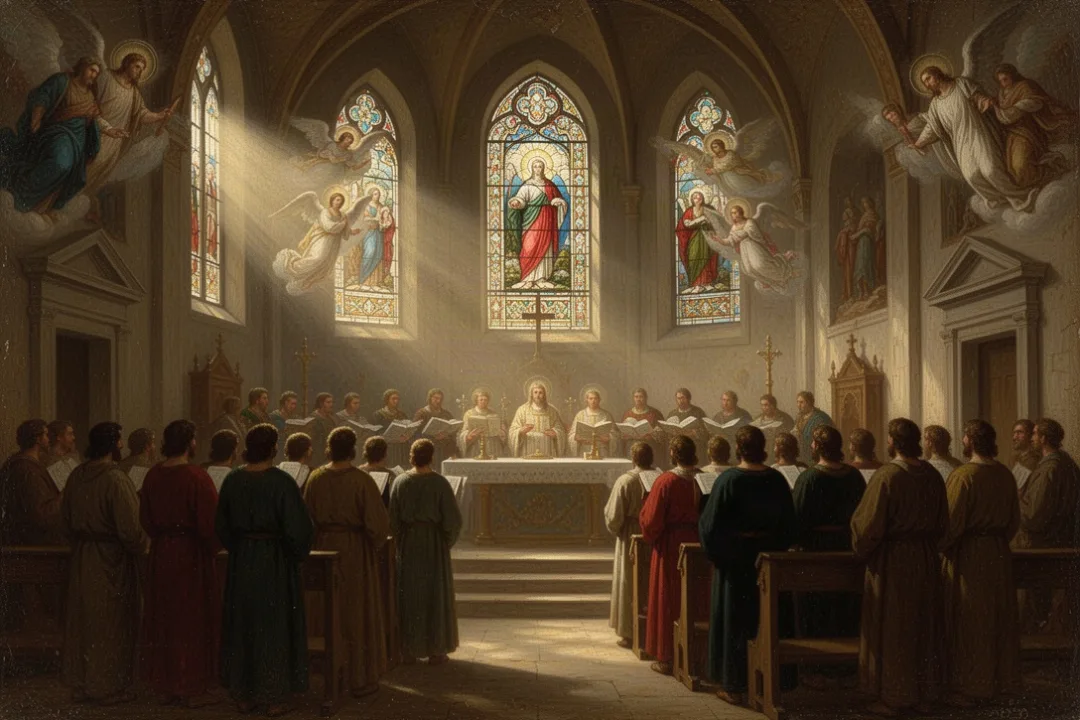
Many Christians recognize Sabaoth from the Sanctus, the part of the Eucharistic liturgy that praises God’s holiness. In the Latin form, the worship text calls God “Dominus Deus Sabaoth,” usually translated in English as “Lord God of hosts.” The phrase is based on the heavenly worship language associated with Isaiah 6.
In this setting, Sabaoth has a strongly liturgical and heavenly meaning. The congregation joins the worship of the angels and all creation, acknowledging God as holy and sovereign. The word is preserved in some traditions because its ancient form connects modern worship with the language of the biblical and historic church.
Hearing the untranslated word can make the phrase seem mysterious, but its function is straightforward. It does not name a separate angel, spirit, or divine person. It is a title for God, describing him as the Lord of the hosts who praise and serve him.
Christian hymns and prayers may also use “Sabaoth” because it fits poetic meter or reflects the wording of older liturgical traditions. When you encounter it in a hymn, the intended sense is usually “Lord of hosts” rather than a reference to the Sabbath or to a particular military event.
The central image is not merely a battlefield; it is the whole heavenly and earthly order under the authority of God.
Different Christian traditions may translate the term differently during worship. One congregation may say “Lord of hosts,” another “Lord God of power,” and another may retain “Sabaoth.” These choices reflect worship tradition and translation preference, not necessarily different beliefs about the identity of God.
What Sabaoth means for reading the Bible today
Understanding Sabaoth changes how you read several familiar passages. When a verse says “LORD of hosts,” do not picture only a deity leading soldiers. Ask what kind of authority the passage is emphasizing: protection, judgment, holiness, power over nations, care for the vulnerable, or rule over the heavenly realm.
The title often challenges human assumptions about power. A government, army, institution, or wealthy individual may appear to control events, but biblical writers place every such power beneath God’s authority. That does not erase real suffering or make injustice insignificant. It establishes a moral framework in which human power is accountable.
Sabaoth also gives depth to passages about worship. If the hosts include heavenly beings, then worship is portrayed as participation in a reality larger than one congregation or one historical moment. The worshiper is not trying to persuade a local deity to act; the worshiper is responding to the sovereign Creator and joining the praise of heaven.
The title can also bring comfort, especially in texts written during crisis. The Lord of hosts is not presented as distant from the disorder of the world. In Psalm 46, the title appears alongside the assurance that God is a refuge amid upheaval. In James 5, it appears alongside the cry of exploited workers. In both cases, divine authority is connected with presence, justice, and protection.
At the same time, readers should avoid using Sabaoth as a slogan for personal victory. The biblical title does not guarantee that every conflict will end according to an individual’s wishes. It calls for trust, humility, repentance, and faithfulness before the God who rules over every host, including those that oppose his purposes.
Read the surrounding passage before deciding whether “hosts” means angels, armies, nations, or a broader heavenly order.
Notice whether the title appears in worship, warning, prayer, conflict, or a promise of restoration.
Ask what human power the passage is challenging or placing under God’s authority.
Remember that the title includes both strength and moral accountability; God’s power is not portrayed as arbitrary force.
In practical terms, Sabaoth means that God is Lord over every power—the heavenly hosts, earthly armies, nations, rulers, and the created order itself. The word’s military imagery is real, but its significance is wider than warfare. It announces that no force is ultimate, no empire is beyond judgment, and no faithful cry is outside the hearing of the Lord of hosts.
Frequently asked questions
Is Sabaoth another name for God?
Sabaoth is best understood as a title or descriptive phrase for God, not as a separate deity or an unrelated divine name. In the expression “LORD of hosts,” it identifies God as the ruler over heavenly beings, earthly armies, nations, and all other powers. Some Christian prayers preserve the Hebrew-derived form, while most English Bibles translate its meaning.
Does Sabaoth mean “Sabbath”?
No. Sabaoth and Sabbath come from different Hebrew words. Sabaoth is connected with hosts, armies, or organized multitudes, while Sabbath refers to rest and cessation from ordinary work. Their similar appearance in English comes from transliteration and pronunciation, not from a shared meaning.
Why do some churches say Sabaoth instead of “Lord of hosts”?
Some churches retain Sabaoth because it appears in historic Greek and Latin liturgical traditions, especially the Sanctus. Other churches translate the word so worshipers can understand it immediately. Both forms refer to the same biblical idea: God’s sovereignty over heavenly and earthly hosts.
Does “hosts” refer only to angels?
No. Angels or heavenly beings are an important possibility, especially in worship scenes, but the context may also evoke armies, nations, or the full order of creation. “Hosts” is deliberately broad. The title emphasizes that God rules every organized power, whether heavenly, human, military, or cosmic.








Leave a Reply