Pool of Bethesda: history, Bible meaning, and location
Pool of Bethesda: history, Bible meaning, and location
The Pool of Bethesda was a large water complex in Jerusalem where Jesus healed a man who had been unable to walk for 38 years. The account appears in John 5:1–18 and connects physical healing with a deeper question about faith, mercy, human need, and Jesus’ authority.
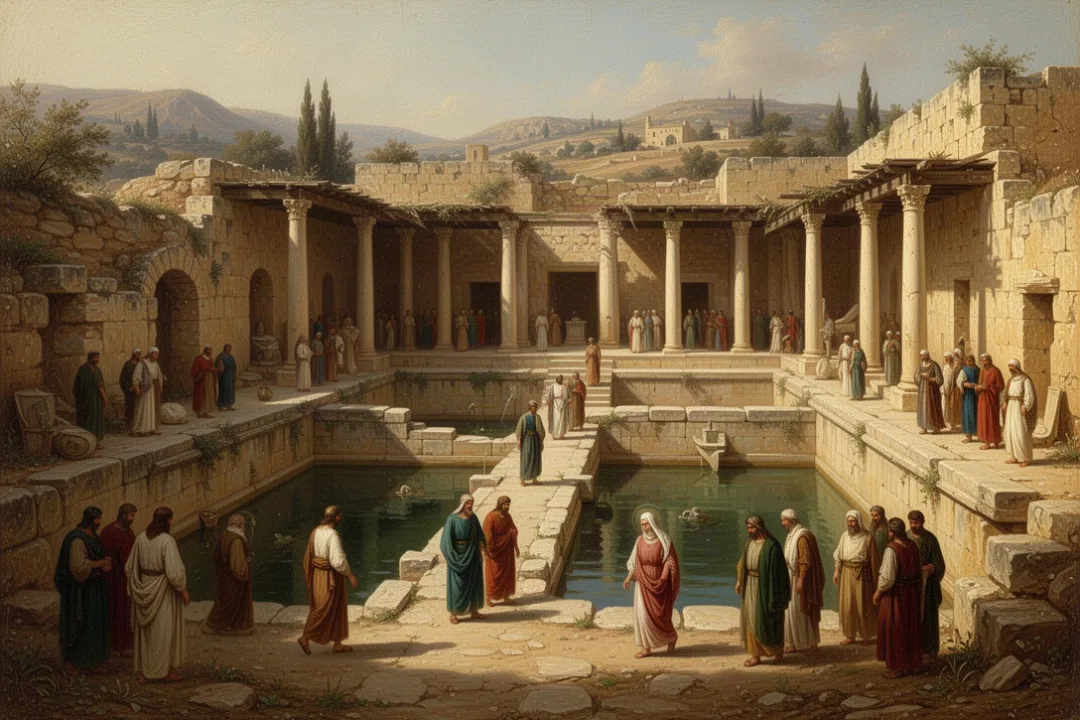
John describes Bethesda as having five covered colonnades, or roofed walkways. Archaeological remains discovered near Jerusalem’s Church of Saint Anne fit that description remarkably well: two adjoining pools separated by a central partition, with surrounding structures that could have supported the arrangement John records.
The central idea: Jesus did not merely help a man reach the water. He healed him directly, then challenged him to live differently after receiving that mercy.
What the Bible says happened at the Pool of Bethesda
John places the event in Jerusalem during one of the Jewish festivals, although he does not name the festival. Jesus went to a pool called Bethesda, where many people with illnesses or disabilities were gathered. The scene includes the sick, blind, lame, and paralyzed, all associated with a place believed to offer healing.
Jesus noticed one particular man who had been disabled for 38 years. The text does not clearly say that he had spent every one of those years beside the pool, but it presents his condition as long-standing and severe. His situation represents not a temporary setback but a life shaped by dependence, disappointment, and limited choices.
Jesus asked him whether he wanted to be made well. The question may sound obvious, but it brings the man’s desire into the open. Instead of giving a simple yes or no, the man explained that he had no one to help him into the pool when the water was disturbed. By the time he tried to get there, someone else had already gone ahead of him.
Jesus then told him to get up, pick up his mat, and walk. John presents the command and the healing together. The man immediately became well, picked up his mat, and began walking. The action is direct and decisive: he does not reach the water first, perform a ritual, or wait for another person to assist him.
The healing took place on the Sabbath, the weekly day of rest observed by Jews. Some religious leaders objected when they saw the man carrying his mat because they regarded that action as unlawful work. Their concern shifted attention away from the man’s restored life and toward the rule they believed he had violated.
Later, Jesus found the man in the temple and told him to stop sinning so that something worse would not happen to him. This statement should not be read as a simple claim that his disability had been caused by a particular personal sin. John’s Gospel does not identify such a cause. Instead, Jesus’ warning directs the man toward the moral and spiritual meaning of a transformed life.
The man then told the authorities that Jesus had healed him. The conflict intensified because Jesus had performed the healing on the Sabbath. John says the leaders sought to persecute him, and the dispute developed into a larger argument about Jesus’ relationship with God and his authority to act.
Why John describes five porticoes and two pools
The detail about five porticoes is one of the most distinctive features of the story. A portico was a covered walkway supported by columns, providing shade and shelter. Such structures would have allowed sick people and caregivers to remain near the water while protected from the sun or rain.
For many years, readers questioned how a pool could have five porticoes. A rectangular pool would normally be expected to have four sides, so the fifth covered walkway seemed unusual. Archaeological discoveries north of the Temple Mount helped clarify how the description may fit the physical setting.
The site traditionally identified with Bethesda contains two large pools arranged alongside each other. A central division ran between them, and colonnades could have stood along the outer edges and across the middle. This arrangement provides a plausible explanation for five covered areas: four around the perimeter and one separating the pools.
The pools were not necessarily designed only for miraculous healing. They may have served practical purposes connected with Jerusalem’s water supply, such as collecting rainwater. The nearby Temple also created demand for water, and the area’s religious importance may have influenced how people understood the site.
John’s description does not require the pool to have looked exactly like a modern swimming pool. The complex may have included steps, terraces, channels, retaining walls, and covered walkways. Water levels could have varied, and different sections may have served different purposes over time.
The archaeological setting also helps explain why large numbers of vulnerable people could gather there. The pool was not presented as an isolated spring in the countryside. It was part of an urban religious landscape, close enough to Jerusalem’s central places for crowds, officials, and temple visitors to pass through.
Two adjoining pools: the remains match a water complex larger than a single simple basin.
A central partition: the division helps make sense of the fifth colonnade described by John.
Covered walkways: these could shelter people waiting near the water.
Nearby religious sites: the pool stood within Jerusalem’s broader Temple-area environment.
Archaeology cannot prove every detail of the Gospel narrative, and it cannot establish that a particular person was healed there. It can, however, show that John’s description is compatible with a real kind of Jerusalem water complex. The physical remains give readers a more concrete picture of the setting in which the story is placed.
How the water-stirring passage affects interpretation
Many Bibles include a statement that an angel periodically went down into the pool and stirred the water, and that the first sick person to enter afterward was healed. This explanation appears in some later manuscripts and was carried into parts of the traditional textual history of the Gospel.
However, the earliest and strongest manuscript evidence does not include the full wording of John 5:3–4. Modern Bible translations often place the passage in a footnote, brackets, or omit it from the main text. This is why readers may find different versions of the pool story depending on which translation they use.
The textual question does not remove the main point of the narrative. Even without the explanation about an angel, John clearly portrays a crowd of sick people gathered at a pool and a man who believed the water was his only possible route to healing. The man’s response to Jesus still makes sense: he had no one to help him reach the water.
The longer reading also helps explain why the man mentioned the water, but readers should avoid treating it as equally certain in every translation. A careful interpretation distinguishes between the central account, which is widely present in the Gospel manuscripts, and the later explanatory wording associated with the pool’s reputation.
Reading tip: When a translation brackets or footnotes the angel-and-water sentence, it is alerting you to a manuscript difference, not suggesting that the entire healing story is uncertain.
The passage raises a broader question about how people seek healing. The crowd appears to be organized around a system in which opportunity favors whoever can reach the water first. The man’s disability leaves him at a severe disadvantage. He is not merely waiting; he is trapped in a process he cannot successfully enter without help.
Jesus’ command interrupts that system. He does not criticize the man for wanting healing, nor does he ask him to compete more effectively. Instead, he addresses him personally and gives him what the man could not obtain through the pool. The contrast between waiting for access and receiving a direct word from Jesus is central to the scene.
What the Pool of Bethesda story means about Jesus
The miracle is also a sign of Jesus’ authority. In many Gospel accounts, healing demonstrates compassion and power, but John uses signs to reveal who Jesus is. The Bethesda story moves quickly from an act of healing to a dispute about the Sabbath and then to claims about Jesus’ relationship with the Father.
The Sabbath controversy is not a minor legal disagreement. In Jewish practice, the Sabbath was a sacred day set apart for rest and worship. Some forms of work were prohibited, and carrying an object through public space could be treated as a violation. The healed man was therefore confronted as soon as others saw him carrying his mat.
Jesus did not treat the Sabbath as meaningless. His response, as presented in John, argues that God’s work of sustaining and giving life continues, and that Jesus acts in harmony with that work. The healing becomes evidence in a debate about whether restoring a person’s life contradicts the Sabbath or expresses its purpose.
The command to carry the mat is significant because it makes the healing visible. If the man had quietly walked away, people might not have noticed the change. Carrying the object associated with his former helplessness turns it into evidence that his condition has changed.
The story also shows that physical restoration does not end every problem. The man faces questioning from authorities, must explain what happened, and later encounters Jesus again in the temple. His new ability to walk places him in a new social and moral situation rather than simply returning him to the life he had before.
Jesus’ later warning gives the healing an ethical dimension. The words about sin should not be used to blame people for illness or disability. Scripture itself contains examples that challenge a simple connection between suffering and personal wrongdoing. In this passage, the warning emphasizes that receiving mercy should lead toward a life shaped by moral seriousness rather than a return to destructive behavior.
The narrative also emphasizes personal attention. A large crowd is present, but Jesus focuses on one man. John does not record that Jesus healed everyone at the pool on that occasion. The story therefore does not offer a formula for predicting who will be healed or when. It presents one particular encounter and uses it to reveal Jesus’ character and authority.
Where the Pool of Bethesda was located in Jerusalem
The traditional location of Bethesda is near the Church of Saint Anne in Jerusalem’s Old City, just north of the Temple Mount area. Excavations in that vicinity uncovered the remains of two pools and architectural features consistent with John’s description of five porticoes.
The site lies in an area associated with the ancient city’s northern approach. Visitors today can see excavated stone structures, channels, walls, and the deep spaces where the pools once held water. Much of the site is below the level of the surrounding modern streets, which helps reveal how Jerusalem was built up over many centuries.
The ruins do not look like a functioning healing pool today. The water is gone or greatly reduced, and the surviving walls are weathered. Yet the scale of the complex helps visitors imagine a public place where people gathered, waited, received care, and passed through on their way to other parts of the city.
Several factors make the identification persuasive:
The two-pool layout fits the possibility of a central colonnade.
The location near the Temple area suits the religious and urban setting of John’s account.
Archaeological remains of covered structures support the description of porticoes.
The site’s water-management features show that it was a substantial engineered complex.
Identification is still a matter of historical reconstruction rather than direct proof. Ancient places can be renamed, rebuilt, or confused with nearby locations, and archaeological evidence rarely answers every question raised by a written narrative. The Bethesda site is best described as the traditional and widely accepted location associated with the Gospel account.
Some readers confuse Bethesda with the Pool of Siloam, another Jerusalem pool mentioned in John. The two stories are different. Jesus sent a blind man to wash at the Pool of Siloam in John 9, while John 5 describes Jesus healing a disabled man at Bethesda without requiring him to wash in the pool.
How to read the man’s 38 years of suffering
The number 38 years gives the narrative emotional weight. John could have said simply that the man had been disabled for a long time, but the specific duration makes the hardship concrete. It suggests years of missed opportunities, dependence on others, and repeated hope that never produced a lasting change.
The man’s explanation also exposes the social reality of illness. He says he has no one to put him into the pool. Whether that means he had no family, no dependable caregiver, or no person willing to help at the critical moment, the result is the same: he is isolated in a crowd.
That detail prevents the story from becoming a vague account of private spirituality. The man’s problem is physical, social, and economic. He cannot move quickly, cannot compete with stronger people, and cannot secure the assistance he needs. Jesus’ question meets him within those circumstances rather than ignoring them.
The question “Do you want to be made well?” can also be heard as an invitation to name a hope that has become difficult to express. Long-term suffering can reshape a person’s expectations. The man does not describe a confident plan; he describes why previous attempts have failed.
Jesus’ command gives him an action he can take immediately. He is not told to explain his past, defend his worthiness, or wait for ideal conditions. He receives a word of authority and responds by standing, taking up his mat, and walking.
For Christian readers, the story speaks about grace that reaches people who cannot reach healing on their own. It does not promise that every illness will be removed immediately, and it should never be used to shame people who remain sick or disabled. Its focus is the identity and work of Jesus in one specific encounter.
The man’s healing also invites practical reflection about how communities treat vulnerable people. A crowd can gather around suffering without providing meaningful help. Religious rules can be discussed while a restored person is overlooked. Bethesda therefore challenges readers to see both the person in need and the systems that leave that person without assistance.
What visitors should know about the site today
The archaeological area associated with Bethesda is part of a historic religious site in Jerusalem. Visitors typically encounter the remains as an open excavation surrounded by later buildings and church architecture. The experience is very different from standing beside a full pool, but the exposed walls make the ancient engineering easier to appreciate.
Because the site is in Jerusalem’s Old City, access can depend on local opening hours, religious observances, security conditions, and current travel guidance. Anyone planning a visit should verify practical details locally rather than assuming that schedules and access will remain unchanged.
When viewing the ruins, look for the relationship between the two pools rather than searching for a single basin that exactly matches a modern picture. Notice the depth of the excavation, the retaining walls, and the way covered walkways could have framed the water. These details help connect the archaeological remains with John’s description.
A thoughtful visit also keeps the site’s limits in view. The ruins can illuminate the setting, but they do not recreate the crowd, the man’s decades of suffering, or the encounter with Jesus. Those elements come from the Gospel narrative and from reflection on its meaning.
The Pool of Bethesda remains significant because it brings together history, archaeology, human vulnerability, and Christian theology. It was a real place in ancient Jerusalem, but John presents it as more than a landmark. The pool becomes the setting for a confrontation between helplessness and authority, social exclusion and personal attention, religious restriction and life-giving mercy.
Frequently asked questions
Is the Pool of Bethesda the same as the Pool of Siloam?
No. They are separate pools connected with different events in John’s Gospel. Bethesda is the setting for the healing of a man disabled for 38 years in John 5. Siloam appears in John 9, where Jesus tells a man born blind to wash there. Their locations and roles in the narratives are different.
Did an angel really stir the water at Bethesda?
The sentence describing an angel stirring the water appears in some later manuscripts but is absent from many early and important manuscripts. That is why modern translations may bracket it or place it in a footnote. The main account of Jesus healing the disabled man remains present in the Gospel text.
Can visitors see the Pool of Bethesda today?
Visitors can see archaeological remains traditionally identified as Bethesda near the Church of Saint Anne in Jerusalem’s Old City. The site includes two excavated pools and structural remains associated with the ancient complex. It is not a functioning pool today, and access, hours, and local conditions should be checked before visiting.
Why did Jesus heal only one person at Bethesda?
John focuses on one healing because the event functions as a sign revealing Jesus’ authority, especially in the Sabbath controversy that follows. The passage does not explain why others were not healed, so readers should not turn it into a general rule about illness, faith, or personal worthiness.








Leave a Reply