The memorial marked a decisive moment in Israel’s story: God had brought the people across the Jordan on dry ground. The event recalled the earlier crossing of the Red Sea, but it also signaled a new stage after the death of Moses and the beginning of Joshua’s leadership.
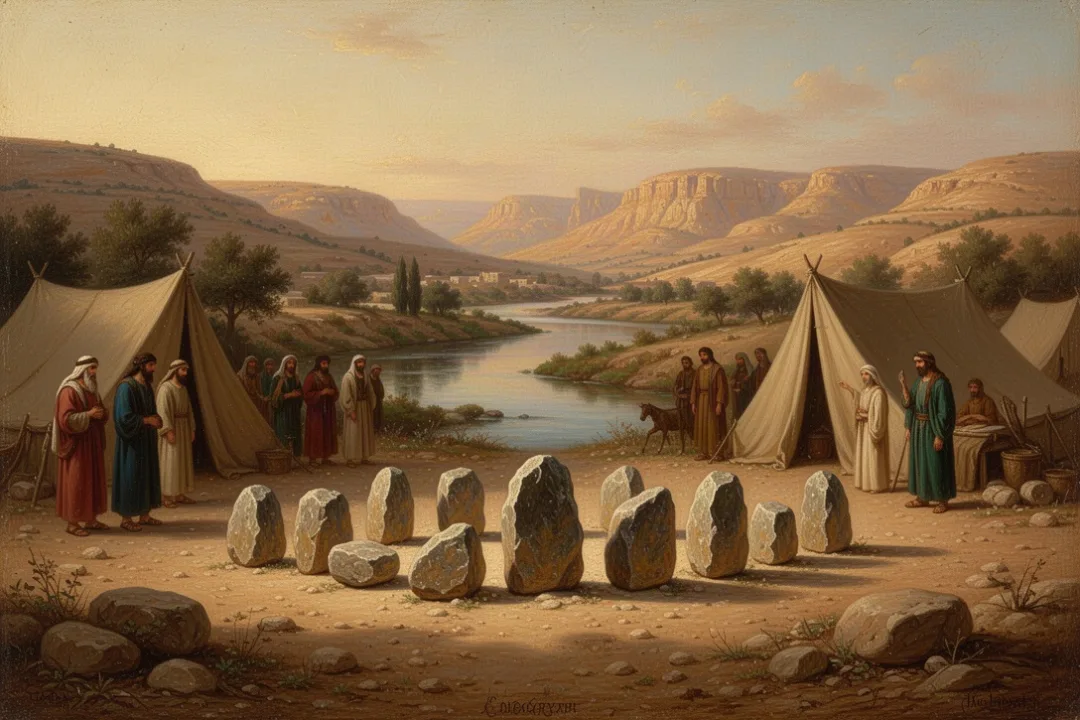
According to Joshua 4, one man from each of Israel’s twelve tribes took a stone from the riverbed. They carried the stones to the place where the Israelites camped, and Joshua set them up at Gilgal. The stones gave a visible form to a story that could otherwise fade from memory.
Gilgal became the first campsite of the Israelites west of the Jordan. From there, the people prepared for the next part of the conquest of Canaan. The memorial therefore stood at a physical and spiritual threshold: Israel had left the wilderness behind, but its life in the land was only beginning.
Central meaning: The stones were not presented as objects with magical power. They served as a public reminder of what God had done and as a teaching tool for future generations.
How the stones were set up at Gilgal
The account in Joshua 3 and 4 gives the memorial a carefully ordered setting. The crossing did not happen by chance or through military strength. It followed instructions given to Joshua, the movement of the priests carrying the ark of the covenant, and the participation of the entire nation.
Priests entered the Jordan. The priests carrying the ark stepped into the river, and the water stopped flowing so the people could cross.
The nation crossed on dry ground. Men, women, children, and livestock passed over while the priests remained in the riverbed.
Twelve representatives selected stones. Joshua instructed one man from each tribe to take a stone from the place where the priests stood.
The stones were carried to the camp. The representatives brought the stones across the river and took them to Gilgal.
Joshua arranged the memorial. The stones were set up at the camp as a lasting sign for the people.
The memorial became a lesson for children. When future children asked what the stones meant, their parents were to explain the Jordan crossing and God’s protection.
The sequence connects the miracle in the river with the responsibility to remember. The people did not simply witness an extraordinary event and move on. They were given a practical way to preserve its meaning in family conversations and community worship.
Why twelve stones represented all Israel
The number twelve corresponded to the twelve tribes of Israel. Each tribe supplied one stone, so the memorial represented the nation as a whole rather than a single leader, family, or military unit.
This detail matters because Joshua could have created a monument that celebrated his own leadership. Instead, the instructions required participation from every tribe. The memorial said, in effect, that the entire community had crossed the Jordan and that every part of the nation shared in the event.
The twelve stones also made the story concrete for people who had not personally seen the river stop. A child born later could see the stones and ask about them. The answer would connect that child to the history of the covenant community.
One stone from each tribe: the memorial included the whole nation.
Stones taken from the riverbed: the objects pointed directly to the place of deliverance.
Stones placed at the camp: the reminder stood where ordinary community life continued.
Questions from children: the memorial was designed to prompt explanation, not silent admiration.
The arrangement also shows that remembrance in the biblical account is both personal and communal. Families were expected to tell the story, while the stones gave the whole nation a shared point of reference.
What the Bible says about Gilgal
Gilgal first appears prominently in the story immediately after the Jordan crossing. Joshua 4 describes it as the place where Israel camped and where Joshua set up the twelve stones. Joshua 5 connects the same camp with the renewal of circumcision, the observance of Passover, and the end of the wilderness-era provision of manna.
These events give Gilgal a layered role. It was not only a campsite. It was a place of remembrance, renewed covenant identity, and preparation for life in the land.
Joshua 5 describes the Israelites celebrating Passover at Gilgal after entering Canaan. The timing links the new memorial with the central story of Israel’s earlier deliverance from Egypt. The Jordan crossing is therefore presented as another act of divine rescue, not as an isolated natural event.
Gilgal also appears in later biblical narratives. Samuel used Gilgal as a significant location, and Saul was associated with the site during the early monarchy. The prophets later referred to Gilgal in ways that could be critical, especially when religious observance was separated from faithful obedience.
Those later references should be handled carefully. The Bible uses the name Gilgal for locations and settings connected with different periods, and the exact identification of every biblical Gilgal is not certain. A later mention of Gilgal does not automatically prove that it describes the same physical stones from Joshua 4.
Why the memorial was meant to teach children
The most explicit purpose of the stones was educational. Joshua 4 anticipates a child asking what the stones mean. The answer was to recount how the Jordan stopped flowing while the ark went before the people and how God brought Israel safely across.
This pattern shows that biblical remembrance often begins with a question. The stones were deliberately visible and unusual enough to invite curiosity. They turned a major theological claim into something children could see in an ordinary place.
The teaching was not limited to a list of facts. Parents were to explain what the event revealed about God’s power, faithfulness, and commitment to the people. The memorial preserved both the event and its meaning.
Families can apply the same principle without treating modern objects as replicas of the biblical stones. A photograph, family Bible, journal, commemorative object, or place connected with a significant experience can prompt conversation. The object matters because it helps people tell the story; it does not replace the story.
For teaching today: When children ask about a meaningful object, answer with the full story behind it. Explain what happened, who helped, what was learned, and why the memory still matters.
What the stones reveal about biblical remembrance
The memorial at Gilgal illustrates several principles about remembering God’s work. These principles arise from the narrative itself rather than from the stones having independent spiritual force.
Memory requires deliberate action
The Israelites were told to choose, carry, and arrange the stones. Remembering was not left to good intentions. The physical task made the community participate in preserving the memory.
That detail challenges the assumption that important experiences remain vivid automatically. Even a dramatic event can become distant as a new generation grows up. The stones provided a deliberate response to that tendency.
Memory should connect the past with the present
The crossing had happened only recently, but the memorial was intended for people who were not there. Its message reached beyond the original witnesses. The community’s present identity rested partly on what God had done in the past.
For the Israelites, the Jordan crossing also shaped how they faced future difficulties. The memorial did not promise an easy life in Canaan. It reminded them that the God who had brought them through the river was still the God they were called to trust.
Memory belongs in ordinary community life
The stones were placed at the camp rather than hidden in a private location. Gilgal was where the people lived, organized themselves, and prepared for what came next. The reminder stood near daily life, not only inside a formal ceremony.
This setting suggests that spiritual memory works best when it is woven into regular habits. Shared meals, family discussions, worship gatherings, and annual observances can all help a community remember what it believes and why.
Memory must include interpretation
A pile of stones by itself cannot explain the Jordan crossing. The people needed to tell the story accurately. Without explanation, a memorial can become a landmark with no living connection to its original purpose.
The biblical account therefore joins visible symbols with spoken testimony. The stones prompted questions, and the community supplied the meaning.
How the stones relate to the ark and the priests
The ark of the covenant is central to the crossing narrative. The priests carrying it stood in the Jordan while the people passed over. The stones were taken from the place where the priests had stood, so the memorial was directly associated with God’s presence and the orderly crossing of the nation.
In the biblical story, the ark was not a good-luck object. It represented the covenant relationship between God and Israel. Its position in the river signaled that God was leading the people, while the priests’ obedience made the crossing possible within the narrative’s instructions.
The stones thus recalled more than the movement of water. They pointed to the relationship among God’s presence, obedient leadership, and the community’s response. Joshua’s role was important, but the narrative places the focus on what God accomplished.
Did Joshua set up one group of stones or two?
Readers sometimes notice that Joshua 4 mentions stones in more than one setting. The chapter clearly describes twelve stones carried from the Jordan to Gilgal. It also contains a statement that Joshua set up twelve stones in the middle of the Jordan where the priests stood.
Interpretations differ over how these details fit together. Some readers understand the passage as describing two groups of twelve stones: one at Gilgal and another in the river. Others see the wording as a narrative detail that has been translated or understood in different ways, or as referring to the same action from a different perspective.
The central point remains clear even where the exact arrangement is debated. The stones were connected with the Jordan crossing, and the Gilgal memorial was intended to preserve the event for future generations.
It is wise not to build an elaborate doctrine on a detail whose interpretation is disputed. The strongest emphasis of the chapter is the public testimony: God brought Israel through the Jordan, the twelve tribes shared in the crossing, and the story was to be taught to their children.
Where was biblical Gilgal located?
The precise location of the Gilgal associated with Joshua is uncertain. Many researchers have proposed sites in the Jordan Valley near Jericho, but no universally accepted identification has been established. The biblical text places the camp east or near the area of Jericho after the crossing, yet the name itself does not provide modern geographic coordinates.
The uncertainty does not weaken the account’s purpose. Ancient memorials could remain meaningful even when later generations no longer knew the exact boundary of the original site. The Bible emphasizes what happened there and why the stones mattered more than a modern archaeological label.
Several places in the Hebrew Bible carry the name Gilgal or a related form. Because of this, references to Gilgal in Joshua, Samuel, Kings, and the prophets should be examined in their own contexts. They may refer to a recognized sanctuary, a settlement, or another location with the same name.
Archaeology can help illuminate the Jordan Valley and settlement patterns, but it has not produced a universally verified set of stones that can be identified as the twelve stones of Joshua 4. Claims that a particular modern stone pile is definitively the biblical memorial should be treated cautiously.
What “Gilgal” may mean in the biblical story
The name Gilgal is commonly associated with the idea of rolling away or removing, based on the wordplay in Joshua 5. There, the text connects the name with God’s removal of the reproach associated with Israel’s time in Egypt. The exact linguistic discussion is complex, but the narrative clearly gives Gilgal a meaning connected with a changed condition.
At Gilgal, Israel was no longer wandering in the same way. The people had crossed into the land, renewed covenant practices, celebrated Passover, and begun a new chapter. The stones fit this setting because they marked a transition from one period to another.
The memorial therefore carried both historical and theological meaning. It remembered a specific crossing while also helping the people understand who they were after that crossing.
How to use the stones of Gilgal as a study theme
If you are studying the passage personally or teaching it in a group, read Joshua 3 through 5 together rather than isolating the stones from their context. The surrounding chapters explain the priests, the ark, the crossing, the memorial, the covenant ceremonies, and the Passover celebration.
Read the movement of the story: notice what happens before, during, and after the crossing.
Track the participants: identify Joshua, the priests, the twelve tribal representatives, and the wider community.
Ask what the stones communicate: consider what a future child would learn from the memorial.
Compare the two crossings: observe how the Jordan event recalls the Red Sea while marking a new stage.
Examine later references carefully: do not assume every biblical Gilgal is the same place.
Apply the teaching principle: identify faithful ways to preserve and explain important spiritual memories.
A useful discussion question is: What would be forgotten if the memorial had never been created? The answer may include the details of the crossing, the unity of the tribes, the role of the priests, and the conviction that God had led the people into the land.
What the stones of Gilgal do not mean
The Bible does not portray the stones as idols or as objects that could control events. They were not given instructions for worship, offerings, or ritual power. Their function was to point beyond themselves to God’s action in history.
They also do not mean that every difficult season will end immediately after a person creates a reminder. The Israelites still faced conflict, moral failures, political struggles, and the consequences of disobedience after crossing the Jordan. Remembering God’s faithfulness strengthens trust, but it is not a promise of a trouble-free future.
Finally, the stones do not encourage people to ignore the past. Their purpose was the opposite. They made the past available for honest retelling so that later generations could understand both God’s faithfulness and Israel’s obligations under the covenant.
Why the stones still matter to readers
The stones of Gilgal remain significant because they address a recurring human problem: people can experience something deeply meaningful and still forget it. Time, fear, prosperity, and new responsibilities can push old evidence of faithfulness into the background.
The memorial offers a disciplined alternative to vague nostalgia. It ties memory to a real place, a shared event, named participants, and a story that can be retold. It also places responsibility on one generation to explain its faith to the next.
For readers today, the main lesson is not to search for a particular pile of rocks. It is to practice truthful remembrance. Remember what has happened, preserve the account, explain its meaning, and let the memory shape present decisions.
In Joshua’s account, the stones stood at the beginning of Israel’s life in the land. They marked a crossing that could not be repeated in the same way, yet its meaning had to be carried forward. Gilgal therefore became a place where history, worship, family teaching, and communal identity met.
Frequently asked questions
How many stones were placed at Gilgal?
The biblical account describes twelve stones, corresponding to the twelve tribes of Israel. One representative from each tribe took a stone from the Jordan riverbed and carried it to the camp at Gilgal. Joshua then arranged the stones as a memorial to the crossing.
Are the stones of Gilgal still visible today?
No set of stones has been universally verified as the memorial described in Joshua 4. The precise location of biblical Gilgal is uncertain, and the Jordan Valley has changed over time. Modern claims identifying a particular stone arrangement should therefore be treated as proposals rather than established fact.
What is the main lesson of the stones of Gilgal?
Their main lesson is that communities should intentionally remember and explain God’s faithfulness. The stones were meant to prompt questions from children, allowing adults to retell the Jordan crossing. They functioned as a visible aid to testimony, not as objects possessing independent spiritual power.
Is Gilgal the same place in every biblical reference?
Not necessarily. The name Gilgal appears in several biblical settings, and scholars do not agree that every reference identifies one location. The Gilgal associated with Joshua’s Jordan crossing should be interpreted from its own context rather than automatically equated with later references in Samuel, Kings, or the prophets.









Leave a Reply