Gilgal in the Bible: Meaning, places, and significance
Gilgal in the Bible: Meaning, places, and significance
Gilgal was Israel’s first camp west of the Jordan River after entering the promised land. It became a place of remembrance, covenant, worship, leadership, and warning, although the Bible also uses the name for more than one location.
The name Gilgal is connected with the Hebrew root associated with rolling or removing. In Joshua 5:9, the Lord explains the name by saying that the disgrace of Egypt had been “rolled away” from Israel. The meaning is tied to a new stage in the nation’s relationship with God, not merely to the physical appearance of the site.
The main Gilgal stood near Jericho, east of the central hill country. After Israel crossed the Jordan on dry ground, Joshua led the people to camp at Gilgal. From there, the Israelites carried out several acts that marked their transition from wilderness wandering to settled life in Canaan.
Gilgal should not automatically be treated as one permanent location every time the word appears. The Old Testament mentions places called Gilgal in different settings, and some references may identify separate sites. The best-known Gilgal is the camp near Jericho, but the name probably functioned as a place-name in more than one part of Israel.
How Gilgal first appears after Israel crossed the Jordan
The main events at Gilgal can be followed in a clear sequence. Together, they show why the location became so important in Israel’s memory.
Israel crossed the Jordan River. In Joshua 3, the priests carrying the ark stood in the river while the people crossed on dry ground. The crossing recalled the earlier passage through the Red Sea and demonstrated that God was leading the nation.
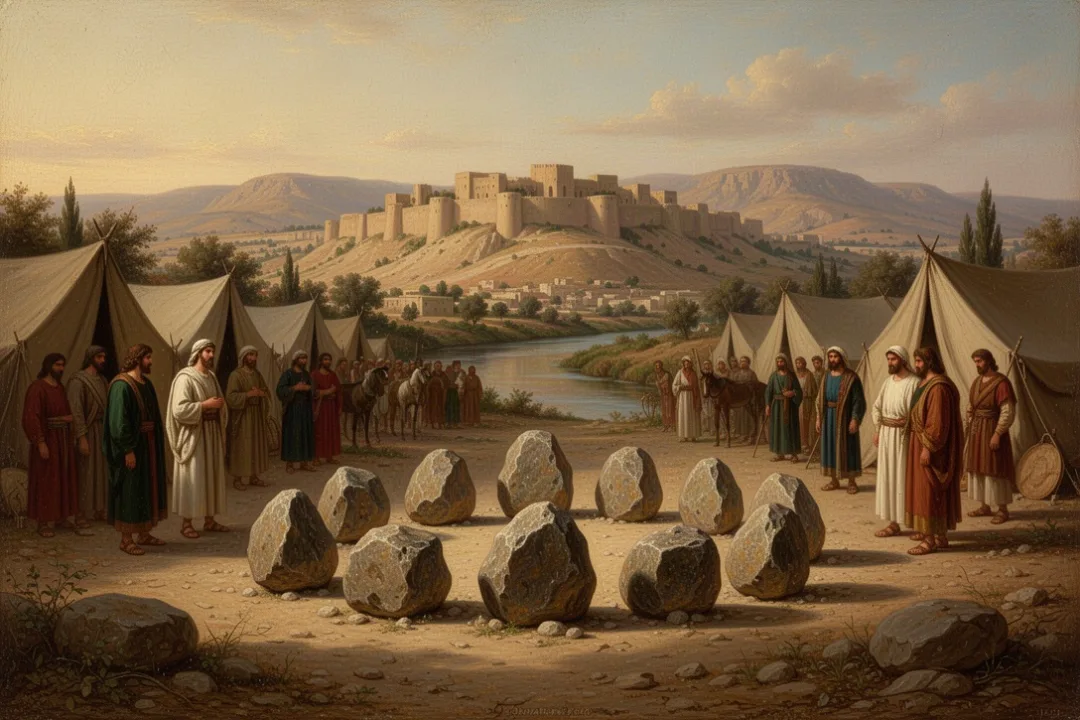
Joshua selected twelve stones from the riverbed. Each tribe supplied a stone, and the stones were carried to the camp at Gilgal, as described in Joshua 4.
The stones became a teaching memorial. Future children would ask what the stones meant. Parents were to explain that God had stopped the Jordan so Israel could cross and enter the land.
Israel camped at Gilgal. The camp became the base for the first stage of the conquest, including the approach to Jericho.
The new generation was circumcised. Joshua 5 records that the Israelite males born during the wilderness period were circumcised at Gilgal.
The Passover was celebrated. Israel kept Passover in the land, near Jericho, and then ate produce from Canaan. The manna stopped after the people began eating the food of the land.
Joshua encountered the commander of the Lord’s army. Before the fall of Jericho, Joshua met a mysterious divine messenger and was told to treat the place as holy, echoing Moses’ experience at the burning bush.
These events give Gilgal a layered meaning. It was a memorial site because of the stones, a covenant site because of circumcision, a worship site because of Passover, and a military base during Israel’s early campaigns.
Central idea: Gilgal represented a boundary between Israel’s wilderness past and its life in the promised land. The site reminded the people that their new beginning depended on God’s faithfulness.
Why the twelve stones at Gilgal mattered
The stones at Gilgal were designed to preserve memory across generations. Joshua 4 presents them as a physical prompt for children who would ask about the unusual stones. The parents’ answer was not meant to glorify human strategy; it was to point back to God’s action at the Jordan.
The memorial also connected the new event with the nation’s earlier history. The crossing of the Jordan resembled the crossing of the Red Sea, so Gilgal helped Israel understand that the God who brought them out of Egypt was still directing them. The place linked exodus, wilderness, and settlement into one continuing story.
Memorials in the Bible often serve a teaching purpose rather than simply marking a historical moment. At Gilgal, the stones were a way to pass faith from parents to children. Their significance depended on explanation: without the story, they were only stones; with the story, they testified to deliverance.
The account also shows that biblical remembrance is active. Israel was not told merely to recall that the Jordan had stopped. The people were to live as a covenant community shaped by that memory. The memorial called them to trust, obedience, and gratitude in the land they had received.
Gilgal as a place of covenant renewal
Joshua 5 describes circumcision at Gilgal after the Israelites entered Canaan. The wilderness generation had not continued the covenant sign in the same way during the years of wandering, so the new generation was circumcised before the conquest advanced.
This moment matters because Israel’s possession of the land was not presented as a reward for military ability alone. The people were bound to God by covenant. Circumcision marked their identity and reminded them that entering the land carried spiritual responsibilities as well as material benefits.
Gilgal therefore became a place where Israel paused before moving forward. The people did not immediately rush from the Jordan toward further victories. They received the covenant sign, observed Passover, and waited for the Lord’s direction. The order of events places relationship with God before military success.
Joshua 5 also records that the Israelites celebrated Passover at Gilgal. The feast recalled God’s deliverance from Egypt and connected the first generation’s rescue with the new generation’s arrival in Canaan. Israel’s story remained one story, even though the people who entered the land were largely a later generation.
Gilgal during the early conquest of Canaan
Gilgal served as a staging point for Israel’s operations in the central Jordan Valley. The Israelite army returned there after the battle of Jericho, and Joshua’s campaigns in the region were organized around movement from and back to the camp.
In Joshua 9, the Gibeonites approached Israel at Gilgal. They used deception to make the Israelites believe they had come from a distant country. Israel’s leaders made a treaty with them without first seeking the Lord’s direction, and the agreement created a lasting obligation.
The episode gives Gilgal another dimension. It was not only a sacred memorial and worship location; it was also a place of national decision-making. Leaders gathered there, evaluated claims, made agreements, and faced the consequences of acting without sufficient discernment.
After the treaty with Gibeon, Joshua led Israel in defending the Gibeonites against an alliance of Amorite kings. Joshua 10 describes the campaign and later refers to Gilgal as the place where the army returned. The location remained connected with Joshua’s command during the southern campaign.
Joshua 14 records Caleb’s appeal for the hill country of Hebron. He reminds Joshua of the earlier spy mission and describes Moses’ promise concerning his inheritance. Although the conversation is not a full narrative about Gilgal, it takes place in the setting of the conquest and reflects the distribution of land that followed Israel’s victories.
Gilgal in the period of the judges
Gilgal continued to appear after Joshua’s death. In Judges 2, the angel of the Lord is described as coming from Gilgal to Bochim. The passage places Gilgal within the larger story of Israel’s covenant failure and the warnings that followed.
The movement from Gilgal to Bochim is significant in the narrative. Gilgal was associated with Israel’s entry into the land and with God’s faithfulness at the Jordan. Bochim became a place of weeping after the people were confronted about disobedience. The contrast reinforces a recurring biblical pattern: remembered grace should produce faithful obedience.
The name also appears in Judges 3:19 in the account of Ehud and King Eglon. Ehud turned back from the carved images near Gilgal before carrying out his mission against the Moabite king. The reference may indicate that Gilgal or its surrounding area had continuing religious or symbolic importance during the judges period.
Because biblical references do not always provide enough geographic detail, readers should be cautious about assuming that every mention points to the famous camp near Jericho. Some passages may refer to another Gilgal or to a location within the same broader region. Context, nearby towns, and the action described are essential for interpretation.
How Samuel used Gilgal as a place of leadership
Gilgal became closely associated with Samuel’s leadership and the early monarchy. First Samuel 7:16 says that Samuel traveled in a yearly circuit through Bethel, Gilgal, and Mizpah, judging Israel before returning to Ramah. This suggests that Gilgal was an established center for gathering and administration.
When Israel asked for a king, Saul was publicly confirmed at Gilgal in 1 Samuel 11. After Saul’s victory over the Ammonites, the people gathered there, renewed the kingdom, and celebrated before the Lord. Gilgal thus became a setting where popular support, military success, worship, and royal authority came together.
That positive beginning did not last. In 1 Samuel 13, Saul waited at Gilgal for Samuel before a battle with the Philistines. Under pressure from the circumstances, Saul offered the burnt offering himself when Samuel had not yet arrived. Samuel rebuked him for failing to keep the Lord’s command and announced that Saul’s kingdom would not endure in the way Saul desired.
First Samuel 15 brings another confrontation at Gilgal. Saul had been commanded to devote the Amalekites and their possessions to destruction, but he preserved King Agag and kept valuable animals. When Samuel came to Gilgal, Saul defended his actions by claiming that the animals were kept for sacrifice. Samuel rejected that reasoning and emphasized that obedient listening to God matters more than religious performance.
These episodes make Gilgal a place of both royal confirmation and royal failure. Saul received public recognition there, but he also showed that kingship without obedience could not secure God’s approval. The location’s meaning shifted from celebration to judgment within the story of one reign.
Practical reading principle: A place associated with past blessing does not guarantee present faithfulness. The stories at Gilgal repeatedly connect privilege with responsibility.
Why the prophets criticized Gilgal
By the time of the prophets, Gilgal had become associated with Israel’s religious life, but not always with genuine covenant obedience. Hosea and Amos mention Gilgal in messages condemning Israel’s sin and empty worship.
Hosea 4:15 warns Judah not to imitate Israel’s unfaithfulness and tells the people not to go to Gilgal or Beth-aven as though sacred locations could make corrupt worship acceptable. Hosea 9:15 again names Gilgal in a context of divine rejection. The issue was not that the ground itself had become inherently evil; the issue was Israel’s rebellion and the false confidence attached to religious centers.
Amos 4:4 uses Gilgal alongside Bethel in a sharp prophetic criticism. The people are portrayed as continuing religious activities while multiplying transgression. Amos 5:5 tells Israel not to seek Bethel, Gilgal, or Beersheba as though pilgrimage could protect the nation from judgment.
The prophetic message is direct: religious activity cannot replace repentance. A site with a powerful history can become a place of presumption if people trust the site, rituals, or national identity while ignoring justice and obedience.
This explains why Gilgal has a mixed reputation in Scripture. Joshua presents it as a place of faith, remembrance, and covenant renewal. Samuel presents it as a center of national leadership, but also as the setting for Saul’s disobedience. Amos and Hosea present it as a symbol of worship that had become detached from faithful living.
Gilgal in the stories of Elijah and Elisha
Second Kings 2 begins the account of Elijah’s final journey with Gilgal. Elijah tells Elisha to remain there while he goes on to Bethel, but Elisha refuses to leave him. The two then continue through Bethel, Jericho, and across the Jordan before Elijah is taken from Elisha.
The Gilgal in this passage raises a geographic question. It may be the Gilgal near Jericho, but the travel sequence and the repeated movement between prophetic centers have led interpreters to consider whether another Gilgal was intended. The text itself does not settle every detail for modern readers.
Second Kings 4:38 also mentions Gilgal during a famine. Elisha returns there, and the sons of the prophets are gathered around him. A stew is prepared, but someone unknowingly adds poisonous wild gourds. Elisha directs the people to add flour, and the food becomes safe to eat.
These references show that Gilgal could be connected with prophetic communities as well as with Joshua’s camp and Samuel’s administration. They also remind readers that the name must be interpreted from each passage rather than assigned one fixed meaning every time it occurs.
How many Gilgals are mentioned in the Bible?
The Bible does not provide a modern map with coordinates for every place called Gilgal. Several references are clear enough to identify a setting, while others remain debated. The name may describe multiple locations, and the same word can appear in different historical periods.
The best-known site is the Gilgal near Jericho, east of the central hill country and close to the Jordan Valley. This is the location connected with the twelve stones, circumcision, Passover, the early conquest, and several events in Joshua.
Other passages may refer to a Gilgal in the hill country or in the territory associated with prophetic activity. Some scholars have proposed additional sites based on biblical geography and archaeological evidence, but proposed identifications should not be stated as certain when the evidence is incomplete.
The ancient place-name may also have had a descriptive origin. Because the Hebrew word can evoke a circle or rolling movement, some interpreters connect Gilgal with a circular stone arrangement or another geographic feature. Joshua 5:9 gives the theological explanation of the name for Israel, but that explanation does not necessarily settle the original linguistic history of every place called Gilgal.
Gilgal near Jericho: the principal camp after the Jordan crossing and the location most often meant in discussions of Joshua.
Gilgal in prophetic narratives: a site associated with Elijah, Elisha, and groups of prophets, though its exact location may be uncertain.
Other possible Gilgals: locations identified from context in the hill country or other regions, requiring careful comparison with surrounding place-names.
What Gilgal teaches about memory, worship, and obedience
Gilgal’s biblical significance can be understood through several connected themes. It was a place where God’s past actions were remembered, but the biblical writers never treat memory as an excuse for disobedience.
Memory: The stones at Gilgal taught Israel to tell the story of the Jordan crossing. Faith was meant to be handed down through ordinary conversations between parents and children.
New beginnings: Circumcision, Passover, and the end of manna marked a transition into a different stage of national life. Gilgal represented a fresh beginning grounded in God’s earlier promises.
Leadership: Samuel judged Israel from a circuit that included Gilgal, and Saul was confirmed as king there. The site was linked with public authority and national decisions.
Testing: Saul’s failures at Gilgal show that a favorable location and a respected office cannot substitute for obedience. The king’s religious language did not excuse his refusal to follow the command he had received.
Warning: The prophets used Gilgal to challenge misplaced confidence in sacred places. Religious history can become a source of pride when it is separated from justice, humility, and loyalty to God.
How to interpret a Gilgal reference when reading the Bible
When you encounter Gilgal in a biblical passage, begin with the immediate context rather than assuming that it refers to Joshua’s original camp. The surrounding names, the people involved, and the action taking place can help distinguish one setting from another.
Identify the book and period. Joshua, Samuel, Kings, Amos, and Hosea use Gilgal in different historical settings.
Check the nearby locations. References to Jericho and the Jordan point toward the eastern camp, while other place-names may suggest a different site.
Ask what is happening there. Is Gilgal a camp, a worship center, a royal gathering place, a prophetic community, or an object of prophetic criticism?
Observe the spiritual emphasis. The passage may highlight remembrance, covenant, leadership, disobedience, judgment, or restoration.
Separate certainty from possibility. Where the geography is disputed, retain the main theological message without claiming more precision than the text provides.
This approach prevents two common mistakes. The first is treating all references as though they describe one location. The second is reducing Gilgal to a dictionary definition while overlooking how its meaning changes across Israel’s history.
Gilgal begins as a place of arrival and remembrance. It becomes a center for campaigns, covenant practices, national leadership, royal testing, prophetic ministry, and eventually prophetic warning. Its significance comes from the events associated with it and from the way those events reveal Israel’s relationship with God.
Why Gilgal still matters when reading Scripture
Gilgal offers a useful lens for reading biblical places as more than points on a map. The site carried memories of deliverance, but those memories demanded a response. Israel was expected to remember the Jordan crossing, keep covenant, listen to God, and practice faithfulness in the land.
The contrast between Joshua and the prophets is especially important. In Joshua, Gilgal is a place where God’s faithfulness is celebrated. In Amos and Hosea, the same name becomes part of a warning against trusting religious heritage without obedience. The contrast shows how a sacred memory can be preserved outwardly while its meaning is ignored inwardly.
For readers today, Gilgal highlights the value of remembering specific acts of God while resisting superstition about places or rituals. A memorial can teach, a gathering can encourage, and worship can shape a community, but none of these replaces sincere obedience.
Gilgal’s lasting message is therefore both comforting and searching: God faithfully brings his people forward, and those who remember that faithfulness are called to live accordingly.
Frequently asked questions
Is Gilgal a person or a place in the Bible?
Gilgal is primarily a place-name, not a person. The best-known Gilgal was Israel’s camp near Jericho after the Jordan crossing. The Bible also appears to mention other locations with the same name, so the exact setting depends on the passage being read.
What happened at Gilgal after Israel crossed the Jordan?
The Israelites set up twelve memorial stones, circumcised the new generation, celebrated Passover, and began eating produce from Canaan. The manna stopped, and Gilgal became the base for early military campaigns under Joshua.
Why did the prophets speak negatively about Gilgal?
Amos and Hosea criticized Gilgal because Israel’s worship had become disconnected from obedience and justice. Their warnings were not necessarily condemning the site’s original history; they challenged people who trusted religious places and practices while continuing in sin.
Where is biblical Gilgal located today?
The principal Gilgal near Jericho is generally associated with the Jordan Valley east of Jericho, but its exact archaeological identification remains uncertain. Other biblical references may concern different places called Gilgal, so no single modern location explains every occurrence.








Leave a Reply