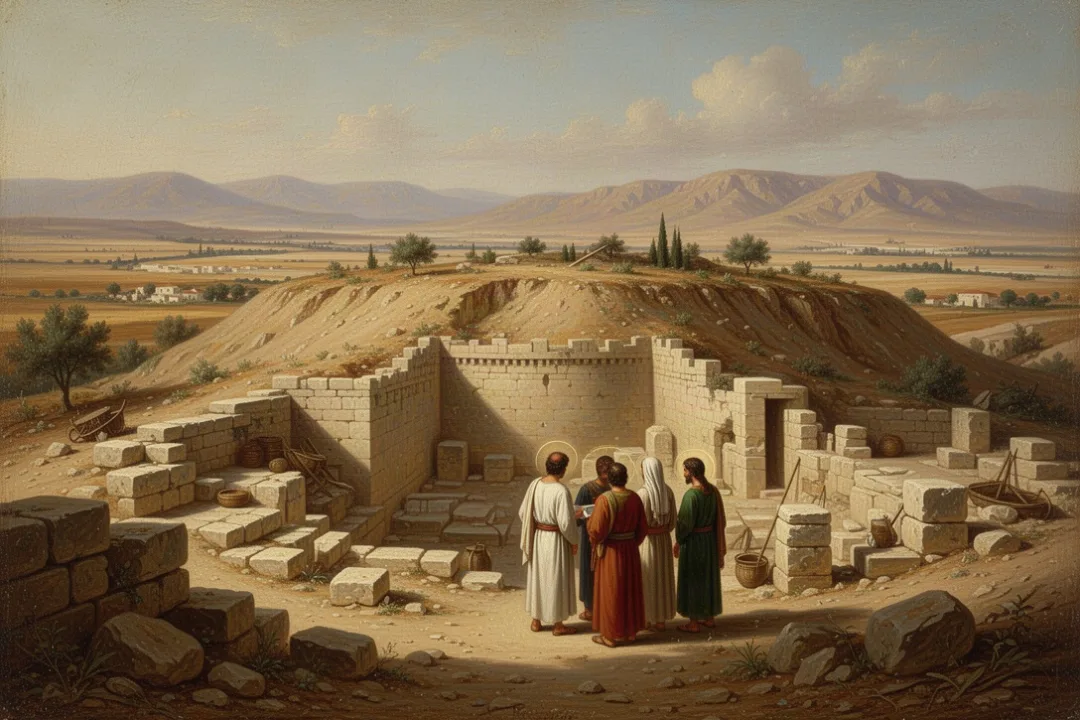
The Jericho Bible story centers on a city that fell after Israel followed God’s unusual instructions rather than a conventional battle plan. The account appears mainly in Joshua 2 and Joshua 6, after the Israelites crossed the Jordan River and before they moved farther into Canaan.
Jericho was strategically important because it stood near the Jordan Valley and controlled access to routes leading into the central hill country. Its defeat became a defining moment in the biblical account of Israel’s settlement in the land God had promised to Abraham, Isaac, Jacob, and their descendants.
The main narrative is found in Joshua 2–6. Joshua 2 tells how two Israelite spies entered Jericho and received protection from Rahab. Joshua 3–4 describes Israel’s crossing of the Jordan, while Joshua 5 records preparations before the assault.
Joshua 6 gives the instructions for the march around the city and describes Jericho’s fall. The chapter also explains that Rahab and her family were spared, while the city and its possessions were placed under a ban connected with the warfare of that period.
Later biblical passages refer back to Jericho in different ways:
Hebrews 11:30 points to the collapse of Jericho’s defenses as an example of faith expressed through obedience.
James 2:25 remembers Rahab as a woman whose actions protected the spies.
Matthew 1:5 includes Rahab in Jesus’ genealogical line.
1 Kings 16:34 refers to the rebuilding of Jericho during the reign of King Ahab.
These references show that Jericho is more than a battle account. The city’s fall, Rahab’s faith and the Israelites’ obedience all became part of the Bible’s wider understanding of God’s promises and judgment.
Why Jericho mattered before the battle
Jericho was not simply a random town selected for Israel’s first attack. The Israelites had just crossed the Jordan River, and Jericho was positioned near the eastern approach to the land. Taking the city would open a route toward the interior of Canaan.
The city also had strong natural advantages. It stood in a fertile oasis supplied by springs, despite the surrounding dry landscape. Its location near the Jordan Valley made it a useful settlement for travel, farming and defense.
Joshua 5 presents Israel pausing at Gilgal before the battle. The men observed the covenant sign of circumcision, celebrated Passover and ate produce from the land. These details frame the battle as part of a covenant story, not merely a military campaign.
The narrative also says that Joshua encountered a mysterious figure described as the commander of the Lord’s army. Joshua bowed before him and received instructions similar to the holy-ground encounter involving Moses. The scene emphasizes that Israel’s victory would not rest on military strength alone.
Central idea: In the biblical narrative, Jericho is won through trust and obedience to God’s direction, not through superior weapons, prolonged siege tactics or human strategy.
How Rahab helped the Israelite spies
Before the battle, Joshua secretly sent two spies to examine the land, especially Jericho. They entered the house of Rahab, a woman who lived in or near the city wall and who is identified in the text as a prostitute.
The king of Jericho learned that the spies had arrived and ordered Rahab to hand them over. Instead, she hid them under stalks of flax on her roof and told the king’s representatives that the men had already left. After the search party departed, she helped the spies escape by lowering them through a window with a rope.
Rahab then explained why she had taken this risk. She had heard how the God of Israel had dried up the Red Sea and given Israel victory over kings east of the Jordan. The people of Jericho, she said, had become afraid because they believed Israel’s God was giving the land to his people.
Rahab asked the spies to show kindness to her household when Israel attacked. The spies agreed on the condition that she keep their mission secret and gather her family inside her home. They gave her a scarlet cord as a sign associated with the rescue arrangement.
Rahab’s actions raise a question about deception. The story does not pause to offer a general rule about every lie; instead, it presents her as someone who recognized Israel’s God and acted decisively to protect vulnerable people in her household. Later biblical writers emphasize her faith and courage rather than treating her as a minor character.
What the march around Jericho involved
God’s instructions to Joshua were highly specific. Israel’s armed men were to lead the procession, followed by seven priests carrying seven trumpets made from rams’ horns. The ark of the covenant came within the procession, and another group followed behind.
For six days, the Israelites were to march around Jericho once each day. The priests would sound the trumpets, but the people were instructed to remain quiet. On the seventh day, they were to circle the city seven times.
After the seventh circuit, the priests sounded a long blast. Joshua instructed the people to shout, and the biblical account says that the city wall collapsed. The Israelites then entered the city from their positions and took it.
The repeated numbers are part of the story’s deliberate pattern:
Seven priests carried the trumpets.
Seven trumpets were used in the procession.
The army marched for seven days.
On the seventh day, they made seven circuits.
In the Bible, seven often signals completion or a finished divine act. The pattern makes the siege ceremonial and theological. The Israelites are not portrayed as improvising under pressure; they are carrying out a command in an ordered sequence.
What happened when Jericho’s walls fell
According to Joshua 6, the people shouted after the final trumpet blast, and the wall fell. The text does not describe Israel using battering rams, ladders or prolonged siege equipment. The central explanation given by the narrative is that God brought down Jericho’s defenses.
The account should not be reduced to the phrase “the walls fell down.” The collapse is the climax of a story about Israel waiting, listening and obeying. For six days, nothing visibly changed. The dramatic result came only after the people completed the assigned pattern on the seventh day.
The Israelites were told to destroy the city and its inhabitants, with the specific exception of Rahab and everyone sheltered with her. Certain objects made from gold, silver, bronze and iron were to be set apart for the Lord’s treasury rather than taken as personal spoils.
Modern readers often find the destruction in Joshua 6 morally difficult, especially because the account includes women and children among the people who died. That difficulty should be faced directly. The text presents the conquest as an act of divine judgment, but it also describes a violent ancient war in terms that require careful theological and historical interpretation.
Some interpreters understand the conquest accounts as describing specific campaigns with theological shaping. Others emphasize the ancient Near Eastern practice of using sweeping victory language to describe warfare. These approaches differ, and the Bible itself does not provide a modern historical analysis of the event. Responsible reading should not ignore either the narrative’s claim of divine judgment or the human cost of the violence it describes.
Why Rahab and her family were spared
Rahab’s rescue is one of the most significant details in the Jericho story. The spies had promised to protect her because she hid them and helped them escape. When the city was taken, Joshua instructed the spies to bring Rahab, her parents, her brothers and the rest of her household to safety.
The text says that Rahab and her relatives were brought outside the Israelite camp before the city was destroyed. She later lived among the Israelites. Her story therefore moves from danger inside Jericho to belonging among the people of Israel.
Rahab’s inclusion also challenges a narrow understanding of who can respond to God. She was a Canaanite woman living in a city marked for judgment, yet the biblical account highlights her recognition of Israel’s God and her courageous actions. Her past does not prevent her from becoming part of the story of God’s people.
The New Testament develops this point in several directions. Hebrews remembers Rahab as someone who welcomed the spies in peace. James uses her actions as an example of faith demonstrated through deeds. Matthew’s genealogy places Rahab among the ancestors of Jesus, though genealogies in the ancient world often condensed family lines.
What “devoted to destruction” means in Joshua 6
Joshua 6 uses language often translated as “devoted to destruction” or “under the ban.” The Hebrew concept, commonly represented by the term herem, refers to placing something under a special ban for destruction or sacred dedication. In the Jericho account, it means the city is not to be treated as ordinary war plunder.
This explains why the Israelites could not simply take valuables for themselves. The metals were assigned to the Lord’s treasury, while other possessions were destroyed. The command was presented as a boundary between obedient participation in the campaign and personal profiteering.
Joshua 7 shows why this command mattered within the story. A man named Achan took items that had been placed under the ban. His action brought consequences on the community and contributed to Israel’s defeat at Ai. The narrative uses this episode to show that obedience was required not only from Joshua but from the entire nation.
Readers should distinguish between describing what the passage says and endorsing violence outside its biblical setting. Joshua 6 is tied to a particular covenant narrative, land promise and judgment claim. It should never be used as a simple model for modern religious or political violence.
What archaeology can and cannot establish about Jericho
The Jericho associated with the biblical story is commonly identified with Tell es-Sultan, an archaeological mound near the modern city of Jericho. Excavations have shown that the site was occupied repeatedly over a very long period and had defensive structures at various times.
Archaeology has not produced a universally accepted reconstruction that settles every question about Joshua 6. Scholars disagree about the date of the conquest, the condition of the settlement during the relevant period and how archaeological layers should be interpreted.
One influential excavation associated with Kathleen Kenyon concluded that the major destruction layer at the site did not fit the traditional date often proposed for Joshua’s conquest. Other researchers have challenged aspects of that interpretation and have argued for different readings of the evidence. The debate remains unresolved.
Several cautions help keep the discussion accurate:
Archaeology dates physical remains, not theological meaning.
A lack of evidence for a particular destruction event does not automatically disprove every feature of a written account.
Evidence of collapsed walls cannot, by itself, identify the cause or connect the remains conclusively to Joshua.
The biblical chronology and archaeological chronology are interpreted differently by different scholars.
It is reasonable to study Jericho as both a biblical narrative and an archaeological site. It is not reasonable to claim that archaeology has settled all details when specialists continue to debate the evidence.
How the Jericho account fits Israel’s wider story
Jericho follows several major events in the book of Joshua. Israel has crossed the Jordan, renewed covenant practices and prepared to enter the land. The city’s fall therefore marks a transition from wilderness wandering to life in Canaan.
The story also introduces a recurring tension: God gives promises, but the people must respond with trust and obedience. Jericho is followed by Israel’s failure at Ai, where Achan’s disobedience brings defeat. The contrast shows that military success is not treated as automatic simply because Israel has entered the land.
Jericho also echoes the earlier exodus. The Israelites had previously crossed the Red Sea, and now they cross the Jordan. Rahab specifically mentions the Red Sea when explaining why Jericho is afraid. The two events connect Israel’s past rescue with its new stage of life.
The ark’s presence in the procession is another important theme. The ark represented God’s covenant presence among Israel. Its place in the march communicates that the battle belongs to God, while the priests, soldiers and people still have defined responsibilities.
Common mistakes when explaining the Jericho Bible story
Jericho is often reduced to a few memorable details, which can lead to inaccurate retellings. These are the mistakes most worth avoiding:
Leaving out Rahab: Rahab’s protection of the spies is not a side detail. Joshua 2 prepares the reader for her rescue in Joshua 6.
Claiming the people marched silently all week: The instructions say the people were to remain quiet during the march, but the priests sounded the trumpets.
Saying the Israelites marched around the city seven times every day: They marched once a day for six days; the seven circuits occurred on the seventh day.
Describing the trumpets as modern instruments: The text refers to horns, commonly understood as shofars or ram’s horns, not metal orchestral trumpets.
Assuming every possession was taken as loot: The passage specifically restricts personal plunder and assigns certain metals to the Lord’s treasury.
Claiming archaeology proves the story beyond dispute: The identification of the site is widely accepted, but the dating and interpretation of its destruction remain debated.
Using Jericho as a general permission for violence: The account belongs to a specific biblical setting and should not be transferred directly to modern conflicts.
Ignoring the moral difficulty: A thoughtful explanation acknowledges the text’s portrayal of judgment while recognizing why its violence troubles modern readers.
Practical ways to read and teach the Jericho story
If you are studying Joshua 2–6, read the chapters as a connected sequence rather than starting only with the fallen walls. The narrative builds suspense through the spies, Rahab’s decision, Israel’s crossing of the Jordan and the instructions given before the city is approached.
Read Joshua 2 first and identify what Rahab knows, fears and believes.
Read Joshua 3–5 to understand why Jericho follows the Jordan crossing and covenant renewal.
Read Joshua 6 carefully and mark the repeated instructions, numbers and actions.
Compare the command with the result to see which details the narrator emphasizes.
Read Joshua 7 afterward to understand the story’s warning about taking what was forbidden.
Consult archaeological discussions cautiously, distinguishing evidence from interpretation and interpretation from certainty.
For personal study, ask what the story says about fear, faith, obedience, judgment and mercy. Rahab responds to what she has heard about God, while Israel must obey instructions that seem unlike ordinary military tactics.
For teaching children, avoid presenting the event as a magic trick or a simple adventure story. Explain that the Bible portrays Jericho as a serious act of judgment and that Rahab’s rescue is central to the account. Age-appropriate teaching can still be honest about the difference between ancient biblical warfare and everyday behavior today.
What the Jericho story means for Christian readers
Christian readers often focus on the story’s emphasis on faith. Hebrews 11 does not describe the walls as falling because the Israelites possessed superior courage or technology. It connects the event with their obedience to God’s direction.
That emphasis does not mean faith is a technique for getting a desired outcome. The people of Israel were not given a universal formula that every believer can apply to make obstacles disappear. The story concerns a particular command in a particular stage of biblical history.
Rahab offers a second major theme: faith can be shown through costly action. She risked her position to protect the spies, asked for mercy for her household and acted on what she had come to believe about Israel’s God.
The account also emphasizes that judgment and mercy appear together. Jericho is condemned in the narrative, but Rahab and her family are rescued. That combination makes the story more demanding than a simple lesson about winning battles. It asks readers to consider both the seriousness of judgment and the surprising reach of mercy.
For Jewish and Christian communities, Jericho has therefore remained a story about God’s covenant faithfulness, Israel’s obedience and the place of outsiders who turn toward the God of Israel. Its meaning is shaped by the whole biblical canon, not by the fallen walls alone.
What happened to Jericho after Joshua
Joshua 6 ends with a curse against anyone who would rebuild the city. The wording connects rebuilding with the loss of a firstborn son when foundations are laid and a youngest son when gates are set up.
Centuries later, 1 Kings 16:34 records that a man named Hiel rebuilt Jericho during the reign of King Ahab. The passage mentions the deaths of his oldest and youngest sons in connection with the earlier curse. It is a brief and troubling reference, and the text does not provide a full account of the rebuilding project.
Jericho also appears in later biblical history as a settled location and as part of the landscape of the Jordan Valley. Its continued name in Scripture shows that the city’s story did not end with the collapse described in Joshua 6.
The Jericho Bible story remains memorable because it brings together an unusual battle plan, a courageous woman, a dramatic act of judgment and a question of historical interpretation. Read carefully, it is not merely a story about walls falling. It is a narrative about how the Bible portrays God’s promise, human obedience, mercy toward Rahab and the moral weight of conquest.
Frequently asked questions
Did the walls of Jericho really fall because of the Israelites’ shouting?
The biblical account says the priests sounded their horns, the people shouted and the city wall collapsed. It presents the collapse as God’s act rather than the physical force of human voices. Archaeology confirms that Jericho had defensive walls at different periods, but scholars disagree about which remains, if any, correspond to the event described in Joshua.
Who was Rahab in the Jericho story?
Rahab was a woman living in Jericho who sheltered two Israelite spies and helped them escape. She asked for protection for her relatives, and the spies promised that everyone inside her home would be spared. Later biblical passages remember her for her faith and actions, and Matthew includes her in Jesus’ genealogy.
How many times did Israel march around Jericho?
Israel marched around the city once each day for six days. On the seventh day, the people circled Jericho seven times. After the final circuit, the priests sounded a long blast, the people shouted and the wall fell according to Joshua 6.
Is Jericho the oldest city in the world?
Jericho is associated with one of the world’s oldest and most extensively studied settlement sites, Tell es-Sultan. However, claims about the single “oldest city” depend on how a city and continuous occupation are defined. Archaeological evidence shows very early settlement at the site, but that question is separate from proving the biblical conquest narrative.











Leave a Reply