The historicity of Genesis: what the evidence shows
The historicity of Genesis: what the evidence shows
When you read Genesis, you may wonder whether it is meant to be a record of actual events, a theological interpretation of the past, or a combination of both. The answer depends partly on which section you are reading and what you mean by historicity. A text can preserve memories of real people and places while presenting them through symbolism, literary structure, and theological purpose.
The historicity of Genesis cannot be settled by one archaeological discovery. Genesis contains several kinds of material, including primeval narratives about creation and the flood, ancestral stories about Abraham and his family, genealogies, poetry, and explanations of customs or place names. Scholars therefore assess each section according to its genre, historical setting, language, and relationship to evidence from the ancient Near East.
Historicity asks whether a written account refers to real events, people, places, or social conditions in the past. It is different from asking whether every detail can be independently verified. Ancient writers often preserved history through speeches, symbolic numbers, compressed timelines, and stories shaped to communicate religious meaning.
For many Jewish and Christian readers, Genesis is both sacred Scripture and a record of God’s dealings with humanity. That conviction leads them to read its narratives as fundamentally truthful, even when they disagree about the age of the earth, the length of the creation days, or the scale of the flood. Other readers approach Genesis primarily as an ancient collection of theological traditions and ask how its stories developed over time.
Academic historians generally avoid treating the entire book as one uniform genre. They ask more focused questions: Does a story fit what is known about the ancient Near East? Are its customs plausible for the period it describes? Does the text contain later language or institutions? Can archaeology confirm a person or settlement? These questions may support, challenge, or simply leave a claim unresolved.
A useful distinction: Archaeology can sometimes confirm a place, people group, custom, or historical setting, but it rarely proves that a particular biblical story happened exactly as narrated.
How Genesis is organized and why that affects historical interpretation
Genesis has a clear literary shape. The first eleven chapters describe the origins of the world and humanity, followed by the stories of Abraham, Isaac, Jacob, and Joseph. The book moves from universal beginnings to a family whose descendants become central to the rest of the Bible.
The text also uses repeated phrases, genealogies, blessings, journeys, family conflicts, and divine promises to connect separate episodes. This careful arrangement suggests that Genesis is not a raw collection of unedited notes. Its authors or editors shaped inherited traditions into a coherent account of creation, human failure, covenant, and family history.
Literary shaping does not automatically make a narrative fictional. Ancient historical writing commonly selected and arranged material to explain why events mattered. The more useful question is what kind of historical claim each passage appears to make and how that claim relates to the text’s theological purpose.
Genesis 1–11 addresses cosmic and human origins through highly structured narratives, genealogies, and judgment stories.
Genesis 12–36 follows ancestral figures, family relationships, migrations, divine promises, and conflicts over land and inheritance.
Genesis 37–50 tells the story of Joseph and his family’s movement into Egypt, with a more sustained narrative and a stronger setting in Egyptian society.
What the creation accounts claim about history
Genesis 1 presents creation in a sequence of ordered acts, moving from darkness and unformed waters toward a world populated by plants, animals, and human beings. The repeated pattern gives the chapter a strong liturgical and literary rhythm. Genesis 2 provides a more localized account centered on the garden, the first humans, and their relationship to God.
Readers disagree about how these chapters relate to one another. Some see them as complementary perspectives on the same creation. Others view them as distinct traditions placed together by the final form of the book. Many religious interpreters accept the theological claims about God as creator while understanding the “days” in different ways, including ordinary days, symbolic periods, or a literary framework.
Modern science does not test every theological statement in Genesis. It can investigate the age of the universe, biological development, and the history of the earth, but it cannot directly measure claims about divine purpose or the meaning of humanity. As a result, debates about Genesis often involve both empirical evidence and assumptions about how sacred texts should communicate.
The historicity of the creation narratives therefore depends on the level of claim being made. A reader may affirm that Genesis truthfully teaches that the world depends on God and that human beings have a distinctive moral calling without reading its sequence as a modern scientific chronology. Another reader may defend a more literal chronology. Both positions involve interpretive choices beyond archaeology alone.
How Genesis 1–11 compares with ancient Near Eastern traditions
Genesis shares themes with other ancient Near Eastern writings, including the creation of the world, the ordering of the cosmos, divine-human relationships, and a devastating flood. Texts from Mesopotamia, such as the Enuma Elish and flood traditions associated with Gilgamesh and Atrahasis, help scholars understand the cultural environment in which Genesis was transmitted and written.
These similarities do not prove that Genesis simply copied another story. They show that ancient communities used familiar subjects and images while making different theological claims. Genesis presents one God as sovereign over creation, whereas some neighboring traditions describe conflicts among multiple deities. Its account of humanity, work, moral responsibility, and divine judgment also has its own emphasis.
The comparison is historically valuable because it identifies shared cultural vocabulary. It can show that biblical writers participated in a wider ancient conversation about origins and catastrophe. It cannot, by itself, determine whether the events described in Genesis occurred or whether the biblical account preserves a direct memory of a single historical incident.
What can be said about the flood in Genesis
The flood story in Genesis 6–9 describes widespread human violence, divine judgment, Noah’s ark, the preservation of his family, and a covenant symbolized by a rainbow. Many readers understand the flood as global, while others interpret it as a catastrophe covering the known human world of the story’s original audience.
Archaeology and geology show that ancient Mesopotamia experienced severe regional floods. Flood deposits have been found at some ancient sites, although they do not all belong to the same event and do not establish the biblical narrative. Such evidence demonstrates that catastrophic flooding was part of the lived experience of ancient communities, making flood traditions historically understandable.
There is no universally accepted geological evidence for a single flood that covered the entire planet in the recent human past. A global reading also raises questions about animal distribution, ecological survival, water volume, and the genetic history of populations. Readers who hold to a worldwide flood may answer these questions through particular theological or scientific models, while other readers regard the story as describing a regional catastrophe or a sacred narrative shaped from older flood traditions.
The account’s historical significance may therefore be considered at several levels. It reflects a real ancient concern about destructive floods, preserves themes found across Mesopotamian cultures, and makes distinctive claims about judgment, mercy, human violence, and covenant. Those observations do not settle every question about the event itself.
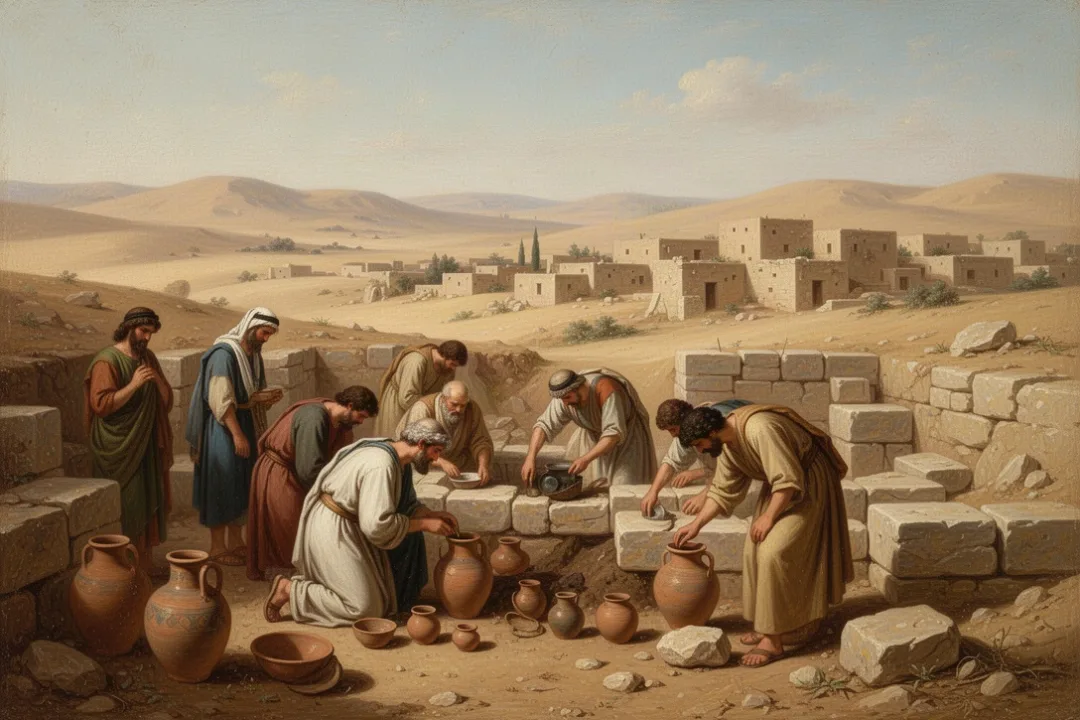
What archaeology can tell us about Abraham and the patriarchs
The stories of Abraham, Sarah, Isaac, Rebekah, Jacob, Rachel, Leah, and Joseph are set in a world of pastoral movement, household servants, arranged marriages, inheritance disputes, wells, treaties, and city-states. Some of these details fit the broad social realities of the ancient Near East. The patriarchs travel among places such as Haran, Shechem, Bethel, Hebron, and Beersheba, many of which were known ancient settlements or geographic locations.
That geographical familiarity is meaningful but limited. A story can use real places without every event being independently documented. Archaeology has not produced inscriptions that clearly identify Abraham, Isaac, or Jacob. Nor can excavations normally verify private conversations, family disputes, divine encounters, or the exact movements of semi-nomadic households.
Some customs in Genesis have been compared with legal and social documents from the ancient Near East. Examples include surrogate childbearing, inheritance practices, marriage arrangements, household labor, and treaty-making. These comparisons may show that certain situations are culturally plausible, but similar customs can exist across long periods. A parallel is not a date stamp.
Scholars also debate whether the patriarchal narratives preserve older memories that were later shaped by Israelite communities. The stories may contain layers: ancient place traditions, family memories, theological interpretation, and editorial organization. The absence of external confirmation does not disprove the patriarchs, but the evidence does not allow historians to reconstruct their lives with confidence.
Why the Joseph story receives a different kind of historical discussion
Genesis 37–50 presents Joseph as a Hebrew sold into slavery, elevated within Egypt, and eventually reunited with his family during a famine. The story includes dreams, administration of grain, social upheaval, and movement between Canaan and Egypt. Compared with the earlier chapters, it reads as a continuous family narrative with sustained attention to character and cause.
Egyptian records do not clearly identify Joseph or his family. Some elements of the story are compatible with known Egyptian practices, including the presence of foreigners, household slavery, famine management, and high-ranking officials. Yet broad compatibility is not direct corroboration. Several people could occupy similar roles in a large and complex society.
The story also reflects the book’s recurring themes: younger sons unexpectedly gaining authority, family betrayal followed by reconciliation, and human actions being incorporated into a larger providential purpose. Those themes may explain why the narrative is shaped in such a deliberate way. Literary design and historical memory are not mutually exclusive, but the text itself does not provide enough external data to verify Joseph’s career.
How language and composition affect the dating of Genesis
The book of Genesis reached its final written form after a long period of oral and written transmission. Many scholars believe that Israelite traditions were collected, preserved, and edited over generations. The exact stages are debated, but the presence of repeated accounts, changes in divine names, genealogical notices, and variations in style has led to theories about multiple sources or layers.
Older scholarship sometimes divided Genesis into highly specific documents. Later researchers have questioned whether those divisions can be established with complete certainty. Most scholars still recognize that the book contains distinctive traditions and editorial seams, but they differ over how those features developed and when the final form was produced.
The final form of Genesis is later than the events it describes, assuming the narratives preserve historical memories. That does not make the accounts worthless as historical sources. It means they must be evaluated like other ancient texts: by considering how transmission works, what the author emphasizes, what details are plausible, and whether independent evidence exists.
Names, vocabulary, political references, and assumptions about institutions can sometimes suggest a period of composition or revision. However, a later writer may preserve an old tradition, and an older tradition may be updated in language. Dating a text is therefore not the same as dating every event within it.
What scholars generally agree and disagree about
There is no single academic verdict on the historicity of Genesis. Scholars use different methods and begin with different assumptions about miracles, oral tradition, the reliability of biblical narratives, and the relationship between theology and history. Still, several broad patterns are visible.
Many scholars agree that Genesis reflects the cultures, geography, social practices, and intellectual questions of the ancient Near East.
Many regard Genesis 1–11 as theological primeval history rather than a modern-style chronological report.
There is limited direct evidence for identifying the patriarchs or Joseph through contemporary inscriptions.
Archaeology can illuminate the settings and customs of Genesis but cannot verify most individual episodes.
Religious traditions continue to affirm the historical and theological authority of Genesis in different ways.
Disagreement is strongest over how much historical memory lies behind the ancestral narratives. Some scholars see the patriarchal stories as primarily later constructions that express Israel’s identity. Others argue that the narratives contain older memories of people, migrations, and social conditions, even if the final text has been shaped extensively.
The debate is not simply between “literal” and “mythical.” The word myth can mean a sacred story about ultimate realities, not merely a false tale. Likewise, the word history can describe a meaningful account of the past without requiring modern standards of documentation. Clarifying these terms prevents the discussion from becoming a choice between oversimplified alternatives.
Practical ways to evaluate claims about Genesis
When you encounter a claim about the historicity of Genesis, consider the type of evidence being offered and the conclusion it can reasonably support. A careful method protects you from both exaggerated skepticism and exaggerated certainty.
Identify the passage. Creation poetry, a genealogy, a family narrative, and a place-name explanation may make different kinds of claims.
Ask what the text emphasizes. Repeated themes such as blessing, covenant, exile, and family conflict may reveal the author’s purpose.
Separate evidence from interpretation. A real ancient city supports the setting, but it does not prove every story associated with that city.
Check the date of the evidence. An inscription from a much later period may illuminate a tradition without confirming its earliest form.
Compare multiple sources. Use archaeology, ancient Near Eastern texts, linguistics, geography, and the biblical text together rather than relying on one parallel.
Allow unresolved questions to remain unresolved. Lack of evidence is not always evidence of absence, especially for mobile or socially marginal people.
Common mistake: Treating a cultural parallel as proof can overstate the evidence. Similar laws, customs, or flood stories may establish plausibility or shared tradition, but they rarely identify one specific event.
Common mistakes when assessing the historicity of Genesis
Several approaches repeatedly create confusion. Avoiding them makes the discussion more precise and fair to both the biblical text and the historical evidence.
Using archaeology as a simple yes-or-no test: Excavations preserve only a fraction of ancient life, and many biblical claims concern people or events that left little material trace.
Assuming a modern genre: Genesis was not written as a twenty-first-century research report with footnotes, dates, and neutral observation.
Ignoring the final form: Even if a tradition is ancient, the arrangement and wording readers have today reflect a process of preservation and editing.
Assuming theological purpose cancels history: Ancient authors could interpret real events religiously rather than separating factual description from meaning.
Assuming every plausible detail proves the whole account: A realistic custom or accurate place name establishes limited support, not complete confirmation.
Forcing one answer onto every chapter: Genesis 1, the flood narrative, the patriarchal cycles, and the Joseph story require different questions and standards.
How Jewish and Christian readers interpret Genesis today
Jewish and Christian communities include a wide range of interpretations. Some readers hold that Genesis reports events substantially as they happened, including a recent creation or a worldwide flood. Others accept an ancient earth and evolutionary science while reading Genesis as a theological account of creation and human vocation. Still others emphasize the book’s literary and symbolic character while affirming its authority as Scripture.
These positions do not always map neatly onto political or denominational categories. A person may believe in the historical reality of Abraham while reading the creation days nonliterally. Another may accept the theological truth of the flood story without claiming that water covered every continent. The relationship between faith and history is often more specific than broad labels suggest.
For religious readers, the central historical claims may concern God’s creation of the world, humanity’s moral failure, divine judgment, covenant, and the origins of Israel’s ancestral identity. For historians, the focus may be narrower: when the traditions arose, how they were transmitted, and what they reveal about ancient Israel. Both approaches can ask serious questions, although they do not use identical standards of proof.
What a balanced view of Genesis can responsibly claim
A balanced assessment recognizes that Genesis is an ancient text with substantial historical interest, but it does not treat every narrative detail as independently verifiable. The book preserves knowledge of ancient landscapes, social relationships, family structures, regional traditions, and questions shared across the Near East. It also presents those materials through a strong theological and literary framework.
Archaeology has not confirmed the entire narrative from Adam to Joseph, and there is no clear external record for most individual figures in Genesis. At the same time, the absence of inscriptions should not be turned into a definitive disproof, especially for people who lived outside royal or urban institutions. Evidence is uneven, and conclusions should match its limits.
The most responsible reading asks several questions at once: What does Genesis claim? What kind of writing is each passage? What did the ancient audience likely understand? What evidence supports the historical setting? Which questions remain matters of faith, interpretation, or uncertainty?
For many readers, Genesis is best understood as theological history: an account that speaks about the past while interpreting it through beliefs about God, humanity, sin, judgment, blessing, and covenant. That category does not resolve every debate, but it explains why the book can matter historically without functioning like a modern laboratory report.
Frequently asked questions
Has archaeology proven that the events in Genesis happened?
No. Archaeology supports parts of the book’s broader setting, including ancient cities, regional customs, and the reality of devastating floods in Mesopotamia. However, it has not independently verified most individual episodes or clearly identified figures such as Abraham, Isaac, Jacob, or Joseph. Archaeology usually offers context and probability rather than direct proof of a complete biblical narrative.
Do scholars consider Abraham a historical person?
Scholars disagree. Some believe the ancestral stories preserve genuine memories of early figures and migrations, while others see Abraham primarily as a later literary and theological ancestor of Israel. No contemporary inscription clearly identifies him. Historians can assess the plausibility of the social world described in Genesis, but they cannot reconstruct Abraham’s life with confidence from existing evidence.
Is the flood in Genesis considered a global event?
Interpretations vary. Some Jewish and Christian readers understand it as a worldwide flood, while others see it as a regional catastrophe described in universal language from the perspective of its ancient audience. Geological research has not established a single recent flood covering the entire planet. Ancient Mesopotamian flood evidence does show why catastrophic flood traditions were culturally powerful in the region.
Can Genesis be historically meaningful if it contains symbolism?
Yes. Ancient historical writing often combined remembered events with symbolism, speeches, theological interpretation, and carefully arranged storytelling. Symbolic features do not automatically mean that a text has no connection to real history. They do mean that readers should ask what each passage is designed to communicate instead of expecting every section to function as a modern chronological report.











Leave a Reply