The Bible does not give a specific year for the Tower of Babel. In the account in Genesis 11, the tower was built after Noah’s Flood and before the time of Abraham, during the early spread of nations from the land of Shinar.
If you use a literal biblical chronology, proposed dates often place Babel somewhere in the third millennium B.C., commonly around 2200 B.C. or earlier. That estimate depends on how a reader calculates the genealogies and the date of the Flood, so it is not a date stated directly in Scripture.
Where the Tower of Babel fits in the biblical timeline
The Tower of Babel appears in Genesis 11:1–9, immediately after the genealogical material that follows the Flood. The story describes people settling in a plain called Shinar, organizing a large building project, and attempting to make a name for themselves.
God responds by confusing their shared language. The people then stop building and scatter across the earth. The biblical explanation for the name Babel connects it with this confusion, although the name also resembles the Akkadian name for Babylon, a major city in ancient Mesopotamia.
Genesis does not identify a king, architect, building season, or calendar year. It also does not say exactly how long construction continued. As a result, any precise date is an interpretation based on chronology, archaeology, or comparison with ancient Mesopotamian traditions.
Direct answer: The Tower of Babel has no agreed historical date. In biblical sequence, it belongs after the Flood and before Abraham; proposed literal-chronology dates usually place it in the third millennium B.C.
What the biblical sequence tells you about its date
The account gives a relative sequence rather than an absolute date. You can place the event by following the story’s order:
Noah’s Flood is completed. Noah’s family leaves the ark, and the post-Flood population begins to grow.
People remain connected by one language. Genesis presents the population as sharing a common language and vocabulary.
Groups travel to Shinar. They settle in a broad plain and decide to build with manufactured bricks and asphalt-like mortar.
The tower project begins. The builders plan a city and a structure reaching toward the heavens.
Language is confused. Communication breaks down, making the project difficult to continue.
The population disperses. The city receives the name Babel, and the people spread into different regions.
Abraham’s family appears later in Genesis. The story then moves toward the account of Abraham, whose life is generally placed by historians in the early second millennium B.C., though exact dates remain debated.
This sequence establishes that Babel comes before Abraham, but it does not tell you how many generations separate the two. Genesis includes genealogies, yet readers disagree about whether those lists name every generation or sometimes skip generations for literary purposes.
Why proposed dates for Babel vary so much
The largest difference comes from the kind of chronology being used. Some readers add together the ages and generations in the biblical genealogies to build a continuous timeline from Adam to Abraham. Others compare biblical events with Egyptian, Mesopotamian, and archaeological evidence. These approaches do not produce the same result.
A strict young-earth chronology usually places the Flood several thousand years before the present and places Babel not long afterward. Within that framework, Babel is often dated to the third millennium B.C., sometimes near 2200 B.C. The exact estimate changes according to the dates assigned to creation, the Flood, and Abraham.
Other Christian interpreters do not treat every genealogy as a complete list of successive generations. They may therefore regard the genealogies as theological or family records rather than a precise calendar. On that reading, the text still places Babel before Abraham but does not support a calculated year.
Historians who do not treat the Genesis account as a chronological record may date the setting more broadly, based on the development of cities and monumental buildings in Mesopotamia. They may discuss Babel as a traditional story connected with ancient Babylon rather than as an event that can be assigned a securely documented date.
Biblical relative date: after the Flood and before Abraham.
Literal genealogical estimates: usually somewhere in the third millennium B.C.
Historical-critical approach: no exact date can be established from Genesis alone.
Archaeological approach: examines Mesopotamian ziggurats and Babylonian building traditions but cannot confirm the episode itself.
What “Babel” means in the setting of Genesis
In the Genesis account, Babel is associated with Shinar, a name commonly linked with southern Mesopotamia. This region included the river plains where some of the earliest known cities developed, including cities associated with Sumer and later Babylonia.
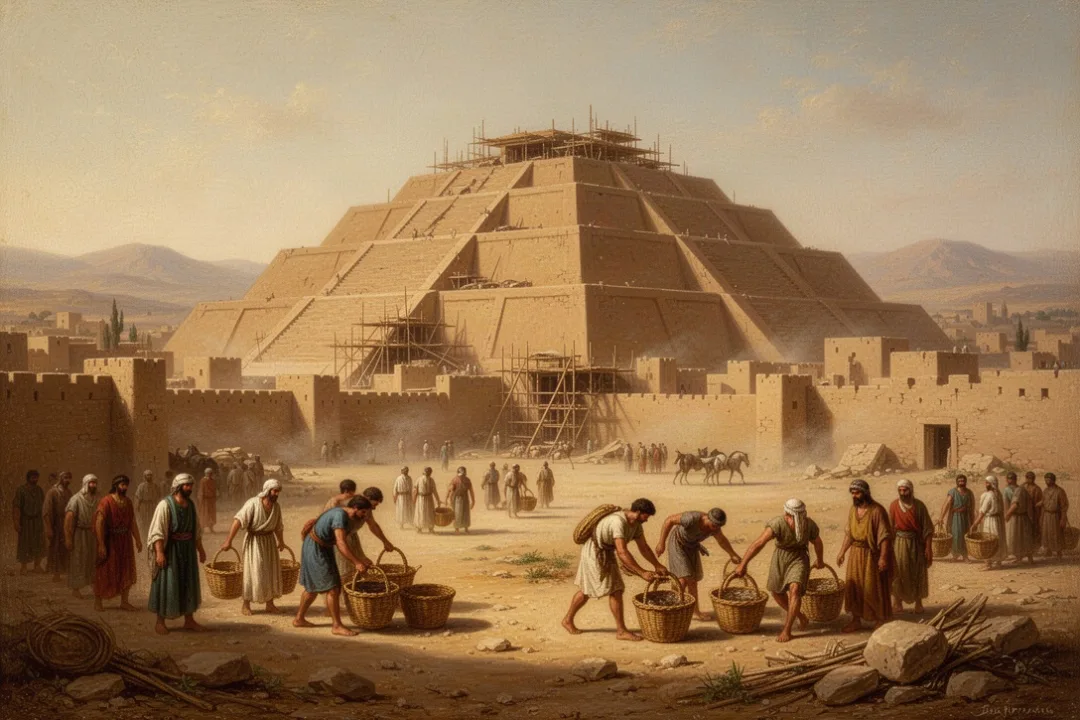
The builders make bricks because stone was not readily available in the flat alluvial plain. They also use a bitumen-based material for mortar. Those details fit the building methods known from ancient Mesopotamia, where fired and sun-dried bricks were widely used in monumental construction.
The project includes both a city and a tower. The tower is not described as a narrow modern skyscraper. The Hebrew term used in the passage refers to a tower-like structure, and many readers connect it with a Mesopotamian ziggurat: a large stepped platform or temple tower built in stages.
The phrase about reaching the heavens communicates extraordinary height and ambition. It does not necessarily mean that the builders expected to enter a physical location above the sky. In the story, the tower represents centralized human power, reputation, and independence from God.
Why the Tower of Babel is often linked with Babylon
Many readers connect biblical Babel with Babylon because the names sound similar and both are associated with the Mesopotamian plain. Babylon became one of the most influential cities of the ancient Near East, and its monumental architecture provided a natural setting for a story about a city and a towering temple structure.
The Hebrew form “Babel” is related by sound to a Hebrew verb associated with confusion. The story uses this wordplay to explain the city’s name within the narrative. In Akkadian, however, Babylon was known as Bāb-ilim, commonly understood as “gate of the god” or “gate of the gods.”
These two explanations serve different purposes. The Babylonian name reflects the city’s own language and religious culture, while Genesis uses a sound association to emphasize the confusion of languages. The similarity does not by itself prove that a particular Babylonian building was the tower described in Genesis.
Keep the terms separate: Babel, Babylon, and the Tower of Babel are closely connected in language and tradition, but the Bible does not provide an archaeological label identifying one surviving structure as the tower.
How ancient Mesopotamian ziggurats help explain the story
Mesopotamian cities built large stepped temple platforms called ziggurats. These structures were made from mud brick, often with baked brick used for protective outer surfaces or important architectural details. Their height and prominent position would have made them visible across the surrounding plain.
A ziggurat was not simply a tower for people to climb. It formed part of a temple complex and was associated with the presence and worship of a city’s deity. The elevated shrine at the top symbolized a meeting point between the divine and human worlds.
The biblical description of a tower built in the plain of Shinar resembles this cultural environment. A reader familiar with Mesopotamian temple towers would recognize the setting: a city, a monumental structure, mass-produced bricks, and an ambition to establish a lasting reputation.
Still, similarity is not the same as identification. Ziggurats were built in several Mesopotamian cities over many centuries. The presence of that architectural tradition helps explain the story’s imagery, but it does not supply a date for the specific episode in Genesis.
Was the Tower of Babel the Etemenanki ziggurat?
The most frequently suggested candidate is Etemenanki, the great ziggurat associated with Babylon. Its name is often translated in a way that refers to the foundation of heaven and earth, making it seem especially relevant to a story about a tower reaching toward the heavens.
Etemenanki was located in Babylon and was dedicated to the god Marduk. Historical records indicate that the structure was restored or rebuilt by Babylonian kings, especially during the first millennium B.C. The famous Babylonian ruler Nebuchadnezzar II undertook extensive construction in Babylon during the sixth century B.C.
The surviving archaeological evidence does not show that Etemenanki was built at the time Genesis places Babel. The structure known from the historical record was repaired and enlarged over time, and earlier versions may have existed at the site. Even so, the evidence cannot demonstrate that it was the tower described in Genesis.
There is also a chronological problem with identifying the biblical tower solely with the best-known Babylonian ziggurat. If the Babel story is placed before Abraham, while the most visible form of Etemenanki belongs to a much later period, the two cannot be treated as the same construction without assuming an earlier predecessor and a long sequence of rebuilding.
The careful answer is that Etemenanki may explain the cultural image of Babel, but no archaeological discovery has established it as the biblical tower.
What archaeology can and cannot tell us about Babel
Archaeology has found abundant evidence for cities, temples, writing, trade, and monumental building in Mesopotamia. It confirms that ancient communities in the region could organize large labor forces and build impressive structures from brick.
Archaeology also shows that Babylon was repeatedly damaged, rebuilt, and expanded. Ruins at the site include remains associated with major Babylonian construction, although later activity and erosion make the original appearance of earlier buildings difficult to reconstruct.
What archaeology has not found is an inscription saying that one particular tower was built during a sudden division of languages. Nor has it uncovered evidence that can independently verify the theological event described in Genesis. Archaeology can illuminate the setting and technology, but it cannot answer every question raised by a religious narrative.
For that reason, claims that archaeology has “proved” or “disproved” Babel usually go beyond the evidence. The material record supports the plausibility of a monumental tower in southern Mesopotamia. It does not establish the date, purpose, or supernatural details of the Genesis account.
How the date of Abraham affects estimates for Babel
Because Babel comes before Abraham in Genesis, estimates for Abraham’s lifetime influence proposed dates for the tower. Historians commonly place Abraham in the early second millennium B.C., but the exact dating of the patriarchal period is debated.
A reader who places Abraham around the early second millennium may place Babel one or more generations earlier. A reader who calculates the genealogies literally may arrive at a much earlier date, depending on how the Flood chronology is understood. Neither method produces a universally accepted year.
The text does not say that Babel occurred immediately before Abraham. The genealogical and narrative transitions may cover a substantial period. It is therefore safer to say “before Abraham, probably in the earlier part of the biblical human story” than to present one date as certain.
Even a broad date should be labeled as an estimate. “Around 2200 B.C.” is a proposed reconstruction, not a biblical timestamp or an archaeological consensus.
How to evaluate a proposed date for the Tower of Babel
When you encounter a specific date, check what kind of evidence supports it. A confident-looking year may come from a particular interpretation of biblical genealogies rather than from an inscription or excavated building.
Ask whether the date is stated in Genesis. It is not. The text supplies sequence and location, not a year.
Identify the chronology behind the estimate. Determine whether it assumes a literal genealogical timeline, a symbolic reading, or comparison with ancient history.
Separate the event from a proposed building. A date for a Babylonian ziggurat is not automatically a date for Babel.
Check whether the source distinguishes evidence from interpretation. Responsible explanations identify uncertainty instead of presenting an estimate as proven.
Compare the date with the biblical order. Any proposed date should place Babel before Abraham if it follows the sequence in Genesis.
This approach helps you distinguish three different questions: when Genesis places Babel, when Mesopotamian ziggurats were built, and when the Babylonian city or Etemenanki existed. Those questions overlap, but they are not identical.
What the story emphasizes beyond its historical date
The narrative is concerned with more than construction technology. The people want to create a city and make a name for themselves, suggesting a desire for security, unity, and lasting fame. The problem is presented as human pride expressed through centralized power, not simply as the decision to build a tall structure.
The confusion of language explains the scattering of humanity into different communities. Within Genesis, the story helps account for the diversity of peoples and languages before the narrative turns to one particular family through which the next stage of the biblical story unfolds.
This theological purpose explains why the text does not pause to give a ruler’s name, an engineering plan, or a year of completion. The account uses the tower and the city to make a claim about human ambition and divine authority.
The story’s date is uncertain, but its place in Genesis is clear: Babel stands before Abraham and explains the scattering of peoples and languages.
What you can say with confidence about when Babel happened
The most accurate short answer has several parts. The Tower of Babel belongs to the period after the Flood, according to the narrative in Genesis. It occurs before Abraham and is set in Shinar, generally associated with southern Mesopotamia.
No biblical verse gives a year, and archaeology has not identified a structure that can be proven to be the tower. Proposed dates in the third millennium B.C. come from particular chronological reconstructions, especially those based on a literal reading of biblical genealogies.
The Babylonian ziggurat Etemenanki is a possible cultural or architectural parallel, but its historically documented form belongs to a later period and cannot be equated with Babel as a settled fact. The strongest answer is therefore precise about what is known and cautious about what remains debated: the date is unknown, the biblical sequence is clear, and third-millennium estimates are interpretations rather than proof.
Frequently confused dates and names connected with Babel
Several dates appear together in discussions of Babel, even though they refer to different things. Keeping them separate prevents a great deal of confusion.
The Genesis event: no exact year is supplied; it is placed after the Flood and before Abraham.
Third-millennium estimates: proposed dates based largely on literal biblical chronology and the development of early Mesopotamian cities.
Early second millennium B.C.: a broad period often associated with traditional estimates for Abraham, whose dating remains debated.
Sixth-century B.C. Babylon: the period when Nebuchadnezzar II carried out major building projects, including work connected with Babylon’s monumental temples.
Etemenanki’s known historical phase: a Babylonian ziggurat restored over time, not a securely dated match for the Genesis tower.
These references belong to different layers of the discussion: biblical narrative, chronology, patriarchal dating, and archaeology. Combining them without qualification can make a proposed date appear more certain than the evidence allows.
Frequently asked questions
Does the Bible say exactly when the Tower of Babel was built?
No. Genesis gives the tower a place in the story rather than a calendar date. It appears after the Flood, when humanity still shares one language, and before the account of Abraham. The genealogies can be used to construct possible timelines, but interpreters differ over whether they include every generation. A precise year cannot be read directly from the text.
Was the Tower of Babel built around 2200 B.C.?
Around 2200 B.C. is one proposed estimate, not an established date. It generally comes from a literal reading of biblical genealogies combined with assumptions about the Flood and Abraham. Other readers calculate the chronology differently or do not use the genealogies as a complete timeline. The estimate may fit some reconstructions, but it should not be presented as universally accepted.
Is the Tower of Babel the same as Babylon’s Etemenanki?
Etemenanki is a strong architectural and cultural parallel because it was a major ziggurat in Babylon. However, the historically documented structure was rebuilt over time, with important work occurring much later than the period in which Genesis places Babel. No surviving inscription proves that Etemenanki was the biblical tower. It is best described as a possible inspiration or counterpart, not a confirmed identification.
Where was the Tower of Babel located?
Genesis places Babel in Shinar, a region generally associated with southern Mesopotamia. Many scholars connect that setting with the area of ancient Babylonia, near the lower Euphrates. Babylon is the most common proposed location because of the similarity between the names Babel and Babylon and the city’s monumental ziggurat tradition. The exact archaeological location of the biblical tower remains unconfirmed.









Leave a Reply