Noah’s Flood has no universally accepted calendar date. The Bible describes when it happened within Noah’s lifetime, but it does not name a year that can be matched securely to the modern calendar.
The Book of Genesis gives the Flood a detailed sequence of events rather than an absolute date. It says Noah was 600 years old when the waters came, and it identifies the beginning of the Flood by the month and day within that narrative’s calendar. The account then describes the rain, the rising waters, the eventual retreat, and Noah’s departure from the ark.
Those details can establish the Flood’s relative timing in Noah’s story. They do not establish whether it occurred in 3000 BCE, 2300 BCE, 5000 BCE, or another year. Genesis does not connect Noah’s family tree to a dated king, recorded eclipse, or other event that would allow historians to convert the account into a universally accepted calendar year.
Genesis also presents genealogies linking Noah’s ancestors to Adam and his descendants to later generations. Some readers use those lists to construct a chronology from creation to the Flood. That approach depends on several assumptions, including how the genealogies are meant to function and which ancient biblical text is being followed.
The clearest answer: Genesis gives an internal timeline for the Flood, but it does not provide an independently verifiable year in the BCE or CE calendar.
The Flood account appears primarily in Genesis chapters 6 through 9. In that narrative, God warns Noah, instructs him to build an ark, and sends the Flood as judgment on human violence and corruption. The story later focuses on the covenant with Noah and the sign of the rainbow, so its purpose is not simply to preserve a dated historical record.
Readers who treat Genesis as a literal historical chronology may still believe that a precise year can be calculated. Readers who understand the genealogies and story in a different literary or theological way may reject that calculation. Both positions recognize that the biblical text itself does not state a modern calendar date.
Why some biblical chronologies place the Flood around 2300 BCE
One well-known traditional calculation places Noah’s Flood in the mid-third millennium BCE, often around 2348 BCE. This date is associated with the chronology of James Ussher, a seventeenth-century Anglican archbishop who calculated biblical events from the genealogies and other chronological statements in the Hebrew Bible.
Ussher’s calculation was not based on geological measurements or an archaeological inscription naming Noah. It was a theological chronology built by adding ages and intervals found in the biblical text. His date became widely known because it appeared in some editions of the King James Bible and in related printed materials, but it has never been an agreed date across all Jewish, Christian, or scholarly traditions.
The calculation works roughly like this: a reader starts with a proposed date for creation, adds the ages of patriarchs when sons were born, and continues through the generations leading to Noah. The age given for Noah at the start of the Flood is then used to identify the event’s place in that sequence. The result depends on which textual details are included and how they are interpreted.
Other traditional chronologies produce different results. The Septuagint, an ancient Greek translation of the Hebrew Scriptures, preserves genealogical ages that sometimes differ from those in the traditional Hebrew text. Those differences can add centuries to a calculation before the reader even reaches Noah.
Jewish chronological traditions also do not all use the same dates. Some rabbinic calculations place creation and the Flood differently from Ussher’s system. Ancient Jewish writers, Christian commentators, and later interpreters have therefore reached more than one proposed year rather than preserving a single universally recognized date.
Ussher’s chronology: commonly associated with a Flood date around 2348 BCE.
Other Hebrew-text calculations: may produce a nearby or substantially different date, depending on the starting point and method.
Septuagint-based calculations: can place the Flood farther back because some genealogical ages are longer.
Nonliteral readings: may treat the genealogies as theological or literary links rather than a continuous year-by-year chronology.
For that reason, saying “the Flood happened in 2348 BCE” is accurate only when describing one particular traditional calculation. It should not be presented as a date that Genesis clearly states or that modern historical research has confirmed.
How biblical genealogies affect the proposed date
The main challenge in calculating Noah’s Flood is that ancient genealogies may not always be intended as complete records of every generation. In biblical writing, a genealogy can establish ancestry, identity, or an important line of descent without naming every person between two major figures.
The Hebrew Bible sometimes uses genealogical formulas that focus on a person’s descendants rather than giving a modern historian’s full family register. A list can therefore be accurate in its theological purpose while still not supplying enough information to calculate an exact number of years. The word “father” in ancient family language could also describe an ancestor, not only a direct parent.
Textual transmission creates another difficulty. The Hebrew text known as the Masoretic Text, the Greek Septuagint, and the Samaritan Pentateuch differ in some ages and genealogical details. These differences are not minor when a calculation adds many patriarchal ages together. A change of decades in several entries can shift the proposed Flood date by hundreds of years.
There is also disagreement about the starting point. A chronology must decide what year to assign to creation, and biblical readers do not all interpret the opening chapters of Genesis as a chronology intended to be converted into a modern date. Even among readers who accept a young-earth interpretation, different assumptions can produce different dates.
The story’s internal numbers can be precise without being externally anchored. Genesis mentions Noah’s age, the duration of the rain, the period when waters covered the land, and the stages by which the waters receded. These measurements help organize the narrative, but they do not connect it to a dated event in Egyptian, Mesopotamian, or other surviving records.
Why a genealogy is not the same as a calendar
A calendar date requires a fixed reference point. Historians can date an event more securely when it is tied to a king’s reign, an astronomical observation, a securely dated artifact, or a sequence of independent records. Genesis does not provide that kind of external anchor for Noah’s Flood.
Adding ages from a genealogy can show what a text appears to imply under a particular reading. It cannot by itself demonstrate that every generation is listed, that every manuscript originally contained identical numbers, or that the proposed starting date is correct. The result is best described as a traditional or interpretive date, not a confirmed historical measurement.
How to phrase the date accurately: “Some biblical chronologies place Noah’s Flood around 2348 BCE, but the Bible does not give a universally verifiable calendar year, and other textual traditions produce different results.”
What geology and archaeology say about a worldwide Flood
Modern geology does not support the idea that the entire planet was covered by floodwater at one recent date. A global flood deep enough to cover the highest mountains would leave a distinctive worldwide geological signal, including deposits formed at the same time across continents. Geologists have not found such evidence.
Earth’s rock layers show many different environments and ages. They include ancient seafloors, deserts, river systems, volcanic deposits, glacial formations, and soils that developed at separate times. Their arrangement does not indicate that all continents were submerged simultaneously by a single flood within the period proposed by most biblical chronologies.
Archaeological evidence also does not show a universal interruption of human civilization at one date. Communities in regions such as Egypt and parts of the Near East have records and material remains that extend across several proposed Flood dates. A worldwide catastrophe would be expected to leave a much broader and more synchronized disruption.
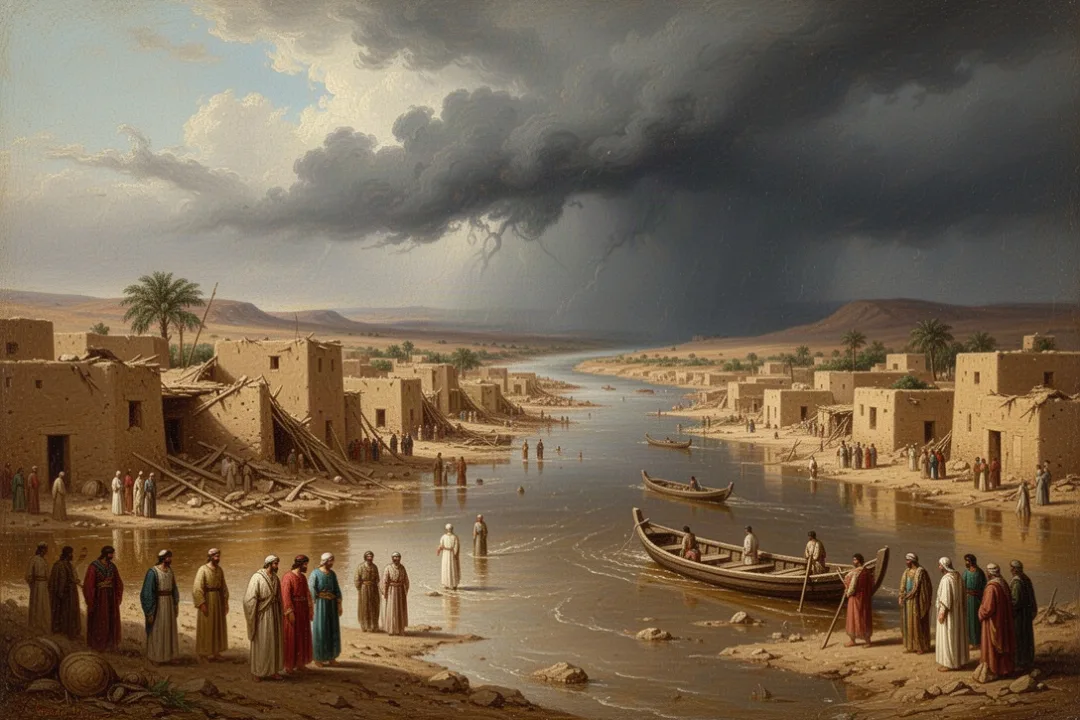
This does not mean that the ancient Near East never experienced devastating floods. Floodplains around the Tigris and Euphrates rivers were vulnerable to sudden and destructive inundation. Archaeologists have found flood deposits at some ancient settlements, although those layers do not all date to one event and do not demonstrate a flood covering the whole world.
Some researchers and religious interpreters therefore understand the biblical Flood as a regional catastrophe remembered and expressed in universal language. From the perspective of people living in a known world bounded by distant mountains and seas, a flood that destroyed every community within their horizon could be described as covering “the whole earth.” That interpretation fits some natural settings, but it cannot establish that one specific archaeological flood was Noah’s Flood.
Other readers accept the Genesis account as a global miracle and do not expect ordinary geological processes to explain it. That is a matter of religious belief rather than a date that can be demonstrated through standard historical or scientific methods. Science can assess physical evidence; it cannot independently verify the theological meaning of the story.
Geology: finds no evidence for a single recent flood covering the entire planet.
Archaeology: records multiple local or regional floods rather than one synchronized worldwide event.
Ancient history: offers no universally accepted inscription that identifies Noah or dates the Flood.
Religious interpretation: may understand the event as global, regional, symbolic, miraculous, or some combination of these ideas.
How Noah’s Flood compares with other ancient flood traditions
The Genesis account is part of a wider group of ancient Near Eastern flood traditions. The Epic of Gilgamesh includes a flood survivor named Utnapishtim, while the earlier Atrahasis Epic describes a man warned to build a vessel and preserve life. These stories share features such as divine warning, a large boat, survival through a flood, and the preservation of living creatures.
The similarities do not provide a date for Noah’s Flood. They do show that catastrophic flooding was a significant part of the cultural memory of ancient Mesopotamia. Floods in the region could destroy settlements, alter river channels, and affect large populations, making them natural subjects for stories passed down over many generations.
The differences between the accounts are also meaningful. Genesis presents the Flood in the context of human violence, divine judgment, preservation, covenant, and a moral relationship between God and humanity. Mesopotamian versions have different gods, motives, ritual details, and endings. Shared story elements may reflect a common cultural environment, literary relationships, memories of regional disasters, or a combination of factors.
Written copies of these traditions come from different periods, and the stories may have circulated orally before being recorded. A later written text is not automatically the date of the event it describes. It is also difficult to identify a single historical flood behind every ancient account because the Tigris-Euphrates basin experienced repeated floods over thousands of years.
For historical research, these traditions are evidence that flood stories were important in the ancient Near East. They are not a reliable method for assigning Noah’s Flood to a particular year. Any proposed date must still deal with the biblical text’s chronology, differences among manuscripts, and the absence of an independent record naming Noah.
What answer is most accurate for different questions about Noah’s Flood?
If the question is asking what the Bible explicitly says, the answer is: Genesis does not give a modern calendar year. It places the Flood during Noah’s 600th year and provides a sequence of months and days within the story, but those details cannot be converted into a universally accepted BCE date.
If the question is asking about a famous traditional calculation, the answer is that James Ussher’s chronology places the Flood around 2348 BCE. That date is an interpretation based on biblical genealogies and a proposed creation date. It is not the only religious chronology and is not confirmed by geology or archaeology.
If the question is asking what mainstream science says, the answer is that there is no evidence for a recent worldwide flood. Scientists do recognize many severe regional floods, including ancient floods in the Near East, but no known event matches the global account in a way that can establish a date for Noah’s Flood.
If the question is asking whether a regional flood could lie behind the story, that remains a possible interpretation rather than a proven identification. A large Mesopotamian flood may have contributed to ancient flood traditions, but researchers cannot securely connect any particular flood layer to the biblical narrative.
The most responsible short answer is therefore: some traditional biblical chronologies place Noah’s Flood around 2348 BCE, but the biblical text does not give a confirmed calendar date, and scientific evidence does not support a worldwide flood at that time. Keeping those distinctions separate prevents a traditional calculation from being mistaken for a documented historical fact.
How to evaluate claims about the Flood’s exact year
Claims about an exact year often sound more certain than the evidence allows. Before accepting a date, check whether the source is presenting a biblical interpretation, an archaeological proposal, a geological claim, or a statement of established historical fact. These categories use different methods and should not be treated as interchangeable.
A reliable explanation should identify the textual tradition behind its calculation. It should also say whether it assumes that the genealogies include every generation, which creation date it uses, and how it handles differences between the Hebrew Bible and ancient translations. Without those details, a precise year can conceal several unspoken assumptions.
Ask what source gives the date. Is it Genesis, a later commentator, an archaeological report, or a modern religious chronology?
Check the textual basis. Compare whether the calculation uses the Masoretic Text, the Septuagint, the Samaritan Pentateuch, or another tradition.
Separate internal timing from absolute dating. Noah’s age and the Flood’s duration do not identify a year in world history.
Look for independent evidence. A proposed date should be compared with geology, archaeology, ancient records, and regional flood history.
Watch for false precision. A date stated to the exact year may still depend on disputed assumptions.
For most readers, the distinction between religious chronology and historical dating is the central point. A faith tradition may preserve a meaningful account of judgment, survival, and covenant without supplying the kind of evidence required to establish an exact year by modern historical standards.
Frequently asked questions
Does the Bible say Noah’s Flood happened in 2348 BCE?
No. The year 2348 BCE comes from a traditional chronology associated with James Ussher. Genesis gives Noah’s age and the Flood’s sequence of months and days, but it does not identify a year in the BCE calendar. Other biblical text traditions and chronological methods produce different proposed dates.
Could Noah’s Flood have been a regional flood?
Some interpreters and researchers consider a major regional flood in ancient Mesopotamia a possible background for the story. The Tigris and Euphrates floodplains experienced destructive inundations, but no particular flood has been proven to be Noah’s Flood. A regional interpretation remains a possibility, not an established identification.
Does science support a worldwide flood?
Mainstream geology and archaeology do not support a recent flood covering the entire planet. Earth’s rock layers record environments formed at many different times, and human settlements do not show one worldwide interruption. Science does document numerous severe local and regional floods, including ancient events in the Near East.
Why do different people give different dates for the Flood?
Proposed dates depend on the biblical text used, the interpretation of genealogies, and the starting date assigned to creation. The Masoretic Text, Septuagint, and Samaritan Pentateuch contain differences in some genealogical ages. If genealogies are not complete lists, adding their ages cannot produce a dependable absolute date.










Leave a Reply