The Lake of Gennesaret: Names, geography, and Bible history
The Lake of Gennesaret: Names, geography, and Bible history
When you read about the Lake of Gennesaret in the Bible, you may wonder whether it is a different body of water from the Sea of Galilee. It is not. Lake of Gennesaret is one of several names for the same freshwater lake in northern Israel, the body of water more commonly known as the Sea of Galilee.
The name appears most prominently in Luke 5:1, where people gather around Jesus as he stands by the lake. Matthew and Mark usually call it the Sea of Galilee, while John also uses the name Sea of Tiberias. These names reflect different geographical, cultural, and historical ways of identifying one central landmark of the Gospel narratives.
The lake lies in the Galilee region of northern Israel, in the northern part of the Jordan Rift Valley. The Jordan River enters it from the north and continues out from its southern end, making the lake part of a larger water system that eventually reaches the Dead Sea.
Its surface is far below sea level, although it contains fresh water rather than salt water. The lake is roughly 13 miles long and 8 miles wide, with a shape that varies depending on how its bays and shoreline are measured. The surrounding hills and mountains give it a distinctly enclosed appearance, especially when viewed from the water.
The lake’s western side includes several sites associated with the ministry of Jesus, including Capernaum, Magdala, and the fertile plain of Gennesaret. The eastern shore is generally steeper and less densely settled. Across the water, visitors can see the hills of the Golan region, which help form the lake’s eastern landscape.
Geographical answer: The Lake of Gennesaret, the Sea of Galilee, and the Sea of Tiberias are different names for the same freshwater lake.
Why the lake has several different names
Ancient places often had more than one name because different communities described them in different languages and historical periods. The lake’s names preserve layers of Hebrew, Greek, Jewish, and Roman usage.
Sea of Galilee is the name most familiar to many Bible readers. It identifies the lake with Galilee, the northern region where much of Jesus’ public ministry took place. Although the body of water is technically a lake, ancient writers commonly used “sea” for a large or significant body of water.
Sea of Tiberias became associated with the city of Tiberias, which Herod Antipas founded on the western shore during the first century. John uses this name in passages such as John 6:1 and John 21:1. The name connects the lake with a major regional city and with the political world of Roman-era Galilee.
Lake of Gennesaret is the name Luke uses in Luke 5:1. It may be connected with the fertile plain of Gennesaret along the lake’s northwestern or western shore. In that passage, the name appears as part of a detailed setting: crowds press around Jesus while fishermen wash their nets near the shoreline.
The lake also has a Hebrew name commonly rendered Kinneret or Chinnereth. This name appears in the Hebrew Bible in references to a town and a body of water in the region. Its exact origin is discussed by scholars, but it is often associated with a harp-like shape or with the ancient town of Kinnereth.
Lake of Gennesaret: Luke’s name for the lake in Luke 5:1.
Sea of Galilee: A regional name connecting the water with Galilee.
Sea of Tiberias: A later name associated with the city of Tiberias.
Kinneret or Chinnereth: An older Hebrew name found in biblical and historical references.
What the Lake of Gennesaret was like in the first century
The lake was not simply a scenic backdrop. In the first century, it supported fishing, farming, transportation, and trade. Villages and towns clustered around parts of the shoreline, and boats were a practical way to move people and goods across the water.
Fishing was especially important. The Gospel accounts refer to fishermen, boats, nets, fish, and the work required to bring a catch to shore. A fishing business could involve more than one boat and several people. Luke 5 presents Simon Peter and his partners as experienced workers who had spent the night fishing before Jesus asked to use one of their boats.
The lake’s northern and western shores were more suitable for settlement and cultivation. The plain of Gennesaret was known for fertile soil, helped by water, mild conditions, and the surrounding volcanic landscape. Crops could grow in an area that contrasted sharply with the drier hills farther away.
At the same time, the lake could become dangerous. Winds moving through the surrounding valleys and hills could produce sudden rough conditions. The Gospel stories of storms are more understandable when read against this physical setting: a calm surface could change quickly, leaving small fishing boats vulnerable.
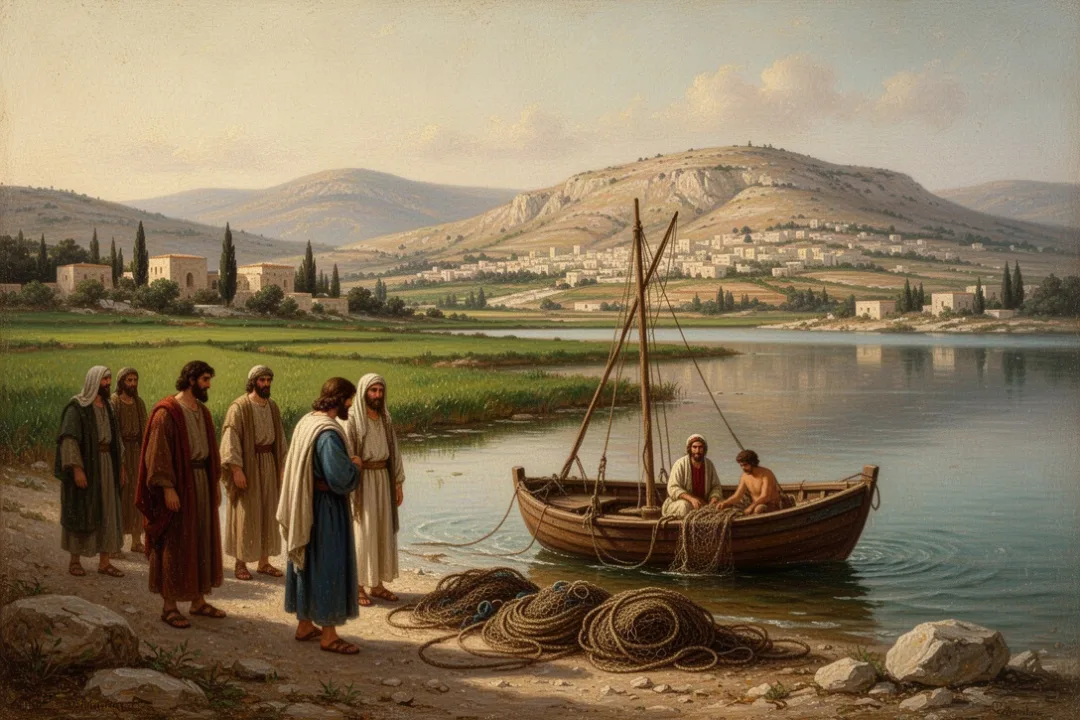
Luke 5 presents the lakeshore as a working place where boats, nets, tired fishermen, and a teaching crowd meet.
What happened at the Lake of Gennesaret in the Gospels
Several important Gospel scenes take place on or near this lake. The episodes are not all identical, and each writer emphasizes different details, but together they show how closely the lake was tied to Jesus’ ministry and to the lives of his first followers.
The calling of Simon Peter and his partners
Luke 5:1-11 describes Jesus teaching near the Lake of Gennesaret. The crowd is pressing around him, so he gets into Simon’s boat and asks him to move a short distance from shore. From the boat, Jesus teaches the people gathered along the water.
After teaching, Jesus tells Simon to put out into deeper water and lower the nets. Simon explains that the fishermen have worked through the night without success, but he follows the instruction. The resulting catch is so large that the nets begin to break and the boats are in danger of sinking.
The episode leads Simon, James, and John to recognize that their encounter is more than a successful day of fishing. Luke presents it as a turning point in which they leave their former work behind and follow Jesus. The lake is therefore both a place of ordinary labor and the setting for a major change in their lives.
Jesus calms a storm on the lake
Matthew 8:23-27, Mark 4:35-41, and Luke 8:22-25 describe Jesus and his disciples crossing the lake when a violent storm arises. Jesus is asleep in the boat, and the disciples fear that the boat will be overwhelmed. He then rebukes the wind and waves, and the conditions become calm.
The account raises the disciples’ question about Jesus’ authority over the natural world. The story also reflects the lake’s real character: fishermen who knew the water could still face conditions beyond their control. The small boat, sudden storm, and steep surrounding terrain make the scene vivid without requiring the lake to be unusually large by modern standards.
Jesus walks on the water
Matthew 14:22-33, Mark 6:45-52, and John 6:16-21 place a nighttime crossing on the lake after Jesus has fed a large crowd. In Matthew and Mark, the disciples struggle against wind and waves while Jesus comes toward them across the water. John gives a shorter account of the encounter.
Matthew includes Peter stepping out of the boat before becoming afraid. Mark emphasizes the disciples’ lack of understanding after the feeding, while John focuses on Jesus’ arrival and the disciples’ response. Each account uses the lake as a setting for fear, recognition, and faith.
The feeding of the five thousand near the lake
The feeding of the five thousand is associated with the region around the lake in all four Gospels. John 6 places the event near the Sea of Galilee, also called the Sea of Tiberias. Jesus withdraws with his disciples, but a large crowd follows him.
The Gospel accounts describe Jesus teaching and providing food for the crowd from a small amount of bread and fish. The event is followed in John by teaching about bread and life. The shoreline setting connects the miracle with the fishing economy and food culture of Galilee.
Appearances after the resurrection
John 21 describes a post-resurrection appearance at the Sea of Tiberias. Several disciples fish through the night without catching anything. At daybreak, Jesus stands on the shore and directs them toward a large catch.
The scene echoes Luke 5, where an extraordinary catch also accompanies a call to follow Jesus. John’s account then includes a meal by the charcoal fire and a conversation between Jesus and Peter. The lake becomes a place where past failure, renewed service, and personal responsibility meet.
Why the lake mattered to Jesus’ ministry
Galilee was not a minor location in the Gospel narratives. Jesus spent much of his public ministry in towns and villages around the lake, especially on the western and northern shores. The area offered access to villages, agricultural communities, fishing families, travelers, and people from different parts of the region.
The lake also provided a natural setting for public teaching. A speaker standing in a boat could address people along the shore, and the water could create distance from a pressing crowd. In Luke 5, the boat is not just transportation; it becomes a practical platform for teaching.
Many of Jesus’ disciples had direct ties to the lake. Simon Peter, Andrew, James, and John are connected with fishing in the Gospel accounts. Their experience with nets, boats, weather, and the rhythms of work shaped the language Jesus used when teaching them.
Images drawn from the lake appear throughout the Gospels. Fishing, nets, fish, boats, storms, waves, shores, and crossings are not abstract illustrations for these disciples. They are familiar elements from everyday life. That familiarity helps explain why lake scenes carry both practical detail and symbolic meaning.
How the surrounding towns connect to the lake
Understanding the shoreline helps clarify many Gospel passages. The lake was bordered by several communities, though the exact identification of some ancient sites remains debated. A few locations are especially important in the New Testament accounts.
Capernaum: A lakeside town associated with Jesus’ teaching and with several disciples.
Bethsaida: A town connected with disciples and with Gospel stories near the lake.
Magdala: A settlement on or near the western shore, associated with Mary Magdalene’s name.
Tiberias: A major city whose name gave the lake another title, Sea of Tiberias.
Gennesaret: A fertile area mentioned in Matthew 14 and Mark 6, as well as in Luke’s name for the lake.
These places should not be treated as interchangeable. A passage may refer to a town, a district, a plain, or the lake itself. Careful reading of the wording helps prevent a common mistake: assuming that “Gennesaret” always means the entire shoreline or that every lakeside event happened at one exact point.
Practical tips for reading references to the Lake of Gennesaret
Readers can avoid confusion by checking the name, the Gospel, and the surrounding details. The following habits are useful when studying a passage or preparing for a visit to the region.
Compare the names before assuming there are multiple lakes. Lake of Gennesaret, Sea of Galilee, and Sea of Tiberias refer to the same body of water.
Read the full passage. The nearby references to boats, towns, crowds, or crossings often reveal which shore or setting the writer has in view.
Separate the lake from the plain of Gennesaret. The plain is a land area beside the lake, while the Lake of Gennesaret is the water itself.
Check which Gospel is using the name. Luke’s wording differs from Matthew’s, Mark’s, and John’s, but the geography overlaps.
Use a map cautiously. Modern labels do not always match ancient boundaries, and archaeological identifications can remain uncertain.
Remember the scale of the lake. It is large enough for open-water crossings and dangerous storms, but it is still a freshwater lake rather than an ocean.
Consider the weather and terrain. Sudden winds and steep surrounding slopes help explain the storm narratives.
Common mistake: “Gennesaret” can refer to the lake in Luke 5:1 or to the fertile plain beside it in other passages. The context determines whether the word means water or land.
Common mistakes about the Lake of Gennesaret
One frequent mistake is to think the Lake of Gennesaret, Sea of Galilee, and Sea of Tiberias are three separate bodies of water. They are not. The different names reflect regional language and historical usage, much as one city or river may have different names in different periods.
Another mistake is to assume that the word “sea” proves the lake contains salt water. In biblical and ancient usage, “sea” can identify a substantial body of water. The Sea of Galilee is a freshwater lake fed by the Jordan River and local springs.
It is also easy to confuse the lake with the nearby plain of Gennesaret. Matthew 14:34 and Mark 6:53 describe Jesus and the disciples arriving in the land of Gennesaret, which points to a district along the shore. Luke 5:1, however, calls the body of water the Lake of Gennesaret.
A fourth mistake is treating every Gospel scene as if it occurred at a precisely known modern location. The broad geography is clear, but some ancient sites and routes are debated. A responsible reading distinguishes between what the text states directly and what later maps or traditions propose.
How geography enriches the biblical accounts
Knowing the lake’s geography adds texture to passages that can otherwise seem detached from ordinary life. When Luke describes fishermen washing their nets, the scene becomes more than a religious gathering. It is a workplace at the end of a long shift, with equipment needing repair and cleaning before the next outing.
When the disciples cross the lake, the trip is not necessarily a symbolic walk from one place to another. It may be a practical journey between populated shores. Yet the physical journey creates space for teaching, conflict, fear, and surprising encounters.
The lake’s enclosed basin also helps explain why people could gather in large numbers along a shore and hear a teacher using a boat. Hills around the water can shape sound and visibility, while the shoreline provides natural places for landing boats or organizing a crowd.
The contrast between fertile land and open water is significant as well. A person could move from productive fields and busy villages to a dangerous lake within minutes. The Gospel narratives repeatedly place confidence, uncertainty, work, and dependence against that changing environment.
What visitors can see around the lake today
Modern visitors can find a mixture of archaeological sites, churches, nature areas, agricultural land, and developed shoreline communities. The landscape has changed substantially since the first century, but the lake itself remains the central geographical feature.
Sites traditionally associated with Capernaum, Tabgha, and other Gospel locations help visitors imagine the relationship between villages and water. Archaeological remains can show the character of ancient settlement, while the shoreline gives a sense of distances that maps alone do not provide.
Conditions can vary by season and time of day. Early morning may bring calmer water and clearer views, while afternoon winds can make the surface rougher. If you plan to take a boat trip, follow local safety guidance and do not treat calm weather at the dock as a guarantee of calm conditions farther from shore.
Visitors should also remember that the lake is a living water resource, not only a historical landmark. Water levels, environmental pressures, fishing regulations, and shoreline development affect how the region is managed. Respecting restricted areas and local instructions helps preserve both the natural setting and archaeological remains.
Why the Lake of Gennesaret remains significant
The Lake of Gennesaret matters because it brings together geography, history, work, and faith in one setting. It was a source of food and transportation for communities in Galilee, a route between towns, and a familiar workplace for several disciples.
In the Gospel narratives, the lake is also a place of encounter. Jesus teaches from a boat, calls fishermen, crosses dangerous water, calms a storm, feeds a crowd, and meets disciples after the resurrection. These scenes use the ordinary features of the lake to communicate themes of calling, trust, provision, fear, and restoration.
Its multiple names do not create a geographical puzzle once their backgrounds are understood. Lake of Gennesaret highlights the area’s local geography, Sea of Galilee identifies the region, and Sea of Tiberias reflects the importance of a later city. Together, they point to the same body of water at the heart of northern Galilee.
Frequently asked questions
Is the Lake of Gennesaret the same as the Sea of Galilee?
Yes. The Lake of Gennesaret and the Sea of Galilee are two names for the same freshwater lake in northern Israel. The New Testament also calls it the Sea of Tiberias, particularly in John. “Gennesaret” is associated with the nearby fertile plain and appears as the lake’s name in Luke 5:1.
Why does the Bible call it a sea if it is a lake?
Ancient writers used “sea” for prominent bodies of water, even when they were inland lakes. The Sea of Galilee is not connected directly to an ocean and contains fresh water. Its size, importance to local communities, and open-water crossings explain why “sea” became part of its traditional name.
What is the land of Gennesaret?
The land of Gennesaret was a fertile area along part of the lake’s western or northwestern shore. It should not be confused with the entire lake. Matthew 14 and Mark 6 refer to the land or district, while Luke 5:1 uses “Lake of Gennesaret” for the body of water itself.
Which Gospel passages mention the Lake of Gennesaret?
Luke 5:1 directly uses the phrase “Lake of Gennesaret.” Related events on the same lake appear in passages such as Luke 8:22-25, Matthew 14:22-33, Mark 4:35-41, John 6:1-21, and John 21. Other Gospels generally use Sea of Galilee or Sea of Tiberias instead.







Leave a Reply