Jesus’ public ministry probably lasted about two to three years, beginning with his baptism and ending with his crucifixion and resurrection in Jerusalem.
The exact timeline cannot be reconstructed with modern precision. The four Gospels arrange events for both historical and theological purposes, and they do not always place every episode in the same sequence. A useful timeline therefore combines the shared outline of Matthew, Mark, and Luke with John’s references to Jewish festivals and visits to Jerusalem.
Jesus’ ministry began after the work of John the Baptist and ended during the Roman governorship of Pontius Pilate. Pilate governed Judea from AD 26 to 36, so the crucifixion must fall within that period. The Gospels also connect Jesus’ death with the Jewish feast of Passover, which helps narrow the possible dates but does not produce one universally accepted answer.
Many scholars place the beginning of Jesus’ public ministry around AD 27 or 28 and his death around AD 30. Others place the crucifixion around AD 33. The commonly used sequence below should be read as an approximate framework rather than a day-by-day calendar.
The length of the ministry is also debated. Matthew, Mark, and Luke can be read as describing a ministry lasting roughly a year, although that may reflect their selective storytelling. John mentions several Passovers and other festivals, which has led many readers to understand the ministry as lasting roughly two or three years.
Best way to read the timeline: treat the major movements—John’s ministry, Jesus’ baptism, Galilean preaching, the journey to Jerusalem, and the final week—as more certain than the exact order of every individual miracle or teaching.
Before the public ministry: John the Baptist prepares the way
Before Jesus begins teaching publicly, the Gospels introduce John the Baptist as a prophetic preacher in the wilderness. John calls people to repentance, announces that God’s reign is near, and baptizes those who respond. His message creates the setting for Jesus’ appearance and explains why crowds are already gathering along the Jordan River.
John’s ministry is associated with the region around the Jordan and the wilderness of Judea. He speaks to ordinary people, tax collectors, and soldiers, urging them to show repentance through changed conduct. He also points beyond himself to someone greater, whom the Gospel writers identify as Jesus.
John’s prominence attracts the attention of religious and political authorities. The Gospels later report that Herod Antipas arrests John because of John’s criticism of Herod’s marriage and conduct. John’s imprisonment becomes an important transition: Jesus’ public work expands as John’s prophetic role recedes.
Jesus’ baptism and temptation mark the beginning
Jesus comes to John for baptism in the Jordan. At this event, the Gospel accounts describe the Spirit descending upon Jesus and a heavenly declaration identifying him as God’s beloved Son. The baptism functions as a public commissioning and marks the beginning of his visible ministry.
Immediately afterward, Jesus goes into the wilderness, where he faces temptation. Matthew and Luke present three major tests involving food, power, and trust in God; Mark gives a shorter account. These scenes portray Jesus as remaining faithful before he begins proclaiming God’s kingdom to others.
The temptation also establishes themes that continue throughout the ministry: dependence on God, rejection of spectacular displays of power, and refusal to gain authority through compromise. Jesus’ mission will involve healing, teaching, and confronting evil, but not the kind of political or military rule many people expected from a messianic figure.
Early disciples and the first signs in Galilee
After John’s arrest, Jesus begins proclaiming the kingdom of God, especially in Galilee. His announcement calls people to repent and believe the good news. Galilee becomes the main setting for the first major phase of his ministry, with Capernaum serving as a central base in the Gospel accounts.
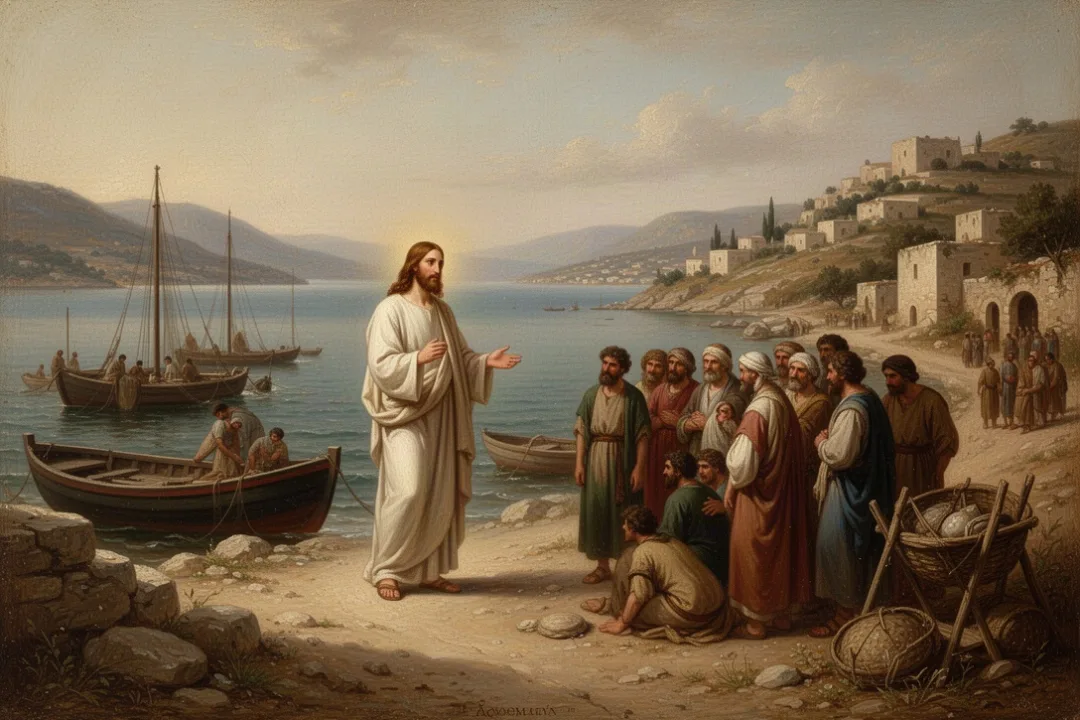
The calling of the first disciples takes place in this period. Simon Peter, Andrew, James, and John are presented as fishermen who leave their work to follow Jesus. Other disciples join later, including Levi or Matthew in the Synoptic accounts. These followers become witnesses, students, and eventually messengers of Jesus’ teaching.
John’s Gospel presents a somewhat different opening sequence. It describes early disciples, a wedding at Cana, a visit to Jerusalem, and conversations with figures such as Nicodemus before the ministry in Galilee receives fuller attention. Rather than forcing every scene into a single rigid order, readers can recognize that John emphasizes the meaning of Jesus’ signs and identity, while the Synoptic Gospels emphasize the developing proclamation of the kingdom.
Jesus’ Galilean ministry gathers crowds
During the main Galilean phase, Jesus teaches in synagogues, villages, homes, and open countryside. He announces forgiveness, calls people to repentance, and explains what life under God’s rule looks like. His teaching attracts crowds because it combines authority, vivid stories, and practical moral demands.
Jesus also heals people with a wide range of illnesses and disabilities. The Gospels describe healings involving fever, paralysis, skin disease, blindness, deafness, and other conditions. These acts are not presented merely as displays of power; they signal restoration and show the compassionate character of the kingdom Jesus proclaims.
Exorcisms are another prominent feature of the Galilean ministry. Jesus confronts forces portrayed as destructive and liberates those under their control. These episodes contribute to the Gospel theme that God’s reign is breaking into ordinary human life and challenging every power that damages people.
As Jesus’ reputation spreads, crowds sometimes make it difficult for him to enter towns or find solitude. He responds by withdrawing for prayer, moving to less crowded areas, or crossing the Sea of Galilee. The contrast between public demand and private prayer appears repeatedly throughout the timeline.
Major teachings shape the middle of the ministry
Jesus’ teaching in Galilee includes some of the best-known material in the Gospels. Matthew gathers many sayings into the Sermon on the Mount, while Luke presents related teaching in a different setting and arrangement. The material emphasizes humility, mercy, reconciliation, purity of intention, love of enemies, generosity, prayer, and trust in God.
The parables are especially important. Jesus uses familiar images—seeds, lamps, debts, fields, vineyards, banquets, and households—to describe the kingdom and expose human responses to it. Some parables stress unexpected reversal: outsiders may respond more faithfully than the religiously confident, and the apparently insignificant may become central.
Jesus also teaches his disciples about prayer, fasting, wealth, leadership, and care for vulnerable people. He challenges the desire for status and presents service as the proper pattern for those who want to lead. His teaching about marriage, divorce, possessions, and childlike receptiveness also creates tension with some listeners and demands serious ethical reflection.
The growing ministry produces conflict with some Pharisees, scribes, and other religious leaders. The disagreements often concern Sabbath observance, ritual purity, forgiveness, table fellowship, and the source of Jesus’ authority. The Gospels do not portray every Jewish group as opposed to Jesus; rather, they describe specific disputes within the religious world of first-century Judaism.
Key events in the Galilean timeline
John the Baptist is arrested: Jesus begins a more prominent public proclamation after John’s imprisonment.
The calling of the disciples: Jesus forms a close group that receives additional teaching and participates in his mission.
Healings and exorcisms: These acts illustrate restoration and the arrival of God’s kingdom.
The forgiveness of sins: Jesus’ authority to forgive becomes a major source of controversy.
The appointment of the Twelve: The chosen group symbolizes the restoration of Israel and receives a special role.
Teaching through parables: Jesus explains the kingdom while also challenging listeners to respond.
Miracles involving nature: The calming of a storm and the feeding of crowds present Jesus as exercising authority beyond ordinary human limits.
One of the most memorable events in this phase is the feeding of a large crowd with a small amount of food. It appears in several Gospel accounts and is followed by teaching about bread, provision, and dependence on God. John connects one version of the sign with a major discourse, while the Synoptic Gospels place greater emphasis on the disciples’ role and the crowd’s needs.
Jesus sends disciples to extend the mission
Jesus does not keep the work of proclamation to himself. He sends the Twelve, and in Luke’s account another group of disciples, to announce God’s kingdom, heal the sick, and depend on hospitality. Their mission gives them practical experience and shows that the ministry is becoming a shared movement.
The instructions vary among the Gospel accounts, but several themes remain consistent: travel simply, announce the message clearly, receive hospitality appropriately, and accept rejection without abandoning the mission. The disciples return with reports of what happened, and Jesus uses their experiences to teach them about service, humility, and the proper source of joy.
This period also reveals the disciples’ limitations. They misunderstand some teachings, struggle to respond to crowds, and sometimes compete for importance. Their failures are part of the Gospel portrait: Jesus forms them gradually rather than presenting them as fully prepared leaders from the start.
Peter identifies Jesus and the ministry turns toward Jerusalem
At Caesarea Philippi, Peter confesses that Jesus is the Messiah. This moment is a turning point in the Synoptic Gospels. Jesus then begins to speak more openly about suffering, rejection, death, and resurrection, while the disciples struggle to accept that the Messiah’s path will involve suffering rather than immediate political triumph.
The Transfiguration follows in the Synoptic sequence. Jesus appears in glory with Moses and Elijah, and the disciples receive a vision that reinforces his importance. The event points back to Israel’s Scriptures and forward to the suffering that Jesus has just predicted.
After this turning point, Jesus continues teaching and healing but spends more attention on discipleship. He warns against causing others to stumble, teaches about forgiveness and reconciliation, and responds to questions about greatness by placing a childlike posture at the center. The journey is no longer simply a circuit through Galilee; it is increasingly directed toward Jerusalem.
John’s Gospel includes major events that the Synoptic Gospels place differently or do not include in the same form, including the raising of Lazarus. In John’s narrative, this sign intensifies the authorities’ concern and directly contributes to the decision to act against Jesus. Its precise relationship to the Synoptic timeline remains a matter of interpretation.
The journey through Judea and toward Jerusalem
As Jesus leaves Galilee, he teaches in Judea and in villages along the route to Jerusalem. Luke gives this journey extensive narrative space, presenting teachings about prayer, wealth, compassion, repentance, and faithful readiness. The famous parable of the Good Samaritan and the story of the prodigal son appear in this broad section of Luke.
Jesus continues to attract crowds, but the tone becomes more urgent. He warns that entering God’s kingdom requires more than admiration or casual association. Followers must count the cost, place loyalty to God above competing claims, and use possessions responsibly.
In John, Jesus makes repeated appearances in Jerusalem around Jewish festivals. He teaches in the Temple area and debates questions about his identity, authority, and relationship with the Father. These Jerusalem scenes help explain why the final conflict develops in the capital rather than remaining a dispute confined to Galilee.
The raising of Lazarus, in John’s account, is followed by Jesus’ withdrawal from public view for a period. The event increases his visibility and also increases the danger surrounding him. By the time he approaches Jerusalem for Passover, the conflict with the authorities has become acute.
Jesus enters Jerusalem and teaches in the Temple
Jesus enters Jerusalem shortly before Passover in an event remembered as the Triumphal Entry. The crowds greet him with actions and words that express messianic hope. The Gospel writers connect the scene with prophetic imagery, especially the image of a humble king arriving on a donkey.
Jesus then goes to the Temple and disrupts commercial activity there. The event is often called the cleansing of the Temple, although the Gospel accounts differ in where they place it. Jesus’ action is a prophetic sign criticizing the misuse of a sacred space and announcing judgment against a religious system that has failed to reflect God’s purposes.
During the days that follow, Jesus teaches publicly in and around the Temple. He answers questions about taxes, resurrection, the greatest commandment, and the authority of his actions. His responses often expose the assumptions behind the questions and place love of God and neighbor at the heart of faithful obedience.
Jesus also condemns hypocrisy and warns against religious leaders who seek honor while neglecting justice and mercy. He praises a poor widow’s small offering, speaks about the destruction of the Temple, and teaches his disciples to remain watchful. These sayings combine judgment, warning, and hope without providing a modern-style schedule of future events.
The Last Supper begins the final sequence
During the Passover period, Jesus shares a final meal with his disciples. The Synoptic Gospels present this meal as a Passover meal, while John’s chronology places Jesus’ death in relation to the preparation for Passover. Christians remember the meal as the Last Supper, and it becomes the foundation for the Eucharist or Communion.
Jesus interprets bread and wine in relation to his body and blood and speaks of a new covenant. John emphasizes additional actions and teachings, including the washing of the disciples’ feet, a model of humble service, and extended teaching about love, unity, the Spirit, and the disciples’ future witness.
During the meal, Jesus predicts betrayal and Peter’s denial. Judas leaves and later leads the arresting group to Jesus. The disciples do not understand everything immediately, but the Gospel narratives present the meal as preparation for the suffering that follows and as a lasting pattern for the community of believers.
Arrest, trials, crucifixion, and burial
After the meal, Jesus prays in Gethsemane or a nearby garden. He experiences deep distress but submits himself to God’s will. Armed men arrest him, and the disciples scatter. The arrest begins a rapid series of hearings before Jewish authorities and the Roman governor.
The Gospel accounts differ in details about the sequence and setting of these hearings. They agree that Jesus is accused of claims connected with his identity and kingship, and that Pontius Pilate authorizes crucifixion. Because crucifixion was a Roman form of execution, the final legal power rests with the Roman administration even though local leaders play a significant role in the narratives.
Jesus is crucified at a place called Golgotha, or “Place of the Skull.” The Gospels describe darkness, mockery, the presence of women followers, and Jesus’ death. They also connect the event with Scripture, Passover imagery, the suffering of the righteous, and the inauguration of a new covenant.
Joseph of Arimathea receives permission to take Jesus’ body and places it in a tomb. Women followers observe where he is buried and later become the first witnesses to the empty tomb. The burial marks the end of Jesus’ earthly public ministry before the resurrection appearances.
Resurrection appearances complete the Gospel timeline
On the first day of the week, women go to the tomb and find it open. The Gospels report that Jesus has been raised and that he appears to his followers. The accounts differ in the order and location of the appearances, but they consistently present the resurrection as the decisive act of God and the foundation of the disciples’ proclamation.
Jesus appears to individuals and groups, including Mary Magdalene, Peter, the Twelve or broader groups of disciples, and followers on the road to Emmaus. Paul’s later summary in 1 Corinthians 15 also refers to appearances to Peter, the apostles, and a large group of believers. These traditions form the earliest Christian testimony that the crucified Jesus was alive.
Matthew ends with Jesus commissioning his followers to make disciples among all nations. Luke continues into Acts, where Jesus instructs the disciples, promises the Holy Spirit, and is taken up into heaven. John closes with resurrection appearances by the Sea of Galilee and a renewed commission to Peter.
These events are not usually counted as part of Jesus’ public ministry in the same way as his Galilean and Judean preaching. They are, however, essential to the complete Gospel timeline because they explain how a movement centered on a crucified teacher became a worldwide mission.
Practical tips for reading the timeline accurately
Separate certainty from precision: the broad sequence is clearer than the exact dates of individual episodes.
Compare all four Gospels: Matthew, Mark, Luke, and John have different structures and emphases.
Do not force identical chronology: a Gospel may group related teachings together rather than preserving the order in which every saying occurred.
Distinguish repeated events: the Gospels sometimes describe more than one healing, controversy, feeding, or journey that may look similar.
Use festivals as clues: Passover, Tabernacles, and other feasts help identify the setting, especially in John.
Avoid treating every estimate as settled: dates such as AD 30 and AD 33 are informed reconstructions, not explicit dates supplied by the Gospel texts.
Read location changes carefully: Galilee, Judea, Samaria, Perea, and Jerusalem represent different stages or settings in the narrative.
Keep theology and chronology together: the Gospel writers arrange events to explain who Jesus is, not simply to create a modern biography.
Common mistake: assuming that every Gospel must provide the same complete itinerary. A better approach is to identify shared events first, then compare how each writer places and interprets them.
A concise chronological sequence
John the Baptist preaches and baptizes in the wilderness and Jordan region.
Jesus is baptized and then undergoes temptation in the wilderness.
Jesus calls his first disciples and begins proclaiming God’s kingdom.
Galilean ministry expands through teaching, healing, exorcisms, and parables.
The Twelve are appointed and later sent to participate in the mission.
Peter confesses Jesus as Messiah, followed by predictions of suffering.
Jesus turns toward Jerusalem while teaching about discipleship and faithful living.
Jesus enters Jerusalem, teaches in the Temple, and confronts religious and political authorities.
The Last Supper, arrest, trials, and crucifixion take place during the Passover period.
Jesus is buried, raised, and seen by his followers before commissioning them for continued mission.
The most dependable way to remember the timeline is as a movement from preparation to proclamation, from Galilee to Jerusalem, and from crucifixion to resurrection. Dates and individual placements remain debated, but this overall pattern is shared across the Gospel tradition.
Frequently asked questions
How long did Jesus’ public ministry last?
Most reconstructions place Jesus’ public ministry at roughly two or three years, although a shorter period is possible when reading the Synoptic Gospels by themselves. John’s references to multiple Passovers support a longer timeline. The Gospels do not state the total length directly, so the figure remains an informed estimate rather than a fixed historical date.
What year did Jesus begin his public ministry?
Jesus likely began his public ministry around AD 27 or 28, though some chronologies allow for a slightly different date. The estimate depends on the dating of John the Baptist’s ministry, Pontius Pilate’s governorship, and the relationship between Jesus’ ministry and Jewish festivals. No surviving source gives a calendar date for Jesus’ baptism or first sermon.
Did Jesus spend most of his ministry in Galilee?
Galilee is the main setting for the early and middle portions of Jesus’ ministry, especially in Matthew, Mark, and Luke. He also traveled through Judea and other regions and taught repeatedly in Jerusalem. John gives Jerusalem a more prominent role, describing several festival visits that are not arranged the same way in the Synoptic Gospels.
Why do the Gospels place some events differently?
The Gospel writers selected and arranged material to communicate who Jesus was and what his ministry meant. They often group teachings by theme or organize events around a theological purpose. Differences in sequence do not erase the shared outline: John’s ministry, Jesus’ baptism, Galilean proclamation, the journey to Jerusalem, crucifixion, and resurrection.








Leave a Reply