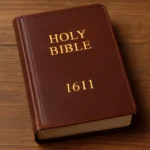
The King James Version Bible is an English translation of the Bible first published in 1611 under the authority of King James I of England. It became one of the most influential English-language Bibles because of its wide use in churches, its memorable literary style, and its impact on English-speaking Christianity.
Often abbreviated as KJV, it is also called the Authorized Version, particularly in Britain. The translation includes the Old Testament, the New Testament, and, in its original form, the Apocrypha. Although many modern English translations are available today, the KJV remains widely read, quoted, studied, and used in worship.
The KJV emerged from a period of disagreement about English Bible translations and church practice. By the beginning of the seventeenth century, several English Bibles were already in circulation, including the Great Bible, the Geneva Bible, and the Bishops’ Bible. Different groups preferred different translations, and some editions contained notes that challenged or criticized established church authority.
King James I supported the creation of a new translation partly to provide a commonly accepted Bible for the Church of England. At the Hampton Court Conference in 1604, proposals for a new translation gained royal support. The project was not intended to create a completely new English Bible from scratch. Instead, translators revised earlier work while consulting the original biblical languages and other scholarly resources.
The translation was prepared by teams of scholars associated with Oxford, Cambridge, and Westminster. They worked in several companies, with each group assigned particular books or sections of Scripture. The commonly cited number is 47 translators, although the surviving historical record does not make every detail of the workforce perfectly certain.
The central point: The King James Version is a translation into English, not a separate collection of biblical books. Its distinctiveness comes mainly from its historical setting, source texts, translation method, and language.
The translators followed detailed instructions intended to promote consistency and preserve familiar church language. They were encouraged to use traditional English terms where possible, keep chapter and verse divisions, and consult other translators during the revision process. The result was a formal translation designed for public reading as well as private study.
When the King James Version was published and revised
The first edition of the King James Bible appeared in 1611. Its title page described it as a translation made from the original tongues and appointed to be read in churches. The phrase “Authorized Version” became common later, especially in Britain, although the extent of any formal royal authorization is debated by historians.
The 1611 publication was not identical to every KJV Bible sold today. Early copies contained printing errors, spelling differences, marginal notes, and typographical variations. Some pages also used typefaces and spelling conventions that can look unfamiliar to modern readers. Over time, publishers corrected errors and standardized the text.
Two significant eighteenth-century revisions helped shape the form most people recognize. A Cambridge edition associated with Thomas Paris appeared in 1762, and an Oxford edition prepared by Benjamin Blayney appeared in 1769. The 1769 edition became especially influential and is often treated as the standard form of the KJV, even though the original translation dates to 1611.
These revisions generally focused on spelling, punctuation, typography, and obvious printing problems rather than producing a new translation. That distinction matters when someone says that the KJV was “published in 1611.” The translation’s origins are in 1611, but many modern printed copies reflect later editorial standardization.
The KJV also changed in physical form as printing technology developed. Early editions used elaborate layouts, decorative initials, and different systems for marking paragraphs. Later editions often removed some features, modernized spelling, and printed the biblical text in a format more familiar to contemporary readers.
The Apocrypha in early King James Bibles
Early KJV editions placed the Apocrypha between the Old and New Testaments. These books and additions were included for historical and ecclesiastical reasons, but their status differs among Christian traditions. Many Protestant editions printed after the eighteenth century omitted them, while Roman Catholic and Eastern Orthodox Bibles use different collections and arrangements of deuterocanonical books.
The absence of the Apocrypha from many modern KJV editions does not mean that the 1611 translators ignored it. The original publication included these writings as a separate section. Readers examining a particular KJV should check its contents rather than assume that every edition has the same books.
Which biblical texts the KJV translators used
The KJV translators worked from Hebrew, Aramaic, and Greek texts, while also consulting earlier translations and commentaries. For the Old Testament, they relied primarily on the Masoretic Hebrew tradition. For the New Testament, they used printed Greek editions commonly associated with the Textus Receptus, along with earlier English versions and other scholarly materials available in their era.
The phrase “original languages” can be misleading if it suggests that the translators possessed the original handwritten copies of biblical books. Those autographs no longer survive. Like other translators, the KJV scholars compared available manuscripts and printed editions to determine the wording they believed best represented the biblical text.
Their work also built on a long history of English Bible translation. The KJV drew heavily from the Tyndale tradition, the Geneva Bible, the Bishops’ Bible, and other earlier versions. A substantial portion of its wording was therefore familiar to English-speaking readers before 1611.
Translation decisions were made through discussion and revision rather than by one person working alone. A company might prepare an initial version, another group might review it, and selected scholars could examine the entire work. This collaborative process helped create consistent terminology and a unified style across the different books of the Bible.
Old Testament: translated primarily from the Hebrew Scriptures, with some passages involving Aramaic.
New Testament: translated from the Greek text available to scholars in the early seventeenth century.
Earlier English versions: consulted for established wording and interpretive choices.
Church tradition and scholarship: used to evaluate difficult passages, names, grammar, and terminology.
Apocrypha: translated and printed as a separate section in the original edition.
Modern textual scholarship has access to more manuscripts and earlier witnesses than were available to the KJV translators. That does not automatically make every modern translation better for every reader, but it explains why some passages differ between the KJV and newer versions. Differences can involve a word, a phrase, a footnote, or the placement of a passage in the text.
What the language of the KJV means today
The KJV is famous for its Early Modern English, but its language is not exactly the same as the English spoken by William Shakespeare or all English speakers in 1611. Its style uses formal vocabulary, distinctive sentence patterns, and pronouns that have largely disappeared from everyday American English.
Words such as “thee,” “thou,” “ye,” and “thine” can make the translation seem difficult, but these forms once carried grammatical information. In broad terms, “thou” and “thee” referred to one person, while “ye” and “you” could refer to more than one person or appear in different grammatical roles. The original distinctions are not always used perfectly consistently in later editions, yet they can still help readers understand the style.
Some KJV words have also changed meaning. A reader may misunderstand a passage if a familiar-looking word is read only with its modern definition. For example, “conversation” can refer to conduct or way of life, “prevent” can mean go before, and “charity” can refer to Christian love rather than simply charitable giving.
The familiar grammar is part of the KJV’s identity. Its translators often use parallel phrases, balanced clauses, and carefully repeated words. This makes many passages memorable when heard aloud, which helped the translation serve congregations at a time when public reading was central to worship.
At the same time, the KJV’s beauty can make its meaning seem clearer than it really is. A graceful sentence may still contain an interpretive decision, an obsolete word, or a grammatical structure that modern readers misunderstand. Reading a difficult passage alongside a recent translation or a reliable study Bible can clarify the meaning without requiring you to abandon the KJV.
Practical reading tip: When a KJV passage seems confusing, check the surrounding context, look up unfamiliar words in a historical dictionary, and compare several responsible translations rather than relying on a single modern paraphrase.
How the KJV compares with modern English Bibles
The main difference between the KJV and modern translations is not that one is a Bible and the others are not. They are English translations made from related biblical traditions, but they reflect different historical periods, source-text decisions, translation philosophies, and goals for readers.
The KJV generally uses a formal and traditional style. Many modern translations aim for clearer contemporary English, although they vary considerably. Some stay close to the wording and structure of the original languages, while others give greater attention to expressing the meaning in natural modern speech.
Modern translations also benefit from advances in textual criticism and the discovery, study, and comparison of additional manuscripts. This can result in differences in verses or passages. Often, modern Bibles place a disputed reading in a footnote rather than silently deleting it. The KJV may contain wording that is absent from some newer translations, while other passages may appear with notes explaining the textual evidence.
Neither the KJV nor a modern translation should be judged solely by whether it sounds familiar. A reader should consider the purpose for reading, the difficulty of the passage, the quality of the edition, and the Christian tradition in which the Bible will be used.
For traditional worship: the KJV may fit a congregation that has long used its language and memorized its wording.
For public reading: its rhythm and formal style can work well when listeners already understand its vocabulary.
For first-time Bible reading: a modern translation may reduce confusion caused by obsolete words and grammar.
For detailed study: comparing the KJV with other translations and notes can reveal important interpretive choices.
For memorization: the best choice is often the version you understand accurately and can recall consistently.
It is also useful to distinguish the KJV from the New King James Version. The NKJV is a later revision published in the twentieth century. It preserves much of the KJV’s textual basis and traditional structure but replaces many archaic words, pronouns, and grammatical forms with contemporary English. The two versions are related, but the NKJV is not simply a reprint of the 1611 translation.
Why the King James Version remains influential
The KJV shaped English religious vocabulary, literature, music, preaching, and public speech for centuries. Phrases associated with it have entered common cultural language, even among people who do not regularly attend church. Its influence is especially visible in the wording of hymns, sermons, quotations, and literary works.
Its influence also comes from sustained institutional use. For generations, many Protestant churches, schools, families, and Bible societies used the KJV as their primary English Bible. Repeated hearing made its phrases familiar, and memorized passages created a shared vocabulary across communities and generations.
Some readers value the KJV because they believe its formal style gives Scripture appropriate dignity. Others appreciate its poetic cadence, historical importance, or connection to family and church traditions. These are legitimate reasons to read it, provided that literary beauty is not confused with automatic clarity.
Many KJV readers use study tools to bridge the gap between historical English and modern understanding. Helpful tools include a Bible dictionary, cross-references, a concordance, manuscript notes, and a second translation written in current English. A strong study approach asks both what the KJV wording communicates and what the underlying passage means in context.
When choosing a KJV edition, examine what it contains and how it is presented. Some editions include only the 66 books commonly found in Protestant Bibles. Others include the Apocrypha, extensive notes, pronunciation guides, maps, or cross-references. Large print, paragraph formatting, and readable type can make a greater practical difference than decorative design.
Check the edition date and contents. Determine whether it follows a traditional 1611-based text, a later standardized edition, or a publisher’s modified format.
Look for study support. Notes, cross-references, word definitions, and introductions can explain historical and linguistic difficulties.
Read the passage aloud carefully. Hearing punctuation and sentence structure can help reveal how a paragraph is organized.
Compare difficult verses. Use another formal translation and a clear modern translation to identify possible meanings.
Separate translation from interpretation. A marginal note or explanatory heading may reflect an editor’s view rather than the wording of the biblical text itself.
The KJV is best understood as a landmark English translation with a particular history, not as a translation that appeared outside history or editorial development. It can be read with appreciation for its language while also being approached carefully where vocabulary, grammar, manuscripts, or church tradition create questions.
Frequently asked questions
Is the King James Version the original Bible?
No. The KJV is an English translation first published in 1611. The biblical books were written in Hebrew, Aramaic, and Greek, and the KJV translators worked from the manuscripts and scholarly editions available to them. Calling it “original” can be misleading, although it is an important historical translation of the Bible.
Is the King James Version still accurate?
The KJV remains a substantial and respected translation, but it can be difficult to understand because some English words have changed meaning. Modern textual scholarship has also examined manuscripts unavailable to the 1611 translators. For careful study, read the KJV alongside notes and one or more reliable modern translations.
What is the difference between the KJV and the NKJV?
The NKJV is a later revision that keeps much of the KJV’s traditional structure and textual heritage while updating vocabulary, pronouns, punctuation, and grammar. The KJV uses forms such as “thee” and “thou,” whereas the NKJV generally uses contemporary English. They are related translations, not identical editions.
Why do some KJV Bibles have different books?
Early KJV editions included the Apocrypha in a separate section between the Testaments. Many later Protestant editions omitted those books, while other Christian traditions include different collections of deuterocanonical writings. Check the table of contents for the specific edition you are considering.










Leave a Reply