The First Testament was written over several centuries, not at one time, with its earliest traditions emerging in the second millennium BCE and its latest books completed by the second century BCE.
“First Testament” is a name some Christians use for the collection more commonly called the Old Testament. It refers to the first major section of the Christian Bible and largely corresponds to the Jewish Scriptures, although the order, number of books, and boundaries differ among Jewish, Catholic, Protestant, and Orthodox traditions.
The word testament comes from a term meaning covenant or binding agreement. In Christian usage, the First Testament describes the Scriptures associated with God’s covenant with Israel, while the New Testament presents writings about Jesus and the early Christian movement. The phrase does not mean that one complete book was written before another complete book called the New Testament.
Instead, the First Testament is a library of different writings. It includes law, history, poetry, wisdom literature, prophecy, prayers, genealogies, and stories about Israel’s relationship with God. These works were produced, edited, preserved, and recognized as sacred across a long period.
The short answer: There is no single writing date for the First Testament. Its books were composed and edited at different times, broadly from the late second millennium BCE through the second century BCE.
That broad range explains why answers to “when was the first testament written?” can look different. A response focused on the earliest traditions may point to the period around 1200 BCE or earlier. A response focused on the final form of the entire collection may point to the second or first centuries BCE, with some books reaching their final shape earlier than others.
When the earliest First Testament traditions appeared
Some of the material later included in the First Testament may preserve memories, laws, poems, and stories that originated in the late second millennium BCE. This period includes the era traditionally associated with Moses and the early history of Israel, although the precise historical setting and date of each tradition remain debated.
Ancient communities often preserved important material through oral transmission before putting it into writing. Songs, legal rules, genealogies, worship practices, and accounts of ancestors could be recited and adapted for generations. Oral tradition did not necessarily mean that the material was unreliable; it meant that memorization, public recitation, and communal use were part of how knowledge survived.
Scholars sometimes identify very old poetic passages within later books. Examples often discussed include the Song of Deborah in Judges 5, the Song of the Sea in Exodus 15, and portions of ancient blessings or victory poems. Their exact dates are uncertain, but their language and style may preserve material older than the surrounding prose.
The historical books also describe events that may have been remembered for a long time before being written down or edited into their present form. Stories about the patriarchs, the exodus, the wilderness, and the early kings of Israel were shaped by religious interpretation as well as by historical memory. The text does not always tell readers when each account was first recorded.
The earliest traditions should therefore be distinguished from the earliest surviving manuscripts. A poem may have been composed centuries before the oldest physical copy that remains. Ancient writings were copied by hand on materials such as papyrus, parchment, and leather, and most early copies disappeared through ordinary wear, reuse, decay, war, and changes in climate.
Tradition: A story, poem, law, or teaching preserved within a community.
Composition: The point at which a writer or group first created a particular written form.
Editing: The process of arranging, expanding, combining, or updating earlier material.
Manuscript: A physical copy that has survived from a later time.
Canon: The collection of writings recognized as authoritative by a religious community.
These terms describe different stages. Saying that a tradition is ancient does not prove that the complete biblical book containing it was written at the same time.
When the Torah and historical books took shape
The first five books—Genesis, Exodus, Leviticus, Numbers, and Deuteronomy—are called the Torah in Judaism and the Pentateuch in many Christian traditions. Traditional religious accounts associate the Torah with Moses, while modern scholarship generally examines the books as a collection containing multiple layers of tradition, law, narrative, and editorial work.
Many scholars place significant stages in the formation of the Torah between the eighth and fifth centuries BCE, though proposed dates vary. Older material may have been incorporated into written collections, and those collections may have been revised in response to political crises, religious reforms, exile, and the rebuilding of Jewish life after the Babylonian conquest.
Deuteronomy and the books of Joshua, Judges, Samuel, and Kings are closely connected by themes such as covenant loyalty, centralized worship, leadership, and the consequences of injustice or idolatry. Some scholars describe a major editorial tradition linking these books. Others use different models, but there is broad agreement that the books reflect a process rather than a single writing session.
The Babylonian exile in the sixth century BCE was especially significant for the preservation and shaping of Israelite literature. Jerusalem had been destroyed, the temple had been lost, and many people had been displaced. Such a crisis encouraged the collection, interpretation, and reorganization of traditions about land, kingship, worship, covenant, and national identity.
Parts of the Torah may have reached a form close to the one known today during the Persian period, after the exile. This does not mean that every sentence was newly written then. It means that earlier traditions may have been brought together and given a more stable literary form during that broad era.
Some biblical books themselves provide clues about their setting. References to exile, restored worship, Persian rulers, or later historical circumstances can help scholars estimate when portions were composed or edited. These clues rarely produce an exact year, because a reference may have been added by a later editor or may describe an earlier event.
Genesis illustrates the difficulty particularly well. Its stories about creation, the flood, the patriarchs, and the family of Jacob may draw on very old traditions, but the book as a literary whole reflects a long process of arrangement. Its final form cannot simply be assigned to the period of the earliest stories.
The same principle applies to Exodus through Deuteronomy. Ancient laws may have circulated independently, and narratives may have developed in separate settings before being woven together. The result is a unified religious work that still contains different voices, styles, repetitions, and perspectives.
When the prophets, poetry, and wisdom writings were composed
The First Testament includes writings from many periods, so the prophetic and wisdom books cannot all be assigned one date. Some prophetic collections are connected with the Assyrian period of the eighth century BCE, while others reflect the Babylonian exile, the Persian period, or later Jewish life under foreign rule.
Isaiah, Jeremiah, Ezekiel, and the Twelve Minor Prophets contain messages associated with particular historical crises. Their books may preserve words or themes linked to named prophets, while also showing later editing and expansion. Isaiah, for example, is often studied as a work containing material from more than one historical setting, including the period of exile and the return from exile.
The book of Amos is commonly associated with the eighth century BCE, when the northern kingdom of Israel faced social inequality and political pressure. Hosea is also linked with that general era. Micah addresses injustice, leadership, and the fate of Jerusalem in language connected to the same broad period.
Jeremiah and Ezekiel are strongly connected with the upheavals surrounding the Babylonian conquest and the destruction of Jerusalem in the sixth century BCE. Their books contain prophetic speeches, symbolic actions, accusations, warnings, promises, and visions. The material was likely preserved and organized by followers or later scribes.
Some prophetic writings belong to later periods. Haggai and Zechariah address the rebuilding of the temple during the Persian era, while Malachi is generally associated with a later postexilic setting. The book of Daniel contains stories and visions that reflect different literary layers, with its final composition commonly placed in the second century BCE.
The Psalms do not have one author or one date. They are a collection of prayers and songs that were written, used, and gathered over a long period. Some may have been connected with Israelite or Judean royal worship, some with temple ceremonies, and others with private or communal prayer. The collection was likely organized into its present broad shape over time.
Proverbs also reflects more than one stage of composition. It includes short sayings, instructions, and longer teachings about wisdom, discipline, speech, work, wealth, and morality. Some collections may be early, while other sections appear connected with later scribal activity.
Job and Ecclesiastes are difficult to date precisely because their settings, language, and themes do not point to one obvious historical moment. They explore suffering, justice, mortality, meaning, and the limits of human understanding. Their final forms may belong to the later part of the First Testament’s development.
The book of Esther is set in the Persian court, but the story’s setting does not automatically reveal when it was written. A narrative can portray an earlier period from a later perspective. This distinction is essential when using biblical books as evidence for their own composition dates.
Why dates remain approximate: A biblical book may contain older poems, newer explanations, later editorial notes, and traditions from several generations. Scholars therefore often give a range or describe stages of composition rather than naming one exact year.
When the latest First Testament books were written
Most of the First Testament had been composed or compiled before the second century BCE, but some books are commonly dated to that period. The clearest example is Daniel, whose visions address persecution under the Seleucid ruler Antiochus IV Epiphanes. Many scholars place the final form of Daniel around the middle of the second century BCE, while religious traditions may understand its origins differently.
The historical setting of Daniel helps scholars distinguish between the book’s stories and its final literary form. Its tales are presented in an earlier Babylonian and Persian setting, but its visions speak powerfully to events of the second century BCE. A story’s setting and a book’s date are therefore not always the same.
Some scholars also associate parts of the book of Isaiah with the Persian period, and the dating of several Psalms, Proverbs collections, and other writings remains open to discussion. The final books to take shape may not have been the same books that were last accepted into every religious canon.
By the second century BCE, Jewish communities were already reading and copying many of these writings as authoritative or highly respected Scriptures. The existence of an established body of sacred writings does not mean that every community used exactly the same list. Recognition developed over time and differed across regions and traditions.
The First Testament was not finalized through a single public event recorded in one ancient document. Instead, canonical recognition grew through worship, teaching, copying, interpretation, and communal use. Some books were accepted broadly, while others had a more varied history among Jewish and Christian communities.
For Judaism, the Hebrew Bible is traditionally organized into the Torah, the Prophets, and the Writings. Christians generally arrange related books as the Old Testament, often grouping them into law, history, poetry or wisdom, and prophecy. Catholic and Orthodox Bibles include books that Protestant Bibles usually place in the Apocrypha or do not include in the Old Testament.
This difference means that “the First Testament was completed” can refer to more than one question:
When was the earliest material first composed?
When did the individual books reach forms close to those read today?
When were the books gathered into recognized collections?
Which religious community’s canon is being discussed?
Those questions have related but different answers. The earliest traditions may reach back into the second millennium BCE, many major writings took shape between the eighth and fifth centuries BCE, and some final compositions likely belong to the second century BCE.
What the oldest surviving manuscripts reveal
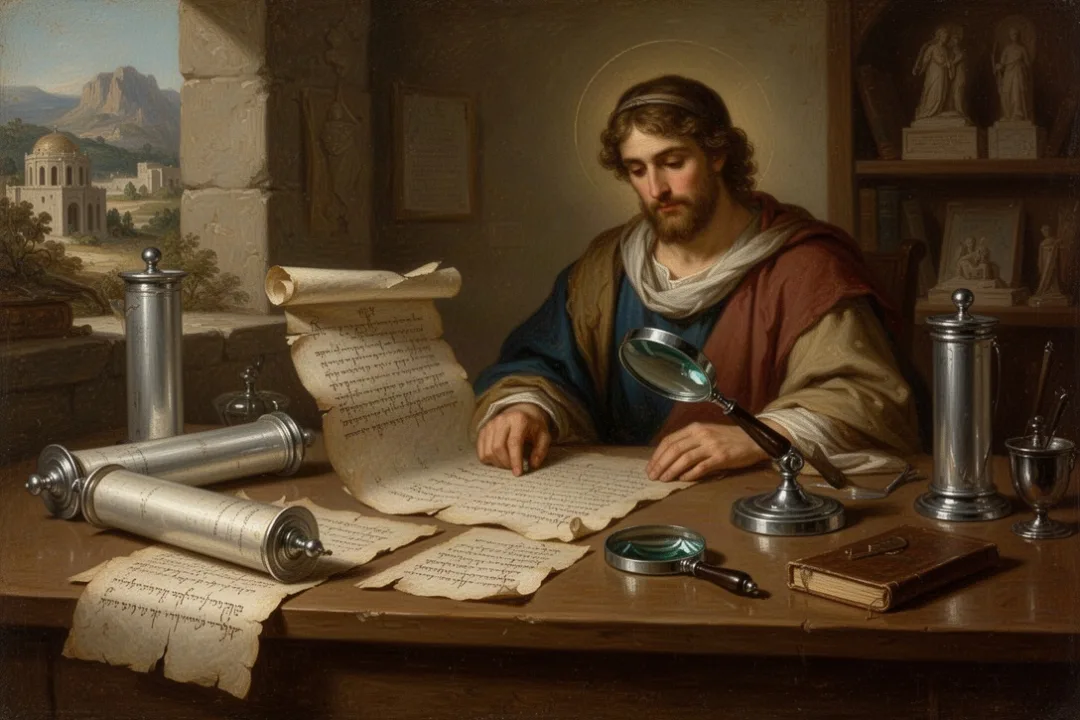
The oldest surviving evidence does not give us the original manuscripts of the First Testament. Instead, it shows that biblical texts were copied and circulated long after their initial composition. One important early witness is the Ketef Hinnom silver scrolls, discovered near Jerusalem and generally dated to the late seventh or early sixth century BCE.
These small silver amulets contain wording related to the priestly blessing in Numbers 6. They do not preserve an entire biblical book, but they demonstrate that language associated with the Torah was in use before the Babylonian exile or around that period. They are valuable evidence for the antiquity of particular passages.
The Dead Sea Scrolls, discovered in the Judean Desert in the twentieth century, provide a much larger body of evidence. The scrolls and fragments were copied from approximately the third century BCE to the first century CE. They include portions of nearly every book in the Hebrew Bible, along with other Jewish writings, community rules, prayers, and interpretations.
The Dead Sea Scrolls do not all match one another or later medieval Hebrew manuscripts word for word. Their differences show that the text was transmitted through more than one textual tradition during the Second Temple period. At the same time, many passages are substantially similar to the Hebrew text preserved in later Jewish manuscripts.
The Septuagint, an ancient Greek translation of Jewish Scriptures, is another major witness. It was produced in stages, beginning in the Hellenistic period, when Greek was widely used in the eastern Mediterranean. Because translation requires an underlying Hebrew or Aramaic text, the Septuagint can sometimes preserve evidence about earlier readings, although it is not a simple mirror of one original manuscript.
Later Hebrew manuscripts, especially the medieval Masoretic tradition, are central to modern editions of the Hebrew Bible. Scribes known as Masoretes carefully preserved consonants, vowels, pronunciation traditions, and reading notes. These manuscripts are much later than the earliest compositions, but comparison with older witnesses helps scholars study how the text was transmitted.
Manuscript evidence can answer some questions better than others. It can show that a passage existed by a particular date, reveal differences between textual forms, and help reconstruct earlier readings. It cannot always identify the exact writer, the first moment of composition, or the complete history of a book before the earliest surviving copy.
Researchers compare several kinds of evidence when estimating dates:
Language: Vocabulary, grammar, spelling, and changes in Hebrew or Aramaic can suggest a general period.
Historical references: Mentions of rulers, political events, exile, or foreign empires can establish possible limits.
Literary style: Form, themes, structure, and links to other writings can indicate relationships between texts.
Manuscripts: The date of a surviving copy shows that the text existed by that time, not necessarily that it was created then.
Archaeology: Inscriptions and material remains can provide background for language, places, practices, and historical settings.
These methods work together, but none guarantees an exact answer for every book. That is why responsible explanations usually describe probable periods rather than claiming a precise year for the entire First Testament.
Why there is no single date for the First Testament
The First Testament developed through a long history of oral tradition, writing, editing, translation, copying, and canon formation. A short answer such as “it was written around 1000 BCE” overlooks later books. An answer such as “it was written around 165 BCE” overlooks the much older poems, laws, narratives, and prophetic collections that were already circulating centuries earlier.
A useful broad timeline looks like this:
Before 1000 BCE: Older oral traditions and possible early poetic material may have developed, although exact dates are uncertain.
1000–700 BCE: Traditions connected with the monarchy, worship, law, and national history were preserved and developed in written and oral forms.
700–500 BCE: Major prophetic, historical, and legal collections took shape amid Assyrian, Babylonian, and Persian rule.
500–300 BCE: Postexilic writings, wisdom traditions, prayers, and edited collections continued to develop.
200–100 BCE: Some later books reached their final form, while a broad body of Jewish Scripture was being copied, translated, and treated as authoritative.
These periods overlap, and the timeline is not a universally agreed sequence. It is a way to show why the First Testament cannot be assigned one composition date. Different books have different histories, and even one book may contain layers from different periods.
For a Christian reader, the most practical answer is that the First Testament predates the New Testament by several centuries and was already a substantial collection of sacred writings by the time of Jesus. For a Jewish reader, the more precise framework is the Hebrew Bible’s development through the Torah, Prophets, and Writings, with textual and canonical histories that do not exactly match later Christian arrangements.
The phrase “first testament” can also create the impression that the collection was written first and then replaced. That is not how the texts functioned historically. The Hebrew Scriptures continued to be sacred to Judaism, and early Christians read them as authoritative while interpreting them in light of Jesus.
If you need one sentence, say that the First Testament was composed and compiled over roughly a thousand years, from ancient traditions and early written material through books completed in the second century BCE. If you need a more precise answer, identify the particular book, passage, manuscript, or religious canon under discussion.
Frequently asked questions
Was the Old Testament written before the New Testament?
Yes. The writings traditionally included in the Old Testament were composed and collected centuries before the New Testament books. By the first century CE, Jewish Scriptures already existed as a substantial body of sacred writings, although communities differed in the precise boundaries and arrangement of that collection.
Did Moses write the entire First Testament?
Jewish and Christian traditions have long connected Moses with the Torah, especially its authority and teaching. Modern biblical scholarship generally sees the Torah as the result of multiple stages of composition and editing. Moses is not traditionally regarded as the author of books such as Psalms, Isaiah, or Daniel.
Which book of the First Testament was written first?
No answer is certain because oral traditions and written sources may have existed before the books reached their current forms. Some scholars consider early poems in Exodus, Judges, and other books among the oldest surviving material. The earliest complete book cannot be identified confidently from the available evidence.
When was the Old Testament translated into Greek?
Jewish translators produced the Septuagint in stages during the Hellenistic period, beginning several centuries before the Common Era. The translation was not completed as one project on one known date. Different books were translated at different times, and some Greek versions preserve readings that differ from later Hebrew manuscripts.








Leave a Reply