The Ark of the Covenant has not been reliably located. No archaeologist, historian, or government has produced verified physical evidence showing where it is today. The most prominent surviving tradition places it in the Church of Our Lady Mary of Zion in Aksum, Ethiopia, but access is restricted and the object has not been independently examined.
Other theories place the Ark beneath or near the Temple Mount in Jerusalem, in a hidden chamber connected with the First Temple, or in locations associated with ancient Israel such as Mount Nebo and Shiloh. These ideas come from biblical passages, religious traditions, and speculative searches rather than confirmed discovery.
Short answer: The Ark’s present location is unknown. The Ethiopian claim is the best-known tradition, but it remains unverified; no publicly documented artifact has been authenticated as the biblical Ark.
In the Hebrew Bible, the Ark of the Covenant was a sacred chest associated with God’s covenant with Israel. It was made of wood covered with gold and had a lid often called the mercy seat or atonement cover. The biblical description also includes cherubim, winged figures facing one another over the lid.
The Ark’s primary religious role was not simply to store an important object. It represented the divine presence among the Israelites and was connected with worship, covenant obligations, and the holiness of the sanctuary. Biblical accounts describe it as being kept in the Most Holy Place, the innermost chamber of the tabernacle and later the Jerusalem Temple.
According to Exodus 25, the Ark was associated with the tablets of the covenant. Other biblical passages refer to additional objects connected with it or with the sacred traditions surrounding it, including a jar of manna and Aaron’s staff. The different passages do not present every detail in exactly the same way, so claims about its contents should be made carefully.
The Ark also appears in stories about Israel’s wilderness travels and entry into the land of Canaan. Priests carried it before the people, and biblical narratives describe it as playing a symbolic role during the crossing of the Jordan and the capture of Jericho. These accounts establish the Ark as a central religious symbol, although they do not provide modern evidence about its survival.
After the Israelites settled in the land, the Ark was associated with several locations before Jerusalem became the center of worship. The book of 1 Samuel describes it at Shiloh, where the sanctuary operated during an earlier period. Later, the Ark was taken by the Philistines and eventually returned to Israel, with the narrative recording stops at Beth-shemesh and Kiriath-jearim.
King David is described as bringing the Ark to Jerusalem. Later, Solomon placed it in the Temple’s inner sanctuary. From that point, it became closely connected with Jerusalem and the First Temple, which is why many later searches have focused on the area of the ancient Temple.
Why historians cannot identify the Ark’s present location
The most significant problem is that the Bible does not give a clear account of what happened to the Ark when the Babylonians conquered Jerusalem and destroyed the First Temple in 586 BCE. The biblical books describing the destruction mention the Temple and its treasures, but they do not plainly say that the Ark was carried to Babylon, hidden, destroyed, or recovered.
This silence has produced several competing interpretations. If the Ark was among the Temple objects taken as booty, it may have disappeared during the Babylonian period or afterward. If priests hid it before the invasion, it could remain in an undiscovered chamber. If later religious writers used the Ark as a symbol rather than a report of a surviving object, there may be no physical chest to find.
Ancient sources also provide limited help. The books of Kings and Chronicles describe the Ark in relation to Solomon’s Temple, but the later account of Jerusalem’s fall does not identify its fate. The book of Jeremiah refers to a future time when people will no longer speak about the Ark or make another one, which some readers interpret as evidence that it had vanished from active use.
Second Maccabees 2:4–8 contains a different tradition. It says that the prophet Jeremiah took the tent, the Ark, and the incense altar to a cave on Mount Nebo and concealed them. The passage also says that the hiding place would remain unknown until God gathered his people and showed mercy. This is an ancient literary and religious tradition, but it is not an archaeological report confirming a discoverable location.
The lack of a clear ancient record matters because an object as important as the Ark would normally require a chain of evidence. Researchers would need to establish that a candidate chest came from the appropriate period, matched the biblical descriptions in a credible way, and had a documented history connecting it to the Jerusalem Temple. No proposed location has met those standards.
Evidence standard: A place described in a religious tradition is not automatically an archaeological location. A credible identification would require controlled examination, dating, historical context, and independent documentation.
The main traditions about where the Ark may be
Aksum, Ethiopia, and the Church of Our Lady Mary of Zion
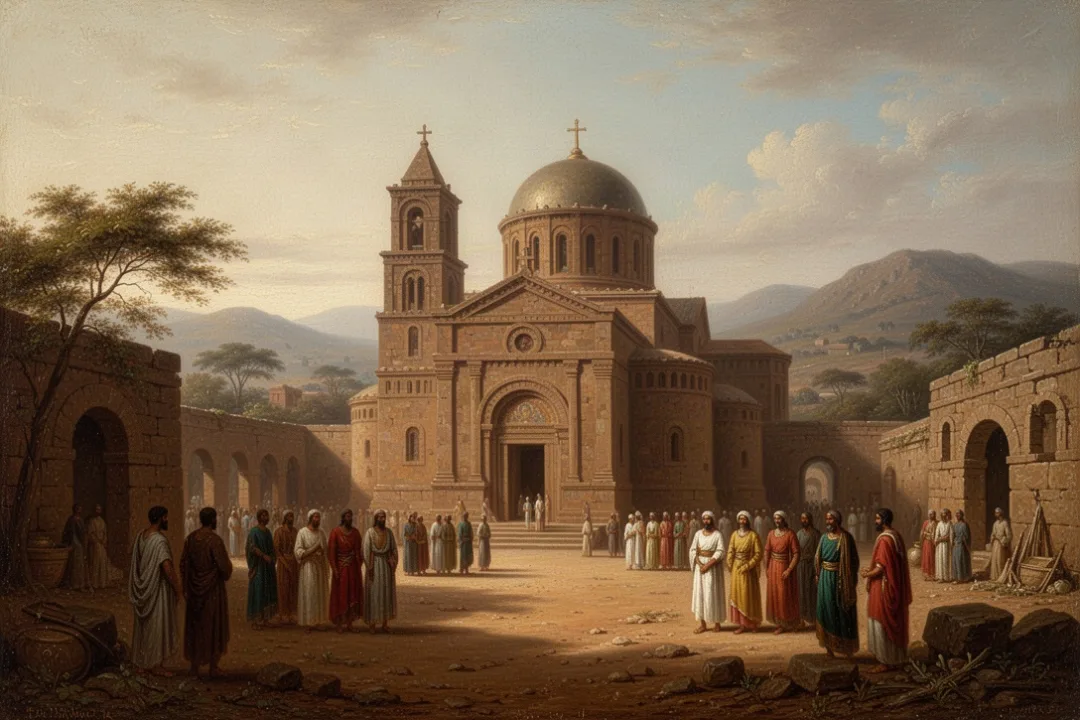
The most famous current claim says that the Ark is kept in Aksum, Ethiopia, at the Church of Our Lady Mary of Zion. Ethiopian Orthodox tradition identifies the object as the Tabot, a sacred replica or representation of the Ark found in Ethiopian churches. The church in Aksum is regarded as the home of the original Ark, which is said to be guarded by a specially appointed custodian.
According to the Ethiopian national tradition, the Ark arrived in Ethiopia through the story of Menelik I, traditionally described as the son of King Solomon and the Queen of Sheba. In versions of the story, Menelik traveled to Jerusalem and brought the Ark back to Ethiopia. This account is associated especially with the Kebra Nagast, a medieval Ethiopian text that presents a theological and royal history.
The claim has cultural and religious importance for Ethiopian Orthodox Christians, but outsiders cannot verify the artifact. The guardian is traditionally the only person permitted to see it, and the object is not available for ordinary scholarly inspection. Photographs that have circulated cannot establish its age, materials, or connection to ancient Jerusalem.
It is also necessary to distinguish the Ethiopian Tabot tradition from the claim that a particular physical chest is the original biblical Ark. Tabots are treated as sacred objects and are carried during religious celebrations, but their role does not by itself prove that the Aksum object is the ancient Ark described in Exodus and Kings.
The Temple Mount and hidden chambers in Jerusalem
Jerusalem is a logical place for many searches because the Ark was traditionally kept in the First Temple. Some Jewish traditions hold that the Ark was hidden before the Babylonian destruction, possibly in a chamber beneath the Temple Mount or in the area associated with the Temple’s inner sanctuary.
The Temple Mount is one of the most sensitive religious and political sites in the world. Its archaeology is difficult to conduct because the area contains major Islamic holy sites and is governed under complex arrangements. Excavations beneath the platform are not freely available, and claims based on tunnels, sealed rooms, or underground passages are often difficult to test.
Some researchers have pointed to passages under the Temple Mount, including areas linked with the Western Wall, as possible hiding places. Others have suggested that priests could have concealed the Ark in a chamber before the city fell. These proposals are plausible only at the level of possibility; no publicly verified chamber has produced an object that can be identified as the Ark.
There is also an important distinction between the Temple’s former location and the areas accessible today. The present Temple Mount platform has been altered repeatedly over many centuries. Even if a hidden object survived beneath the ancient complex, locating it would require reliable evidence about the original building, later construction, and the condition of underground spaces.
Mount Nebo and the Jeremiah tradition
Mount Nebo, in present-day Jordan, is connected with the tradition in 2 Maccabees that Jeremiah hid the Ark and other sacred objects. The location is attractive to some researchers because the text identifies the mountain rather than offering only a general reference to a secret hiding place.
However, the passage does not identify a precise cave, chamber, or route. The mountain contains numerous geological formations and historical sites, and a general statement that an object was hidden there would not be enough to guide a responsible excavation. The text itself presents the location as concealed and possibly withheld from human discovery.
Archaeological work in the region has revealed evidence from many periods, but no accepted discovery has connected a specific cave or artifact with the Ark. Searches based only on the Mount Nebo tradition must also account for the possibility that the account is theological rather than a literal record of the Ark’s final movements.
Shiloh, Kiriath-jearim, and other earlier locations
Some theories focus on places where the Ark was kept before Solomon’s Temple. Shiloh was an important sanctuary, and biblical accounts associate the Ark with it during the period of the judges. The site has produced archaeological evidence of ancient settlement and worship, but no object has been identified as the Ark.
Kiriath-jearim is another important location because 1 Samuel says the Ark remained there for many years after it returned from Philistine territory. Archaeological research at the site has examined a large platform and the history of the settlement, but no verified Ark has been found there either.
These locations can help explain the Ark’s earlier history, but they do not necessarily explain what happened after David brought it to Jerusalem. A search at an earlier sanctuary would need to show that the Ark was returned there or hidden there after the Temple period, and no strong ancient record makes that case.
What archaeology and historical sources actually show
Archaeology has confirmed that ancient Israel and Judah used sanctuaries, temples, religious objects, and portable sacred traditions. It has also found evidence for the destruction of Jerusalem by the Babylonians. However, archaeology has not produced a chest with a documented connection to the First Temple.
Descriptions of the Ark give researchers some characteristics to compare. Exodus presents it as a rectangular wooden chest overlaid with gold, fitted with rings and carrying poles, and topped with a decorated cover. Yet these details do not uniquely identify one object. Ancient sacred chests could share similar construction, and an artifact’s physical resemblance would not prove its identity.
Materials create another difficulty. Wood and precious-metal coverings may deteriorate, be stripped, melted down, or reused. If the Ark was destroyed or dismantled during the upheavals that affected Jerusalem, it may have left no recognizable remains. Even a surviving chest could have been modified over time, making its original identity hard to establish.
Ancient records are also incomplete. Royal administrations recorded valuable goods, but surviving texts represent only a small portion of what was written. A missing record cannot prove that the Ark disappeared, just as a later tradition cannot prove that it survived intact. Historians must compare the date, purpose, wording, and reliability of each source.
A careful investigation would normally ask several questions:
Is the object or site accessible to independent researchers?
Can its age be established through materials, construction, and archaeological context?
Does it have a continuous and credible history connecting it to ancient Jerusalem?
Are the supporting claims based on primary evidence rather than later speculation?
Have qualified scholars reached agreement after examining the evidence?
None of the leading Ark claims currently satisfies all of these requirements. That does not prove that the Ark never existed or that no physical remains survive. It means only that the available evidence cannot identify a present location with confidence.
How to evaluate modern claims about the Ark
Stories about the Ark often combine biblical passages, local traditions, private visions, satellite imagery, underground exploration, and sensational media reports. A claim can sound detailed while still lacking evidence. Specificity is not the same as verification.
Begin by asking whether the source distinguishes between faith, tradition, and historical evidence. A religious community may have a sincere and ancient belief about the Ark without offering the kind of access required for archaeological confirmation. Respecting the tradition does not require treating it as proven fact.
Next, check whether a proposed discovery has been examined by independent specialists. Genuine archaeological finds are usually documented through photographs, excavation records, material analysis, stratigraphy, and reports that other researchers can assess. Anonymous statements, restricted viewing, or claims that authorities are suppressing the truth provide no reliable substitute.
Be cautious with objects discovered in caves or old buildings. A chest may be ancient without being the Ark. To establish the identity of a religious artifact, researchers need more than an approximate date or a resemblance to a written description. They need a strong archaeological context and evidence that links the object to the correct place and historical period.
Online images can be especially misleading. A dark photograph of a covered object, a radar scan, or an architectural drawing may be presented as proof even though it does not reveal the object’s materials, age, or location. Image quality cannot solve the underlying problem of missing access and documentation.
Useful questions include:
Who made the claim? Identify the researcher, institution, religious authority, or media outlet.
What exactly was found? Separate a chamber, fragment, replica, inscription, and complete chest.
What tests were performed? Look for transparent methods rather than vague references to experts.
Can other qualified people inspect the evidence? Independent review is essential.
Does the conclusion go beyond the evidence? A possible location should not be presented as a confirmed one.
Popular culture has also shaped expectations. Films and television often portray the Ark as an immediately recognizable object with supernatural effects, but those images are fictional interpretations. They can make speculative discoveries seem more convincing than the historical evidence allows.
What can responsibly be said about the Ark today
The most responsible answer is that the Ark of the Covenant’s location is unknown. The Aksum tradition deserves recognition as a significant Ethiopian religious belief, but the artifact in Aksum has not been independently authenticated. Jerusalem, Mount Nebo, Shiloh, and Kiriath-jearim remain connected with different historical or biblical traditions, yet none has yielded conclusive evidence.
The question cannot be settled simply by naming the place most often repeated online. It requires separating the Ark’s biblical role from later stories about its disappearance, and separating ancient tradition from archaeological proof. Those distinctions allow the subject to be taken seriously without presenting speculation as fact.
For many readers, the Ark remains important even without a confirmed physical location. In the biblical tradition, it represents covenant, holiness, divine presence, and the relationship between worship and communal responsibility. Its historical fate is unresolved, but its religious meaning does not depend entirely on a modern discovery.
If credible evidence ever emerges, it would need to be made available for careful, independent study. A confirmed discovery would involve more than a dramatic announcement or a restricted glimpse of an object. It would require a documented excavation or provenance, scientific examination, historical analysis, and broad scholarly scrutiny.
Frequently asked questions
Is the Ark of the Covenant in Ethiopia?
Ethiopian Orthodox tradition says the Ark is kept in Aksum at the Church of Our Lady Mary of Zion. A guardian is traditionally responsible for it, and the object is not available for independent examination. For that reason, the Ethiopian claim is an important religious tradition but not a location confirmed by archaeology or historical scholarship.
Has anyone found the Ark beneath the Temple Mount?
No verified discovery has been reported beneath the Temple Mount. The site is associated with Solomon’s Temple, so it is a logical focus for theories about a hidden Ark, but access and excavation are highly restricted. Claims about underground chambers, tunnels, or sealed rooms have not produced publicly authenticated evidence of the biblical chest.
Does the Bible say where the Ark disappeared?
The Bible does not provide a clear account of the Ark’s fate after the Babylonian destruction of Jerusalem. Later Jewish literature, particularly 2 Maccabees, describes Jeremiah hiding it on Mount Nebo. That passage is an ancient religious tradition, but it does not establish a precise location or confirm that the Ark still survives.
Could the Ark have been destroyed?
Yes, destruction is one historically possible explanation. The Ark may have been taken, dismantled, burned, hidden, or lost during the wars and political upheavals surrounding Jerusalem’s fall. Because ancient records do not describe its fate clearly and no authenticated remains have been found, historians cannot determine whether it survived as an intact object.










Leave a Reply