The Mount of Olives is a ridge immediately east of Jerusalem’s Old City, across the Kidron Valley in Jerusalem.
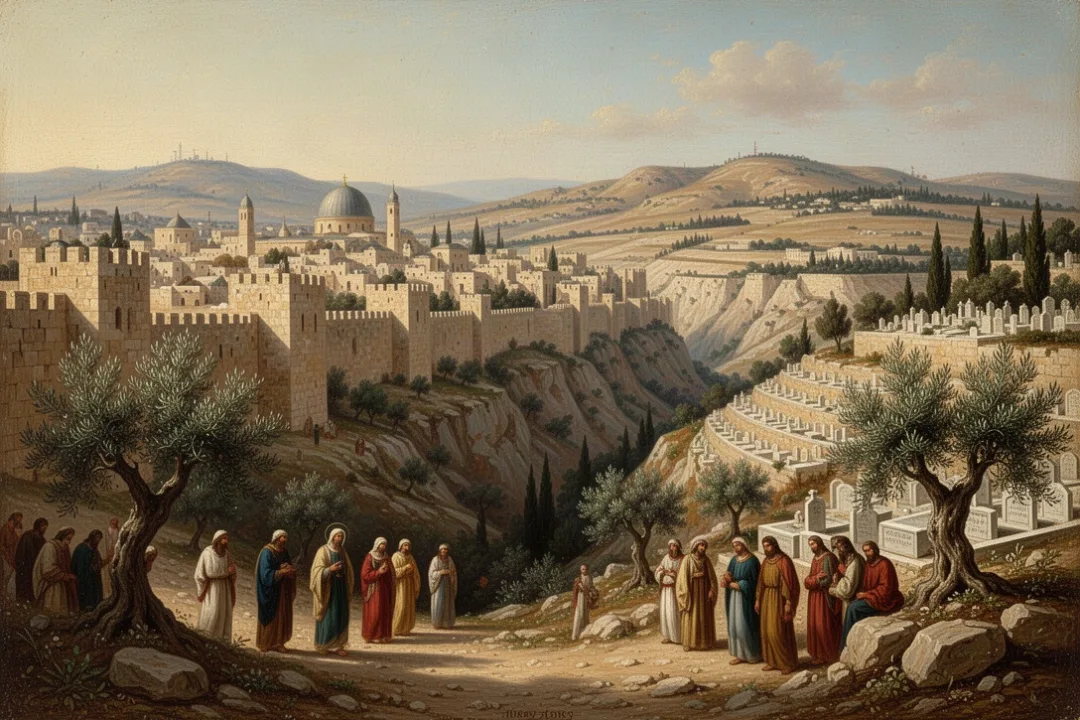
It is not a single sharp peak but a long, rounded ridge with several elevated points and slopes. The ridge extends generally from north to south along Jerusalem’s eastern side, forming one of the city’s most recognizable landscapes. From its upper slopes, you can look west toward the Old City, the Temple Mount, and the historic walls.
The name comes from the olive trees that once covered much of the hillside. Some olive trees still grow there, although modern neighborhoods, roads, churches, cemeteries, and archaeological sites now share the landscape. The mountain is also known by names connected with its biblical and religious history, including Mount Olivet.
Where the Mount of Olives sits in relation to Jerusalem
The Mount of Olives lies on Jerusalem’s eastern edge, directly opposite the Old City. The Kidron Valley runs between the ridge and the Old City’s eastern walls, creating a natural separation that is visible from several viewpoints.
To understand its location, picture Jerusalem’s historic center on a high ridge. The Old City occupies that central ridge, while the Mount of Olives rises on the other side of the valley. The two areas are close together, but the descent into the Kidron Valley and the climb up the opposite slope make the route more demanding than a map may suggest.
West: the Old City of Jerusalem, including the Temple Mount and its surrounding walls.
East: newer Jerusalem neighborhoods and the wider Judean landscape.
North: the ridge continues toward areas associated with Mount Scopus.
South: the slopes descend toward the Silwan area and the southern end of the Kidron Valley.
Below the western slopes: the Kidron Valley separates the mountain from the Old City.
The Mount of Olives is part of the broader mountain and ridge system east of Jerusalem. Mount Scopus lies to its north and is sometimes treated as a separate high point, although the ridges and urban areas connect closely. The exact boundaries can vary depending on whether someone is speaking geographically, historically, or in terms of a particular holy site.
The simplest location answer: The Mount of Olives is east of Jerusalem’s Old City, on the far side of the Kidron Valley. It is within Jerusalem and is not a separate city or a distant mountain range.
What the Mount of Olives looks like geographically
The Mount of Olives is a north-south ridge rather than a solitary summit. Its western face looks toward the Old City and is marked by steep slopes, religious buildings, roads, terraces, and extensive burial grounds. The eastern side opens toward the desert hills and the wider Judean terrain.
The ridge reaches an elevation higher than much of the Old City, which helps explain its commanding views. Exact elevation figures can differ according to which point on the broad ridge is being measured. The northern portion near Mount Scopus is among the highest areas, while the central and southern sections contain the sites most commonly identified with the Mount of Olives.
The landscape is shaped by the region’s dry Mediterranean climate. Winters can bring rain, while summers are generally hot and dry. The ground is often pale and rocky, with exposed limestone, stone walls, scattered trees, and cultivated or landscaped areas. Olive trees remain a visible part of the setting, but the ridge is much more developed than the name may suggest.
Several physical features help visitors recognize the mountain:
Broad views westward: the Old City walls and Temple Mount are prominent from many elevated points.
Steep western slopes: paths and roads descend toward the Kidron Valley.
Terraced ground: stone terraces and cemetery sections follow the contours of the hillside.
Religious landmarks: churches, chapels, monasteries, and cemeteries occupy different parts of the ridge.
Open eastern vistas: the view beyond Jerusalem leads toward the Judean wilderness and, on clear days, distant areas east of the city.
Because Jerusalem is built on hills, the Mount of Olives can appear close or far depending on where you stand. From the Old City, its slopes rise clearly beyond the Kidron Valley. From the mountain itself, the Old City can seem very near, but walking between the two involves uneven paths, steep sections, and busy roads.
Which important sites are on the Mount of Olives
The mountain contains a concentration of sites associated with Jewish, Christian, and Muslim history. They are spread across the ridge rather than gathered in one enclosed complex. Some are on the western slopes near the Kidron Valley, while others are farther uphill or toward the southern end.
Jewish cemetery and burial tradition
The western and southern slopes include the Mount of Olives Jewish Cemetery, one of the oldest and most significant Jewish cemeteries in the world. Burial on these slopes has continued across many centuries, though the cemetery has experienced periods of damage, disruption, and restricted access.
The cemetery’s location reflects longstanding Jewish beliefs about the importance of Jerusalem and the Mount of Olives. It also provides a physical explanation for why so much of the hillside appears covered with pale stone tombs. The burial grounds extend across uneven terrain, so they are not simply one flat cemetery that can be viewed from a single entrance.
Christian churches and chapels
Christian sites on or near the Mount of Olives commemorate events connected with the life of Jesus. The Church of All Nations and the Garden of Gethsemane are located at the foot of the western slope, near the Kidron Valley and the Old City. The church is associated with prayer and events described in the New Testament before the crucifixion.
Higher on the ridge are sites connected with the Ascension, including the Chapel of the Ascension. Christian traditions place the Ascension on or near the summit area, although different denominations and historical traditions identify particular locations in different ways. The exact site matters deeply to pilgrims, but the wider mountain is the central geographic setting.
Other Christian landmarks include the Church of the Pater Noster, associated with the Lord’s Prayer, and the Russian Orthodox Church of Mary Magdalene, recognizable by its distinctive golden domes. The Church of Dominus Flevit, located on a slope overlooking Jerusalem, is known for its view toward the Old City and its association with Jesus weeping over Jerusalem.
Muslim and shared sacred heritage
The Mount of Olives also has a place in Islamic tradition and Jerusalem’s broader Muslim heritage. Islamic buildings, cemeteries, and historical associations appear on the ridge and in the surrounding valleys. Because Jerusalem’s sacred geography is shared across religions, a visit to the mountain often involves overlapping traditions rather than a single religious narrative.
The buildings and sites do not all belong to one period. Some preserve ancient or medieval traditions, while others were built or restored in more recent centuries. Their architectural styles reflect the many communities that have maintained a presence in Jerusalem, including Eastern Christian, Western Christian, Jewish, and Muslim communities.
Landmark location can be confusing: Some places commonly described as being “on the Mount of Olives” sit at its lower western edge or in the nearby Kidron Valley. Ask for the specific site, not only the mountain’s name, when planning a visit.
Why the Mount of Olives is important in the Bible and religious history
The Mount of Olives is prominent in the Hebrew Bible and the New Testament. Its importance comes partly from its physical relationship to Jerusalem: the ridge overlooks the city, stands beyond the eastern walls, and provides a route toward the wilderness and villages east of the capital.
In the Hebrew Bible, the mountain appears in accounts connected with King David’s flight from Jerusalem and in the prophetic vision described in Zechariah 14. The Zechariah passage presents the Mount of Olives as a significant place in a future divine intervention, which has influenced Jewish and Christian interpretation of the site.
The New Testament associates the Mount of Olives with several episodes in the final period of Jesus’ life. The Gospels describe Jesus traveling between Jerusalem, Bethany, and nearby areas, often using routes that cross or pass the mountain. The ridge is linked with teachings, prayer, the entry into Jerusalem, and the events before the crucifixion.
The Acts of the Apostles places the Ascension in the vicinity of the Mount of Olives. Christian pilgrims therefore visit the mountain not only to see historic churches but also to connect a real landscape with the journeys and teachings described in scripture. References may identify nearby villages or slopes rather than a modern boundary line.
For Jewish tradition, the mountain’s importance is strongly connected with the hope of resurrection and the sacred status of Jerusalem. The cemetery’s location on the ridge reflects the belief that burial near Jerusalem and the Temple Mount carries special religious significance. For Christians, the mountain is a place associated with Jesus’ final days, prayer, and Ascension. Muslim tradition adds another layer to the history of the landscape.
These traditions help explain why the Mount of Olives has remained a pilgrimage destination for centuries. The significance is not limited to one building or viewpoint. It comes from the combination of scriptural references, burial customs, sacred architecture, and the mountain’s direct view of Jerusalem.
How to visit the Mount of Olives from the Old City
Most visitors reach the Mount of Olives from Jerusalem’s Old City or from surrounding East Jerusalem neighborhoods. The route depends on your destination, since the mountain stretches across a considerable area and its sites are not arranged in a simple line.
A common sightseeing plan begins near the Old City and travels to the upper western slopes by road. From there, visitors can walk downhill toward churches and viewpoints, although the descent includes uneven pavement and steep sections. Another approach begins near the lower sites by the Kidron Valley and climbs upward.
Walking is possible, but the terrain deserves careful planning. The distance between the Old City and a particular Mount of Olives landmark may look short on a map, yet the route can include:
Steep roads or stone paths with limited shade.
Uneven ground around cemeteries and archaeological areas.
Traffic on narrow or busy roads.
Closures or restricted access at individual religious sites.
Long uphill or downhill sections if several landmarks are visited in one outing.
Taxis and organized tours are commonly used for the upper viewpoints and the more widely separated landmarks. Public transportation options can change, so check current routes before traveling. A taxi may reduce the climb, but it will not eliminate walking inside cemeteries, church grounds, or archaeological sites.
Modest clothing is appropriate because many sites are active places of worship. Some churches require covered shoulders or knees, and rules may differ by denomination. Check opening hours and entrance policies before setting out, especially for sites that may close during services, religious holidays, or security restrictions.
Where the best views are found
The upper western slopes offer some of the clearest views of the Old City walls and Temple Mount. The exact view depends on trees, buildings, weather, and access to a particular terrace. From a high viewpoint, you can also see the Kidron Valley below and trace the steep relationship between Jerusalem’s two historic ridges.
Sunrise and sunset can produce striking light across the limestone buildings, but conditions and access matter more than timing alone. Summer heat can make exposed slopes uncomfortable, while winter rain may make stone paths slippery. Carry water, wear shoes with a secure sole, and allow more time than the map distance suggests.
What the Mount of Olives is not
The phrase can cause several location misunderstandings. The Mount of Olives is not the same as the Mount Zion, which lies southwest of the Old City. It is also not the Temple Mount, although the two are directly opposite each other across the Kidron Valley and are often visited together.
It is not located in the Galilee, near Nazareth, or beside the Sea of Galilee. Those regions contain other important biblical mountains and hills, but the Mount of Olives belongs to Jerusalem’s eastern landscape. It is also separate from the Mount of Olives viewpoint sometimes shown in travel materials that may actually be on a nearby ridge or a hotel terrace.
The mountain is not entirely outside the city. Modern Jerusalem has expanded around and across its slopes, and municipal or neighborhood boundaries may not match the ancient landscape. A traveler can move from urban streets to ancient cemeteries and religious compounds within a relatively short distance.
Its relationship to the Old City is the most useful way to remember the location:
Find Jerusalem on a map.
Locate the Old City in the historic center.
Look east across the Kidron Valley.
Identify the long ridge rising beyond the valley.
That ridge is the Mount of Olives, with Mount Scopus extending farther north.
The mountain’s location gives it both practical and historical importance. It is close enough to Jerusalem’s center for a walking visit, high enough to overlook the city, and broad enough to contain many separate religious and historical sites. When someone asks where the Mount of Olives is located, the clearest answer is therefore both geographic and relational: it is the ridge east of Jerusalem’s Old City, across the Kidron Valley.
Frequently asked questions
Is the Mount of Olives inside Jerusalem?
Yes. The Mount of Olives is part of Jerusalem’s eastern urban landscape, although it lies outside the Old City walls. Modern neighborhoods, roads, religious compounds, and cemeteries occupy portions of the ridge. The mountain’s historic setting remains distinct because the Kidron Valley separates its western slopes from the Old City.
How far is the Mount of Olives from Jerusalem’s Old City?
The mountain is very close to the Old City, but the practical distance depends on the site you want to visit. The Kidron Valley and steep slopes make some routes tiring on foot. A particular church, cemetery entrance, or viewpoint may require a road journey or a substantial climb even when it appears nearby on a map.
Can you see the Mount of Olives from the Old City?
Yes. The ridge is clearly visible from many parts of the Old City, especially from areas facing east. Its slopes, cemetery, churches, and distinctive skyline stand beyond the Kidron Valley. The view is particularly direct from the Temple Mount area and from sections of the eastern Old City walls, subject to access restrictions.
Why is the Mount of Olives important to Christians?
Christian tradition connects the mountain with several events involving Jesus, including prayer, teaching, his movements before the crucifixion, and the Ascension. Churches and chapels across the ridge commemorate these traditions. Its importance also comes from the mountain’s close relationship to Jerusalem, Bethany, the Kidron Valley, and the routes described in the New Testament.











Leave a Reply