When someone asks, “Who was the mother of Jesus?” the direct answer is Mary, a Jewish woman from Galilee who appears throughout the accounts of Jesus’ birth, ministry, death, and resurrection. Christians also call her the Virgin Mary or Mary, the mother of the Lord.
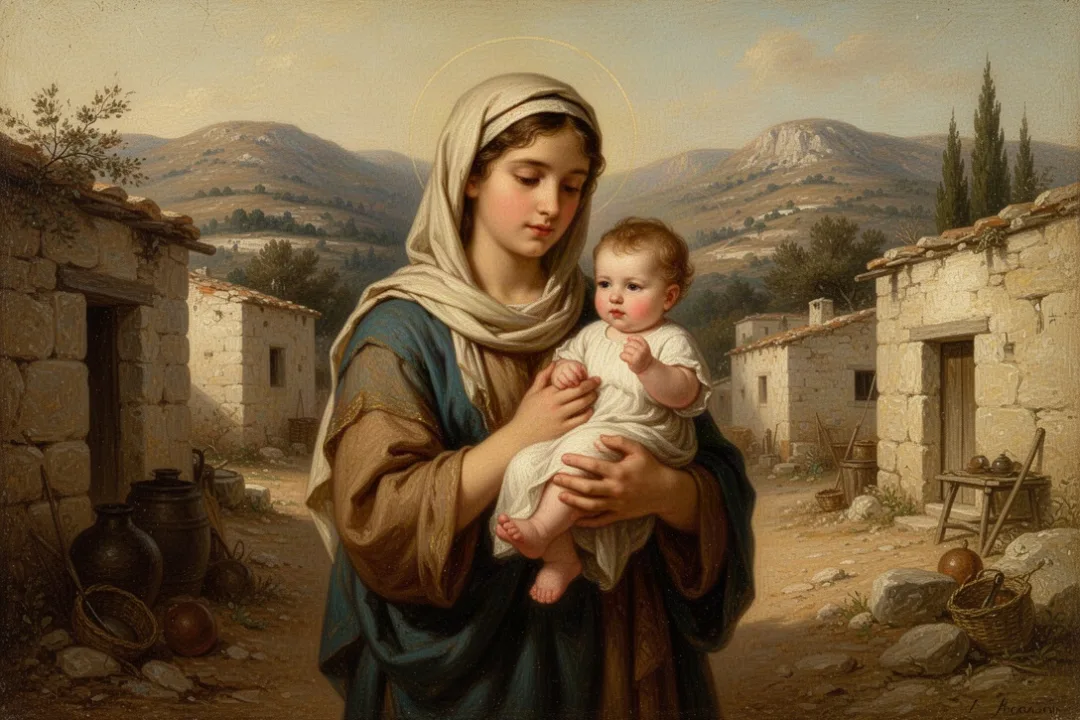
The Bible presents Mary as the woman chosen to give birth to Jesus through the work of the Holy Spirit. She was engaged to Joseph, lived in Nazareth, and became the mother of Jesus while still a virgin, according to the Gospel accounts. Her story is both personal and theological: it describes a young woman responding to an extraordinary calling and points Christians toward beliefs about Jesus’ identity.
What the Bible says about Mary, the mother of Jesus
Mary first appears by name in the opening chapters of Matthew and Luke. Luke gives the fuller account of the announcement of Jesus’ birth. The angel Gabriel tells Mary that she will conceive a son, and that the child will be called the Son of the Most High. The message identifies Jesus as the promised king in the line of David, not merely as an unusually gifted human child.
Mary is described as living in Nazareth, a town in Galilee, and as being engaged to Joseph. Luke 1:26–38 presents her as asking how the promised birth can happen since she has not been with a man. The angel explains that the Holy Spirit will bring about the conception. Mary then accepts the message with trust, although the passage does not suggest that she understands every future consequence.
Matthew 1:18–25 tells the story mainly from Joseph’s perspective. Joseph learns that Mary is pregnant before their marriage, and he initially plans to end the engagement quietly. In a dream, an angel tells him that the child has been conceived through the Holy Spirit and instructs him to take Mary as his wife. Joseph obeys, giving protection and legal family standing to Mary and the child.
Several details help place Mary’s story in its historical setting:
She was Jewish and lived under Roman rule in first-century Judea and Galilee.
She was engaged to Joseph, a descendant of David according to Matthew’s genealogy and Luke’s family records.
She gave birth to Jesus in Bethlehem, after traveling there with Joseph for a registration connected with the Roman government.
She raised Jesus in Nazareth, where he was known as a Galilean from that town.
She appears at several major moments, including Jesus’ birth, an early sign at Cana, his crucifixion, and the community of believers after his ascension.
The Gospel accounts also show Mary responding actively rather than serving as a silent background figure. In Luke 1, she visits her relative Elizabeth, who recognizes the significance of Mary’s pregnancy. Mary responds with a hymn of praise often called the Magnificat, celebrating God’s mercy, concern for the humble, and faithfulness to Israel’s promises.
Essential distinction: Christians believe Mary is the human mother of Jesus, while Jesus’ divine sonship comes from God. Joseph is presented as Jesus’ legal or earthly father, but not as the biological father of Jesus’ conception.
What “virgin birth” means in Mary’s story
The virgin birth refers to the Christian belief that Mary conceived Jesus without sexual relations, through the power of the Holy Spirit. Matthew and Luke both affirm this belief, although they tell the surrounding events differently. The claim is not that Mary gave birth without a pregnancy or without ordinary labor; it concerns how Jesus was conceived.
This belief is closely connected to Christian teaching about who Jesus is. In the Gospel narratives, Jesus is not introduced as only a prophet or moral teacher. His conception, names, and mission point to a unique relationship with God. Matthew connects the child with the name Immanuel, meaning that God is with his people, while Luke connects him with David’s royal line and divine sonship.
Mary’s question in Luke 1 and her response show both realism and faith. She recognizes that the announcement is extraordinary, yet she accepts her role. The text does not portray her as powerful in a political or military sense. Instead, her importance comes from her willing participation in what Christians understand as God’s work through the incarnation—the coming of the Son of God in human flesh.
The virgin birth should not be confused with the Immaculate Conception. The Immaculate Conception is a later Catholic teaching about Mary’s own conception: it holds that Mary was preserved from original sin from the beginning of her life. It does not mean that Jesus was conceived without a human father; that teaching is the virgin birth. Many Christians accept the virgin birth while not accepting the Immaculate Conception as doctrine.
The Bible does not give Mary’s age, the precise date of Jesus’ birth, or detailed information about her parents. Traditions outside the New Testament supply additional names and stories, but those details should be distinguished from what the canonical Gospels directly state. The strongest biblical evidence about Mary comes from Matthew, Luke, John, and Acts.
Mary’s role during Jesus’ childhood and public ministry
Luke records several scenes from Jesus’ early life that include Mary. After Jesus’ birth, Mary and Joseph present him at the temple in Jerusalem. There they meet Simeon and Anna, two elderly worshipers who recognize that the child has significance for Israel. Simeon blesses the family but also warns Mary that sorrow will deeply affect her because of what will happen to Jesus.
Luke 2:41–52 describes another important episode when Jesus is twelve years old. Mary and Joseph take him to Jerusalem for Passover, and Jesus remains in the temple after the family begins the journey home. Mary and Joseph search for him anxiously. When they find him, Jesus speaks about being in his Father’s house or engaged in his Father’s concerns, depending on the translation. Mary does not receive a complete explanation, but she keeps these events in mind.
That scene portrays Mary as a mother dealing with a child whose vocation is greater than ordinary family expectations. She worries about his safety, looks for him, questions him, and continues to live with truths she does not fully grasp. The account gives her a recognizable human role while also showing that Jesus’ mission has a divine priority.
Mary is mentioned directly in the story of the wedding at Cana in John 2:1–12. She tells Jesus that the wedding has run out of wine. Jesus responds in a way that signals his public “hour” has not yet arrived, but he then performs a sign by turning water into wine. John does not describe Mary as controlling Jesus or as possessing independent miraculous power. Her role is that of a perceptive mother who brings a need to him and tells the servants to follow his instructions.
Cana has received different interpretations across Christian traditions. Some readers see it as an example of Mary’s intercession, meaning that she presents human needs to Jesus. Others emphasize that Jesus remains the decisive actor and that the sign reveals his glory. Both readings recognize that the passage ultimately directs attention to Jesus’ authority, not away from it.
During Jesus’ public ministry, Mary appears less frequently than the disciples, the women who supported Jesus, or his opponents. Mark 3:31–35 and parallel passages describe Mary and Jesus’ brothers asking to speak with him while he is teaching. Jesus uses the moment to explain that those who do God’s will belong to his spiritual family. The statement is not necessarily a rejection of Mary; it broadens the meaning of family around faithful obedience.
Mary’s limited presence in the ministry narratives is itself useful context. The Gospels do not present her as the leader of Jesus’ movement, one of the Twelve, or the source of his teaching. They present her as his mother and as a believer whose life intersects with his mission at crucial points.
What Mary experienced at Jesus’ death and after the resurrection
John 19:25–27 places Mary near the cross during Jesus’ crucifixion. The scene is brief but emotionally intense. Jesus entrusts his mother to the beloved disciple, and the disciple takes her into his household. This suggests that Mary was present during the execution and that Jesus made provision for her care.
The other Gospel writers focus on groups of women who witnessed the crucifixion and later visited the tomb. They do not all name the women in the same way, so readers should avoid assuming that every reference to “Mary” identifies Jesus’ mother. The New Testament mentions several women named Mary, including Mary Magdalene, Mary the mother of Jesus, and other women connected with Jesus’ followers.
After Jesus’ ascension, Acts 1:14 specifically names Mary as being with the apostles and other believers in prayer. This is the last direct reference to her in the New Testament. It shows her as part of the early Christian community, waiting with other disciples for the promised Holy Spirit rather than standing apart from them.
The New Testament does not provide a detailed account of Mary’s later life, death, or burial. Stories about her final years developed in later Christian writings and traditions. Some traditions say she lived in Jerusalem; another longstanding tradition associates her later life with Ephesus. Neither location is stated clearly in the canonical New Testament, so these claims should be presented as tradition rather than settled biblical fact.
A careful reading helps: The Bible gives substantial information about Mary’s place in Jesus’ birth and family life, but it does not record every later tradition about her. Separating biblical testimony from later devotional history prevents confusion.
Why Christians call Mary the mother of God
Some Christians are surprised by the title Mother of God, also translated from the Greek term Theotokos as “God-bearer.” The title does not mean that Mary existed before God, created the divine nature, or is the source of Jesus’ divinity. It means that the person she bore was truly God the Son in human flesh.
The title developed as Christians clarified how Jesus can be both fully divine and fully human. If Jesus is one person, not two separate persons, then Mary can properly be called the mother of the person she gave birth to—even though she is not the origin of his divine nature. The title therefore says more about Christian beliefs concerning Jesus than about Mary’s power.
The Council of Ephesus in the fifth century is associated with the formal defense of Theotokos against teachings that separated Jesus’ humanity and divinity too sharply. Catholic and Eastern Orthodox Christians continue to use the title extensively. Many Protestants prefer “mother of Jesus” because they want to avoid language that might seem to assign Mary a divine status, although some Protestant theologians also accept the logic behind Theotokos.
Different Christian traditions give Mary different levels of honor:
Roman Catholic Christians honor Mary as the mother of Jesus, emphasize her unique role in salvation history, and teach doctrines including her perpetual virginity, Immaculate Conception, and Assumption.
Eastern Orthodox Christians venerate Mary as Theotokos and celebrate her within the liturgical life of the church, while using theological language and devotional practices distinct from Roman Catholicism.
Many Protestant Christians respect Mary as a faithful servant of God and an example of trust, while generally rejecting prayers directed to her and doctrines not considered explicit in Scripture.
Other Christian communities may share belief in the virgin birth but place little emphasis on Marian devotion beyond the biblical accounts.
Honor and worship are distinguished differently across these traditions. Catholic and Orthodox Christians say that Mary receives honor or veneration, while worship belongs to God alone. Many Protestants remain cautious about the practical difference, especially when Marian prayers or images appear central to devotion. The disagreement is therefore not only about Mary’s biography but also about authority, prayer, tradition, and how Christian teaching should be formed.
What Mary can teach readers about faith and discipleship
Mary’s significance does not depend on turning her into either a flawless, superhuman figure or an insignificant background character. The Gospel accounts show a woman who receives a difficult calling, asks a serious question, accepts risk, raises a child with an extraordinary mission, and remains near him in suffering.
Her response in Luke 1 is often remembered because it combines humility and courage. Mary calls herself the servant of the Lord and accepts what has been announced. That acceptance could expose her to misunderstanding, social shame, and uncertainty about Joseph’s response. The story therefore presents faith as trust under pressure, not as having every answer in advance.
Mary also demonstrates the value of remembering and reflecting. Luke repeatedly describes her as keeping events in her heart or pondering them. She does not treat every experience as immediately clear. Her example allows room for questions, gradual understanding, and faithful endurance.
Her hymn in Luke 1 emphasizes God’s concern for the lowly and hungry, along with the fulfillment of promises made to Israel. Mary’s praise is not merely private emotion. It connects her pregnancy with God’s justice, mercy, covenant faithfulness, and care for people without status. Readers who study Mary closely should therefore pay attention to her words about society and power, not only to later devotional titles.
Her presence at the cross adds another dimension. Mary cannot prevent Jesus’ death or explain it away. She remains near him while his mission appears to end in disgrace. In that sense, she represents the cost of discipleship: love can require faithful presence when circumstances are painful and answers are incomplete.
For practical study, readers can examine Mary’s story through these questions:
What does the passage actually say about Mary? Separate direct biblical details from assumptions and later traditions.
How does Mary respond to God’s call? Notice her questions, praise, obedience, and perseverance.
What does the passage reveal about Jesus? Mary’s role consistently points toward his identity and mission.
How does the surrounding culture matter? Consider marriage, family honor, Jewish worship, Roman rule, and the vulnerability of women in the ancient world.
Which teaching belongs to a specific tradition? Identify whether an idea comes from the Bible, Catholic doctrine, Orthodox tradition, or another Christian interpretation.
Mary is therefore more than a label attached to the Christmas story. She is a central witness to Jesus’ human birth, a mother who appears at moments of joy and grief, and a believer remembered in the earliest Christian community. Christians disagree about several doctrines concerning her, but all of the major traditions recognize that her role is inseparable from the question of who Jesus is.
Frequently asked questions
Was Mary the biological mother of Jesus?
Mary was Jesus’ human mother, and the Gospels say she conceived him while still a virgin through the Holy Spirit. Joseph was engaged to Mary and acted as Jesus’ legal or family father, but the biblical accounts do not present him as the biological father of Jesus’ conception. Christian belief holds that Jesus’ divine sonship comes from God.
Did Mary have other children after Jesus?
The New Testament mentions Jesus’ “brothers” and refers to sisters, but Christian traditions interpret these references differently. Some understand them as younger biological children of Mary and Joseph. Catholic and Orthodox traditions commonly interpret them as relatives or, in some accounts, Joseph’s children from an earlier marriage. The biblical text does not settle the question in a way all Christians accept.
Why do Catholics pray to Mary?
Catholics say they do not worship Mary; they ask her to pray for them, much as someone might ask another Christian for prayer. This practice is based on Mary’s unique relationship to Jesus and traditions about her intercession. Many Protestants do not pray to Mary because they believe prayer should be directed to God through Jesus alone.
What happened to Mary after Jesus’ death?
Acts 1:14 places Mary among Jesus’ followers who were praying after his ascension. The New Testament does not give a detailed account of her later years, death, or burial. Catholic and Orthodox traditions preserve teachings about her final life and bodily destiny, but those claims should be distinguished from the limited information recorded in the Bible.





Leave a Reply