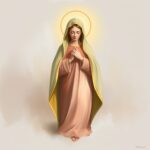
The Immaculate Conception is a foundational Marian doctrine for Catholics because it reveals who Mary is and why she is uniquely prepared to bear the Son of God. It proclaims that from the moment of her conception, Mary was preserved free from original sin by a singular grace of God, in anticipation of Christ’s merits. This truth shapes Catholic devotion, liturgical life, and theological reflection, guiding how we honor Mary as the Mother of Jesus and our Mother. The teaching rests on Sacred Scripture, Sacred Tradition, and the authoritative Magisterium of the Church. The Latin Church’s Marian titles, prayers, and feasts—all reflect this conviction. While it is not a scriptural verse or a book, the Immaculate Conception is reconciled with the NABRE Bible and the deposit of faith as interpreted by the councils and popes. This article explores its biblical foundations, historical development, and apologetic responses to common objections.
What is The Immaculate Conception?
Historically, belief in Mary’s sinlessness has deep roots in the Church’s prayer and teaching. The phrase “Immaculate Conception” describes Mary’s unique grace, not a scriptural book. It is not part of the Protestant Bible, but it is a defined Marian dogma in the Catholic canon of faith. In 1854, Pope Pius IX defined the doctrine in Ineffabilis Deus, teaching that Mary, by a singular grace from God, was preserved from all stain of original sin from the moment of her conception. This truth is supported by Sacred Scripture (especially the cues found in Luke 1) and by Sacred Tradition, as interpreted by the Magisterium. The Catechism of the Catholic Church (CCC 490‑492) and the teachings of Vatican II (Lumen Gentium) show Mary’s exceptional holiness as the mother of Christ and our mother. The doctrine harmonizes with the wider Deposit of Faith and is not meant to diminish Christ’s unique work, but to honor Mary’s role in salvation history.
Most Important Verses from The Immaculate Conception
Luke 1:28 — The angel greets Mary with special grace and favor, signaling God’s intimate plan for her. Catholic commentators see this as a marker of Mary’s unique vocation and sanctity (NABRE).
Luke 1:42 — Elizabeth proclaims Mary blessed among women and blessed is the fruit of her womb, highlighting Mary’s exceptional status in salvation history.
Luke 1:38 — Mary’s fiat: “Behold, I am the handmaid of the Lord; let it be to me according to your word.” This readiness to cooperate with God’s plan is central to her sinless openness to grace.
Luke 1:46-47 — The Magnificat: Mary rejoices in God her Savior, acknowledging God’s mercy and her own need for grace, which Catholic theologians see as consistent with her being preserved from sin.
Luke 1:49 — The Mighty One has done great things for Mary, highlighting the extraordinary grace she has received in anticipation of Christ’s work.
Genesis 3:15 — Protoevangelium: God’s promise of enmity between the serpent and the woman is read by Catholic theologians as pointing to Mary’s unique role and grace in the plan of salvation.
Luke 2:19 — Mary treasured and pondered these things in her heart, revealing a profound interior life shaped by grace and formation for obedience.
Luke 2:34-35 — Simeon’s prophecy about Mary’s future sorrow and mission foregrounds Mary’s intimate participation in the mystery of salvation, which the Church connects to her sinless reception of grace.
Revelation 12:1 — The vision of a woman clothed with the sun is interpreted by many in Catholic tradition as a symbolic reference to Mary, underscoring her exalted role in cosmic salvation history.
Luke 1:34-35 — Mary’s question to the angel about the birth of the divine Son occurs within a context where grace enables the decisive act of conception to occur in accordance with God’s plan.
Note: These verses are read in light of Sacred Tradition and Magisterial teaching. The Immaculate Conception is not a direct scriptural quotation, but a doctrine drawn from the whole of Scripture, along with Tradition and the teaching authority of the Church.
What the Catholic Church Teaches
The Immaculate Conception is a defined Marian dogma of the Catholic Church. Key teachings include:
The dogma was solemnly defined by Pope Pius IX in Ineffabilis Deus (1854), declaring that Mary was preserved free from original sin from the moment of her conception by a singular grace of God in view of Christ’s merits.
The Catechism of the Catholic Church (CCC 490‑492) teaches that Mary is “full of grace” and was prepared from the outset to be the Mother of God, conceived without sin in order to fulfill her role in salvation history.
Canonically, the doctrine does not rest on a single biblical verse but on the Church’s Tradition guided by the Magisterium. The Council of Trent’s teaching on Mary’s perpetual virginity and the Mariology of Vatican II (Lumen Gentium, especially chapters on Mary) provide context for Mary’s unique holiness, while still maintaining Christ as the center of salvation.
Apologetics: When confronted with objections, emphasize that the deposit of faith comprises Scripture, Tradition, and the Magisterium. The lack of a single explicit biblical verse does not negate the truth; the Church reads Scripture through the lens of Tradition and the teaching office that guards the apostolic testimony about Mary’s role and grace.
This Book/Topic in Church History
Several key milestones and figures illuminate the development of this doctrine in the life of the Church:
Medieval scholastic theology, especially the contributions of Duns Scotus (13th–14th c.), who defended the Immaculate Conception as a consistent truth of grace given to Mary in anticipation of Christ’s merits. His defense helped pave the way for later formal definitions.
The Great Marian Devotion and the dogmatic development continued through the centuries, with saints and theologians fostering the belief that Mary’s sanctity was exceptional and integral to Christ’s mission.
1844–1854 culminated in the formal definition by Pope Pius IX in Ineffabilis Deus (1854). This defined dogma clarified the Church’s witness about Mary’s sinless conception.
Vatican II (1962–1965) reaffirmed Marian teaching within a renewed ecclesial vision (Lumen Gentium), emphasizing Mary’s role as Mother of the Church and model of faith and obedience to the Father’s plan.
The Feast of the Immaculate Conception (December 8) remains a universal sign of Mary’s unique grace in the life of the Church.
Later Marian encyclicals, such as Pius XII’s Fulgens Corona (1953), contributed to the broader cultivation of Marian doctrine and devotion as a living witness of faith.
What is the Immaculate Conception, exactly? Answer: It is the Catholic teaching that Mary was preserved from original sin from the moment of her conception, by a singular grace of God, in view of Christ’s merits.
Is Mary sinless from conception? Answer: Yes, according to the Catholic understanding of this dogma; this sinless state was granted to Mary by grace from God in anticipation of Jesus’ redemptive work.
Does the Bible say Mary was immaculate? Answer: The Bible does not use the phrase “Immaculate Conception,” but Catholics read Scripture (Luke 1:28; 1:42; 1:46–47; 1:49; Genesis 3:15; Revelation 12:1) in light of Tradition and Magisterial teaching to affirm Mary’s unique grace.
Why was this dogma defined in 1854? Answer: The Church, guided by the Holy Spirit, sought to articulate what had long been believed and venerated in the life of the Church, clarifying Mary’s role in salvation history as the Mother of God and the Graced One.
How does this relate to Jesus and salvation? Answer: Mary’s sinless conception prepares her to be a worthy Mother of the Incarnate Word, enabling the hypostatic union of divine and human natures in Christ without stain or resistance to grace.
Closing Prayer
O Mary, conceived without sin, pray for us who have recourse to thee. Amen.
Final verse (NABRE): My soul magnifies the Lord, and my spirit rejoices in God my savior; for he has looked with favor on his lowly servant. Behold, henceforth all generations will call me blessed.

 Por Fernando Ortiz