Scriptures about Mary Magdalene and her place in the Bible
Scriptures about Mary Magdalene and her place in the Bible
When you search for Scriptures about Mary Magdalene, you may wonder whether the Bible says more about her than the familiar resurrection story. It does. The New Testament presents Mary Magdalene as a woman healed by Jesus, a committed supporter of his ministry, a witness to his crucifixion and burial, and the first person to see the risen Christ in John’s Gospel.
Her story appears mainly in the four Gospel accounts. Read together, these passages show a consistent pattern: Mary stayed near Jesus when many others had left, carefully observed where he was buried, returned to the tomb, and reported what she had seen. Scripture does not identify her with the unnamed sinful woman in Luke 7 or with Mary of Bethany.
Luke 8:1-3 describes Mary Magdalene as a healed disciple
The first direct reference to Mary Magdalene appears in Luke 8:1-3. Jesus is traveling through towns and villages, proclaiming the good news of God’s kingdom. The Twelve are with him, along with several women who had been healed and who supported the group’s ministry.
Luke names Mary called Magdalene, Joanna, Susanna, and other women. He says that seven demons had gone out from Mary. The passage does not explain the nature of her suffering, and it does not describe her as a prostitute. It simply records a profound deliverance and places her among Jesus’ active followers.
The phrase “Mary Magdalene” most likely connects her with Magdala, a town or region near the Sea of Galilee. The name distinguishes her from other women named Mary in the Gospel accounts, including Mary the mother of Jesus and Mary of Bethany.
Luke also says that these women were contributing to Jesus and the disciples from their own resources. That detail gives Mary a significant role. She was not merely present in the background; she was part of a group that used its possessions to help sustain Jesus’ public ministry.
What Luke establishes: Mary Magdalene was personally healed by Jesus, became his disciple, traveled with his ministry, and helped provide practical support for the work.
What the reference to seven demons means
Readers sometimes try to use the number seven to reconstruct details that Scripture does not provide. The text does not say that Mary had a particular disease, lived an immoral life, or committed a specific sin. It says that seven demons had gone out from her, emphasizing the seriousness of her bondage and the completeness of her release.
In the Gospels, descriptions of demonic oppression are not presented as simple labels for ordinary moral failure. They belong to the biblical account of spiritual affliction and Jesus’ authority over it. Mary’s story therefore begins with mercy and restoration, not with a reputation for sexual sin.
Luke’s wording also places Mary alongside other women who had received healing from Jesus. Their gratitude led to service and loyalty. The passage shows that receiving help from Christ did not make these women secondary participants; it became part of the reason they followed him and supported his mission.
The crucifixion passages show Mary Magdalene’s faithful presence
Several Gospel passages place Mary Magdalene near Jesus during the final events of his earthly life. Matthew 27:55-56 names her among the women watching from a distance at the crucifixion. Mark gives a similar account in Mark 15:40-41, identifying Mary Magdalene, Mary the mother of James and Joses, and Salome.
Mark adds that these women had followed Jesus and cared for his needs in Galilee, and that many other women had traveled with him to Jerusalem. This connects the women at the cross with the discipleship described earlier in Jesus’ ministry. Mary did not appear suddenly at the end; she had been a continuing follower.
Matthew, Mark, and Luke each mention women connected with the crucifixion and burial. Their accounts vary in which individuals they name and how closely they describe the scene, but they agree that female disciples witnessed Jesus’ death and remained connected to the events that followed.
Mary’s presence matters because the crucifixion was a moment of public shame, danger, and grief. The Gospel writers do not portray her as leaving when Jesus’ situation became difficult. Her loyalty continued when his mission appeared to end in defeat.
Mary Magdalene and the burial of Jesus
After Jesus’ death, Joseph of Arimathea placed his body in a tomb. Matthew 27:61 says that Mary Magdalene and the other Mary were sitting opposite the tomb. Mark 15:47 identifies Mary Magdalene and Mary the mother of Joses as observers of where Jesus was laid. Luke 23:55 likewise says that the women who had come with Jesus from Galilee saw the tomb and how his body was placed.
These verses prepare the reader for the resurrection accounts. The women knew which tomb contained Jesus’ body. Their later discovery that the tomb was empty was not based on visiting an unknown location. They had seen the burial place before leaving.
Luke 23:56 says the women returned and prepared spices and perfumes, then rested on the Sabbath in obedience to the commandment. The detail reveals both their grief and their care. They intended to honor Jesus’ body according to the burial customs of the time, even though they had not yet understood the resurrection.
Mary’s role at the burial also demonstrates patient faithfulness. She could not prevent Jesus’ death or change the circumstances, but she remained attentive to what had happened. Her witness became essential when the disciples later heard that the tomb was empty.
The resurrection accounts identify Mary Magdalene as a first witness
All four Gospels connect Mary Magdalene with the empty tomb. The details differ in emphasis, but each account places her among the women who went to Jesus’ burial place after the Sabbath. These passages are found in Matthew 28:1-10, Mark 16:1-11, Luke 24:1-12, and John 20:1-18.
According to Matthew 28, Mary Magdalene and the other Mary visit the tomb. They encounter an angel who announces that Jesus has risen and instructs them to tell the disciples. As they leave, Jesus meets them. They take hold of his feet and worship him, and he tells them not to be afraid and to tell his brothers to go to Galilee.
Matthew’s account presents Mary as both a recipient of the resurrection announcement and a direct encounter with the risen Jesus. Her response combines reverence, fear, joy, and obedience. The women do not keep the news to themselves; they carry Jesus’ message to the disciples.
Mary Magdalene in Mark 16:1-11
Mark 16:1-8 describes Mary Magdalene, Mary the mother of James, and Salome bringing spices to the tomb. They find that the stone has been rolled away and hear a young man announce that Jesus has risen. The women leave trembling and astonished, initially saying nothing to anyone because they are afraid.
Many Bibles identify Mark 16:9-20 as the longer ending of Mark and include a note that the earliest manuscripts do not contain those verses. In that ending, Jesus first appears to Mary Magdalene, who then tells the grieving disciples. The disciples do not believe her report at first.
That textual note does not erase the other Gospel testimony. Matthew, Luke, and John independently connect Mary with the empty tomb, and Matthew and John describe encounters involving the risen Jesus. When studying Mark, it is best to distinguish the shorter ending at Mark 16:1-8 from the longer ending at Mark 16:9-20.
Mary Magdalene in Luke 24:1-12
Luke 24 names Mary Magdalene first among the women who come to the tomb with spices. They find the stone moved, but Jesus’ body is gone. Two men in dazzling clothing remind them that Jesus had told them he would be crucified and raised on the third day.
The women return and report these things to the apostles. Luke names Mary Magdalene, Joanna, Mary the mother of James, and other women with them. The apostles regard the report as an idle tale and do not believe it, although Peter runs to the tomb and sees the linen cloths.
Luke highlights a contrast between the women’s testimony and the disciples’ initial disbelief. Mary and the other women faithfully repeat what they have experienced, even though their message is not immediately accepted. The passage does not present faith as instant emotional certainty; it shows the disciples gradually confronting the evidence of the resurrection.
John 20:1-18 records Mary Magdalene meeting the risen Jesus
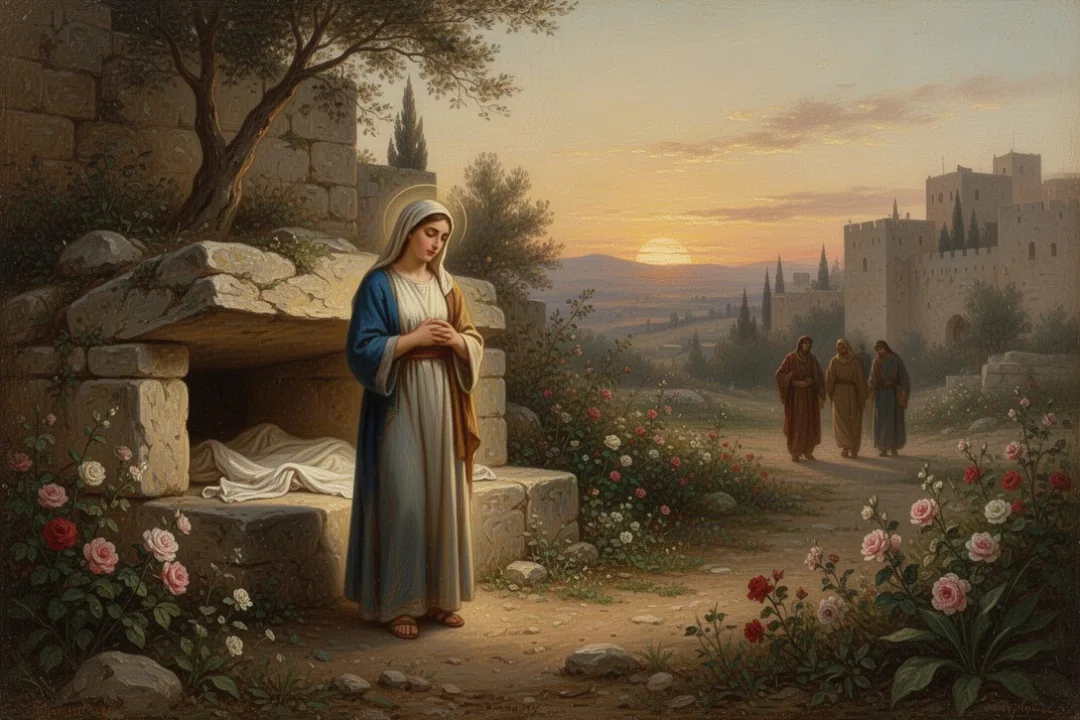
John gives the most detailed account of Mary Magdalene’s personal encounter with Jesus. John 20:1 says that she comes to the tomb early on the first day of the week, while it is still dark, and sees that the stone has been removed.
Mary runs to Simon Peter and the disciple Jesus loved. Her initial report is that someone has taken the Lord from the tomb, and she does not know where his body has been placed. Peter and the other disciple inspect the tomb and see the linen wrappings, but they return home.
Mary remains outside the tomb weeping. She bends down and sees two angels seated where Jesus’ body had been. When they ask why she is crying, she repeats that someone has taken away her Lord and that she does not know where he is.
She then turns and sees Jesus, though she does not recognize him immediately. He asks why she is crying and whom she is seeking. She supposes he may be the gardener and asks whether he has carried the body away.
Jesus says her name, and Mary recognizes him. John records her calling him “Teacher,” but the wording of the verse varies by translation; the central point is that Jesus identifies himself to Mary personally. He then instructs her to go to his brothers and tell them that he is ascending to his Father and their Father, his God and their God.
Mary goes to the disciples and announces that she has seen the Lord. John’s account gives her a distinctive place as the first named witness to the risen Jesus in the Gospel. She is not portrayed as discovering the resurrection through abstract reasoning. She hears Jesus call her by name, recognizes him, receives a message, and delivers it.
A central theme in John 20: Mary moves from grief and confusion to recognition and testimony when the risen Jesus calls her by name.
What “do not hold on to me” means in John 20:17
John 20:17 is sometimes misunderstood because translations render Jesus’ words in slightly different ways. The verse does not mean that Mary was forbidden from touching Jesus in every sense; Matthew 28:9 describes the women taking hold of his feet. Jesus’ instruction in John directs Mary toward a new assignment: she must go and tell the disciples about his resurrection and ascension.
The passage marks a change in how Jesus’ followers will relate to him. His physical presence will not continue in the same way as before. Mary’s task is not to remain at the tomb holding on to the moment, but to carry his message to the community of disciples.
Scripture does not identify Mary Magdalene with other women
Church tradition has sometimes blended several women in the Gospel narratives, but the biblical text gives separate identities. Mary Magdalene is not called the sinful woman of Luke 7:36-50. Luke does not name that woman, and the passage does not say she was Mary Magdalene.
Mary Magdalene is also distinct from Mary of Bethany, the sister of Martha and Lazarus. Mary of Bethany appears in Luke 10:38-42, John 11, and John 12:1-8. John says that Mary of Bethany anointed Jesus’ feet, while the Gospel passages about Mary Magdalene identify her through her connection with Magdala and her role in the crucifixion and resurrection narratives.
The four Gospels also mention other women named Mary. Matthew 27:56 refers to Mary the mother of James and Joses, while Mark 15:40 calls her Mary the mother of James the younger and Joses. John 19:25 names several women near the cross, including Mary the wife of Clopas and Jesus’ mother. These names can be difficult to compare across accounts, so it is wise not to merge people simply because they share a first name.
Keeping these women distinct protects the meaning of Mary Magdalene’s own story. Her biblical identity does not depend on a later accusation of sexual immorality. Scripture presents her as healed, devoted, observant, courageous, and entrusted with resurrection news.
What the Scriptures about Mary Magdalene teach readers today
Mary Magdalene’s passages offer several connected lessons, beginning with the way Jesus’ ministry restores people. Luke introduces her as someone from whom seven demons had gone out. Her past suffering is acknowledged, but it does not define her future. She becomes a disciple whose life is directed toward Jesus and his work.
Healing can lead to faithful service: Mary’s deliverance is followed by practical support for Jesus’ ministry.
Discipleship includes endurance: She remains connected to Jesus through his crucifixion, burial, and apparent defeat.
Careful observation matters: She sees where Jesus is buried and later returns to that same tomb.
God entrusts important news to unexpected witnesses: Mary is sent to tell the disciples that Jesus is alive.
Recognition can grow out of grief: In John 20, Jesus meets Mary in her sorrow and calls her personally.
Her story also challenges assumptions about who can serve as a trustworthy witness. In the Gospel narratives, Mary’s testimony is initially met with disbelief by the disciples, yet the evangelists preserve her name and her message. Her role is not ornamental. She is a messenger of the resurrection.
Mary’s example is especially clear in the sequence of events recorded by the Gospels:
Jesus delivers her from severe spiritual affliction.
She follows him and supports his ministry with other women.
She stays near the cross when Jesus is executed.
She watches where his body is placed.
She returns to the tomb after the Sabbath.
She reports the empty tomb and, in John, her encounter with the risen Lord.
These passages do not portray Mary as flawless or as understanding everything immediately. In John, she first assumes that Jesus’ body has been moved. In Luke and Mark, the women’s announcement is not believed at once. Scripture allows room for confusion, grief, fear, and growing understanding within a faithful response.
For personal study, read Luke 8:1-3 first, then follow Mary through the passion and resurrection passages: Matthew 27:55-61 and 28:1-10; Mark 15:40-47 and 16:1-11; Luke 23:49-56 and 24:1-12; and John 19:25 and 20:1-18. Reading the references together makes her continuity visible.
The clearest biblical picture is neither a romanticized legend nor a reduced caricature. Mary Magdalene is a woman whom Jesus healed, a disciple who gave her resources and loyalty, a witness who stayed near the cross and tomb, and the person Jesus commissioned to announce that he had risen. Those are the central Scriptures about Mary Magdalene, and they give her a lasting place in the Gospel story.
Frequently asked questions
Was Mary Magdalene a prostitute according to the Bible?
No. The Bible never calls Mary Magdalene a prostitute. Luke 8:1-3 says that Jesus cast seven demons out of her and that she supported his ministry. Her identification with the unnamed sinful woman in Luke 7 developed through later tradition, but the Gospel text does not make that connection.
How many times does Mary Magdalene appear in the Bible?
Mary Magdalene appears by name in several passages across all four Gospels, especially Luke 8, the crucifixion and burial accounts, and the resurrection narratives. The exact count can vary depending on whether parallel references and the longer ending of Mark are counted separately.
Was Mary Magdalene the first person to see Jesus after the resurrection?
The Gospel accounts emphasize Mary Magdalene as an early resurrection witness. John 20:1-18 records Jesus appearing to her personally, and Matthew 28:1-10 also describes Jesus meeting her and the other Mary. Paul’s summary in 1 Corinthians 15 lists appearances in a different sequence and does not name her.
Why is Mary Magdalene called Magdalene?
“Magdalene” distinguishes her from other women named Mary and likely identifies her connection with Magdala, a place near the Sea of Galilee. The name is not a title describing her character or occupation. It functions much like a geographical identifier in the Gospel narratives.










Leave a Reply