The Nicene Fathers were early Christian bishops and theologians associated with the Council of Nicaea and the defense of Nicene faith. Most directly, the term refers to church leaders who helped define Christian teaching about Jesus Christ at Nicaea in 325, though it is also used for a much broader collection of early Christian writings.
The most prominent figures include Athanasius of Alexandria, Alexander of Alexandria, Hosius of Cordoba, Eusebius of Caesarea, and other bishops who addressed the controversy surrounding Arius. Their work helped shape the Nicene Creed and influenced Christian theology, worship, and biblical interpretation for centuries.
“Nicene Fathers” does not have one universally fixed meaning. In church history, it can describe the bishops and theologians connected with the First Council of Nicaea. In publishing, it often points to the well-known English collection titled Nicene and Post-Nicene Fathers, which contains translations of many early Christian works.
The narrower historical meaning focuses on the leaders who supported the council’s teaching about Christ. The broader meaning includes influential writers who lived before or after Nicaea and whose works explain the development of Christian doctrine. A reader should therefore consider the context whenever the phrase appears.
Many of these writers are also called Church Fathers. That title is a traditional designation for respected early Christian teachers, not an official list with universally agreed membership. Writers are commonly associated with the Fathers because of their antiquity, doctrinal influence, holiness of life, and importance to Christian teaching.
The word “Nicene” points to the council and the confession of faith it produced. It does not mean that every writer in a collection called Nicene and Post-Nicene Fathers attended Nicaea or agreed on every theological question. Some lived long before the council, while others wrote generations afterward.
Useful distinction: The Nicene Fathers in the historical sense were connected with Nicaea; the Nicene and Post-Nicene Fathers volumes are a later English anthology containing works by many early Christian authors.
Why the Council of Nicaea gathered in 325
The Council of Nicaea met during a serious dispute about the identity of Jesus Christ. Arius, a presbyter in Alexandria, taught that the Son of God was not eternal in the same way as the Father and had been brought into existence by the Father. His opponents argued that this teaching reduced Christ’s divine status and could not account adequately for Christian worship of him.
The controversy was not simply a disagreement over one technical word. It affected the Christian understanding of salvation, prayer, baptism, and the relationship between the Father and the Son. If Christ were only a highly exalted creature, opponents of Arius argued, then the church’s worship and its teaching about humanity’s reconciliation with God would require major revision.
Emperor Constantine called the council after becoming concerned that the dispute was causing division within the empire’s churches. Constantine’s role was political and administrative rather than that of a bishop or theological author. The bishops themselves debated the question and issued the council’s doctrinal decisions.
The exact number of bishops present is uncertain. Ancient accounts preserve different figures, and the traditional number of 318 bishops became especially influential in later Christian memory. Most historians describe the gathering as involving several hundred bishops, along with assistants, deacons, and other clergy.
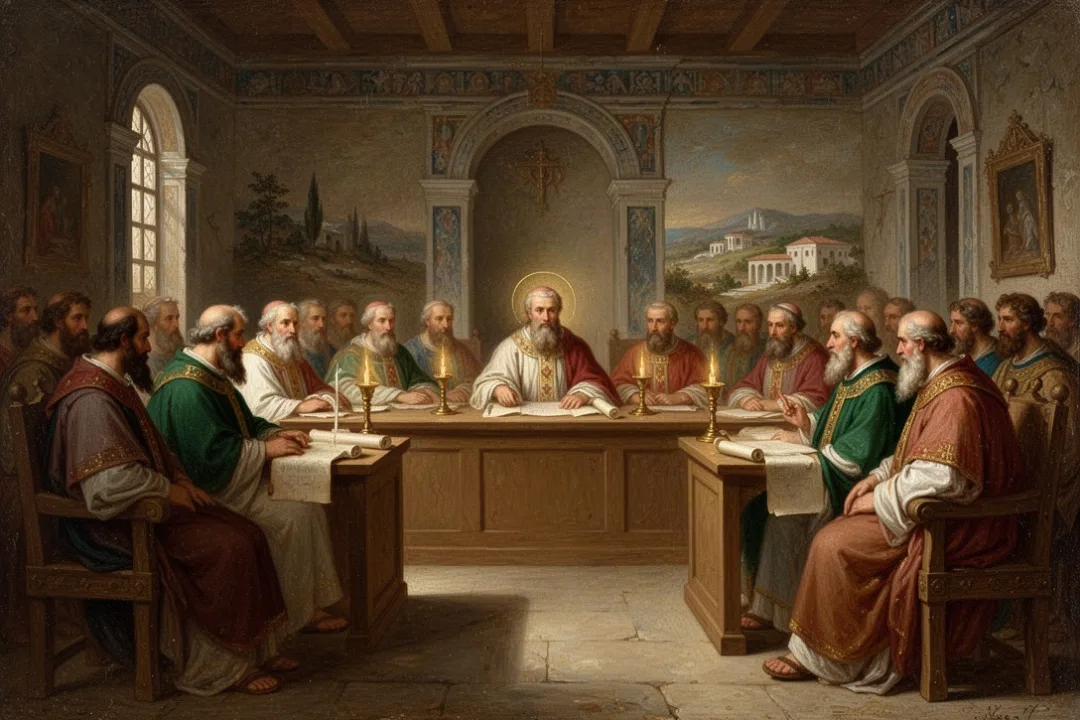
The council brought together leaders from different regions of the Christian world. Representatives came from areas including Egypt, Syria, Palestine, Asia Minor, Greece, Rome’s western territories, and North Africa. Their theological vocabulary and local customs varied, but the central debate required them to state clearly what the church confessed about the Son.
Arius and his supporters defended a lower understanding of the Son’s status.
Alexander of Alexandria and his allies maintained that the Son was fully divine and eternal.
Hosius of Cordoba appears to have played an important role in guiding the proceedings.
Athanasius, then a deacon assisting Alexander, became one of the most forceful defenders of the council’s position.
Eusebius of Caesarea helped preserve an account of the gathering and later explained its significance.
Nicaea also addressed practical matters, including disputes over the date of Easter, questions of clerical discipline, and church order. The theological controversy, however, made the council historically significant. Its creed became a standard against which later teachings about Christ were evaluated.
What the Nicene Creed taught about Jesus Christ
The Council of Nicaea confessed that the Son is truly divine, not a created being who merely resembles God. The creed describes the Son as begotten from the Father and emphasizes that he is “of the same substance” or homoousios with the Father. That Greek term became the central theological word associated with the council.
“Of the same substance” means that the Son fully shares the divine reality of the Father. It does not mean that the Father and Son are the same person. Instead, the language distinguishes the persons while affirming their unity in divinity. Later Christian theology used this distinction as part of its account of the Trinity.
The creed also teaches that the Son was involved in creation, became human, suffered, died, and rose again. These statements connect Christ’s eternal identity with the events of the gospel. The council was not discussing an abstract divine principle separated from Jesus of Nazareth; it was defending the belief that the crucified and risen Jesus is truly the divine Son.
Nicaea rejected the idea that “there was a time when the Son was not.” That phrase captures the council’s objection to Arius’s teaching. If the Son came into existence at a point in time, then he would not be eternal in the same sense as the Father. The Nicene position instead held that the Son’s relationship to the Father belongs to God’s eternal being.
The creed’s language was shaped partly by the need to rule out interpretations that sounded orthodox but assigned the Son a lesser status. The council therefore used a technical term not found as a standalone word in the New Testament. Its leaders believed that carefully chosen language was necessary to protect the meaning of the church’s biblical faith.
The central Nicene claim is that the Son is not a created intermediary but fully divine, sharing the Father’s divine being.
Nicaea did not provide the complete wording of the creed commonly recited in many churches today. The familiar form was expanded and confirmed at the Council of Constantinople in 381. For that reason, the creed used in modern worship is often called the Nicene-Constantinopolitan Creed, even though it is commonly shortened to the Nicene Creed.
The council also condemned Arius’s teaching and associated statements. That condemnation did not end the dispute. Political pressure, changing imperial policy, regional rivalries, and disagreements about terminology led to decades of controversy after Nicaea. The council’s decision became authoritative over time, but its acceptance was neither immediate nor uniform.
Major figures associated with the Nicene tradition
Athanasius of Alexandria
Athanasius is the figure most often linked with the defense of Nicene Christianity. He attended Nicaea as a young deacon and later became bishop of Alexandria. His writings argued that only a truly divine Savior can unite humanity with God and bring genuine renewal to human life.
As bishop, Athanasius faced repeated exile because of opposition from bishops and emperors who favored different formulas. His career shows that the post-Nicene debate was not a simple contest between one side called orthodox and another side called Arian. Several groups used different descriptions of Christ’s relationship to the Father, and political circumstances changed repeatedly.
Athanasius wrote theological defenses, letters, and works on the incarnation. His Life of Antony also helped spread knowledge of the Egyptian monk Antony and contributed to the development of Christian biography and monastic literature. His influence extended beyond the specific controversy at Nicaea.
Alexander of Alexandria
Alexander was bishop of Alexandria and Athanasius’s predecessor. He opposed Arius’s teaching and supported the understanding of Christ as eternal and fully divine. His leadership in the Alexandrian church helped establish the theological position that Athanasius later defended with greater detail and persistence.
Alexander’s role also illustrates how local church conflicts could become matters of wider concern. The dispute began in Alexandria but quickly spread through correspondence, preaching, and appeals to other bishops. The geographic reach of the controversy made an empire-wide council appear necessary.
Hosius of Cordoba
Hosius, a bishop from Spain, was an influential western church leader connected with Constantine. Ancient evidence suggests that he helped mediate disputes and played a significant part in the council’s proceedings. His presence reflects the cooperation between eastern and western bishops at Nicaea.
Hosius is less familiar to many modern readers than Athanasius, but he represents the broad episcopal leadership behind the council. Nicaea was not the achievement of one author. Its decisions emerged from deliberation among bishops with different regional backgrounds and ecclesiastical experiences.
Eusebius of Caesarea
Eusebius of Caesarea is best known as a historian of early Christianity and as a bishop who attended Nicaea. He initially had reservations about the council’s wording but eventually accepted its creed. His writings provide valuable information about the early church, though they must be read with attention to his theological and political perspective.
His Ecclesiastical History preserves accounts of earlier Christian leaders, persecutions, bishops, and controversies. Eusebius also wrote a biography of Constantine. These works make him one of the most important sources for understanding the transition from a persecuted church to a church receiving imperial support.
The Cappadocian theologians
Basil of Caesarea, Gregory of Nazianzus, and Gregory of Nyssa lived after the Council of Nicaea, so they are more accurately called post-Nicene Fathers. Their writings helped clarify how Christians could confess one God while speaking about the Father, Son, and Holy Spirit as distinct persons.
The Cappadocians were especially important in the development of Trinitarian language. They distinguished between ousia, meaning the shared divine essence or being, and hypostasis, meaning the distinct personal reality. Their work helped make the Nicene confession more precise and contributed to the theological settlement associated with Constantinople in 381.
How the Nicene Fathers interpreted Scripture and salvation
The Nicene Fathers did not treat theology as a detached philosophical exercise. They believed the question of Christ’s divinity was inseparable from the Bible and from the church’s practice of worship. Their arguments often drew on passages that describe Christ’s preexistence, divine authority, participation in creation, and role in salvation.
They also read Scripture within the church’s inherited rule of faith. This meant that a disputed passage was interpreted alongside baptismal teaching, Eucharistic worship, prayers, and the testimony of earlier Christian writers. For them, Christian doctrine was not created from a single proof text; it was a coherent account of the faith the church had received and practiced.
Athanasius’s approach to salvation is a useful example. He argued that the Son became human so that humanity could be restored to communion with God. His famous language about participation in divine life is sometimes misunderstood as teaching that humans become God by nature. More precisely, he described a gracious transformation in which people share in God’s life because of Christ, while remaining creatures.
The Fathers also emphasized the incarnation as a real union of divine and human. Jesus was not merely a divine presence appearing to be human, nor was he simply a human adopted by God. The Nicene and later post-Nicene tradition insisted that the one Christ is truly divine and truly human, a teaching developed with further precision at the Council of Chalcedon in 451.
Early Christian writers used several methods when interpreting Scripture:
Literal and historical reading: They considered the wording, setting, and narrative of a biblical passage.
Canonical reading: They interpreted individual passages in relation to the whole biblical witness.
Christological reading: They looked for how Scripture presents Christ’s identity and saving work.
Moral and spiritual application: They asked how biblical teaching should shape worship, character, and community life.
Ecclesial interpretation: They considered how the church’s received faith guided responsible interpretation.
Their methods varied considerably. Origen used extensive allegorical interpretation, while other writers placed greater emphasis on historical meaning. The Fathers should therefore not be treated as if they all used one identical interpretive system. Their agreement on central doctrines existed alongside real differences in style, emphasis, and theological vocabulary.
What is in the Nicene and Post-Nicene Fathers collection
Many English-speaking readers encounter the phrase through the nineteenth-century collection Nicene and Post-Nicene Fathers. Edited primarily by Philip Schaff and other translators, the series gathered English translations of writings from early Christian authors. It remains widely consulted because many volumes are available in the public domain.
The collection is generally divided into two series. The first focuses largely on later Greek and Latin Fathers, including Augustine, Jerome, John Chrysostom, Gregory the Great, and other major figures. The second includes earlier writers and church documents, as well as historians and theologians associated with the period surrounding Nicaea.
The collection is valuable, but its title can mislead readers. It is not a complete list of every Nicene Father, and it does not represent the only authoritative set of early Christian writings. It reflects the editorial choices, translation practices, and scholarly standards of the period in which it was produced.
Translations in the collection can sometimes sound formal or archaic. Names, punctuation, and terminology may differ from modern editions. When a passage is important for serious study, compare it with a newer translation or a critical edition, especially if the argument depends on one technical term.
Works commonly encountered in discussions of the Nicene and post-Nicene tradition include:
On the Incarnation by Athanasius
Ecclesiastical History by Eusebius of Caesarea
Homilies and theological writings by Gregory of Nazianzus and Gregory of Nyssa
Letters and sermons by Basil of Caesarea
Writings by Augustine of Hippo, including works on the Trinity and Christian doctrine
Homilies attributed to John Chrysostom
Church histories and selected documents concerning early councils
Not every text in the series carries the same level of certainty about authorship. Some works were later attributed to famous teachers, while others survive in forms shaped by transmission and editorial arrangement. A responsible reader should distinguish between a text’s traditional attribution and what modern scholarship can establish confidently.
For careful reading: Use the collection as a gateway to primary sources, then check the author, date, translation, and historical setting before treating a passage as representative of all early Christianity.
How to read the Nicene Fathers responsibly
The Nicene Fathers wrote in a world very different from the modern United States. They addressed controversies involving imperial authority, local episcopal rivalries, classical education, persecution, monasticism, and changing relationships between church and state. Their language cannot always be transferred directly into modern debates without considering its original setting.
Begin by identifying the writer, date, audience, and purpose of the work. A bishop writing a theological defense uses language differently from a preacher addressing a congregation or a historian describing events decades earlier. The same author may also use different terms in a letter, a biblical commentary, and a formal doctrinal treatise.
Pay attention to technical vocabulary. Words such as “substance,” “person,” “nature,” and “begotten” carried meanings that developed over time. English translations may use one word for several Greek or Latin terms, or several English words for one term. A theological argument can appear inconsistent if the translation’s choices are not examined.
It also helps to separate three questions:
What does the writer claim? State the argument in its historical and literary context.
What problem is the writer addressing? Identify the opposing view, pastoral concern, or biblical question behind the argument.
How did later Christians use the text? Later reception can be influential without proving that the original writer intended every later interpretation.
Do not assume that the Fathers were interchangeable. Athanasius, Augustine, Basil, Gregory of Nazianzus, Jerome, and Chrysostom had different interests and theological styles. Some emphasized doctrinal controversy, some biblical interpretation, some pastoral care, and some the spiritual disciplines of Christian life.
Nor should the Nicene Fathers be treated as a substitute for the biblical text. They are witnesses to early Christian interpretation and doctrine. Their writings can illuminate how Christians understood Scripture, but they remain historical sources that require careful reading and comparison.
Their lasting importance lies in the questions they forced the church to answer: Who is Jesus Christ? How is he related to the Father? How can Christian worship of Christ remain faithful to belief in one God? What does salvation mean if God has not truly entered human life?
The Nicene answer became foundational for most Catholic, Eastern Orthodox, Anglican, and many Protestant churches: the Son is eternally divine, fully united with the Father in being, and truly involved in humanity’s salvation. The debates surrounding that answer also established patterns of theological reasoning that continued to shape Christian history long after the bishops left Nicaea.
Frequently asked questions
Were the Nicene Fathers the same as the apostles?
No. The apostles belonged to the first generation of Christian witnesses, while the Nicene Fathers lived mainly in the second through fourth centuries and later. The Nicene leaders considered themselves heirs to apostolic teaching, but they were not apostles themselves. Some earlier Church Fathers, such as Ignatius of Antioch and Irenaeus, lived closer to the apostolic period than the bishops who attended Nicaea.
Did Constantine write the Nicene Creed?
No. Constantine called the council and helped organize its meeting, but the bishops debated and approved the creed. Constantine was not a bishop and did not function as the creed’s theological author. He supported unity within the church, partly because religious division threatened public stability, but the wording came from the council’s episcopal deliberations.
Was the Nicene Creed finalized at the Council of Nicaea?
The creed issued in 325 established the central teaching that the Son is fully divine and shares the Father’s being. The form commonly recited in churches today includes later wording associated especially with Constantinople in 381. “Nicene Creed” is therefore a convenient short name for a creed whose historical development involved more than one council.
Where can I read the Nicene Fathers?
Public-domain translations of the Nicene and Post-Nicene Fathers collection are available through several online libraries. For serious study, newer translations and annotated editions are often preferable because they explain historical context and Greek or Latin terminology. Start with a work by Athanasius, Eusebius, Basil, or one of the Cappadocians, depending on your interest.






Leave a Reply