Constantine called the Council of Nicaea in 325 to address a major dispute about the identity of Jesus Christ and to restore unity within the Christian churches of the Roman Empire. The bishops rejected Arius’s teaching that the Son was a created being and affirmed that the Son is truly divine, using the term homoousios, commonly translated as “of the same substance” or “of the same essence” as the Father.
Constantine did not write the Nicene Creed, decide Christian theology by himself, or choose which books belonged in the Bible. His role was that of an emperor seeking religious and political stability: he summoned the meeting, supported its proceedings, and pressed the bishops to reach agreement. The bishops themselves debated and formulated the council’s doctrinal statement.
Constantine became the dominant ruler of the Roman Empire after a series of civil wars. His victory at the Battle of the Milvian Bridge in 312 was associated with his favorable turn toward Christianity, and in 313 he and Licinius issued an agreement commonly called the Edict of Milan. This policy ended official persecution of Christians and allowed confiscated property to be restored.
Religious disagreements that had once been internal matters of local churches now had consequences across the empire. Constantine wanted a stable empire, and disputes among bishops could affect communities, public order, and imperial administration. He therefore treated Christian unity as a matter requiring imperial attention, even though he was not yet a baptized Christian when Nicaea met.
The immediate dispute began in Alexandria, where the presbyter Arius taught that the Son of God was not eternal in the same way as the Father. Arius argued that the Son had been brought into existence by the Father and therefore occupied a position above creation but below the one God. His opponents, including Bishop Alexander of Alexandria and Alexander’s associate Athanasius, argued that salvation required Christ to be fully divine.
The central question: Was the Son an exalted creature made by God, or was the Son eternally divine and truly one with the Father? Nicaea answered that the Son was fully divine.
What happened before the bishops gathered at Nicaea
Constantine first tried to settle the conflict through correspondence and personal intervention. He sent the Spanish bishop Hosius of Cordoba to investigate the dispute and later invited bishops from across the empire to a larger council. The emperor’s effort shows that he initially saw the controversy as a divisive quarrel that might be resolved through agreement rather than as a question requiring a new theological formula.
Earlier Christian writers had already used different expressions to describe the relationship between the Father and the Son. Some language emphasized the distinction between Father and Son, while other language emphasized their shared divinity. The controversy became more intense because terms such as ousia and hypostasis did not always carry the same meaning for every Greek-speaking bishop.
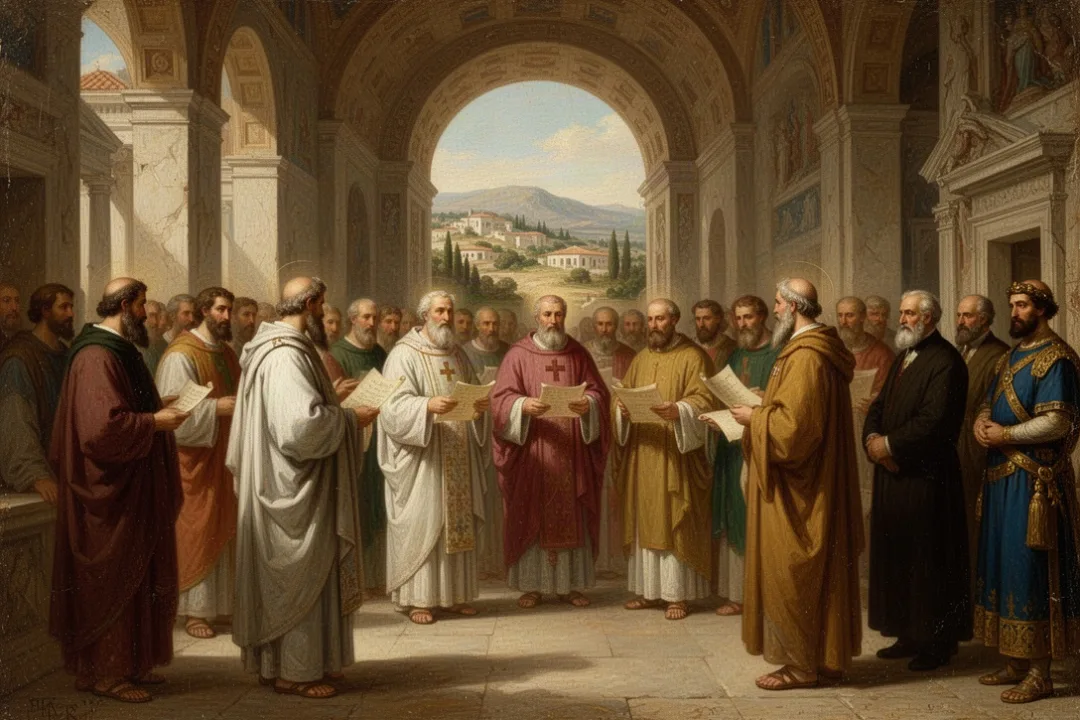
Nicaea was not the first meeting of Christian leaders, but it was the first council with broad representation from churches across the Roman Empire. Bishops traveled from regions including Egypt, Syria, Palestine, Asia Minor, Greece, and the western provinces. The traditional figure of 318 bishops is widely remembered, although ancient accounts and modern historians discuss the exact attendance differently.
What the Council of Nicaea decided, step by step
The bishops examined Arius’s teaching. They considered whether the Son had been created and whether there was a time when the Son did not exist.
They adopted a creed. The creed described the Son as begotten, not made, and as sharing the same divine essence as the Father.
They condemned Arian teaching. Arius and several supporters who would not accept the council’s formula were excluded from communion and sent into exile.
They issued disciplinary rules. The council addressed clergy conduct, church administration, and the restoration of unity after persecution.
They addressed the date of Easter. Bishops sought a common practice rather than allowing different regional calculations to continue dividing churches.
They sent the decisions to Christian communities. The council’s conclusions were communicated throughout the empire, although later resistance showed that agreement was not immediate or permanent.
The council’s creed is the foundation of what is now called the Nicene Creed, although the form commonly recited in many churches today reflects an expanded version associated with the Council of Constantinople in 381. The original Nicene statement was shorter and focused especially on the Son’s divine status.
Why the word homoousios mattered
The most significant term in the council’s creed was homoousios. It stated that the Son is of the same essence or substance as the Father. This language was intended to rule out the claim that the Son was merely the highest creature or a lesser divine being.
The word itself was not a simple solution to every theological question. Some bishops were cautious because similar terminology had been used in earlier disputes, and they worried that it might erase the real distinction between the Father and the Son. Others accepted it because they believed it protected the Christian claim that God truly entered human history in Jesus Christ.
Nicaea did not say that the Father and the Son are the same person. Its purpose was to affirm both distinction of persons and unity of divine being, although later theologians would develop more precise language to explain that relationship. The council’s formula became the starting point for later Trinitarian theology rather than the end of every debate.
The Son is not described as a creature who resembles God, but as truly sharing the divine reality of the Father.
This distinction mattered for Christian ideas about salvation. Athanasius and other supporters of Nicaea argued that if Christ were not fully divine, Christ could not unite humanity to God in the way Christian worship and doctrine claimed. The council’s decision therefore involved more than abstract terminology; it addressed what Christians believed about incarnation, worship, and redemption.
Constantine’s actual role at Nicaea
Constantine had decisive influence over the council’s existence and public importance, but he was not the author of its central doctrine. He summoned the bishops, arranged for travel and expenses, opened the gathering, and encouraged them to settle their differences. His imperial authority gave the meeting a reach and urgency that earlier regional synods had not possessed.
Ancient accounts describe Constantine as participating in the proceedings and speaking to the bishops. Still, the theological work belonged to the bishops, who examined statements, debated terminology, and approved the creed. The emperor’s interest was closely tied to unity, while the bishops were responsible for defining what they believed the churches had received from apostolic teaching.
Constantine also had a complicated relationship with the outcome. He supported the council’s decision at Nicaea, but later political developments led him to recall Arius from exile and to become more receptive to bishops who opposed or softened the Nicene formula. Near the end of his reign, Constantine was baptized by Eusebius of Nicomedia, a bishop associated with the anti-Nicene side of the dispute.
That baptism does not mean Constantine secretly rejected Christianity or that Nicaea was simply a political invention. It does show that imperial policy after the council was not identical to the later idea of a permanently settled Nicene orthodoxy. The controversy continued through changes in leadership, local councils, exiles, and competing theological formulas.
What the Council of Nicaea said about Arius
The council rejected the idea that the Son was created out of nothing or that the Son came into existence at a particular point in time. Its condemnation targeted teachings associated with the claim that the Son was not eternal and not truly divine in the same sense as the Father.
The creed also included a series of anathemas directed against statements such as “there was when he was not” and claims that the Son was changeable or made from another substance. These phrases were designed to prevent readers from interpreting the creed in an Arian direction.
Arius himself was not the only person involved in the controversy. Some bishops who had concerns about Arius’s language eventually accepted the council’s creed, while others continued to challenge the word homoousios. The later history cannot be reduced to two perfectly uniform parties, because bishops differed over language, authority, and the political treatment of those who had been condemned.
Other decisions made at Nicaea
The council issued disciplinary canons that dealt with practical matters in church life. These rules covered topics such as the readmission of clergy who had lapsed during persecution, the conduct of clergy, the movement of bishops between cities, and the proper organization of church authority.
One canon addressed the practice of clergy members marrying after ordination, while another discussed the selection and ordination of bishops. Other canons dealt with how people who had denied the faith during persecution might be restored. These decisions reveal that Nicaea was not only a theological meeting; it was also an administrative council dealing with a rapidly expanding church.
The council recognized the importance of established regional authority, particularly in major centers such as Alexandria, Rome, and Antioch. Its rules did not create the later medieval papal system, nor did they give Constantine control over every Christian congregation. Instead, they worked within the existing patterns of bishops, provinces, and regional churches.
Clergy discipline: The bishops addressed standards for ordained ministers and their conduct.
Restoration after persecution: The council considered how repentant Christians and clergy could return to communion.
Episcopal authority: It recognized the standing of important regional churches and their bishops.
Church order: It offered rules for ordination, appointments, and the resolution of local disputes.
Liturgical unity: It encouraged common practice concerning the annual celebration of Easter.
How Nicaea addressed the date of Easter
Christians in different regions had not always celebrated Easter on the same date. Some communities connected the celebration closely with the Jewish Passover calculation, while others followed a different method. Constantine wanted the churches to observe the feast together, and the council supported greater uniformity.
Nicaea did not leave behind a complete mathematical formula for calculating Easter in the way later calendars would express it. The council’s practical concern was that Christian communities should not continue celebrating the central feast of the Christian year according to visibly conflicting regional schedules.
The decision about Easter is sometimes presented as though Constantine personally selected a date. That description is too simple. The emperor favored unity, but the council’s bishops discussed the issue within the wider traditions of church calendars and regional practice.
What Nicaea did not decide
Several popular claims confuse the Council of Nicaea with later developments. The council did not choose the books of the Bible, create Christianity, or turn Jesus from a human teacher into a divine figure. Belief in Jesus’s divine status existed long before 325 and appears in early Christian worship, writings, and baptismal formulas.
Nicaea also did not make Christianity the official religion of the Roman Empire. Constantine ended persecution and favored Christianity, but he did not eliminate all other religions. Christianity gained an increasingly privileged position during the fourth century, and Emperor Theodosius I later took stronger measures in support of Nicene Christianity.
The council did not produce the complete version of the creed used by many churches today. The creed known in churches as the Nicene-Constantinopolitan Creed contains language associated with the later Council of Constantinople. The phrase about the Holy Spirit, for example, appears in a fuller form in that later tradition.
Nor did the council end the controversy permanently. Arius and his supporters were condemned at Nicaea, but opposition to the council’s wording continued. Some emperors and bishops later promoted alternatives, and Athanasius himself experienced repeated exile. The debate persisted until later councils and theological explanations helped establish the Nicene position more firmly.
Common misconception: Nicaea did not decide which Bible books were included. Questions about the boundaries of the biblical canon developed over a longer period and varied by region and Christian tradition.
Why the controversy continued after Constantine
The Nicene settlement depended partly on a term that different groups interpreted through different theological traditions. Bishops who opposed Arius did not always agree with one another about the best vocabulary for describing the Father and the Son. Some preferred to say that the Son was of a similar essence, while Nicene supporters insisted that “same essence” was necessary.
Imperial politics also affected the controversy. Constantine’s successors favored different church leaders and formulas, which meant that a bishop’s position could lead to exile or restoration depending on who controlled the government. Councils held after Nicaea sometimes issued statements that seemed to revise or replace the original creed.
Athanasius became one of the best-known defenders of the Nicene position, but he also faced criticism and removal from his see. His writings argued that the Son’s full divinity was essential to Christian salvation. Other theologians, including the Cappadocian Fathers later in the century, helped clarify how Christians could affirm one God while speaking of the Father, Son, and Holy Spirit as distinct.
The Council of Constantinople in 381 reaffirmed the Nicene faith and contributed to the fuller creed used in many churches. Even then, disagreements did not disappear everywhere. The history of the fourth century shows that doctrinal definitions were shaped through sustained debate rather than by one meeting producing instant and universal agreement.
How historians assess Constantine’s motives
Constantine’s motives were probably mixed rather than belonging to a single category. He appears to have been personally committed to Christianity, especially after his victory in 312, while also thinking like an emperor responsible for public order. Religious unity could strengthen the empire, but his interest in unity does not prove that he considered doctrine unimportant.
He often used the language of harmony and peace when addressing Christian disagreements. That language reflects an imperial concern with conflict, yet the council’s decision had serious theological content. Constantine could pressure bishops to meet and sign an agreement, but he could not make a disputed formula persuasive to every church by political command alone.
The emperor’s involvement also changed how Christian councils functioned. Nicaea established a precedent for large gatherings of bishops supported by imperial resources. Later emperors continued to summon councils or influence their implementation, creating a close and sometimes uneasy relationship between church authority and imperial power.
Why the Council of Nicaea still matters
For most Trinitarian Christian traditions, Nicaea provides the basic affirmation that Jesus Christ is not a lesser divine being or a created intermediary. The council’s language became central to the doctrine that the Son is eternally related to the Father and fully shares the divine nature.
Its legacy also reaches beyond theology. Nicaea illustrates how religious beliefs develop through argument, communal decision-making, inherited texts, and institutional authority. It shows the tension between a universal faith and the cultural, linguistic, and political differences among churches spread across a large empire.
When people refer to Constantine and the Council of Nicaea, they are often asking whether the emperor invented Christian doctrine. The historical answer is more precise: Constantine created the conditions for a major imperial council, gave it political support, and promoted unity, while the bishops debated and formulated the creed that defined the council’s central theological judgment.
Frequently asked questions
Did Constantine preside over the Council of Nicaea?
Constantine opened and supported the council, but he was not a bishop and did not preside as the theological authority. He encouraged the bishops to settle their conflict and took an active interest in the proceedings. The creed was developed and approved by the participating bishops, whose responsibility was to define Christian teaching.
Was Constantine a Christian when Nicaea met?
Constantine favored Christianity from the early fourth century and supported the church publicly, but he had not yet received baptism when the council met in 325. He was baptized near the end of his life. His delayed baptism was not unusual in that period, when some Christians postponed it because of the seriousness attached to post-baptismal sin.
Did the Council of Nicaea decide that Jesus was God?
No. Christians had affirmed Jesus’ divine status long before 325. Nicaea addressed a specific dispute about whether the Son was created or eternally divine. Its creed declared that the Son shares the same divine essence as the Father, giving formal and authoritative expression to a belief already held by many Christian communities.
Did Nicaea create the Bible?
No. The council did not select the books of the Bible or produce a complete canon. Different churches had been using many of these writings for generations, while questions about the exact collection developed over a longer period. Canon lists varied among Christian traditions, and the process cannot be attributed to one fourth-century meeting.






Leave a Reply