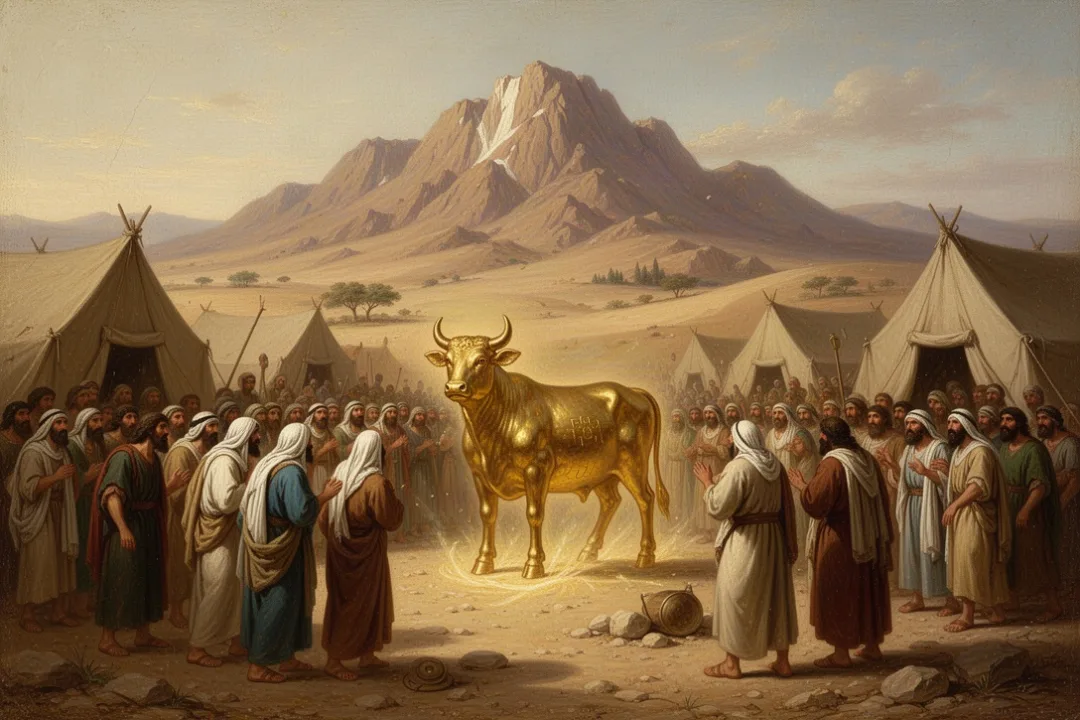
The Israelites made the golden calf because Moses had been gone too long on Mount Sinai, and the people became afraid, impatient, and uncertain about what would happen next. They pressured Aaron to give them a visible object to represent divine leadership, and he fashioned a calf from their gold.
The episode was not simply a random act of idol worship. It grew out of fear, religious confusion, group pressure, and a desire for a god they could see. The story in Exodus 32 also presents the calf as a direct violation of Israel’s covenant with the Lord, especially the command against making and worshiping images.
The Israelites had recently left Egypt after a series of extraordinary events. They had crossed the sea, traveled through the wilderness, and arrived at Mount Sinai. There, Moses went up the mountain to receive God’s instructions for the people, including the covenant laws that would shape Israel’s life.
According to Exodus 24 and 32, Moses remained on the mountain for an extended period. The people could not see him, and they did not know when he would return. Their uncertainty became especially serious because Moses had served as their main human leader and intermediary.
At the mountain, the people had already heard God’s commands through Moses. Yet the delay exposed how dependent they were on a visible leader. When Moses did not come back on the schedule they expected, the crowd gathered around Aaron and demanded something they could see and follow.
The central issue: The golden calf gave the Israelites a visible focus at the very moment when their covenant required trust in the unseen God who had rescued them.
Why did the Israelites want a visible god?
The Israelites had lived for generations in Egypt, a society filled with temples, statues, sacred animals, and religious images. The biblical story does not say that every Israelite copied one specific Egyptian god, but their cultural surroundings had accustomed them to physical representations of divine power.
In the ancient Near East, people commonly used images in worship. A statue or animal figure could function as a representation, throne, symbol, or meeting point associated with a deity. This does not mean every image was understood as the entire god, but it helps explain why a visible calf may have seemed religiously meaningful to the crowd.
The Israelites’ request also reflects a practical crisis. Moses had been the person who led them, spoke for God, settled disputes, and communicated divine instructions. Without him, the people felt exposed. Their demand for a visible object was connected to the need for direction and reassurance, not only curiosity about a new religious symbol.
Exodus 32 describes the request in terms of making gods who would go before them. The wording may suggest that the people were seeking a visible replacement for Moses’ leadership, or a tangible representation of the divine presence that had guided them. Either way, the demand showed that they had lost patience with waiting for God’s appointed leader.
How did the golden calf episode unfold?
The sequence in Exodus 32 shows how a crisis became a public act of worship. Each stage increased the pressure on the next one.
Moses delayed on the mountain. The people did not know when he would return, and his absence created fear and instability.
The crowd confronted Aaron. They asked him to make gods that would lead them, treating the visible object as a solution to their uncertainty.
Aaron collected gold. He asked the people to remove their gold earrings and bring them to him.
The gold was shaped into a calf. Aaron formed the image, and the people responded with a religious celebration.
The people offered sacrifices. Exodus 32 describes burnt offerings and fellowship offerings connected with the calf.
The celebration became uncontrolled. The account portrays feasting, revelry, and behavior that violated the seriousness of the covenant.
Moses returned and confronted the sin. He broke the stone tablets, destroyed the calf, and challenged Aaron and the people.
The community faced judgment. The story emphasizes that covenant rebellion had serious consequences.
This progression matters because the calf did not appear without warning. The people moved from anxiety to demand, from demand to image-making, and from image-making to worship. The story presents collective panic becoming collective disobedience.
Was the golden calf meant to replace the God of Israel?
Readers often ask whether the Israelites abandoned the Lord entirely or tried to worship the Lord through the calf. The biblical text leaves room for discussion about the crowd’s exact intention, but it does not treat their behavior as acceptable either way.
When Aaron announces a festival, his language appears to connect the celebration with the Lord. This has led many interpreters to argue that the calf may have been intended as a visible representation or pedestal associated with the God who brought Israel out of Egypt, rather than a completely unrelated deity.
Other interpreters understand the event as a direct turn toward pagan worship. The people ask for “gods,” and the calf becomes the focus of offerings and celebration. The text may intentionally show a mixture of beliefs: the Israelites could have claimed to honor the God of the exodus while adopting an image and ritual pattern that contradicted his commands.
The distinction does not remove the offense. The first commands given at Sinai prohibited making images for worship and warned Israel not to bow to them. The problem was not solved by using a calf to represent the right God. Israel’s covenant called for faithfulness without an idol.
The story therefore warns against reducing religious disobedience to the question, “Which god did they mean?” The form of worship mattered. The Israelites were not free to reshape their covenant relationship around a symbol that made the divine presence manageable and visible.
Why was a calf used instead of another animal?
A young bull or calf carried strong religious associations in the ancient world. Bulls were widely linked with strength, fertility, kingship, and storm power. A calf could communicate physical strength and divine authority, making it a compelling image for a people seeking protection and leadership.
The Bible does not provide a detailed explanation of why Aaron chose this particular form. It is safer to say that the calf belonged to a familiar symbolic world rather than claim that the Israelites copied one precisely identified Egyptian object.
Some scholars connect the image with religious traditions in which a bull served as a symbol, throne, or accompanying figure for a deity. Others emphasize the cultural influence of Egypt and neighboring peoples. These explanations can illuminate the setting, but the biblical narrative focuses less on identifying the calf’s exact artistic origin than on Israel’s breach of faithfulness.
The calf’s symbolism may also have appealed to the people because it was concrete and powerful. An invisible God could feel distant during a crisis; a crafted animal figure could be seen, carried, and placed at the center of a public ceremony. That visibility was precisely part of the danger.
What role did Aaron play in making the calf?
Aaron was Moses’ brother and Israel’s first high priest, so the people naturally turned to him when Moses remained on the mountain. Instead of firmly rejecting the demand, Aaron collected the gold and supervised the creation of the image.
His actions show how leaders can contribute to wrongdoing by trying to manage a crowd rather than correct it. Aaron may have feared the people, misjudged the seriousness of the situation, or attempted to control a movement that had already begun. The text does not excuse him, however. He held responsibility because he gave the demand religious form.
When Moses questioned Aaron, Aaron’s explanation placed much of the blame on the people and described the calf as if it had emerged almost by itself from the fire. The account presents this as an inadequate defense. The leader had participated in gathering the materials and organizing the worship.
Aaron’s failure is especially striking because he had witnessed the exodus and stood alongside Moses during the revelation at Sinai. His position gave him knowledge and authority, but pressure from the crowd overcame his duty. Religious leadership requires more than responding to popular demand; it also requires guarding the community’s commitments when fear is high.
How did fear and impatience influence the people?
The people were not waiting in comfortable surroundings. They were in a wilderness, dependent on provisions, direction, and protection. Moses’ prolonged absence may have made them wonder whether their leader had died, abandoned them, or lost contact with the God who had brought them out of Egypt.
Fear often creates a demand for immediate certainty. Instead of accepting an unseen promise or waiting for Moses, the people sought something they could gather around. The calf offered a quick answer to questions that required patience: Who will lead us? Where is God? What should we do next?
Impatience also shaped their behavior. The covenant was new, and the people had not yet developed the habits of trust and obedience expected of them. Their rescue from Egypt had happened quickly, but forming a faithful community would require time. They wanted the benefits of divine guidance without enduring the uncertainty involved in following it.
Fear made Moses’ absence seem dangerous.
Impatience turned a delay into a demand for action.
Uncertainty made a visible symbol seem reassuring.
Group pressure made resistance more difficult for Aaron and others.
Familiar religious habits made an image seem like a reasonable answer.
These motives do not make the sin harmless. They explain why the decision could seem attractive in the moment while remaining deeply wrong within the covenant. The story places emotional understanding and moral responsibility side by side.
How did the golden calf violate Israel’s covenant?
The golden calf violated the relationship Israel had just entered with God. The covenant was not merely a list of abstract rules; it established Israel as a people devoted to the Lord after being rescued from slavery. Worshiping the calf rejected the exclusive loyalty at the heart of that relationship.
The episode directly conflicts with the command against making an idol or bowing before an image. It also resembles the kind of worship Israel was being called to leave behind. The people had been delivered from Egypt, but they had not fully separated their imagination of divine power from the religious forms surrounding them.
The breaking of the stone tablets dramatizes the breach. Moses does not treat the calf as a minor misunderstanding or a harmless substitute. The covenant documents are shattered in front of the people because their actions have represented a rupture in the covenant itself.
Exodus 32 also describes judgment within the camp. The details are severe, and readers may find them difficult. The narrative’s point is that idolatry was not a private preference; it threatened the identity, worship, and unity of the newly formed nation.
Why did Moses react so strongly?
Moses’ anger came from more than personal frustration. He had been receiving instructions for a covenant community while the people were publicly violating the relationship those instructions established. Their celebration represented a rejection of the very purpose of the encounter at Sinai.
His breaking of the tablets is a symbolic act, but it also communicates the seriousness of what has happened. The written covenant and the people’s conduct no longer correspond. Moses then destroyed the calf, burned it, ground it into powder, scattered it on water, and made the people confront what they had made.
Moses also acted as an intercessor. After confronting the people, he returned to the Lord and pleaded for mercy. Exodus 32 presents both judgment and intercession: the sin must be named and confronted, yet the relationship is not treated as beyond restoration.
This combination prevents two shallow readings. The story is not only about angry punishment, and it is not only about easy forgiveness. It shows the destructive seriousness of idolatry while also showing Moses standing between the people and complete destruction.
What does the golden calf teach about leadership and group behavior?
The episode reveals how quickly a community can abandon its stated values when its usual structures of leadership disappear. The Israelites had seen God’s power and had agreed to the covenant, but a period of uncertainty exposed how fragile their commitment remained.
The crowd’s demand also shows the force of shared pressure. Individuals may have had different concerns, but together they created an atmosphere in which Aaron felt compelled to act. Once the gold was collected and the image was formed, participation became a public expectation.
Aaron’s example highlights the danger of appeasing a group in crisis. He did not invent the people’s fear, but he gave it an object and a ceremony. His response made the situation worse by turning anxiety into organized worship.
Moses’ response offers a contrasting model. He refused to minimize the problem, removed the idol, called for accountability, and interceded for the people. Strong leadership in the story includes truthful confrontation, protective action, and concern for restoration.
Did the golden calf affect later Israelite history?
The golden calf became a lasting symbol of Israel’s tendency toward idolatry. Later biblical writers refer back to the event as a defining failure in the wilderness. It represents the temptation to replace faithful worship with a visible, controllable religious substitute.
Centuries later, King Jeroboam of the northern kingdom established golden calves at Bethel and Dan, according to 1 Kings 12. He presented them in connection with Israel’s worship, but the biblical account condemns the policy. The later calves are not the same event as the wilderness calf, yet the similarity is deliberate and significant.
The later story suggests that the pattern had not disappeared. A ruler could use religious images to make worship more accessible, strengthen political control, or keep people from traveling to Jerusalem. Whatever the political motives, the biblical writers view the practice as a return to the kind of idolatry represented by Exodus 32.
The connection between the episodes shows why the golden calf matters beyond one wilderness crisis. It became a recurring warning about mixing the worship of the Lord with forms that contradict the covenant.
What is the main spiritual lesson of the golden calf?
The story warns that people may seek a manageable substitute when trust becomes difficult. An idol does not have to be a carved statue in order to function like one. Anything treated as a controllable source of security, identity, or ultimate authority can take a similar place.
The Israelites wanted something visible because waiting felt unsafe. Their mistake was not simply that they chose the wrong material. They tried to make the divine presence fit their immediate expectations. The calf allowed them to turn worship into something they could design, display, and control.
The account also teaches that sincerity does not make every form of worship faithful. Aaron may have tried to connect the celebration with the Lord, and the people may have believed they were honoring the God who rescued them. Yet intention could not erase the clear covenant prohibition against images and divided loyalty.
For readers of the Bible, the golden calf raises practical questions about patience, fear, and spiritual compromise:
What do you reach for when trusted guidance seems delayed?
Are you replacing faithful obedience with something easier to see or control?
Are you allowing group pressure to shape convictions you once held firmly?
Are you confusing familiar religious practices with genuine faithfulness?
When someone is afraid, are you offering wise direction or merely giving the fear a public form?
The story does not suggest that uncertainty itself is rebellion. The Israelites faced real hardship and had understandable fears. The failure came when they responded to those fears by abandoning the boundaries of their covenant and creating a substitute for the God they were called to trust.
How should Christians and other readers interpret the story today?
Different religious traditions emphasize different aspects of Exodus 32. Some focus on the danger of idolatry, others on the weakness of human leadership, and others on Moses’ role as an intercessor. These readings can coexist because the narrative addresses worship, community behavior, authority, judgment, and mercy at the same time.
The story should not be used to claim that every religious image has the same meaning or that every disagreement about worship is equivalent to the golden calf. Its specific setting matters: Israel had entered a covenant with clear commands, and the calf represented a direct violation of those commands.
It is also unhelpful to treat the Israelites as uniquely foolish people from the distant past. The pressures in the story remain recognizable: delayed answers, anxious communities, leaders afraid to resist popular opinion, and a desire for certainty that can override conviction.
The most careful reading holds together the historical and moral dimensions. The calf reflects the religious world of the ancient Near East, yet the biblical narrative uses it to make a lasting claim about exclusive worship. It explains the people’s behavior without excusing it.
Remember the distinction: The Israelites’ fear helps explain why they made the calf, but fear does not justify replacing covenant faithfulness with a visible religious substitute.
Why does the golden calf remain such a powerful biblical image?
The golden calf is memorable because the collapse happens so soon after a major experience of deliverance and covenant. Israel had not forgotten that God brought them out of Egypt; the crisis came when they could not see what God was doing next.
That timing gives the story its force. A person or community may sincerely remember past help and still respond badly to present uncertainty. Memory alone does not guarantee faithfulness. The Israelites needed to learn how to live by the covenant after the dramatic rescue had passed.
The calf also exposes the difference between religion shaped by trust and religion shaped by control. A visible object can be carried, decorated, celebrated, and used to rally a crowd. The God of the covenant cannot be reduced to an object made by human hands.
For that reason, the question “Why did the Israelites make a golden calf?” has a clear historical answer and a deeper human one. Historically, they were frightened by Moses’ delay and influenced by familiar religious practices. At a deeper level, they chose a visible and controllable substitute when faithful waiting became difficult.
Frequently asked questions
Did the Israelites worship the golden calf instead of God?
The text indicates that the calf became the focus of offerings and celebration, but it is debated whether the people viewed it as a separate god or as a representation of the Lord. Either interpretation involves disobedience because Israel’s covenant prohibited making an image for worship. The central failure was attempting to represent and control divine worship through a physical object.
Was Aaron punished for making the golden calf?
Exodus 32 clearly portrays Aaron as responsible because he gathered the gold and oversaw the calf’s creation. The chapter focuses on Moses’ confrontation with him and on the judgment that followed in the camp. Later biblical passages also remember Aaron’s failure. However, the narrative does not give a simple standalone account of a separate punishment matching the judgment faced by every participant.
How long was Moses away when the calf was made?
Exodus describes Moses as being on Mount Sinai for an extended period, and the people concluded that his absence had become indefinite. The passage does not require readers to calculate a precise number of days for understanding the event. The important point is that the delay tested the people’s patience and confidence in the leadership God had given them.
Is the golden calf the same as the calves made by King Jeroboam?
They are separate events, occurring in different periods of Israel’s history. Jeroboam later established golden calves at Bethel and Dan, and biblical writers deliberately connect that policy with the earlier wilderness failure. The similarity suggests a recurring pattern of using visible religious images in ways that compromise Israel’s exclusive worship of the Lord.










Leave a Reply