2 Samuel explained: David’s rise, failures, and faith
2 Samuel explained: David’s rise, failures, and faith
Are you trying to understand what 2 Samuel is about, or wondering why David’s story becomes so troubled after he becomes king? The book answers both questions by following David from the death of Saul through his reign over Israel, his serious moral failure, family disasters, national rebellion, and renewed dependence on God.
Unlike a simple success story, 2 Samuel presents David as a gifted ruler who is also capable of abuse, deception, and poor judgment. His faith is genuine, but it does not protect him from consequences. The book’s central tension is that God establishes David’s kingdom while showing that David himself is not the perfect king Israel ultimately needs.
2 Samuel continues the narrative that begins in 1 Samuel. First Samuel describes Samuel’s leadership, Saul’s troubled reign, and David’s rise from shepherd and military leader to Saul’s chosen successor. Second Samuel begins after Saul’s death and traces David’s rule over Judah and then over all Israel.
The book includes political victories, religious decisions, prophetic messages, personal grief, and civil war. It is not arranged as a list of abstract lessons. Instead, the meaning emerges through events: David refuses to seize the throne by murdering Saul, receives God’s covenant promise, commits adultery and arranged murder, and later suffers the consequences within his own household.
The book’s main movements are:
David mourns Saul and Jonathan rather than celebrating the deaths of his rivals.
David becomes king over Judah and eventually rules all Israel.
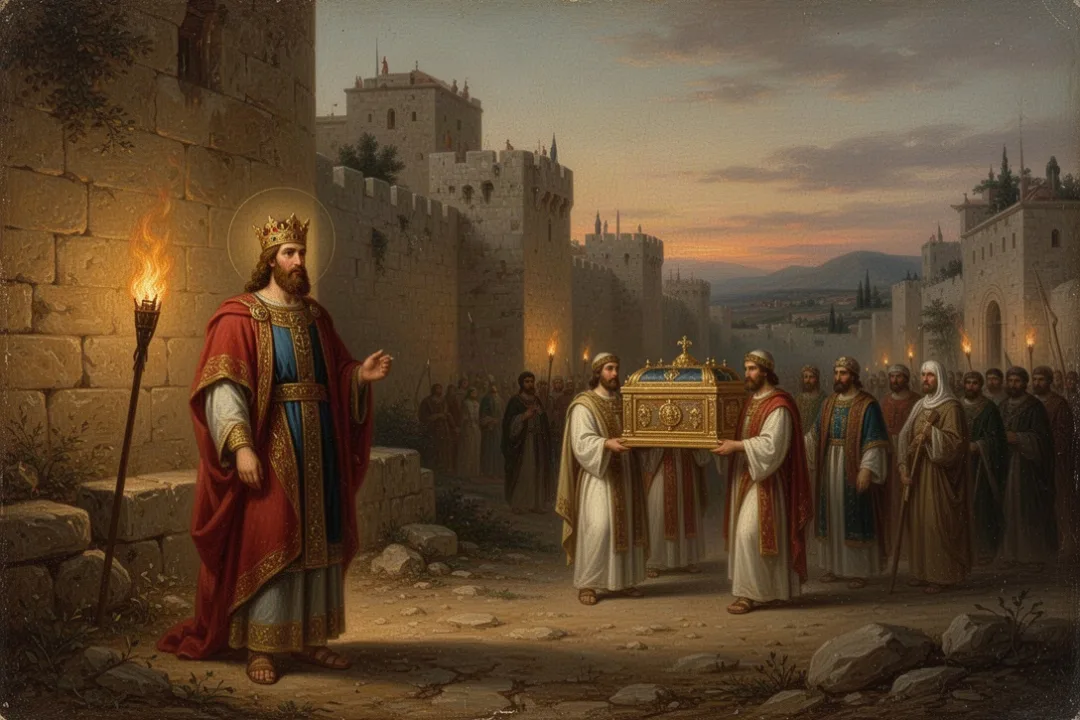
Jerusalem becomes David’s capital, and the ark is brought there.
God promises David an enduring dynasty through the covenant in chapter 7.
David sins against Bathsheba and Uriah, and the prophet Nathan confronts him.
David’s family and kingdom fracture through violence, rebellion, and political instability.
David returns to worship and dependence on God near the end of the book.
Central idea: 2 Samuel holds together two truths: God is faithful to his covenant promises, and human sin still brings painful, real consequences.
How to read 2 Samuel in its biblical context
Samuel was originally one larger work in the Hebrew Bible, later divided into 1 Samuel and 2 Samuel. The division helps readers navigate the material, but the story is continuous. Saul’s rejection, David’s anointing, and the conflict between the two kings in 1 Samuel lead directly into David’s reign in 2 Samuel.
The book is part of Israel’s historical narrative, but it is not merely a royal chronicle. It evaluates kings and events according to faithfulness to God, not only military success or political strength. David wins battles, expands the kingdom, and establishes Jerusalem, yet the narrative also exposes his failures with unusual directness.
Several themes help organize the book:
God’s sovereignty over leadership: David becomes king through God’s purpose, not simply through military ability.
The danger of power: David’s authority gives him opportunities that he uses both wisely and wickedly.
The seriousness of sin: Private choices create public and family-wide damage.
Repentance and mercy: David responds to prophetic correction with confession rather than denial.
The hope of a lasting king: God’s promise to David points beyond David’s imperfect reign.
2 Samuel chapter by chapter
Chapters 1–4: David becomes king through a divided nation
Second Samuel opens with an Amalekite reporting that Saul and Jonathan have died. The messenger appears to claim responsibility for Saul’s death and expects a reward, but David has him executed because he says he killed the Lord’s anointed king. The episode shows that David will not treat the death of his former enemy as permission for revenge or self-promotion.
David then composes a lament for Saul and Jonathan, recorded in 2 Samuel 1. He grieves their deaths and honors their courage, with special attention to his friendship with Jonathan. The lament is politically significant as well as personal: David teaches the people to mourn the fallen king instead of turning the tragedy into a celebration of regime change.
David asks God where he should go and settles in Hebron, where the people of Judah anoint him king. Saul’s son Ish-bosheth becomes king over much of northern Israel under the influence of Abner, Saul’s military commander. This produces a prolonged conflict between the house of Saul and the house of David.
Abner eventually breaks with Ish-bosheth and offers to help David unite the kingdom. Before that agreement can bring stability, Joab kills Abner in retaliation for the death of his brother Asahel. David publicly mourns Abner and refuses to appear responsible for the assassination. Later, two men murder Ish-bosheth and bring his head to David, expecting approval. Instead, David has them punished.
These chapters establish a pattern: David benefits from the collapse of Saul’s house, but he repeatedly refuses to treat treachery as legitimate political strategy. His kingdom grows, yet the route to power remains marked by grief, violence, and mistrust.
Chapters 5–6: Jerusalem becomes the center of Israel’s worship
After Ish-bosheth’s death, the tribes of Israel come to David at Hebron and recognize him as king. He is thirty years old when he begins to reign, and he rules first from Hebron before capturing Jerusalem. The city becomes known as the City of David and serves as the political center of the united kingdom.
David’s victories over the Philistines strengthen Israel’s position. But military success is not the only priority. David brings the ark of the covenant toward Jerusalem because he wants the city to be connected with God’s presence and worship, not merely with government.
The first attempt to move the ark ends in tragedy when Uzzah reaches out to steady it and dies. The narrative emphasizes that sacred objects were not to be handled casually or moved according to convenience. David responds with fear and temporarily leaves the ark at the house of Obed-edom.
When David later brings the ark to Jerusalem according to the proper instructions, he celebrates with energetic worship. He dances before the Lord, wears a linen garment associated with priestly service, and blesses the people. His wife Michal despises what she sees as undignified behavior, revealing a conflict between public status and humble worship.
The movement of the ark teaches that worship is not a decorative addition to national life. For David, the kingdom needs to be ordered around God. At the same time, the account warns that enthusiasm does not replace reverence or obedience.
Chapter 7: God’s covenant with David
David wants to build a permanent temple for the ark. The prophet Nathan initially agrees with the idea, but God gives Nathan a different message. David will not build the temple; instead, God will establish David’s “house,” meaning a continuing royal line.
Rather than promising that David’s own building project will secure the future, God promises to establish David’s dynasty. David’s son will build the temple, and God will maintain a special relationship with that royal line. The covenant includes discipline when future kings do wrong, but it also emphasizes that God’s covenant commitment will not be abandoned as Saul’s kingship was abandoned.
Second Samuel 7 is one of the most significant chapters in the Old Testament because it shapes later expectations about the Davidic king. The promise has an immediate historical dimension in Solomon and David’s royal descendants. It also becomes part of the Bible’s larger expectation of a future ruler whose reign will be lasting and righteous.
David’s response is a prayer of humility and wonder. He does not argue that he deserves the promise. Instead, he acknowledges that God has brought him from a relatively obscure background and has spoken about his family’s future.
Reading tip: When studying 2 Samuel 7, distinguish between David’s plan to build a house for God and God’s promise to build a lasting house, or dynasty, for David.
Chapters 8–10: David’s victories and his treatment of others
David defeats several surrounding enemies and strengthens Israel’s borders. The text presents these victories as evidence that God gives him success. David also organizes officials, military leaders, and administrative officers, showing the development of a functioning kingdom rather than a loose tribal coalition.
Yet David’s power is not portrayed as purely aggressive. He remembers his covenant friendship with Jonathan and asks whether any member of Saul’s family remains to whom he can show kindness. Jonathan’s son Mephibosheth, who has a disability in both feet, is brought to David and given a place at the royal table.
This act of kindness does not erase the political tension surrounding Saul’s family, but it demonstrates that David can use royal authority to protect someone who might otherwise be vulnerable. Mephibosheth receives land associated with Saul and eats regularly at David’s table. The account contrasts covenant loyalty with the normal practice of eliminating potential rivals.
David also attempts to show kindness to Hanun, the new king of Ammon, because Hanun’s father had shown kindness to David. Hanun’s advisers interpret David’s delegation as espionage, humiliate the messengers, and provoke war. The conflict expands when Aramean forces join the Ammonites, but David’s armies defeat them.
Chapters 11–12: David’s sin and Nathan’s confrontation
At the beginning of chapter 11, David remains in Jerusalem while his army is at war. From the roof of his palace, he sees Bathsheba, the wife of Uriah the Hittite, and sends for her. After she becomes pregnant, David tries to conceal what happened by bringing Uriah home from the battlefield. Uriah refuses to enjoy domestic comfort while the army is in danger.
David then sends instructions that place Uriah in the most dangerous part of the battle and withdraw support from him. Uriah is killed, and David takes Bathsheba as his wife. The narrator gives a brief but devastating assessment: what David did displeased the Lord.
The sin involves more than private sexual wrongdoing. David abuses royal authority, violates marriage, manipulates military policy, and arranges the death of a loyal soldier. The story also shows how people around a powerful ruler can become instruments of his will, even when the plan is corrupt.
God sends Nathan to David with a story about a wealthy man who takes a poor man’s beloved lamb. David condemns the fictional offender before Nathan reveals that the story describes David himself. Nathan announces consequences: violence will arise from David’s own household, and David’s hidden wrongdoing will have public effects.
David confesses his sin. God grants forgiveness in the sense that David will not die for the offense, but forgiveness does not remove every consequence. The child born from the relationship dies, and the family turmoil predicted by Nathan unfolds in later chapters.
Bathsheba later gives birth to Solomon. The narrative does not pretend that Solomon’s birth cancels the grief or injustice that came before it. Instead, it shows God continuing his purposes through a damaged family while still taking David’s actions seriously.
Chapters 13–20: David’s household and kingdom unravel
David’s failure as a father becomes especially visible in the story of Amnon and Tamar. Amnon desires his half-sister Tamar, deceives her, and assaults her. David becomes angry when he hears what happened, but the narrative records no decisive judgment from him. His passivity leaves the family wounded and creates space for further revenge.
Absalom, Tamar’s full brother, waits and eventually arranges Amnon’s murder. He then flees. David grieves for both sons, but the relationships within the royal household remain fractured. After Absalom returns to Jerusalem, David initially keeps him at a distance, and their relationship never fully recovers.
Absalom gradually wins the loyalty of many Israelites by presenting himself as an attentive alternative to his father. He stands at the city gate, listens to people with legal complaints, and suggests that their cases would receive better attention if he were judge. His political ambition culminates in a revolt that forces David to flee Jerusalem.
David’s flight is marked by sorrow and humility. He does not assume that God must preserve him simply because he is king. He leaves the city and sends the ark back, saying in effect that he will return only if God allows it. This response contrasts with Absalom’s attempt to seize the kingdom through public persuasion and military force.
Several advisers offer conflicting counsel during the rebellion. Hushai, loyal to David, counters Ahithophel’s strategic advice and creates time for David to escape. Ahithophel later takes his own life when his counsel is rejected. The rebellion ends when Joab kills Absalom despite David’s order to treat him gently.
David’s grief over Absalom is one of the most emotionally intense scenes in the book. He wishes he could have died in his son’s place, even though Absalom had caused the rebellion that nearly destroyed the kingdom. Joab confronts David and warns him that public mourning is demoralizing the soldiers who saved his life. David returns to his public duties, but the family loss cannot be undone.
The later chapters describe disputes between Judah and the northern tribes, another revolt led by Sheba, and continued instability. David’s return to Jerusalem restores the monarchy without restoring complete unity. His kingdom survives, but it has been deeply marked by his earlier failure.
Chapters 21–24: Famine, songs, heroes, and the census
The final section of 2 Samuel gathers several episodes that do not follow a simple chronological order. A famine leads David to seek God’s explanation. The account connects the famine with Saul’s earlier violence against the Gibeonites, a people protected by Israel’s covenant. David addresses the wrong, though the passage raises difficult questions about corporate responsibility and the suffering connected with past actions.
David’s song in chapter 22 praises God as his rock, refuge, deliverer, and protector. The song describes God responding to David’s distress and giving him strength against enemies. Its language is poetic, so it should be read as worshipful testimony rather than as a technical description of every event in David’s life.
The “last words of David” in chapter 23 emphasize the ideal of a ruler who governs justly and in reverence for God. These words sit beside the history of David’s actual failures. That contrast matters: the book distinguishes between the standard of righteous kingship and the imperfect man who sometimes falls short of it.
The chapter also lists David’s mighty warriors and their courageous deeds. Their stories show that David’s reign depended on a community of loyal and capable people. The king is central to the narrative, but he is not the only person through whom courage, sacrifice, and skill appear.
Chapter 24 describes David ordering a census of Israel and Judah. The motive is not explained in a way that removes every difficulty, and the passage presents the census as sinful. David recognizes his wrongdoing after the count is completed. A plague follows, and David purchases the threshing floor of Araunah, where he builds an altar.
The book ends with sacrifice and mercy at the site that will later become associated with the temple. The ending does not tie every problem into a neat resolution. Instead, it leaves readers with a king who has failed, confessed, suffered, worshiped, and remained dependent on God’s mercy.
What David’s life teaches about power and responsibility
David’s story shows that personal spirituality and public responsibility cannot be separated. He writes songs, seeks divine guidance, and expresses sincere repentance, but his decisions as king affect soldiers, spouses, children, advisers, and the entire nation.
His sin with Bathsheba is especially significant because it reveals how unchecked power distorts judgment. David does not merely make a private mistake. He uses the machinery of government to obtain what he wants and remove the person who stands in his way.
The narrative does not excuse David because he is chosen by God. Nor does it present his failure as proof that repentance is meaningless. Instead, it shows both accountability and mercy. David receives forgiveness, yet he also lives through consequences that affect his family and kingdom.
Readers can observe several warnings in David’s decline:
Success can reduce vigilance: David is most vulnerable when he is settled at home rather than engaged in the responsibilities of war.
Authority can isolate a leader: Few people challenge David directly, allowing a harmful decision to develop.
Delayed discipline increases damage: David’s failure to address Amnon’s crime contributes to Absalom’s revenge.
Private sin rarely stays private: David’s actions produce consequences in the public, military, and family spheres.
Repentance begins with truthful recognition: David stops defending himself when Nathan exposes the reality of his actions.
How 2 Samuel presents leadership
David is both a model and a warning. He seeks God before major decisions, shows restraint toward Saul, values worship, and remembers his covenant with Jonathan. These qualities help explain why the biblical writers regard him as a significant king.
At the same time, David fails to govern his own household well. He can be decisive against political enemies but passive when confronting crimes within his family. He also allows personal affection and grief to interfere with public leadership, as seen when Absalom’s rebellion begins and ends.
The book therefore presents leadership as more than charisma or military achievement. A king must exercise justice, restrain appetite, listen to correction, and protect vulnerable people. David possesses some of these qualities at different times, but he never embodies them consistently.
The contrast between David and the ideal ruler of 2 Samuel 23 also points readers toward a larger biblical expectation. The promised Davidic line matters because God’s purposes do not depend on David’s perfection. The story creates hope for a king who will combine David’s covenant significance with complete righteousness.
Why 2 Samuel matters for Christian readers
Christian readers commonly connect God’s promise to David in 2 Samuel 7 with the later biblical expectation of the Messiah. The New Testament presents Jesus as belonging to David’s line and identifies him with the promised kingly hope. Those connections should not erase the original historical meaning of the chapter: God was making a covenant commitment concerning David’s royal house.
David’s life also helps explain why biblical faith does not rest on idealized human heroes. Scripture preserves his courage and worship, but it also preserves his exploitation of Bathsheba, the murder of Uriah, and the damage that followed. The honesty of the account makes its teaching sharper.
The book encourages readers to take repentance seriously. David’s confession is not a vague expression of regret. He accepts that his action was wrong and submits to God’s judgment. At the same time, 2 Samuel does not suggest that saying sorry automatically repairs every relationship or removes every consequence.
Its message about grace is equally serious. God does not abandon the covenant promise because David fails. Divine faithfulness is not the same as divine approval of sin. God can preserve his purposes while confronting wrongdoing and allowing its consequences to expose the seriousness of the offense.
Difficult passages in 2 Samuel
Some sections of 2 Samuel raise questions that deserve careful reading rather than quick answers. The death of Uzzah, the judgment connected with David’s census, the famine associated with Saul’s violence, and the deaths surrounding political rebellion can be disturbing. The text often describes events without resolving every moral or theological question for the reader.
A helpful approach is to read each episode in its immediate setting and in the wider biblical story. Ask who acts, what authority they possess, what covenant or command is involved, and how the narrator evaluates the event. Avoid treating every action David takes as an example to follow merely because David is an important king.
It is also useful to distinguish description from approval. The Bible may report murder, deception, sexual violence, or political manipulation without endorsing those actions. In 2 Samuel, the narrative frequently allows the consequences and prophetic criticism to reveal the moral failure.
A practical reading plan for 2 Samuel
You can read 2 Samuel in one sitting for the overall story, then return to the major turning points. The following approach keeps the narrative connected while giving attention to its central themes:
Read chapters 1–6 to follow David’s accession, the divided kingdom, Jerusalem, and the ark.
Read chapters 7–10 to understand the Davidic covenant, military success, kindness, and royal administration.
Read chapters 11–12 slowly because David’s sin becomes the turning point for the rest of the book.
Read chapters 13–20 with attention to family relationships, neglected justice, and Absalom’s revolt.
Read chapters 21–24 as a reflective final section that revisits judgment, worship, poetry, and David’s legacy.
As you read, mark every place where David asks for guidance, responds to correction, or makes a decision without seeking God. Notice how often other people suffer from choices made in the royal court. Also compare David’s private character with the ideal of righteous kingship described near the end.
What the title “2 Samuel” means
The title refers to the second part of the biblical book traditionally associated with Samuel. Samuel himself dies before the events that dominate much of the narrative, so the title identifies the larger work rather than claiming that Samuel personally wrote every chapter.
In some Bible traditions, the books are called 2 Samuel; in others, the material has been connected with the broader books of Samuel or with the history of the kings. If you searched for “Samuel 2,” the standard reference you want is usually 2 Samuel, which contains chapters 1 through 24.
For a focused study, begin with chapters 7, 11–12, and 22–23. Together they show the covenant promise, David’s central moral failure, his response to correction, and the ideal of a righteous ruler. Reading these chapters alongside the surrounding narrative gives a balanced picture of David’s importance and limitations.
Frequently asked questions
Is 2 Samuel the same as Samuel 2?
Yes. “Samuel 2” usually refers to the biblical book formally called “2 Samuel.” It contains 24 chapters and continues the story begun in 1 Samuel. The book follows David after Saul’s death, covering his reign over Judah and Israel, the covenant God makes with him, his sin involving Bathsheba and Uriah, and the rebellions that trouble his family and kingdom.
What is the main message of 2 Samuel?
2 Samuel emphasizes God’s faithfulness to the Davidic covenant while showing that David’s sins have serious consequences. The book does not portray David as flawless. He is a capable leader and sincere worshiper who also abuses power and fails his family. His repentance matters, but it does not erase the damage caused by his actions.
Why did David not build the temple?
David wanted to build a permanent temple for the ark, but God told him that his son would build it instead. In 2 Samuel 7, God redirects David’s plan and promises to establish David’s royal “house,” meaning his dynasty. David’s role was to prepare and establish the kingdom, while the temple would be built by the next generation.
What is the most important chapter in 2 Samuel?
Many readers regard 2 Samuel 7 as the pivotal chapter because it records God’s covenant promise to David and his descendants. Chapters 11–12 are equally important for understanding David’s moral failure and repentance. Chapter 22 offers a poetic reflection on God’s deliverance, while chapter 23 contrasts the ideal ruler with the imperfect history recorded in the book.











Leave a Reply