Amalekites history: What the Bible and archaeology show
Amalekites history: What the Bible and archaeology show
The Amalekites are known primarily through the Hebrew Bible, while archaeology has not securely identified an independent inscription or settlement that can be assigned to them.
Why Amalekites history is difficult to reconstruct
The Amalekites appear in several biblical books as a mobile people connected with the southern Levant and northern Arabian desert margins. Biblical writers describe them as enemies of Israel, especially during the period between the exodus from Egypt and the early Israelite monarchy. Those accounts preserve important traditions, but they do not provide a continuous political history.
The available evidence comes from different periods and literary settings. Some passages present Amalek as a people known from the ancestral past, while others describe encounters involving Moses, the judges, Saul, and David. These texts may preserve older memories, later theological interpretation, or both.
No known ancient Egyptian, Assyrian, Moabite, or other external inscription clearly identifies the Amalekites by name. Archaeologists have found settlements and material cultures in regions where the Amalekites may have traveled, but material evidence alone cannot establish that those sites belonged to Amalek.
Most reliable starting point: Treat Amalekites history as a reconstruction from biblical literature, geography, and broader knowledge of Iron Age desert societies—not as a fully documented national history.
What the main biblical sources say about the Amalekites
The references to Amalek are scattered across the Hebrew Bible. Reading them in sequence helps show how the group’s identity and significance develop over time.
Amalek’s ancestry: Genesis 36 and 1 Chronicles 1 connect Amalek with Esau’s descendants through Eliphaz and Timna. This genealogy places Amalek within the larger family tradition associated with Edom.
An early appearance: Genesis 14 mentions Amalekite territory in a passage describing ancient kings and battles. The wording and chronology are difficult, so this reference should not be treated as a straightforward date for the group’s historical emergence.
The desert encounter: Exodus 17 describes an attack on the Israelites at Rephidim after the exodus. Moses’ raised hands, Joshua’s leadership, and a later altar all form part of the story.
A warning in the wilderness: Numbers 14 portrays Amalekites and Canaanites as threats when some Israelites attempt to enter the land without divine approval.
Balaam’s oracle: Numbers 24 presents Amalek as an ancient or early power whose future decline is foretold.
A moral explanation: Deuteronomy 25 connects the Amalekite attack with their assault on stragglers, the weary, and the vulnerable. The passage commands Israel to remember what happened.
Conflicts during the judges’ period: Judges 3, 6, and 10 associate Amalekites with other enemies, including Moabites and Midianites, in attacks on Israelite communities.
Royal warfare: 1 Samuel 14 and 15 describe Saul’s campaign against Amalek and his failure to carry out Samuel’s command completely.
David’s encounters: 1 Samuel 27 and 30 portray David fighting Amalekite groups while he is based among the Philistines. An Amalekite later claims responsibility for Saul’s death in 2 Samuel 1.
Later references: 1 Chronicles 4 describes a group of Simeonites destroying an Amalekite remnant in the hill country of Seir during a period presented as earlier history.
These passages do not all function in the same way. Genealogies explain relationships among peoples, narrative accounts describe conflict, and prophetic or legal passages draw theological lessons. A careful reading separates those purposes instead of treating every reference as an entry in one chronological record.
Where the Amalekites may have lived
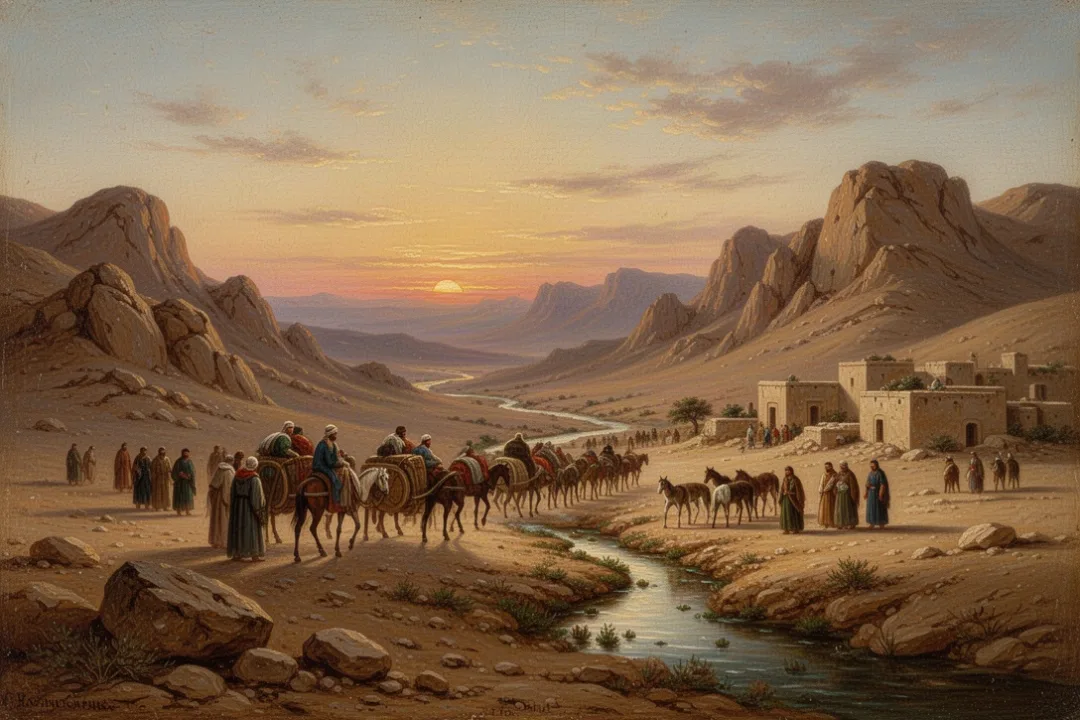
The Bible does not assign the Amalekites one permanent capital or a clearly bounded kingdom. Their descriptions suggest a mobile or semi-mobile population operating across dry southern regions rather than a centralized state with fixed borders.
Several geographical clues are especially useful:
The Negev: Genesis 14, Numbers 13, and 1 Samuel associate Amalek with the southern desert and the Negev. This region includes dry plateaus, seasonal watercourses, and routes linking Canaan with Sinai.
The wilderness south of Canaan: Exodus and Deuteronomy place Amalekite activity along routes used by travelers and migrating groups. Rephidim is not securely located, which limits the precision of the reconstruction.
The hill country of Seir: Some passages connect Amalek with Seir, a region strongly associated with Edom. That connection may reflect geography, genealogy, political proximity, or later efforts to classify neighboring peoples.
Havilah and Shur: The account of Saul’s campaign in 1 Samuel 15 describes territory extending between Havilah and Shur. These names are difficult to map with certainty, but they point toward a broad desert zone rather than a small urban district.
Areas near Philistia: David’s battles in 1 Samuel place Amalekite groups in or near the southern zones contested by Philistines, Judahites, and other desert peoples.
These references fit a society that could move with herds, raid settlements, protect trade routes, and use knowledge of wells and seasonal pasture. Such groups could be politically significant without leaving large cities or monumental buildings.
What kind of society may the Amalekites have been
The biblical portrayal of the Amalekites often emphasizes raiding, mobility, and military alliances. That description reflects the viewpoint of neighboring settled communities, which commonly represented desert raiders as dangerous and unpredictable. It does not tell us everything about the Amalekites’ economy, family structure, or religious practices.
Pastoral and semi-pastoral societies in the ancient Near East were not isolated from towns. They traded animals, hides, food, and labor; guided travelers; served as mercenaries; and sometimes collected tribute. During drought or political instability, conflict over water, grazing, and access to routes could become more intense.
The biblical narratives frequently show Amalekites acting with other groups. They appear alongside Canaanites, Moabites, Midianites, and Philistines in different settings. This pattern may indicate temporary coalitions rather than a single centrally directed Amalekite empire.
The word “Amalekite” may therefore have worked in more than one way. It could identify a particular people, a lineage remembered in tradition, or a broader category for hostile desert groups connected with an older enemy. Ancient ethnic labels were not always as fixed as modern national identities.
Why the encounter with Israel in Exodus matters
Exodus 17 presents the first major conflict between Israel and Amalek. The Israelites have left Egypt and are traveling through a difficult wilderness. Amalek attacks at Rephidim, and Joshua leads the fighting while Moses stands on a nearby elevation with the staff associated with divine action.
The narrative emphasizes that the outcome depends on more than battlefield strength. When Moses’ hands remain raised, Israel prevails; when he grows tired, Aaron and Hur support him. The story then records a victory and an altar associated with the declaration that the Lord is at war with Amalek across generations.
This is not a neutral military report. It explains the conflict as a defining act of hostility against a vulnerable people in transit. It also establishes a long-term relationship between Amalek and the memory of opposition to Israel.
The story’s geography remains uncertain. Proposed locations for Rephidim include areas in the Sinai Peninsula, but no identification has achieved universal acceptance. That uncertainty does not erase the narrative’s importance, though it does caution against presenting the episode as precisely mapped history.
How Deuteronomy explains Amalek’s lasting reputation
Deuteronomy 25 revisits the earlier conflict and focuses on the Amalekites’ treatment of Israel’s weakest travelers. The passage says that Amalek did not fear God and attacked from behind, where the exhausted and vulnerable were found. It commands the Israelites to remember this action after they have settled in the land.
This passage gives the Amalekite conflict a strong ethical dimension. Amalek is not portrayed merely as a rival claiming territory; the group becomes an example of predatory violence against people who could not defend themselves. The command to remember links historical memory with communal identity.
Deuteronomy also looks forward to a time when Israel will have rest from surrounding enemies. At that point, the text says, Israel should erase Amalek’s memory. This language is severe and has produced difficult questions for Jewish and Christian readers. It belongs to an ancient war text shaped by the conventions of its era, and it should not be detached from that literary and historical setting.
Historical and ethical caution: Biblical commands concerning Amalek describe an ancient sacred-war tradition. They are not a general permission for modern violence against any group labeled an enemy.
Amalekites in the period of the judges
The book of Judges presents the era after Israel’s settlement as a cycle of oppression, deliverance, and renewed conflict. Amalek appears in several of these episodes, usually as part of a coalition rather than as an isolated power.
Judges 3 associates Amalek with Moabite rule under Eglon. Judges 6 describes Midianite and Amalekite forces crossing into Israelite territory and damaging crops. Their attacks are portrayed as repeated incursions that leave the population impoverished and dependent on fortified places.
These accounts may preserve memories of raids in agricultural zones along the southern and eastern edges of the Israelite highlands. They also serve the book’s larger theological pattern: Israel suffers when it turns away from God, cries out, and receives a deliverer.
The stories should not be read as proof that one permanent Amalekite army controlled all of central Canaan. Their language is broad, and the campaigns may represent different episodes remembered and shaped by later storytellers. The Amalekites’ repeated appearance signals their symbolic importance as much as their military reach.
Saul’s campaign and the conflict over obedience
The longest and most influential account of Amalek appears in 1 Samuel 15. Samuel tells Saul to attack Amalek because of the earlier hostility against Israel. The story uses the language of total destruction, including people, animals, and property, within the ancient category often called ḥerem, or something devoted to destruction.
Saul defeats the Amalekites but spares Agag, their king, along with the best animals and valuable goods. Saul says the animals were preserved for sacrifice, but Samuel rejects that explanation. The central issue becomes whether the king has obeyed the divine command, not simply whether he won the battle.
Samuel then executes Agag, and the narrative declares that God has rejected Saul as king. The episode is therefore a turning point in the transition from Saul’s reign to David’s rise. Amalek functions as the setting for a story about authority, incomplete obedience, and the consequences of treating royal judgment as more important than prophetic instruction.
Historically, the account may preserve traditions about conflict between Israel’s early monarchy and desert groups to the south. Yet the narrative has also been shaped to explain Saul’s political failure. Readers should distinguish the possible military event from the theological interpretation placed upon it.
David’s battles with Amalekite groups
David encounters Amalekites during the period when he lives among the Philistines. In 1 Samuel 27, he conducts raids in the southern region and reports them in ways that protect his position with the Philistine ruler Achish. The account suggests that the southern borderlands were politically complex, with several peoples competing for access and security.
In 1 Samuel 30, an Amalekite force attacks Ziklag while David and his men are away. The attackers burn the settlement and take its inhabitants captive. David pursues them, receives help from an Egyptian servant abandoned by the raiders, and recovers the captives and property.
The story offers several clues about desert warfare. The Amalekites move quickly, carry captives and goods, and operate across a landscape where local knowledge matters. The Egyptian servant’s testimony also implies that the raiding force included people from different backgrounds, or at least that outsiders could be absorbed into such groups.
Second Samuel 1 adds a controversial episode. A young man who identifies himself as an Amalekite tells David that he killed Saul at Saul’s request and brings Saul’s crown and armband. David has him executed. The account may conflict with the death scene in 1 Samuel 31, where Saul falls on his own sword, and many readers understand the Amalekite’s report as a self-serving claim rather than a reliable account.
What archaeology can and cannot tell us
Archaeology provides valuable information about the environments in which the Amalekites may have lived, but it has not produced a definitive “Amalekite site.” Surveys in the Negev, Sinai, Edom, and adjacent regions reveal camps, settlements, fortifications, pottery, tools, and agricultural installations from different periods. None of these categories automatically carries an ethnic label.
Mobile communities are especially difficult to identify archaeologically. Temporary camps may leave shallow or scattered traces. Groups may use pottery made by neighboring communities, move between regions, or live near settled populations without building large urban centers. Written records can also preserve a group’s name long after its material culture has changed.
The lack of external confirmation should be stated accurately. It does not prove that the Amalekites never existed, but neither does it confirm every biblical detail. The evidence supports a cautious conclusion:
The southern Levant contained mobile and semi-mobile societies capable of raiding and forming alliances.
The biblical geography fits a frontier environment linking the Negev, Sinai, Edom, and Philistine territories.
No independent inscription securely identifies the Amalekites as a documented kingdom or ethnic state.
The biblical accounts were edited and transmitted for theological purposes, so their narratives require historical criticism.
Some scholars have proposed links between Amalek and names found in Egyptian or other ancient records, but these proposals remain uncertain. Similar-sounding names are not enough to establish identity; location, date, language, and historical context must also agree.
Were the Amalekites the same as the Edomites?
The relationship between Amalek and Edom is one of the most debated points in the biblical material. Genesis 36 places Amalek within the genealogy of Esau, whose descendants are associated with Edom. Other passages mention Amalek and Edom near each other geographically or genealogically.
That connection does not necessarily mean that Amalekites and Edomites were one people. Ancient genealogies often express political relationships, shared ancestry, regional proximity, or claims about status. A group could be presented as related to Edom while remaining distinct in political identity.
The Bible sometimes lists neighboring peoples separately, which suggests that its writers recognized a difference between them. At other times, the borders and relationships appear fluid. Amalek may have been a southern group linked to Edom without being identical to the Edomite kingdom.
The Edomites later developed identifiable centers and a more clearly documented political history, especially in the period of Assyrian and Babylonian imperial expansion. Comparable external documentation for Amalek is absent, which may reflect the latter’s less urban and less centralized character.
How the Amalekites disappear from the historical record
The Hebrew Bible eventually speaks of Amalekite remnants rather than a unified people. Saul’s campaign, David’s victories, and the Simeonite attack in 1 Chronicles are presented as steps toward their disappearance. Yet these texts are not independent population records, and they do not establish that every Amalekite community was literally eliminated.
Ancient groups often changed names, joined other populations, or were absorbed into neighboring societies. A people can vanish from written sources without every individual being destroyed. The absence of later references may indicate assimilation, political collapse, loss of the group’s distinct identity, or the end of a literary tradition.
Later biblical and postbiblical writers continue to use Amalek as a remembered enemy. In this setting, “Amalek” becomes more than a name for a vanished desert people. It represents a recurring threat to the community and a symbol of hostility directed toward the vulnerable.
Amalek in Jewish and Christian interpretation
In Jewish tradition, the Amalek story is read especially through the command to remember what happened in the wilderness. The passage from Deuteronomy is associated with the Sabbath before Purim, known as Shabbat Zakhor, when the community recalls Amalek’s attack. The story of Haman in Esther does not call him an Amalekite directly, but later Jewish interpretation connects him with Amalek because of his hostility toward the Jewish people.
Rabbinic discussions often explore the meaning of Amalek, the reliability of genealogical identity, and the conditions under which ancient commands could apply. In many traditional contexts, Amalek is treated as a historical enemy whose identity cannot simply be assigned to contemporary people without a valid chain of knowledge.
Christian interpreters have read Amalek in several ways. Some treat the stories as part of Israel’s ancient history, others interpret Amalek symbolically as sin or opposition to God, and still others focus on the ethical difficulties raised by the commands of total destruction. Responsible interpretation avoids turning a complex ancient text into a direct model for modern political or military action.
How to study Amalekites history responsibly
A sound approach combines close reading with restraint. The Bible is the primary source for the name, but its accounts were written and edited over time. Archaeology provides environmental and social context, while external records help establish what can be confirmed independently.
Separate the passages by genre. Read genealogies, laws, prophetic sayings, and royal narratives according to their different purposes.
Map the geography cautiously. Use the Negev, Sinai, Seir, and southern borderlands as broad regions rather than pretending every place name has a certain modern location.
Distinguish tradition from confirmation. A biblical claim may be historically possible without being independently verified.
Account for mobile societies. Lack of monumental remains does not disprove a pastoral or raiding population, but it limits what archaeology can demonstrate.
Recognize theological shaping. The Amalek narratives explain memory, obedience, kingship, justice, and Israel’s identity—not only military events.
Avoid modern ethnic labels. Equating a present-day population with biblical Amalek is historically unsupported and can encourage dangerous misuse of sacred texts.
The most balanced reconstruction sees the Amalekites as a southern Levantine people or cluster of related groups remembered for conflict with early Israel. They may have operated through mobile pastoralism and raiding rather than a centralized kingdom. Their historical footprint is uncertain, but their role in biblical memory is unmistakably large.
Frequently asked questions
Did the Amalekites really exist?
The Amalekites may have been a real population or network of southern desert groups, but independent evidence is limited. The Hebrew Bible is the main source naming them, and no widely accepted inscription securely identifies an Amalekite kingdom or settlement. Archaeology confirms that the region supported mobile societies capable of raiding, but it cannot prove that particular sites belonged to Amalek.
Where were the Amalekites located?
Biblical references place them broadly in the southern Levant, especially the Negev, the wilderness south of Canaan, and areas near Seir and Edom. Some accounts also associate them with the southern edge of Philistine territory. Because many of these communities were mobile, their location likely changed over time rather than remaining within one fixed border.
Were Amalekites and Edomites the same people?
They appear to have been related in biblical genealogy and connected geographically, but the texts do not consistently treat them as identical. Amalek may have been a southern group associated with Edom while maintaining a separate identity. Similar ancestry in an ancient genealogy does not necessarily mean the groups formed one political nation.
Why is Amalek still discussed today?
Amalek remains significant because biblical passages use the group to discuss memory, vulnerability, justice, obedience, and hostility toward Israel. Jewish tradition especially emphasizes remembering the attack described in Deuteronomy. Modern readers should not identify contemporary populations as Amalek or use these ancient war traditions to justify violence.











Leave a Reply