Biblical history is the study of the people, places, kingdoms, cultures, and events described in the Bible and the ancient world surrounding it. It covers a broad period, from the origins of Israel’s story through the early Christian movement under Roman rule.
To study it responsibly, compare the biblical text with archaeological evidence, ancient inscriptions, geography, and the historical setting of each passage. The Bible contains historical narratives, poetry, prophecy, wisdom writing, letters, and theological interpretation, so each text must be read according to its purpose and genre.
Biblical history is not limited to making a list of dates. It asks how communities understood their past, how rulers governed, how people worshiped, and how events shaped the identities of Israel, Judah, and the early church. The subject connects political history with religion, economics, family life, warfare, law, and trade.
The Bible itself presents history from a particular perspective. Its writers often focus on God’s covenant, human faithfulness, justice, judgment, and redemption rather than describing every event with equal attention. That focus does not make the material irrelevant to history, but it means readers should distinguish between historical events, literary presentation, and theological meaning.
The field generally includes several overlapping areas:
Ancient Israel and Judah: the formation of Israelite communities, the monarchy, the divided kingdoms, exile, and restoration.
The wider ancient Near East: Egypt, Aram, Assyria, Babylon, Persia, and other powers that influenced the biblical lands.
The Second Temple period: Jewish life from the Persian period through Greek and Roman control.
The life and ministry of Jesus: studied within first-century Jewish society and Roman administration.
The early Christian movement: its expansion through the eastern Mediterranean and its relationship to Jewish and Roman institutions.
How the biblical timeline is organized
Dates in biblical history are not equally certain. Some periods can be placed within a reasonably secure political framework, while earlier periods depend more heavily on interpretation of the biblical text and indirect evidence. The timeline below provides a useful framework without pretending that every date is settled.
Origins, ancestors, and the formation of Israel
Genesis presents the stories of creation, the flood, the ancestors Abraham, Isaac, and Jacob, and the family that becomes associated with Israel. These accounts establish themes of land, family, covenant, promise, and migration. Their setting reflects the world of the ancient Near East, where clans, pastoral movement, city-states, and long-distance trade shaped daily life.
Exodus through Deuteronomy describes the Israelites’ escape from Egypt, wilderness experiences, covenant laws, and arrival at the land of Canaan. The precise historical reconstruction of these events remains debated. Archaeology can illuminate settlements, Egyptian influence, and Canaanite society, but it does not provide a simple answer to every question raised by the biblical narrative.
Settlement, judges, and the united monarchy
The books associated with Joshua and Judges portray changing relationships between Israelite groups and the peoples living in Canaan. Rather than imagining a single uniform society, it is more accurate to picture a region of villages, local leaders, competing loyalties, and shifting alliances. The archaeological record shows that settlement patterns changed over time, although the causes and chronology are interpreted differently by scholars.
According to the biblical account, Saul, David, and Solomon ruled a united kingdom before it divided. David becomes the central royal figure connected with Jerusalem, while Solomon is associated with major building projects and the temple. Evidence such as the Tel Dan inscription, which refers to a “House of David,” is frequently discussed because it provides external evidence for a Davidic dynasty, even though it does not confirm every detail in the biblical narratives.
The kingdoms of Israel and Judah
After Solomon’s reign, the kingdom divided into Israel in the north and Judah in the south. Israel’s capital eventually became Samaria, while Jerusalem remained the political and religious center of Judah. The two kingdoms sometimes fought one another, sometimes cooperated, and often responded to pressure from larger empires.
Assyria conquered the northern kingdom in the late eighth century BCE and deported portions of its population. Judah survived longer but faced repeated Assyrian pressure, including the campaign associated with Sennacherib during the reign of Hezekiah. The Assyrian royal inscriptions and the biblical account in 2 Kings, 2 Chronicles, and Isaiah describe these events from different perspectives.
Babylonian exile and Persian restoration
Babylon defeated Judah, captured Jerusalem, and destroyed the temple in the early sixth century BCE. The resulting exile became one of the defining experiences of Jewish history. Biblical books such as Jeremiah, Ezekiel, and Lamentations reflect the trauma of displacement, while later passages describe questions of return, worship, identity, and rebuilding.
The Persian king Cyrus conquered Babylon and permitted displaced peoples to return to their homelands. The books of Ezra and Nehemiah describe the rebuilding of Jerusalem’s temple and walls, along with disputes about community membership and religious practice. This period helped shape postexilic Judaism, although Jewish communities also continued to live outside Judah.
Greek rule and the Second Temple period
Alexander the Great’s conquests brought much of the eastern Mediterranean and Near East under Greek control. After his death, the region was contested by successor kingdoms, especially the Ptolemies and Seleucids. Greek language and culture became influential, but local traditions continued to shape Jewish communities.
The Hasmonean revolt against Seleucid rule led to a period of Jewish political independence. The books of 1 and 2 Maccabees provide important accounts of this era, though they are not included in every Christian biblical canon. The period also saw the development of diverse Jewish groups, institutions, and interpretations that form an essential background for the New Testament.
Roman rule and the early church
Rome became the dominant power in the eastern Mediterranean during the first century BCE. Herod the Great ruled Judea under Roman authority and sponsored extensive construction, including work connected with the Jerusalem temple. After Herod’s death, Roman officials and local rulers governed different parts of the region.
Jesus lived and taught in this world of Roman power, Jewish religious diversity, local economic pressures, and messianic expectation. The Gospels present his ministry, death, and resurrection through theological narratives, while historians also study them as sources for first-century Galilee and Judea. Acts then follows the growth of Christian communities across cities such as Jerusalem, Antioch, Corinth, Ephesus, and Rome.
Why geography matters when reading the Bible
Geography often explains details that are easy to miss in a quick reading. The land described in the Bible includes coastal plains, central highlands, desert margins, river valleys, and mountain routes. Travel, farming, military strategy, and communication were all shaped by this varied landscape.
Jerusalem stood on a ridge in the hill country of Judah and served as a religious and political center. Samaria occupied a strategic position in the central highlands. Galilee included fertile areas around the Sea of Galilee as well as uplands and villages, while Judea extended southward toward drier terrain.
Distances also affect how you understand the narratives. A journey that appears brief on a modern map could involve steep hills, rough roads, seasonal heat, border crossings, or political danger. The route between Jerusalem and Jericho, for example, descends sharply through difficult terrain, which helps explain why travel along it carried practical risks.
Waterways and imperial roads influenced settlement and trade. The Mediterranean coast connected the region with Egypt, Syria, Asia Minor, and the wider Greek world. The Jordan Valley and routes through the hill country created additional corridors, while the Negev and eastern deserts formed difficult but not impassable boundaries.
Reading tip: Before interpreting a journey, battle, or city, locate it on a map and check the terrain. Physical distance and elevation often clarify the choices made by biblical characters.
How archaeology contributes to biblical history
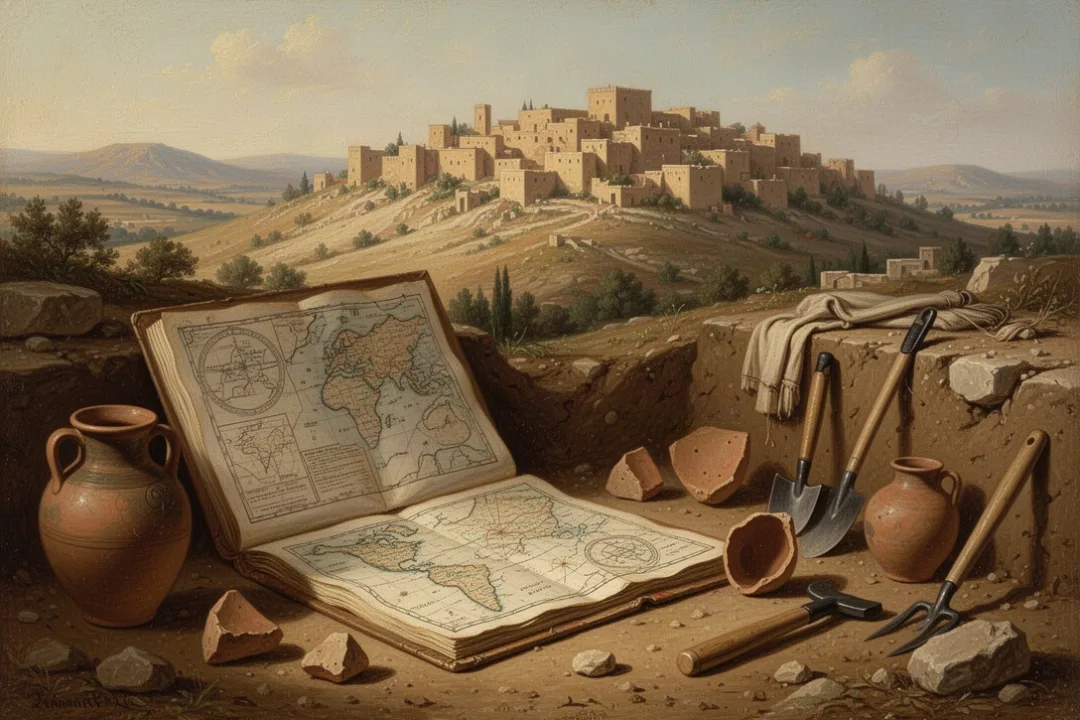
Archaeology studies buildings, pottery, coins, tools, inscriptions, burial sites, roads, food remains, and settlement patterns. These discoveries can show how people lived and how cities changed, even when they do not mention a biblical figure. A ruined wall, storage jar, or administrative seal may reveal the character of a society more effectively than a dramatic object presented without context.
Some discoveries provide direct connections to names or events in the Bible. The Merneptah Stele includes an early reference to Israel in a late second-millennium BCE Egyptian context. The Mesha Stele describes the Moabite king Mesha and his conflict with Israel, offering a non-Israelite perspective on a period also discussed in 2 Kings.
Other finds illuminate later periods. The Dead Sea Scrolls preserve ancient Jewish writings, including biblical manuscripts, and reveal the diversity of textual traditions and religious communities before and around the time of Jesus. Inscriptions connected with Pontius Pilate, Jewish burial practices, and Roman administration help place the New Testament within its first-century setting.
Archaeology has limits. Excavations are incomplete, objects can be difficult to date, and the same evidence may support more than one interpretation. A site’s destruction layer may show that a city was destroyed, but it may not identify the attacker or prove that the event occurred exactly as a biblical account describes it.
What ancient written sources add
Biblical writers were not the only people recording the history of the ancient Near East. Egyptian, Assyrian, Babylonian, Persian, Greek, and Roman sources offer additional evidence. Royal inscriptions often celebrate victories and minimize defeats, so they must be read critically rather than treated as neutral reports.
Assyrian records provide valuable information about rulers, military campaigns, tribute, and deportations. Babylonian records help establish the political setting around the fall of Jerusalem. Persian-era evidence contributes to understanding imperial administration, while Greek and Roman authors offer background for the centuries surrounding the New Testament.
Later Jewish writings can also help explain customs and debates in the Second Temple period. Works such as Josephus’s histories provide information about Judea under Hasmonean and Roman rule, although Josephus wrote for particular audiences and shaped his material rhetorically. His accounts should be compared with inscriptions, coins, archaeology, and the New Testament rather than used in isolation.
Each source has a point of view. A royal inscription may exaggerate military success; a biblical narrative may focus on covenant and judgment; a later historian may organize events to support an argument. Historical study becomes stronger when the differences between sources are examined instead of forced into artificial agreement.
How to read biblical texts as historical sources
Start by identifying the kind of writing you are reading. A narrative in Samuel or Acts functions differently from a psalm, a prophetic oracle, a wisdom saying, or a letter. Genre does not determine whether a passage has historical value, but it affects the questions you should ask and the expectations you should bring.
Pay attention to the text’s setting, audience, and structure. Ask who appears to be speaking, what problem the passage addresses, and how the writer arranges events. Repeated speeches, summaries, genealogies, battle scenes, and chronological notices may serve literary purposes as well as historical ones.
Compare parallel accounts carefully. The books of Kings and Chronicles overlap in their treatment of Judah’s monarchy, but they emphasize different features. The four Gospels also arrange and present material in distinct ways. Differences do not automatically prove that an account is false; they may reflect selection, audience, chronology, or theological emphasis.
Use dates cautiously. Ancient calendars could begin the year in different seasons, reigns might be counted using different systems, and co-regencies can complicate calculations. A precise modern date should not be assigned unless the evidence justifies that level of confidence.
Read the passage in context rather than isolating one sentence.
Identify the genre and the writer’s apparent purpose.
Locate the places and identify the relevant political powers.
Compare parallel passages and note both agreements and differences.
Check external evidence without assuming that silence proves the event did not happen.
Separate evidence from interpretation when writing or discussing your conclusion.
Common mistakes when studying biblical history
Good study requires more than collecting impressive names and dates. Several habits can distort the past or create confidence that the evidence does not support.
Treating the Bible as a modern textbook: Ancient authors had different conventions for chronology, speeches, genealogy, and historical explanation.
Using archaeology as a simple proof system: A discovery may support a setting or detail without proving an entire narrative.
Ignoring nonbiblical evidence: External sources can supply names, dates, political context, and perspectives missing from Scripture.
Assuming silence is disproof: Most ancient records have been lost, and surviving evidence is unevenly distributed.
Flattening all biblical periods together: The world of Abraham, the monarchy, the exile, and the Roman era differed in language, government, economy, and religious practice.
Reading modern borders into the ancient world: Ancient territories changed frequently and rarely matched contemporary political boundaries.
Confusing later tradition with early evidence: A location or interpretation may be ancient and meaningful without being directly confirmed by the earliest sources.
Turning a disputed date into a settled fact: Present competing proposals honestly when the evidence remains uncertain.
Important distinction: Historical evidence can clarify a text’s setting and test particular claims, but it cannot by itself settle every theological question about meaning, revelation, or faith.
How society and daily life shaped the biblical world
Most people in biblical lands lived in agricultural communities. Grain, olives, grapes, dates, livestock, fishing, and small-scale trade supported households, while drought, disease, crop failure, and warfare could quickly create hardship. Wealth and land were unevenly distributed, and large building projects often depended on taxation, labor, or tribute.
Family and household relationships organized much of social life. Extended families could include several generations, servants, dependents, and workers. Marriage, inheritance, adoption, widowhood, and land ownership were not merely private concerns; they affected a family’s economic security and social standing.
Writing existed, but literacy was concentrated among trained scribes, administrators, priests, and other specialists. Many biblical teachings were first communicated orally or performed in communal settings before being copied and transmitted in written form. Manuscripts were reproduced by hand, so the study of textual variants is part of understanding how biblical writings reached later readers.
Religious practice took place in homes, local gatherings, sanctuaries, synagogues, and the Jerusalem temple, depending on the period and community. Sacrifice, prayer, fasting, festivals, purity practices, almsgiving, and study shaped Jewish life in different ways. Early Christians inherited many Jewish categories while developing distinctive practices around Jesus, baptism, communal meals, and the interpretation of Scripture.
Why biblical history still requires careful judgment
Historical reconstruction rarely rests on one piece of evidence. It usually depends on several kinds of clues that vary in strength: a dated inscription, a city layer, a coin, a literary account, a place name, or a pattern of settlement. The best conclusions explain the evidence while acknowledging what remains unknown.
Some questions have broad agreement, such as the existence of major empires, the destruction of Jerusalem by Babylon, Roman control of Judea, and the spread of early Christianity through the eastern Mediterranean. Other questions remain contested, including aspects of the patriarchal narratives, the chronology of the early monarchy, the size of ancient kingdoms, and the dating of particular texts.
Disagreement does not make the subject pointless. It shows where evidence is limited and where interpretation matters. A careful reader can hold a well-supported conclusion while recognizing that responsible scholars may differ about the explanation.
The most useful approach combines close reading, historical context, geographical awareness, and humility about uncertain evidence. Biblical history becomes clearer when you ask not only, “What happened?” but also, “Who recorded this, for whom, when, and why?”
Reliable ways to continue studying
Begin with a readable Bible translation and a historical atlas that shows ancient regions, routes, and changing political boundaries. Then consult introductions to the Old Testament and New Testament, archaeological reference works, and resources that distinguish established evidence from debated interpretation.
When evaluating an online claim, look for specific evidence rather than confident language. A responsible source identifies the discovery, provides its date and location, explains its limitations, and acknowledges alternative readings. Be cautious with claims that one artifact has “proven” or “disproved” the entire Bible.
A simple study file can make your research more useful. Record the passage, approximate period, important places, political rulers, external evidence, and questions that remain unresolved. This method helps you avoid blending information from widely separated centuries.
Use maps for every major journey, battle, and imperial campaign.
Build a timeline that separates approximate dates from disputed ones.
Read multiple perspectives, including biblical, archaeological, and nonbiblical sources.
Check the period before applying a custom or political idea to a passage.
Mark uncertainty with words such as “probably,” “possibly,” or “the evidence is debated.”
Studied this way, biblical history is both a field of ancient history and a way to understand how biblical communities remembered their past. Its central subjects—migration, kingdom, exile, worship, empire, suffering, hope, and community—become more intelligible when read against the lands and cultures where these texts took shape.
Frequently asked questions
Is biblical history the same as Bible study?
No. Bible study can focus on theology, personal application, devotion, or literary interpretation. Biblical history concentrates on historical settings, people, institutions, chronology, geography, and evidence. The two approaches often overlap, but they ask different primary questions. Studying history can clarify a passage’s background without replacing theological or literary interpretation.
Can archaeology prove that every biblical event happened?
Archaeology cannot verify every event or detail. It can provide evidence about cities, rulers, buildings, customs, destruction, and settlement patterns, and sometimes it confirms names or political settings. Many events left no recoverable trace, while surviving evidence can be incomplete or ambiguous. Conclusions should match the strength of the evidence.
Why are some biblical dates disputed?
Ancient dating is complicated by different calendar systems, incomplete records, overlapping reigns, and literary texts that do not always provide modern-style chronology. Scholars also weigh evidence differently. Dates become more secure when they can be connected with dated inscriptions or well-established imperial events, but earlier periods often involve broader chronological ranges.
What is the best place to start learning biblical history?
Start with a historical map, a basic timeline, and a readable Bible translation. Read one period at a time, such as the monarchy or the Roman era, and identify its major rulers, cities, and neighboring powers. A reputable Bible dictionary or academic introduction can then explain unfamiliar terms and distinguish widely accepted findings from disputed theories.











Leave a Reply