Ammonites in the Bible: History, Stories, and Meaning
Ammonites in the Bible: History, Stories, and Meaning
The Ammonites in the Bible were an ancient people who lived east of the Jordan River, in the region associated with modern-day Jordan. The Bible presents them as relatives of Israel through Lot, yet their history includes repeated political, military, and religious conflicts with the Israelites.
They appear in the stories of Jephthah, King Saul, David, the prophets, and the postexilic community in Jerusalem. Their story is not simply about one enemy nation: it also raises questions about family relationships, territorial boundaries, violence, idolatry, judgment, and the difference between an individual’s actions and a nation’s reputation.
According to Genesis 19:30–38, the Ammonites traced their ancestry to Ben-Ammi, the son born to Lot’s younger daughter. Lot was Abraham’s nephew, which made the Ammonites distant relatives of the Israelites. Jacob, the ancestor of Israel, was Abraham’s grandson, so the two peoples shared an ancestral connection even when their governments became rivals.
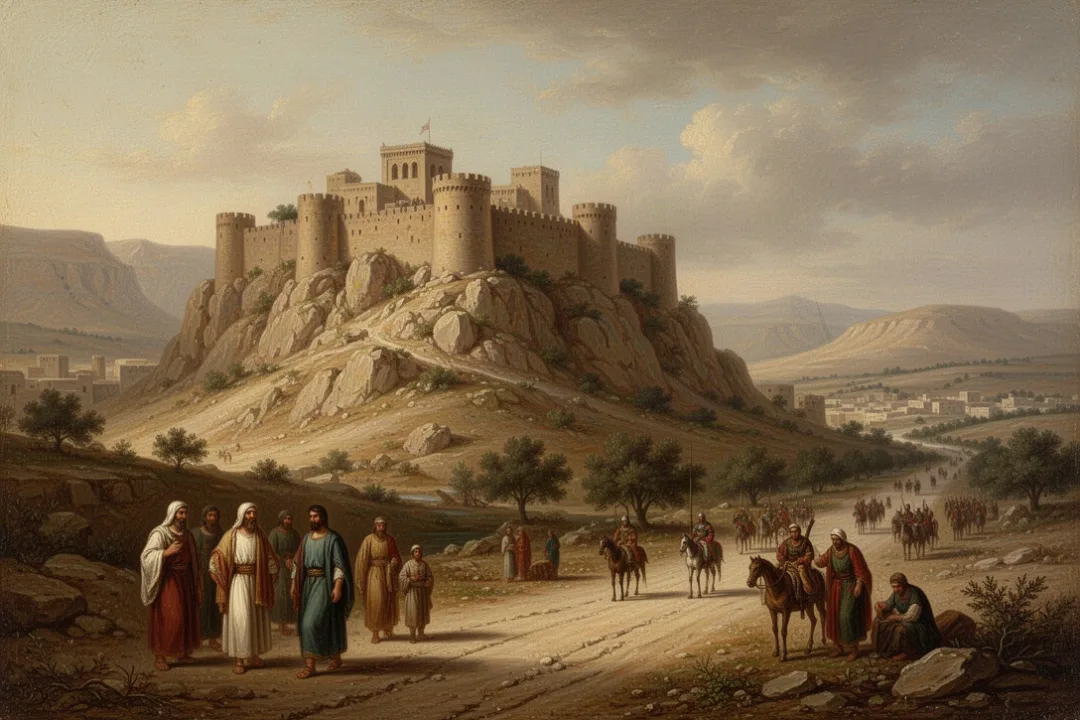
The Ammonite kingdom lay east of the Jordan River and north or northeast of Moab. Its central territory included the highlands around the Arnon and Jabbok regions, although its borders changed over time. The most prominent city was Rabbah, also called Rabbah of the Ammonites. This city is commonly connected with the area of modern Amman, Jordan, though the ancient kingdom was larger than one city.
The Ammonites were part of the wider network of kingdoms and tribal groups living around Israel. Their neighbors included Moab to the south, Aram to the north and northeast, and various peoples connected with the Transjordan. They were not a wandering tribe throughout the biblical period; they developed a recognizable kingdom with a capital, rulers, military forces, and religious practices.
Relationship in one sentence: The Ammonites were related to Israel by ancestry, but their kingdoms frequently competed with Israel for land, influence, and security.
How the Bible describes the Ammonites
The biblical account develops the identity of the Ammonites through several connected themes. Their ancestry begins with Lot, their political history unfolds through wars with Israel, and their prophetic reputation grows because of hostility toward neighboring peoples and opposition to God’s purposes.
Family connection: They descended from Lot’s younger daughter and were therefore related to Israel.
Distinct kingdom: They had their own land, rulers, capital, army, and religious life.
Frequent conflict: They fought Israel during the period of the judges and the monarchy.
Religious difference: They worshiped their own deity, especially Milcom or Molek, rather than the God of Israel.
Prophetic judgment: Later prophets condemned Ammon for violence, territorial aggression, pride, and contempt toward Israel.
Continuing presence: Ammonites still appear in the biblical record after the destruction of Jerusalem and during the rebuilding of the city walls.
These descriptions should be read carefully. The Bible does not treat every Ammonite as personally guilty of every national crime. Its strongest accusations usually concern kings, armies, political communities, and public behavior. The text also preserves examples of Ammonite individuals who appear in different settings, including Naamah, an Ammonite woman who became the mother of Rehoboam according to 1 Kings 14:21 and 31.
What happened between Israel and Ammon during the wilderness period
As Israel traveled toward the land of Canaan, the people encountered instructions concerning several nations east of the Jordan. Deuteronomy 2:19 says that Israel was not to seize the land of the Ammonites because God had given that territory to the descendants of Lot. This instruction recognized the Ammonites as a people with a legitimate territorial inheritance.
That detail matters because the Bible does not portray Israel as having unlimited permission to conquer every neighboring kingdom. The Israelites were told to respect the territories of Ammon, Moab, and Edom in different ways, even though later conflicts occurred. The relationship between divine judgment and political warfare is therefore more specific than a general command to attack all non-Israelite nations.
Deuteronomy 23:3–6 also gives a restrictive statement about Ammonites and Moabites entering the assembly of Israel. The passage connects the restriction with their failure to provide support when Israel traveled through the wilderness and with their hiring of Balaam to curse Israel. The text presents this as a communal policy connected with the nations’ historical conduct.
Readers should avoid treating these passages as a simple description of every Ammonite person. Biblical laws concerning nations often address covenant identity, public allegiance, and the boundaries of Israel’s worshiping community. Later passages add complexity by showing political alliances, foreign marriages, and individual relationships across ethnic lines.
How the Ammonites oppressed Israel in the period of the judges
The Ammonites became a major threat during the era of the judges. Judges 10 describes Israel turning to the worship of multiple foreign gods and then facing oppression from both the Ammonites and the Philistines. The Ammonites attacked communities east of the Jordan and crossed the river to fight against Judah, Benjamin, and the house of Ephraim.
The account emphasizes the seriousness of Israel’s situation. The Israelites confessed that they had abandoned God and asked for deliverance, but the narrative first stresses the consequences of their unfaithfulness. They removed foreign gods and returned to the worship of the Lord, after which the threat from Ammon becomes the setting for the rise of Jephthah.
Jephthah was a military leader from Gilead who had previously been driven away by his relatives. When the Ammonite threat became severe, the elders of Gilead asked him to lead them. His story illustrates a recurring pattern in Judges: a rejected or unlikely leader is called upon during a national crisis, but the leader’s response can still be morally and spiritually complicated.
Why Jephthah argued with the king of Ammon
Before fighting, Jephthah sent a message to the king of Ammon asking why the Ammonites were attacking Israel. The king replied that Israel had taken Ammonite land when it came out of Egypt. Jephthah answered with a historical argument based on Israel’s journey through the wilderness and the earlier conflicts with Sihon, king of the Amorites.
Judges 11 says that Israel had not taken land belonging to Ammon. Instead, Jephthah argued that Sihon had controlled the territory and had attacked Israel first. He also pointed out that Israel had occupied the land for a long period, asking why Ammon had not claimed it earlier if the territory truly belonged to them.
Jephthah’s speech is significant because it shows that ancient warfare was sometimes justified through competing historical claims. The dispute was not described only as a struggle between good and evil. It involved memories of migration, earlier kingdoms, borders, treaties, and the interpretation of inherited territory.
After negotiations failed, the conflict turned into battle. Judges 11:32–33 reports that Jephthah defeated the Ammonites. The victory, however, is followed by the troubling account of his vow concerning his daughter. That episode concerns Jephthah’s rash vow and the treatment of his daughter; it should not be used to define the Ammonites themselves.
How King Nahash treated Jabesh-gilead
The Ammonite king Nahash appears at the beginning of Saul’s reign in 1 Samuel 11. He besieged Jabesh-gilead, an Israelite town east of the Jordan. The terms he offered were intentionally humiliating: the town’s people would be subjected to a mutilating condition that would bring disgrace on Israel.
The elders of Jabesh-gilead asked for seven days to seek help from the Israelite tribes. When Saul heard the report, he summoned an army. The Israelites attacked the Ammonite camp and defeated Nahash’s forces, relieving the city.
This event helped establish Saul as king in the eyes of the people. It showed that a united Israel could respond effectively to a threat from across the Jordan. It also created a lasting connection between Saul and the people of Jabesh-gilead, who later honored Saul after his death according to 1 Samuel 31.
The story portrays Nahash’s demand as more than a normal military surrender. It was a calculated attempt to impose public humiliation and weaken Israel’s identity. The biblical writer uses the crisis to highlight both the danger facing the Israelites and the importance of national unity under a king.
What happened between David and the Ammonites
The Ammonites appear again during the reign of David. When Nahash died, David sent representatives to express sympathy to Hanun, Nahash’s son. The gesture may have reflected a previous relationship between David and Nahash, but Hanun’s advisers persuaded him that David’s messengers were spies.
Hanun humiliated the delegation by shaving them and cutting their garments. The men returned to David in shame, and David told them to remain at Jericho until their beards grew back. The insult then developed into a major military conflict.
The Ammonites hired Aramean forces from surrounding regions. David’s army, led by Joab, found itself facing enemies both in front and behind. Joab divided the forces, assigning one group to confront the Arameans and another to face the Ammonites. The Arameans fled, and the Ammonites withdrew to their city.
The campaign continued until the Arameans made peace with Israel. David later besieged Rabbah, the Ammonite capital. The narrative in 2 Samuel 11–12 connects the siege with David’s adultery with Bathsheba and the death of her husband, Uriah, a story that exposes serious wrongdoing within Israel’s own royal household.
This connection is ethically important. The biblical account does not present Israel as morally superior in every respect simply because it defeated Ammon. David’s abuse of royal power, deception, and responsibility for Uriah’s death receive severe attention. The defeat of a foreign enemy does not erase the sins of an Israelite king.
Why the prophets condemned the Ammonites
Later biblical prophets criticized Ammon for more than military opposition to Israel. Their accusations include violence, territorial greed, contempt for Israel, and atrocities committed against vulnerable people. These charges appear in Amos, Jeremiah, Ezekiel, and Zephaniah.
Amos 1:13–15 condemns the Ammonites for violent actions in Gilead and connects those actions with an attempt to enlarge their territory. The passage describes warfare against pregnant women, an image of extreme brutality and the destruction of future generations. The prophecy announces judgment on the Ammonite royal house and capital.
Jeremiah 49:1–6 challenges Ammon’s claim to territory associated with Gad, one of Israel’s tribes. It refers to Milcom and to the loss of the kingdom’s treasures, then speaks of fear, exile, and eventual restoration. This combination of judgment and a promise of future return shows that prophetic messages can contain both condemnation and hope.
Ezekiel 25:1–7 condemns Ammon for rejoicing over the destruction of the sanctuary, the devastation of Judah, and the exile of the people. The prophecy describes Ammon’s punishment as a consequence of its contempt and delight in another nation’s disaster.
Zephaniah 2:8–11 similarly addresses the insults and threats of Moab and Ammon against Judah. The prophet presents God’s judgment as reaching beyond Israel to the surrounding nations. These texts locate Ammon’s downfall within a broader moral order in which pride, cruelty, and exploitation bring accountability.
Read prophetic judgments in context: The accusations against Ammon focus on concrete actions and attitudes—violence, arrogance, abuse of power, and hostility toward the vulnerable—not on an ethnic trait shared by every individual.
What religion did the Ammonites practice
The Ammonites worshiped a national deity called Milcom, a name associated in the biblical text with the Ammonites. Some passages use the related name Molek, although scholars discuss how these names and references relate to one another. The biblical writers consistently present Ammonite worship as distinct from worship of the God of Israel.
Solomon’s reign provides an important example. According to 1 Kings 11:1–8, Solomon formed marriages with foreign women, including Ammonite women, and his wives influenced him to worship other gods. The passage specifically connects Solomon’s religious decline with the construction of worship sites for deities associated with neighboring peoples.
Milcom also appears in 1 Kings 11:5 and 33, where the writer explains that Solomon followed the gods of the surrounding nations. The criticism concerns the king’s divided loyalty and his departure from exclusive worship of the Lord. It is not a claim that foreign people were incapable of moral conduct or that every cross-cultural marriage had the same result.
Naamah, an Ammonite woman, became the mother of Rehoboam, Solomon’s successor, according to 1 Kings 14:21 and 31. Her appearance shows that the biblical account includes individuals from outside Israel’s tribal ancestry within the royal family, even while criticizing the religious practices associated with foreign gods.
How Tobiah the Ammonite opposed Nehemiah
The Ammonites continued to appear in the postexilic period. In the book of Nehemiah, Tobiah the Ammonite opposed Nehemiah’s leadership during the rebuilding of Jerusalem’s walls. Tobiah was connected by marriage to influential Judean families and had political relationships in Jerusalem, so he was more than a distant foreign enemy.
Nehemiah 2–6 describes Tobiah mocking the rebuilding project and trying to weaken the effort. Sanballat and other opponents questioned whether the Jews could restore the city and its defenses. Their resistance combined ridicule, political pressure, threats, and attempts to draw Nehemiah away from Jerusalem.
Later, Nehemiah 13 says that the high priest had provided Tobiah with a room in the temple complex because of his family connections. Nehemiah removed Tobiah’s belongings and restored the room for its intended use. The episode reflects the postexilic community’s concern about religious boundaries, temple purity, and outside influence.
Tobiah’s story also shows that biblical references to Ammonites are not limited to battlefield conflicts. By this period, the issue involved social networks, marriage alliances, economic relationships, and access to religious institutions. The Ammonite identity remained part of the political and religious debate surrounding Jerusalem.
What the Ammonite story teaches about biblical relationships
The Ammonites were relatives of Israel, but shared ancestry did not guarantee peace. Their story shows that family connections can coexist with competition over land, political power, and national survival. The Bible does not treat kinship as a substitute for justice or as an automatic promise of harmony.
Their history also warns against reducing biblical peoples to one label. Ammon appears as an enemy in one passage, a neighboring kingdom in another, a source of religious influence in a royal household, and a political presence during Jerusalem’s restoration. The same name carries different meanings depending on the historical setting.
Another major theme is the moral evaluation of power. Ammonite kings are condemned for humiliation, violence, and territorial ambition, but Israelite leaders are also judged for arrogance, idolatry, deception, and abuse. The biblical writers apply moral standards to both nations rather than treating Israel’s victories as proof that every Israelite action was righteous.
The prophetic texts add a wider perspective. God’s judgment is not limited to Israel’s enemies, and it is not triggered merely by ethnic difference. The accusations focus on what nations do with power: how they treat the weak, respond to disaster, pursue territory, and regard the suffering of others.
Common mistakes when studying the Ammonites
Several misunderstandings can make the biblical references to Ammonites harder to interpret. Reading every passage as though it describes the same generation, king, or political situation can flatten a history that extends across centuries.
Confusing Ammon with Moab: Both peoples were associated with Lot, but they were separate kingdoms with different stories. Eglon in Judges 3 was king of Moab, not Ammon.
Assuming every conflict was identical: Jephthah’s dispute concerned territorial history, Nahash threatened Jabesh-gilead, and Hanun’s insult led to a separate war under David.
Equating modern populations with ancient enemies: Biblical Ammon belonged to the ancient Near Eastern world. Modern Jordanian communities should not be treated as the same political or religious entity.
Ignoring Israel’s own failures: The Bible criticizes David, Solomon, and other Israelite leaders even while describing victories over Ammon.
Reading prophetic judgment as ethnic hatred: The prophets identify particular acts of violence, pride, oppression, and contempt as the grounds for judgment.
Assuming all references have a positive or negative meaning: The biblical record includes enemies, relatives, royal family members, political opponents, and people connected through marriage.
Where the Ammonites fit in the Bible’s larger message
The Ammonites help place Israel’s history in its regional setting. Israel did not develop in isolation; it shared borders, ancestry, trade routes, military pressures, and political relationships with surrounding kingdoms. References to Ammon make the biblical narrative more geographically and historically specific.
They also demonstrate how the Bible preserves tension rather than smoothing it away. Israel was told to respect Ammonite territory, yet later fought Ammonite armies. Ammonites were condemned for hostile actions, yet an Ammonite woman appears in the royal line. Solomon’s foreign marriages contributed to idolatry, yet the biblical narrative does not erase the reality of cross-border relationships.
For readers studying these passages, the most reliable approach is to ask several questions: Which period is this? Which ruler or community is involved? What action is being criticized? Is the passage describing history, law, poetry, prophecy, or wisdom? These questions help distinguish between a national origin story, a military report, and a prophetic announcement of judgment.
In the Bible, the Ammonites represent a neighboring people whose story is intertwined with Israel’s but never absorbed into it. Their history includes kinship and hostility, cultural exchange and religious conflict, military defeat and political survival. Studied in context, the Ammonites reveal how biblical writers examined the responsibilities of nations and rulers while preserving a complex record of the ancient world.
Frequently asked questions
Were the Ammonites related to the Israelites?
Yes. Genesis 19 presents the Ammonites as descendants of Ben-Ammi, the son of Lot’s younger daughter. Since Lot was Abraham’s nephew, the Ammonites were distant relatives of Israel. This shared ancestry explains why some biblical laws treated them differently from completely unrelated nations, even though Israel and Ammon later became frequent enemies.
What god did the Ammonites worship?
The Ammonites worshiped a deity called Milcom in several biblical passages. The Bible associates their religious practices with worship outside Israel’s covenant faith and criticizes Solomon for supporting shrines connected with foreign gods. References to Molek are related but require careful interpretation because the names and practices are discussed differently across biblical passages.
Are the Ammonites the same as modern Jordanians?
No. The ancient Ammonite kingdom occupied part of the region that is now Jordan, and its capital Rabbah is commonly associated with the area of modern Amman. However, ancient Ammon was a distinct Iron Age kingdom. Modern Jordanian society cannot be identified wholesale with the Ammonites described in the Bible.
What is the main lesson of the Ammonites’ story?
Their story shows that shared ancestry does not prevent conflict and that political power is judged by how it treats others. Biblical writers condemn Ammonite violence, pride, and hostility, but they also expose failures among Israelite kings and communities. The account encourages readers to assess actions and motives rather than reducing entire peoples to a single stereotype.









Leave a Reply