Edomites in the Bible: Their history and significance
Edomites in the Bible: Their history and significance
The Edomites were the descendants of Esau, Jacob’s older brother, and they lived in the rugged territory of Edom southeast of the Dead Sea. The Bible presents them as a related but frequently hostile nation whose history was closely connected with Israel’s.
Edom appears in the stories of Israel’s wilderness journey, the reigns of David and Solomon, the divided kingdom, the fall of Jerusalem, and the prophetic books. The name also continues into the New Testament period through the Idumeans, including Herod the Great’s family.
The Edomites traced their ancestry to Esau, also called Edom. Genesis explains that Esau received the name Edom in connection with the red stew associated with his birthright story. His descendants became a distinct people and established themselves in the hill country of Seir, a region south of the Dead Sea.
Genesis 36 lists Esau’s descendants, chiefs, and kings. This genealogy shows that Edom had an organized society with recognized tribal leaders and rulers. The biblical account also presents Seir’s earlier inhabitants, the Horites, as part of the region’s history before or alongside the development of Edomite power.
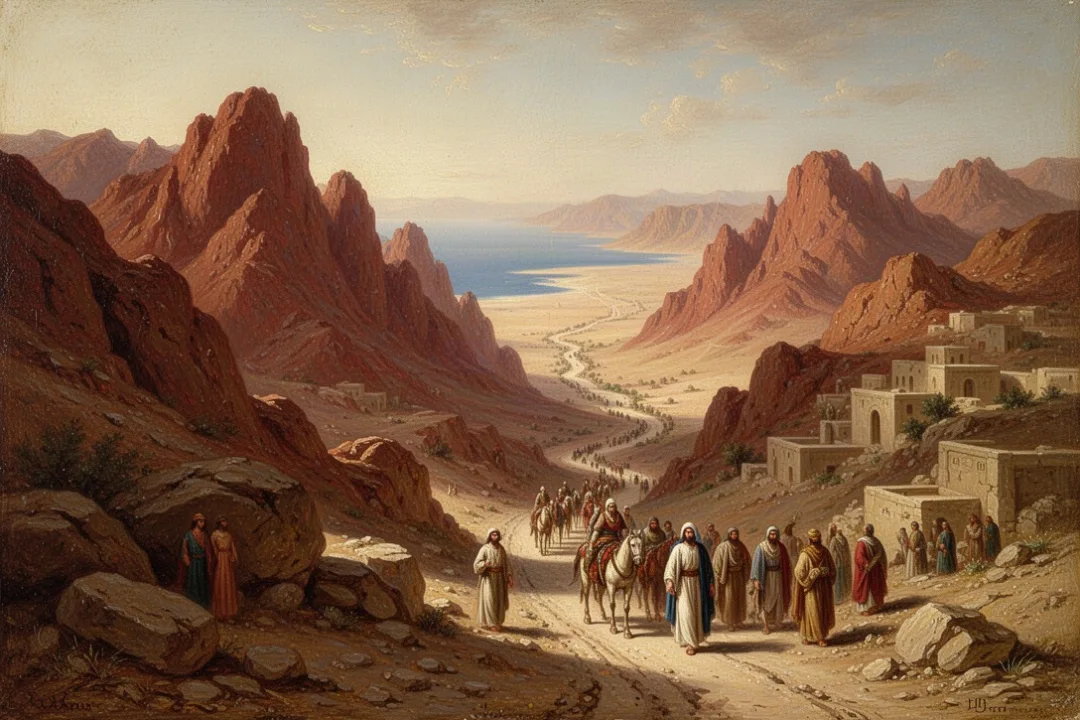
The land of Edom was generally associated with the area extending south from the Dead Sea toward the Gulf of Aqaba. Its terrain included mountains, narrow valleys, and important travel routes. The region’s geography offered natural defenses, but it also connected Edom with trade moving between Arabia, the southern Levant, and areas farther north.
Family connection: The Bible treats Edom as a nation related to Israel through Esau and Jacob. That relationship explains why biblical writers often judge Edom’s actions more severely than they would those of a completely unrelated foreign power.
Deuteronomy 2 describes Edom as a people whose territory God had given to Esau’s descendants. Israel was instructed not to seize the land as it passed through the wilderness. This passage is significant because it recognizes Edom’s possession of its territory even while describing the two nations as neighbors.
The relationship was not simply one of two unrelated kingdoms competing for land. Israel descended from Jacob, while Edom descended from Esau, making the nations traditionally understood as closely related. That shared ancestry created expectations of mutual treatment that Edom did not always meet.
How Esau and Jacob shaped the relationship between Israel and Edom
The relationship begins in Genesis with the difficult story of Esau and Jacob. The brothers struggled even before birth, and their parents, Isaac and Rebekah, received a divine message that the older would serve the younger. Their rivalry intensified when Jacob obtained Esau’s birthright and later received Isaac’s blessing.
These events created a family conflict that lasted beyond the lives of the two brothers. Genesis also records a later meeting in which Esau and Jacob embraced and separated peacefully. That reconciliation did not erase the broader tension between their descendants, but it shows that the biblical tradition contains both conflict and moments of restored family connection.
Esau’s other name, Edom, became the name of the nation associated with his descendants. Biblical writers therefore use Edom as both a personal and national name. In some passages, “Edom” refers to the kingdom or its territory; in others, it represents the people as a whole.
The Pentateuch distinguishes Edom from several neighboring peoples. Deuteronomy 23 gives instructions concerning Edomites and Moabites in the community of Israel, reflecting their historical relationship and their status as nearby nations. The precise social application of these laws has been discussed by interpreters, but the passage clearly treats Edom as a recognizable people with a special connection to Israel.
That connection also appears in the account of Israel’s journey from Egypt to Canaan. When Moses asked Edom for permission to pass through its territory, Edom refused and came out with a large force, causing Israel to take another route. Numbers 20 records the episode, while Judges 11 and other passages recall Edom’s position in Israel’s southern neighborhood.
The refusal at the wilderness border became a lasting memory. It represented more than a logistical problem: Edom had denied passage to its related nation during a vulnerable stage of Israel’s journey. Later biblical references to Edom often draw on this history of tension.
What happened between Edom and Israel during the monarchy
The conflict became military during the monarchy. According to 1 Samuel 14, Saul fought against several surrounding peoples, including Edom. The reference places Edom within the network of neighboring kingdoms that challenged Israel’s early kings and competed for influence in the region.
David achieved a decisive victory over Edom. Accounts in 2 Samuel 8 and 1 Chronicles 18 describe David’s defeat of the Edomites and the establishment of Israelite control over the area. The biblical books present this victory as part of David’s wider expansion and as an important stage in securing Israel’s southern frontier.
Psalm 60 reflects a period of military crisis involving Edom, while its heading connects the composition with Davidic battles. The psalm should not be read as a simple historical report, but it shows that Edom became a symbol of a dangerous southern enemy in Israel’s worship and national memory.
During Solomon’s reign, Edom’s territory remained important to Israel’s trade and military access. Solomon’s ships operated from Ezion-geber near the Gulf of Aqaba, as described in 1 Kings 9 and 10. Control of this area gave Israel access to commercial routes, although the biblical narrative does not present the arrangement as permanently stable.
After Solomon’s death, Edom eventually broke away from Judah. First Kings 11 describes Hadad the Edomite, a member of the royal family, who became an adversary of Solomon after fleeing to Egypt. Second Kings 8 later reports an Edomite revolt against Judah during the reign of Jehoram, and the account says that Edom established its own king.
Judah and Edom continued to fight during the divided monarchy. Jehoshaphat joined with Israel’s king and the king of Edom in a campaign against Moab in 2 Kings 3. The three-king alliance shows that political circumstances could temporarily bring the kingdoms together even when their deeper relationship remained unstable.
Second Kings 14 and 2 Chronicles 25 describe Amaziah of Judah’s campaign against Edom. Amaziah captured a major Edomite stronghold and took significant territory, but the victory did not end the rivalry. Edom remained a persistent regional power and later benefited from Judah’s weakening position.
In the days of Ahaz, Edomites attacked Judah and carried away captives, according to 2 Chronicles 28. The account comes during a period when Judah faced pressure from multiple enemies. It portrays Edom not as a distant threat but as a nearby kingdom able to exploit Judah’s military and political distress.
Saul’s reign: Edom appears among the nations Israel fought during the early monarchy.
David’s reign: Israel defeated Edom and gained control over its territory.
After Solomon: Edom rebelled and regained independence from Judah.
Later kings: Judah and Edom continued alternating between warfare, alliances, and retaliation.
Why the prophets condemned Edom
The strongest biblical criticism of Edom appears in the prophetic books. The prophets do not condemn Edom merely because it was a military rival. They focus on pride, violence, betrayal, and participation in Judah’s suffering, especially when Jerusalem was attacked or destroyed.
Obadiah is devoted almost entirely to Edom’s judgment. The prophecy addresses Edom’s pride in its mountain strongholds and its confidence that enemies could not reach it. The prophet declares that Edom’s apparent security would not protect it from divine judgment.
Obadiah also accuses Edom of standing aside when Jerusalem was invaded, rejoicing over Judah’s disaster, entering the city, taking possessions, and handing over survivors. The exact historical details behind these accusations are debated, but the central charge is clear: Edom acted against its brother nation at the moment of greatest vulnerability.
Psalm 137 remembers Edom’s call for Jerusalem’s destruction and places that hostility within the pain of the Babylonian exile. The psalm is a lament expressing the emotional force of catastrophe, not a neutral description of diplomatic policy. It helps explain why Edom became associated with betrayal in Israel’s later memory.
Several other prophetic books announce judgment against Edom. Isaiah 34 depicts Edom as a focus of sweeping divine punishment, while Isaiah 63 pictures a divine figure coming from the direction of Edom in imagery of judgment. Jeremiah 49 condemns Edom’s wisdom, pride, and confidence in its natural defenses.
Ezekiel 25 and 35 also speak against Edom. Ezekiel 25 emphasizes Edom’s revenge against Judah, while Ezekiel 35 portrays the hostility as persistent and deeply rooted. Amos 1 condemns Edom for pursuing its brother with violence and refusing to end its anger.
These passages use several recurring themes:
Arrogance: Edom trusted its elevated and defensible location.
Revenge: The prophets describe Edom as holding onto anger against Israel.
Betrayal: Edom’s family relationship with Israel made its hostility especially offensive.
Opportunism: Edom is accused of benefiting from Judah’s defeat.
Reversal: The nation that seemed secure would itself experience devastation.
The prophetic judgments should be read as theological interpretations of national conduct. They do not mean that every Edomite individual was personally guilty of every action attributed to Edom. Biblical prophecy often addresses a nation collectively, using its name to describe the behavior of its rulers, armies, and public identity.
Why Edom matters in prophecy: The issue is not only ancient border warfare. The prophets use Edom to show that power, pride, and celebration of another nation’s suffering can bring judgment, especially when the offender has a close relationship with the people it harms.
How Edom declined and became Idumea
The historical Edomite kingdom did not continue as an independent power indefinitely. By the postexilic and Second Temple periods, the region was increasingly known by the Greek form Idumea. The exact stages of Edom’s decline and population movements are complex, and the biblical books provide only part of the historical record.
Malachi 1 refers to Edom as a people whose land had been devastated. The prophecy contrasts Jacob and Esau in a theological discussion about God’s covenant purposes. The passage does not offer a complete political history, but it reflects the continuing importance of Edom as a symbol of opposition to Israel.
In later centuries, Idumeans lived in the southern part of the former Edomite area and in neighboring regions. The Hasmonean ruler John Hyrcanus conquered Idumea during the second century BC. Ancient historical sources report that the Idumeans were incorporated into the Jewish state and adopted Jewish religious practices, although the details and extent of this process are discussed by historians.
The New Testament does not commonly use the name Edom for a contemporary ethnic group. Instead, the Herodian dynasty came from an Idumean background. Herod the Great, who ruled Judea under Roman authority and appears in Matthew 2, was associated with this Idumean lineage.
That fact connects the old biblical name of Edom with the political world surrounding Jesus’ birth. Herod’s family was deeply involved in Judean and Roman politics, but the New Testament does not portray every later Idumean as personally responsible for the Edomite actions condemned by the prophets.
Some readers connect Herod’s actions with the Old Testament hostility between Edom and Israel. That connection may help explain why Edom remained a powerful symbolic category in Jewish interpretation, but it should not replace careful attention to the differences between ancient Edom, later Idumea, and the Herodian dynasty.
What the Edomites teach about biblical themes
The Edom narratives illustrate how the Bible treats relationships between neighboring peoples. Israel was not told to erase the existence of Edom; Deuteronomy recognizes Edom’s inherited territory. At the same time, Edom’s violent actions and treatment of Judah were subject to moral evaluation.
The story also shows that shared ancestry does not automatically produce loyalty. Edom and Israel were related through Esau and Jacob, but family connection could intensify resentment instead of preventing it. The prophets repeatedly return to the idea that betrayal by a brother is especially grievous.
Edom’s mountain setting becomes a recurring image of false security. The nation believed that its elevated cities and difficult approaches would protect it. Prophetic judgment challenges that confidence by insisting that geographical strength cannot shield a nation from accountability.
Another theme is the danger of taking advantage of disaster. Obadiah’s charges focus on Edom’s response when Jerusalem fell. The prophecy condemns not only direct violence but also watching from a distance, celebrating calamity, seizing property, and blocking escape.
The Bible’s treatment of Edom also cautions against simplifying national conflict into a permanent label for every person. Biblical texts sometimes speak of Edom collectively, but individuals and communities lived within changing political conditions. Good interpretation distinguishes between prophetic judgment on a nation and assumptions about all people who shared an ethnic or regional identity.
For readers studying the Edomites, several passages provide a useful starting point:
Genesis 25 and 36: Esau’s story and the genealogy of Edom.
Numbers 20: Edom’s refusal to allow Israel passage.
2 Samuel 8 and 1 Kings 11: David’s victory and later Edomite opposition.
2 Kings 8 and 14: Edom’s revolts and conflicts with Judah.
Obadiah: The clearest concentrated prophecy against Edom.
Jeremiah 49, Ezekiel 25 and 35, and Amos 1: Additional prophetic judgments.
Matthew 2: Herod the Great in the later Idumean context.
Read together, these passages present Edom as more than a minor Old Testament nation. Edom represents a real historical people with a recognizable territory, political institutions, and changing relations with Israel. It also becomes a biblical example of how pride, resentment, and exploitation of another nation’s weakness can lead to judgment.
The Edomites disappear as an independent biblical kingdom, but the questions raised by their story remain clear. How should related nations treat one another? What happens when a people turns another’s disaster into an opportunity? And can military strength or secure geography protect injustice from accountability? The biblical writers consistently answer that national power does not excuse betrayal or violence.
Frequently asked questions
Are the Edomites and Israelites related?
Yes. The Bible presents the Edomites as descendants of Esau and the Israelites as descendants of Jacob, Esau’s younger brother. Their relationship is therefore described as one between related peoples rather than unrelated nations. This family connection is central to the biblical criticism of Edom because Edom’s hostility toward Israel is portrayed as especially bitter and disloyal.
Where was Edom located in the Bible?
Edom was southeast of the Dead Sea, extending toward the Gulf of Aqaba. Its territory included rugged mountains and defensible settlements in the region later called Idumea. The landscape helped Edom protect itself and control routes connecting southern Arabia, the Dead Sea area, and the wider Levant.
Did David completely destroy the Edomites?
No. David defeated Edom and established Israelite control over much of its territory, but Edom continued as a people and later regained independence. The kingdom remained involved in conflicts with Judah during the divided monarchy. Its later history continued under the name Idumea, particularly during the Second Temple period.
Was Herod the Great an Edomite?
Herod the Great was from an Idumean, or later Edomite, family background. His family became integrated into the Jewish political world after Idumea was incorporated into the Hasmonean state. Herod ruled Judea under Roman authority and is mentioned in Matthew 2, but the New Testament does not simply equate his personal actions with every biblical judgment against ancient Edom.







Leave a Reply