Daniel 7 is a vision of God judging oppressive kingdoms and giving everlasting authority to “one like a son of man.”
The chapter uses vivid symbols rather than presenting a straightforward historical narrative. Daniel sees four beasts rising from a troubled sea, a heavenly courtroom, a terrifying final ruler, and a figure who receives dominion from God. Its central movement is from chaos to judgment and from human empires to God’s lasting kingdom.
Readers have interpreted the details in different ways. Some connect the beasts with four successive empires, while others see the vision as a pattern that applies to worldly powers across history. Christian interpreters also connect the “son of man” figure with Jesus, although the chapter itself first presents him within Daniel’s vision and its immediate setting.
Daniel 7 appears after six chapters that mostly tell stories about Daniel and his companions in foreign courts. The first half includes accounts of royal demands, persecution, miraculous deliverance, and God’s sovereignty over rulers. Chapter 7 begins a more concentrated section of symbolic visions that Daniel receives and struggles to understand.
The chapter is dated to the first year of Belshazzar, king of Babylon, according to its opening. Belshazzar appears elsewhere in Daniel as a ruler whose kingdom is nearing its end. The setting therefore places the vision near a period of major political transition, when one empire is giving way to another.
Daniel 7 is written in Aramaic, like Daniel 2:4 through 7:28. That linguistic section focuses heavily on kingdoms, rulers, judgment, and the future of God’s people. Daniel 8 through 12 return to Hebrew and develop further visions involving later rulers and conflicts.
The chapter has two layers of communication. First, Daniel describes what he sees. Then an interpreting figure explains selected symbols, especially the beasts, the kings, and the kingdom given to the holy ones. The interpretation does not explain every visual detail, so readers should avoid treating every feature as a separate code.
What the four beasts rising from the sea represent
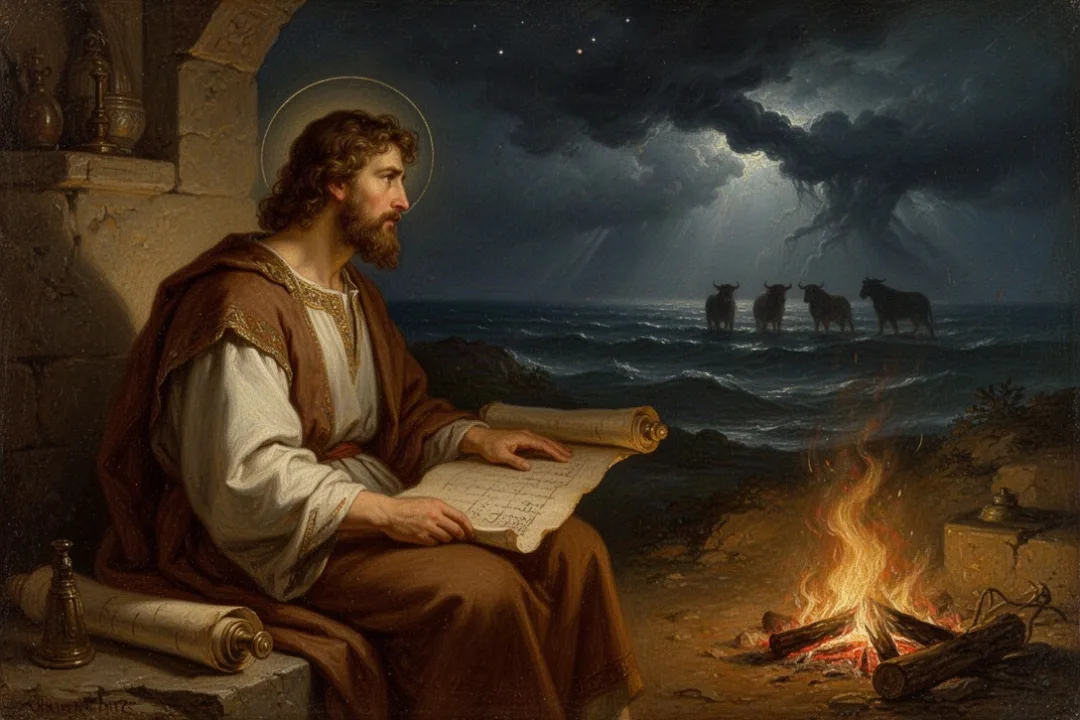
Daniel sees the four winds of heaven stirring up the Great Sea. Four large beasts then rise from it, each different from the others. In biblical imagery, the sea can represent danger, disorder, or forces beyond human control. The winds intensify that impression: the scene begins with turbulence rather than peace.
The interpreting figure later says that the four beasts are four kings or kingdoms that will arise from the earth. The wording allows the symbols to refer both to individual rulers and to the political powers they represent. The beasts are not merely animals in a strange dream; they portray kingdoms that become predatory, proud, and violent.
The first beast resembles a lion with eagle’s wings
The first beast looks like a lion and has eagle’s wings. Its wings are torn off, it is lifted from the ground, and it is made to stand like a human being with a human mind. The image combines royal strength with rapid conquest, then shows the beast being humbled and humanized.
Many interpreters identify this first kingdom with Babylon, the empire that dominates the early chapters of Daniel. The lion and eagle are fitting symbols for imperial power, although the chapter itself does not name Babylon at this point. The beast’s transformation may recall the humbling and restoration of a proud king described earlier in Daniel.
The change from beastlike behavior to human understanding suggests that political power can be judged and restrained. A ruler or kingdom may appear nearly unstoppable, yet God can remove its pride and limit its power. The detail also prepares the reader to contrast brutal human kingdoms with the genuinely human figure who comes later.
The second beast is raised up on one side
The second beast resembles a bear and is raised up on one side. It is told to consume much flesh and has three ribs in its mouth. The picture conveys heaviness, aggression, and uneven strength, though the text does not explain the ribs individually.
Common interpretations identify this kingdom with the Medo-Persian Empire, often emphasizing the beast’s uneven posture as a possible image of the two-part empire. Other interpreters organize the kingdoms differently, depending on whether they begin the sequence with Assyria, Babylon, or another power. The main point remains that the second beast represents a kingdom of substantial military force.
The command to devour much flesh highlights the human cost of imperial expansion. Daniel does not describe empire only through palaces, armies, or political succession. He shows what such power does to bodies and communities, making the vision a moral critique as well as a prediction or historical interpretation.
The third beast has four wings and four heads
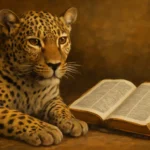
The third beast resembles a leopard but has four wings on its back and four heads. A leopard already suggests speed, while multiple wings intensify the impression of swift conquest. The four heads imply a division or multiplication of authority after the kingdom’s initial rise.
Many readers associate this beast with Greece, especially the rapid expansion of Alexander the Great and the later division of his empire. That interpretation connects the four heads with major successor kingdoms, though the exact historical mapping is debated. The text’s emphasis is on speed, reach, and fragmented rule.
The third beast illustrates how a kingdom can expand rapidly and then become divided. Military success does not create permanence. A power may move across territories with remarkable speed, but its structure can fracture when leadership changes or competing rulers claim control.
The fourth beast is unlike the others
The fourth beast receives the most attention because it is more terrifying and difficult to describe. It has large iron teeth, bronze claws, and ten horns. It crushes and devours its victims, leaving a stronger impression of systematic domination than the earlier beasts.
The interpretation calls it a fourth kingdom different from the others. Many traditional interpreters identify it with Rome, especially when the four kingdoms are understood as Babylon, Medo-Persia, Greece, and Rome. Other scholars connect the fourth beast with the Seleucid kingdom or another power arising from the Greek world, particularly because of the chapter’s concern with persecution and temple-related oppression.
The disagreement matters because Daniel 7 uses language that can be read in more than one historical framework. A responsible explanation should distinguish between what the chapter explicitly says and what a particular interpretation infers. The text clearly presents a final oppressive power; it does not provide a universally accepted chart matching every horn to a named ruler.
Interpretive guide: Treat the four beasts as symbols of arrogant political power before assigning them to specific empires. Historical identifications can clarify the vision, but they should not overshadow its central message about God’s judgment.
Why the ten horns and little horn matter
The fourth beast has ten horns, and another smaller horn rises among them. Three of the first horns are uprooted before it. The little horn has humanlike eyes and a mouth speaking boastful things. These details shift the focus from a general empire to a specific arrogant ruler who claims authority beyond proper limits.
The ten horns are explained as ten kings arising from the fourth kingdom. The little horn is another king who comes after them and differs from the earlier rulers. He defeats three kings, speaks against the Most High, oppresses the holy ones, and attempts to change appointed times and law.
These actions reveal the horn’s character more clearly than its physical appearance. It is not simply powerful; it is blasphemous, oppressive, and hostile to faithful people. Its ambition reaches into religious life and the ordering of time, suggesting an effort to control what belongs to God.
Many historical interpreters connect the little horn with Antiochus IV Epiphanes, a second-century B.C. ruler who persecuted Jews and desecrated the Jerusalem temple. This reading fits the concerns found in Daniel 7–12 and the historical crisis often associated with those chapters. Other interpreters see the little horn as a later end-time ruler, while some understand Antiochus as a historical pattern that points beyond itself.
The chapter does not say that the little horn wins permanently. Its boastful speech continues only until the heavenly court sits in judgment. This limits the ruler’s apparent freedom and gives the persecution a defined boundary. Evil may be severe, but it is not sovereign.
What the Ancient of Days reveals about God’s judgment
After the beasts appear, Daniel sees thrones placed in position and the Ancient of Days seated. His clothing is white, his hair is like pure wool, and his throne is fiery, with wheels of burning fire. A stream of fire flows from before him, and countless attendants stand before him.
The image presents God as the eternal judge. White clothing and hair suggest purity and age beyond ordinary human limits, while fire communicates holiness and judgment. The wheels indicate movement or majesty in the throne scene, though the chapter does not require a separate symbolic meaning for every feature.
Books are opened before the court. This detail communicates that the judgment is informed and accountable rather than arbitrary. The kingdoms may act with violence and propaganda, but their actions are known and brought before a higher tribunal.
The judgment begins with the fourth beast’s boastful words. It is killed and its body destroyed by fire. The other beasts lose their authority but are allowed to continue for a limited period. This difference may suggest that the fourth kingdom faces a decisive end, while earlier powers survive only as diminished remnants or memories.
The courtroom scene changes the perspective of the vision. On earth, the beasts look dominant. In heaven, they are defendants before the throne. Power is redefined by God’s verdict, not by military strength, territory, fear, or political longevity.
Who is “one like a son of man”?
Daniel then sees one like a son of man coming with the clouds of heaven. He approaches the Ancient of Days and is presented before him. He receives authority, glory, and a kingdom so that people from every nation and language serve him.
The phrase “one like a son of man” literally emphasizes a humanlike figure. The contrast is striking: the kingdoms rise as beasts, but the rightful ruler appears in human form. This does not necessarily mean the figure is weak or ordinary. He arrives with the clouds, a detail associated with heavenly authority, and receives universal dominion.
His rule is described as everlasting. Unlike the beasts, whose authority is removed, his dominion will not pass away and his kingdom will not be destroyed. The vision therefore places true human rule within a relationship to God rather than in opposition to God.
In the immediate interpretation, the son of man is closely connected with the holy ones of the Most High. The holy ones receive the kingdom, possess it forever, and are identified with the people who endure the beast’s oppression. This creates an important interpretive question: is the figure an individual representative of the holy ones, a heavenly figure, or both?
Christian readers commonly connect this passage with Jesus because the Gospels repeatedly use “Son of Man” language for him. Jesus’ sayings about coming with clouds and receiving authority echo Daniel 7, especially in passages such as Matthew 24:30, Mark 13:26, and Mark 14:62. Those New Testament connections shape Christian interpretation, but they should be read alongside Daniel’s original contrast between beastly kingdoms and God’s humanlike ruler.
Daniel’s vision turns the question from “Which empire is strongest?” to “Who receives authority when God judges the powers of the earth?”
How the holy ones receive the kingdom
The interpretation of the vision repeatedly mentions the holy ones of the Most High. The little horn wages war against them and seems to prevail for a time, but the court rules in their favor. They ultimately receive the kingdom and possess it forever.
The holy ones are not portrayed as escaping every period of suffering. They experience hostility, loss, and apparent defeat. Daniel 7 therefore does not promise that faithfulness will always produce immediate safety or political success. It promises that persecution does not determine the final outcome.
The chapter also places the holy ones within a shared future rather than focusing only on the survival of one heroic individual. Their vindication is communal. God’s judgment restores a people who have been treated as powerless by the beastly ruler.
This theme can be read pastorally without reducing the vision to private encouragement. Daniel is addressing the public realities of empire, religious pressure, and political arrogance. The chapter assures communities that their identity and future do not depend on the approval of the rulers who threaten them.
How Christians read Daniel 7 in relation to Jesus
Daniel 7 is one of the most influential Old Testament passages for Christian teaching about Jesus’ identity and future reign. Jesus uses “Son of Man” language in contexts involving authority, suffering, judgment, and coming with the clouds. Early Christian preaching also presents Jesus as the one exalted by God and given universal rule.
Several connections are especially significant:
Authority: Daniel’s humanlike figure receives dominion from the Ancient of Days, while the New Testament presents Jesus as receiving authority from God.
Cloud imagery: The figure comes with the clouds, and Jesus’ future appearing is described with similar imagery in the Gospels and Revelation.
Judgment: Daniel’s vision places the beasts before God’s court, while Jesus is associated with the final judgment of nations and rulers.
Kingdom: Daniel describes an everlasting kingdom, and Christian teaching identifies Jesus’ reign with the fulfillment of God’s kingdom.
These connections do not mean every Christian tradition explains the passage in exactly the same way. Some emphasize Jesus as the individual Son of Man who represents his people. Others stress that Jesus shares his victory with the saints, so the vision includes both the Messiah and the community joined to him.
The chapter also helps explain why Jesus’ title could sound both humble and exalted. “Son of Man” can refer to human identity, yet Daniel 7 gives the figure heavenly access and worldwide authority. The tension between suffering humanity and divine appointment becomes central to Christian readings of Jesus’ ministry.
How Daniel 7 relates to Revelation and other biblical passages
Daniel 7 contributes imagery to several later biblical passages. Revelation draws on the pictures of beasts, horns, heavenly thrones, opened books, judgment, and an everlasting kingdom. These later texts often combine Daniel’s symbols with images from other prophetic books, so readers should not assume that each symbol keeps exactly the same meaning.
Daniel 7 also connects with Psalm 2, where earthly rulers oppose God but are ultimately placed under divine authority. Isaiah’s visions of God’s reign and Ezekiel’s throne imagery provide additional background for the courtroom and kingdom themes. The New Testament’s use of Daniel 7 shows that early Christians viewed the chapter as relevant to both Jesus’ present authority and his future appearing.
These connections should be handled carefully. A later biblical writer may reuse an image to develop a related point rather than offer a one-to-one explanation of every detail in Daniel. Comparing passages is most helpful when you first identify the main idea in each context.
Practical tips for reading Daniel 7 accurately
Daniel 7 can become confusing when readers move too quickly from symbol to prediction. The following habits help keep the interpretation grounded in the chapter’s wording and structure:
Separate vision from interpretation. Read Daniel’s description first, then examine what the interpreting figure explicitly explains.
Start with the main contrast. Notice the difference between beastly kingdoms and the humanlike ruler who receives an everlasting kingdom.
Distinguish certainty from possibility. The chapter clearly speaks of four kingdoms, a boastful horn, judgment, and the holy ones’ vindication. The precise historical identities of every horn are less certain.
Read the chapter as a whole. The beasts, courtroom, little horn, son of man, and holy ones belong to one vision rather than isolated prediction units.
Consider historical context. Ask how the vision would have encouraged people living under foreign rule or religious persecution.
Compare related passages responsibly. Use the Gospels and Revelation to understand Christian reception, but do not erase Daniel’s own setting.
Avoid assigning a modern politician too quickly. Daniel 7 has been repeatedly applied to contemporary rulers, often with conflicting results. Its warning concerns recurring patterns of arrogant power, not only one modern figure.
Common mistakes in explaining Daniel 7
One common mistake is treating the chapter as a secret timeline in which every claw, wing, tooth, and horn must correspond to a separate modern event. Daniel’s symbolism is detailed, but the interpreting figure explains only some features. Overconfident precision can obscure the chapter’s clear theological message.
Another mistake is focusing so intensely on the beasts that the Ancient of Days and the son of man receive less attention. The vision is not designed to make readers fascinated by terrifying rulers. The beasts are judged, while the kingdom given by God endures.
A third mistake is assuming that any reference to four kingdoms has only one possible historical scheme. The most widely known Christian framework identifies Babylon, Medo-Persia, Greece, and Rome. Other readings give different weight to the Median kingdom, the Persian period, or the Hellenistic crisis. Good interpretation acknowledges the debate instead of presenting a contested detail as certain.
Keep the center in view: Daniel 7 is not primarily a puzzle about predicting headlines. It is a vision of God’s authority over violent kingdoms and the promised vindication of those who remain faithful.
What Daniel 7 means for power, suffering, and hope
Daniel 7 presents political power as morally accountable. The kingdoms are not condemned simply because they govern; they are portrayed as beasts because they devour, boast, oppress, and resist God. The chapter asks readers to judge power by its treatment of people and its posture toward divine authority.
The vision also gives language for periods when evil appears to win. The little horn makes war against the holy ones and prevails over them for a time. Daniel does not deny that oppression can be real or frightening. Instead, he places it within a larger scene in which the heavenly court reaches a final verdict.
Hope in Daniel 7 is therefore more than optimism. It rests on God’s judgment, the end of beastly rule, and the permanence of the kingdom entrusted to the son of man and the holy ones. The chapter invites faithful people to see beyond the temporary appearance of political dominance.
Its final emphasis is the character of the coming kingdom. It is not described through sharper claws, heavier teeth, or greater violence. It is defined by divine authorization, enduring rule, and the restoration of a people who have suffered under oppressive power.
Frequently asked questions
Are the four beasts in Daniel 7 four specific empires?
Many interpreters identify them as Babylon, Medo-Persia, Greece, and Rome. Others place the fourth beast within the Hellenistic period and connect the little horn with Antiochus IV Epiphanes. Daniel clearly presents four successive kingdoms, but the precise historical scheme remains debated. The chapter’s main point does not depend on identifying every empire with complete certainty.
Is the “son of man” in Daniel 7 Jesus?
Christian interpretation commonly connects Daniel’s humanlike figure with Jesus because the Gospels use “Son of Man” language and echo the imagery of coming with the clouds. In Daniel’s immediate vision, the figure is also closely associated with the holy ones who receive the kingdom. Christians therefore often understand him as an individual representative whose victory includes his people.
What does the little horn symbolize?
The little horn represents an arrogant ruler who rises from the fourth kingdom, defeats other rulers, speaks against God, and persecutes the holy ones. Many historical readings associate him with Antiochus IV Epiphanes, while other traditions view him as an end-time ruler or a pattern of future opposition. The text emphasizes his pride and limited duration more than his exact identity.
What is the main message of Daniel 7?
Human kingdoms may become violent, proud, and oppressive, but they remain accountable to God’s heavenly court. Their authority is temporary, while the kingdom given to the son of man and the holy ones is everlasting. Daniel 7 encourages faithful endurance by redefining apparent political defeat: the beasts may dominate for a time, but God determines the final verdict.





Leave a Reply