Daniel in the Bible: His Story, Visions, and Meaning
Daniel in the Bible: His Story, Visions, and Meaning
Daniel in the Bible is a Jewish exile who serves in the royal courts of Babylon and Persia while remaining faithful to God. His story appears in the Book of Daniel, which combines accounts of his life with symbolic visions about kingdoms, judgment, suffering, and God’s lasting rule.
Daniel is best known for surviving the lions’ den, interpreting dreams, and receiving visions of beasts, rulers, and future events. The book presents him as a wise interpreter and a disciplined man of prayer, but its central message is broader: earthly empires rise and fall, while God remains sovereign.
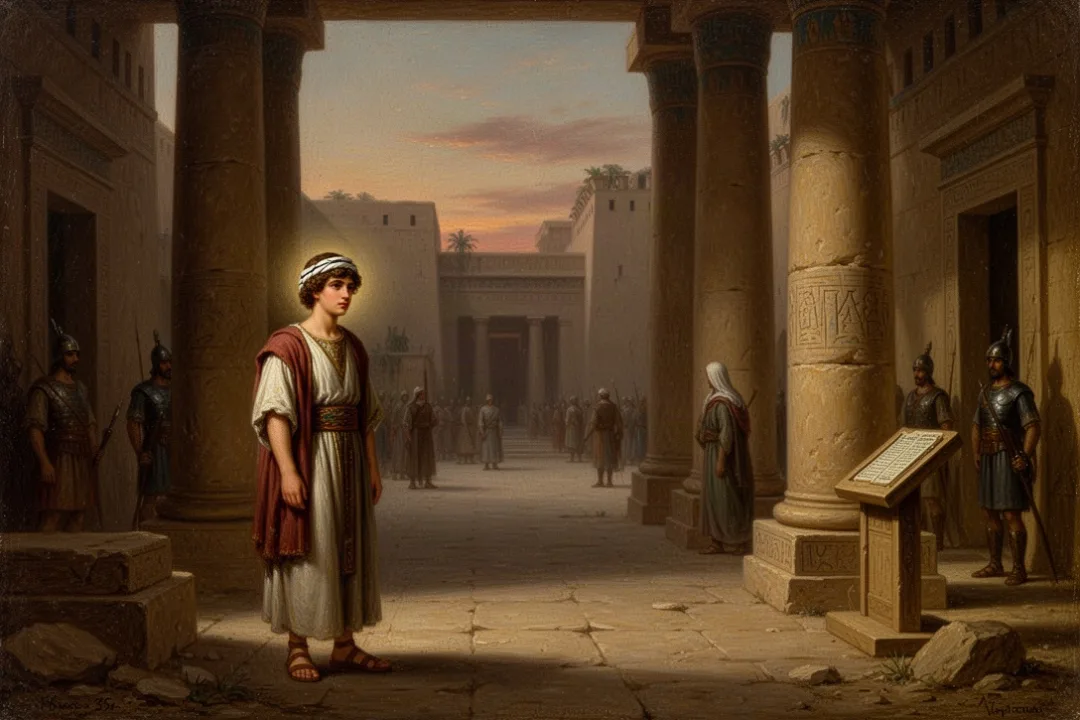
Daniel first appears as a young man from Judah who was taken to Babylon after Jerusalem was conquered. The opening chapter places his exile during the reign of King Nebuchadnezzar, the Babylonian ruler who captured Jerusalem and brought members of Judah’s royal and noble families into his service.
Daniel was selected for royal training because he was considered capable, intelligent, and suitable for court work. Along with Hananiah, Mishael, and Azariah, he was given a Babylonian education and new names. Daniel’s companions became known as Shadrach, Meshach, and Abednego, while Daniel continued to be identified by his Hebrew name in much of the narrative.
The name Daniel is commonly understood to mean “God is my judge.” That meaning fits the book’s portrayal of him. Daniel works inside foreign governments, learns the language and literature of Babylon, and serves several kings, yet he does not allow political pressure to determine his loyalty to God.
His situation creates a tension that shapes the entire book. Daniel lives in a foreign land, holds a position in a non-Israelite government, and uses skills connected with royal administration. At the same time, he refuses practices that would violate his worship of the God of Israel.
Daniel’s central conflict: He must serve faithfully in a pagan empire without treating that empire, its rulers, or its demands as higher than God.
Daniel’s story is not presented as a simple escape from hardship. He does not immediately return to Judah, and the book does not suggest that faith prevents danger. Instead, Daniel remains faithful while living under foreign power, sometimes receiving protection and sometimes facing serious threats.
The book connects Daniel’s life with a major biblical question: What happens to God’s people when powerful nations control their homeland? Its answer is that exile does not mean God has abandoned his people. God can guide, judge, and preserve them even when they live under rulers who do not honor him.
What Daniel does in the Book of Daniel
The first six chapters focus mainly on events in Daniel’s life. These chapters show him interpreting dreams, explaining supernatural signs, praying under pressure, and advising kings. The stories are arranged around public tests of loyalty and the limits of human power.
Daniel chooses faithfulness in the royal court
In Daniel 1, the young exiles are assigned food and wine from the king’s table. Daniel decides not to make himself ritually unclean and asks for a different arrangement. He and his companions are permitted to eat vegetables and drink water for a trial period, after which they appear healthy and capable.
The point is not that every believer must follow Daniel’s exact diet. The passage emphasizes his deliberate refusal to compromise and the wisdom with which he handles the situation. He does not respond with a reckless confrontation. He asks for permission, proposes a test, and remains committed to his convictions.
At the end of the training period, Daniel and his companions are found to be exceptionally capable. The chapter attributes their understanding to God, showing that their learning and public service do not require them to abandon their identity.
Daniel interprets the king’s dream
In Daniel 2, Nebuchadnezzar demands that his advisers tell him both the dream he has forgotten and its interpretation. When they cannot do so, the king threatens the wise men of Babylon. Daniel asks for time, prays with his companions, and receives the mystery in a nighttime vision.
Daniel explains that the dream concerns a large statue made from different materials. He identifies the parts as representing a succession of kingdoms, although interpreters differ over the precise historical identification of every section. A stone then strikes the statue and becomes a great mountain, symbolizing a kingdom established by God that will not be destroyed.
The story makes a clear distinction between human political power and God’s authority. Daniel does not claim that his own intelligence solved the problem. He tells the king that the mystery was revealed by God, who can disclose what human advisers cannot discover.
Daniel explains signs of royal pride
Daniel 4 describes another dream of Nebuchadnezzar, this time involving a great tree that is cut down and restrained. Daniel interprets the tree as a picture of the king’s power and impending humiliation. He urges the king to turn from wrongdoing and show mercy to the oppressed.
The warning is connected to pride. Nebuchadnezzar’s greatness is presented as something permitted by God, not as proof that the king is self-sufficient. The narrative then portrays the king losing his power and living in a diminished state before recognizing that heaven rules over earthly kingdoms.
This chapter does not merely criticize one ancient ruler. It gives a recurring biblical warning: leaders who treat their authority as absolute place themselves under divine judgment. Political success may be real, but it remains temporary and accountable.
Daniel reads the writing on the wall
Daniel 5 takes place during a feast held by Belshazzar, a Babylonian ruler. A mysterious hand writes words on the wall, and the king’s advisers cannot explain them. Daniel is summoned because of his reputation for wisdom.
Before interpreting the message, Daniel reminds Belshazzar of Nebuchadnezzar’s earlier humiliation. Belshazzar knew that story but failed to humble himself. Daniel explains that the writing announces that the king’s rule has been evaluated, found deficient, and brought to an end. The chapter presents the fall of Babylon as an act of judgment rather than an unpredictable political accident.
The episode also shows that knowing religious history is not the same as responding to it. Belshazzar has witnessed the lesson of pride in the previous king’s life, yet he repeats the same error. Daniel’s words apply to rulers who celebrate power while ignoring justice, humility, and accountability.
Daniel survives the lions’ den
Daniel 6 places him under the rule of Darius. Other officials become jealous of Daniel because of his exceptional work and try to find a legal way to accuse him. They persuade the king to issue an order forbidding petitions to any god or person except the king for a limited period.
Daniel learns about the decree but continues praying to God three times each day. The text describes him praying toward Jerusalem, maintaining a visible pattern of worship that his opponents can report. He is arrested and thrown into a den of lions, while the king spends the night distressed over what has happened.
God protects Daniel, and the king finds him alive the next morning. Daniel explains that God sent an angel to shut the lions’ mouths. The king then issues a proclamation honoring Daniel’s God, although the story’s deeper emphasis remains Daniel’s trust and God’s power to preserve him.
Daniel’s prayer life is especially significant because it is not created by the crisis. He does not begin praying only when the decree threatens him. His regular practice continues when obedience becomes costly.
He prays consistently rather than treating prayer as an emergency measure.
He serves diligently without using public responsibility as a substitute for faith.
He speaks honestly to kings, even when the message is uncomfortable.
He accepts risk rather than making self-preservation his highest priority.
What Daniel’s visions mean in the Bible
Chapters 7 through 12 shift from court stories to visions received by Daniel. These passages use vivid images: beasts, horns, heavenly courts, angels, warfare, scrolls, and symbolic periods of time. Their purpose is not to provide an easy timetable for every later event. They reveal the spiritual and moral character of kingdoms and point to God’s judgment.
The visions can be difficult because they draw on symbols familiar to the ancient world and address historical pressures in ways that are not always explained directly. Faithful readers have reached different conclusions about the identity of particular kingdoms and the timing of later events.
Read the visions with care: Daniel clearly emphasizes God’s rule and the judgment of arrogant powers, but not every symbol has one universally accepted interpretation.
The four beasts and the heavenly court
Daniel 7 describes four beasts rising from the sea. They represent kingdoms or rulers whose power is portrayed as violent, unstable, and less than truly human. The imagery contrasts earthly domination with a heavenly court in which the “Ancient of Days” sits in judgment.
In the vision, one like a son of man receives authority and an everlasting kingdom. The phrase has influenced later Jewish and Christian interpretation, especially because Jesus frequently uses “Son of Man” language in the Gospels. Daniel 7 itself presents the figure as receiving dominion from God and sharing in the rule that replaces oppressive empires.
The chapter also speaks of the suffering of the holy ones and their eventual participation in the kingdom. That pattern matters: God’s people may be oppressed for a time, but oppression does not have the final word. The vision gives hope without pretending that faithfulness will always be safe or immediately rewarded.
The ram, the goat, and the arrogant ruler
Daniel 8 shows a ram and a goat in conflict. The vision identifies the ram with the kings of Media and Persia and the goat with Greece, giving readers more direct information than some of the earlier symbols. A prominent horn is broken, and several others arise in its place.
The chapter then focuses on a ruler who exalts himself, interferes with worship, and attacks the holy community. Many scholars connect this material with the second-century BCE ruler Antiochus IV Epiphanes, whose policies contributed to severe persecution and the Maccabean revolt. The passage uses that historical crisis to speak about desecration, suffering, and God’s appointed limit on arrogant power.
Readers should distinguish between the vision’s ancient setting and later applications. The passage has often been used to discuss future rulers, but its first force lies in assuring oppressed people that a blasphemous power is neither unlimited nor permanent.
The seventy weeks and Daniel’s prayer
Daniel 9 begins with Daniel studying the writings of Jeremiah and recognizing that Jerusalem’s desolation is connected with a period of seventy years. He responds not with speculation alone but with confession, mourning, and a prayer for mercy.
An angelic message then speaks of seventy weeks, often understood as seventy groups of seven. Interpretations vary widely. Some connect the periods to events surrounding the restoration of Jerusalem and later persecution; others read them through a broader end-times framework.
Several features remain clear despite the disagreement. The vision is concerned with sin, atonement, justice, the restoration of what is holy, and the consequences of rebellion. It also shows Daniel identifying himself with his people in prayer. He does not approach God by claiming personal innocence. He confesses communal failure and asks God to act for the sake of God’s name and city.
The final visions and hope beyond suffering
Daniel 10 through 12 records an extended vision involving spiritual conflict, political rulers, persecution, and the future deliverance of God’s people. Daniel is shown that history includes struggles not visible in ordinary political reports. Human rulers make plans, but their power remains subject to God’s purposes.
Daniel 12 contains one of the clearest statements in the Hebrew Bible about resurrection and final judgment. The passage describes many who sleep in the dust awakening, with different outcomes for the righteous and the wicked. It also promises that the wise and faithful will shine, using imagery of lasting honor after a period of suffering.
The book ends without answering every question Daniel asks. He is told that the words will remain sealed until the appointed time and that he should continue faithfully. That ending discourages obsessive date-setting. Daniel receives enough understanding to persevere, not a complete schedule that removes the need for trust.
What Daniel teaches about faith, work, and pressure
Daniel is often remembered for spectacular miracles, but many of the book’s lessons concern ordinary habits. He studies, works, serves rulers, prays, speaks truth, and keeps going when the consequences are uncertain. His faith is visible in both public crises and repeated private practices.
Faithfulness does not require cultural isolation
Daniel learns the language and literature of Babylon and becomes useful within its government. The book does not portray all engagement with foreign culture as contamination. Instead, it distinguishes between learning skills for responsible service and adopting practices that deny God.
That distinction can help modern readers think carefully about work, education, and public life. Daniel does not withdraw from every institution he distrusts, but neither does he let professional success erase his convictions. His example combines competence with moral limits.
Prayer remains central under government pressure
Daniel’s prayer in chapter 6 is not portrayed as a performance designed to impress others. It is a settled rhythm of dependence on God. When the law changes, Daniel’s practice becomes visible because he continues doing what he had already done.
Chapter 9 adds another dimension: prayer includes confession and intercession. Daniel prays for Jerusalem and the people of Judah, acknowledging sin and asking for mercy. Together, the two chapters show prayer as both daily devotion and honest communal lament.
Wisdom includes humility about interpretation
Daniel has unusual insight, but he repeatedly gives credit to God rather than presenting himself as the ultimate source of knowledge. The book also models restraint for readers. Its visions invite serious study, yet their symbolism has generated disagreements across Jewish and Christian traditions.
A responsible reading should therefore ask several questions:
What does the passage say about its original rulers, audience, and crisis?
Which symbols does the text itself explain?
What themes recur across the narratives and visions?
Does an interpretation honor the book’s emphasis on humility, justice, and God’s sovereignty?
Does it avoid claiming certainty where the passage leaves room for debate?
God’s sovereignty does not erase human responsibility
Daniel teaches that God rules over kingdoms, but the human characters are still judged for pride, violence, dishonesty, and contempt for worship. Nebuchadnezzar is accountable for arrogance. Belshazzar is accountable for profaning what is holy. The officials who target Daniel are accountable for manipulation and false accusation.
This combination matters. Divine sovereignty is not presented as an excuse for injustice. Instead, it assures readers that injustice will be judged even when it appears protected by government, wealth, or military power.
How Daniel connects with the rest of the Bible
Daniel belongs to the Old Testament and is closely connected with the history of Judah’s exile. Its themes continue ideas found in the prophets: God judges nations, preserves a faithful remnant, restores the oppressed, and establishes a kingdom greater than human empires.
The book also has a strong relationship with later Christian writings. Jesus refers to Daniel’s prophetic imagery, including the “son of man” vision and the “abomination of desolation.” The Book of Revelation uses symbolic patterns that resemble Daniel, such as beasts, horns, heavenly judgment, and the defeat of evil powers.
These connections do not mean that every detail in Daniel has only one later interpretation. They show that Daniel became a major source for biblical reflection on kingdoms, persecution, judgment, resurrection, and hope.
Daniel’s companions also contribute to the biblical picture of faithful resistance. Their refusal to worship Nebuchadnezzar’s image in Daniel 3 parallels Daniel’s refusal to stop praying in Daniel 6. In both accounts, obedience to God places believers in conflict with royal demands, and God’s people must decide whom they will ultimately serve.
The book’s final message is not that believers can predict every political development. It is that no empire deserves the absolute trust or worship that belongs to God. Daniel serves kings, but he does not worship them. He benefits from positions of influence, but he does not confuse influence with permanence.
For readers seeking the main answer to what Daniel means in the Bible, the book offers a steady pattern: remain faithful in exile, seek wisdom from God, pray under pressure, resist pride, and trust that God’s judgment will outlast every empire. Daniel’s life and visions are ultimately about the endurance of faith when history appears to be controlled by someone else.
Frequently asked questions
Was Daniel a prophet or a government official?
Daniel was both a royal official and a recipient of divine visions. The book presents him serving in the administrations of Babylonian and Persian rulers while receiving dreams and messages that reveal God’s judgment and purposes. Jewish and Christian traditions classify the Book of Daniel differently within their biblical collections, but Daniel’s prophetic role is clear from his visions and interpretations.
Did Daniel personally enter the lions’ den?
Yes. Daniel 6 says that officials persuaded King Darius to prohibit prayer to anyone except the king. Daniel continued his regular prayers to God, was sentenced to a den of lions, and was found alive the next morning. The account emphasizes both God’s protection and Daniel’s established pattern of worship before the crisis began.
What language was the Book of Daniel written in?
The book uses both Hebrew and Aramaic. Daniel 1:1–2:4a and chapters 8–12 are in Hebrew, while Daniel 2:4b–7:28 are in Aramaic. That bilingual structure reflects the book’s setting among Jewish exiles and imperial courts, where Aramaic was widely used for administration and international communication.
Is Daniel’s seventy weeks prophecy easy to interpret?
No. Daniel 9 has produced several major interpretations among Jewish and Christian readers. Differences involve how the symbolic periods are calculated, which historical events they describe, and whether later fulfillment is included. The passage clearly addresses sin, restoration, persecution, and God’s appointed purposes, but readers should avoid presenting one disputed timeline as universally settled.








Leave a Reply