A practical study of Daniel: themes, visions, and faith
A practical study of Daniel: themes, visions, and faith
When you read Daniel, you may wonder how stories about a young exile, fiery trials, strange dreams, and future kingdoms fit together. The answer is that the book presents <strongfaithful living under pressure alongside a vision of God’s authority over rulers and history. Its familiar narratives and difficult prophecies belong together.
A useful study of Daniel reads the book in two connected parts. Chapters 1–6 contain court stories about Daniel and his companions, while chapters 7–12 record visions received by Daniel. The stories show what loyalty to God looks like in public life; the visions explain why that loyalty matters when kingdoms appear powerful and oppressive.
Central idea: Daniel does not promise that faithful people will avoid danger. It teaches that God remains sovereign, gives wisdom to his servants, judges arrogant powers, and sustains his people through uncertain times.
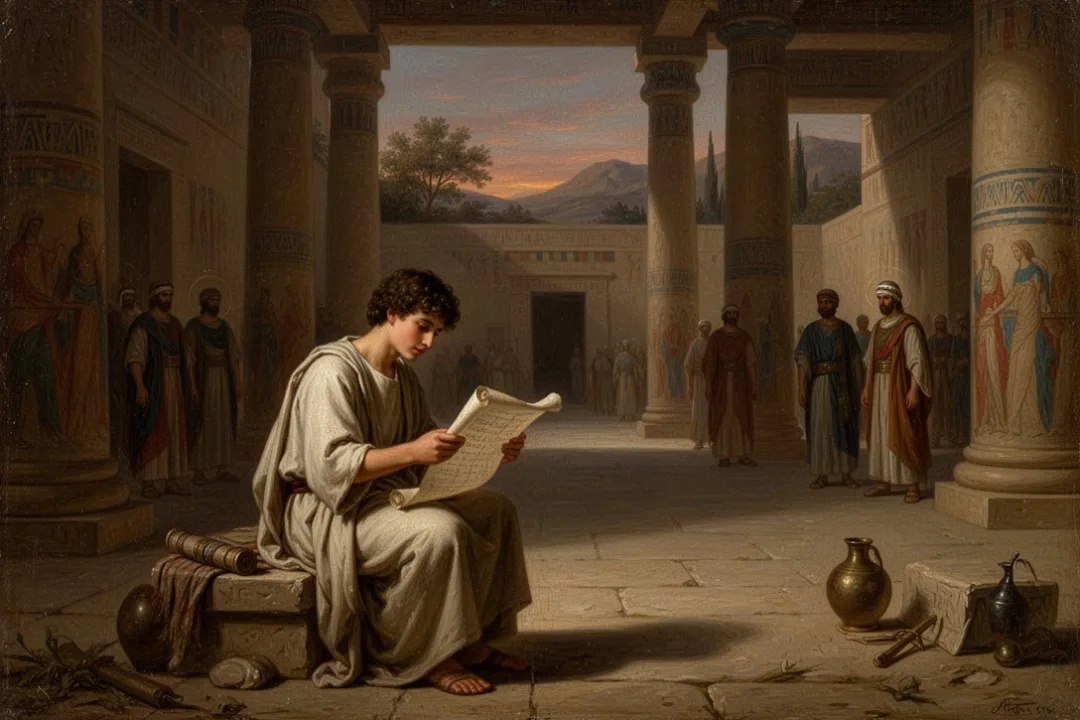
Daniel begins during the exile of Judah, when Jerusalem had been conquered and members of the Judean elite were taken to Babylon. The opening chapter places Daniel and his friends in a foreign court, where they are given new training, new responsibilities, and Babylonian names. Their situation raises a question that remains central throughout the book: How can God’s people remain faithful when they live under a culture that does not share their worship?
The book identifies Daniel and his friends as young Judeans brought to Babylon during the reign of Nebuchadnezzar. Daniel’s exact age is not stated. He receives education in the language and literature of the empire, suggesting that Babylon intends to reshape him for service in its administration.
Daniel does not respond by withdrawing from public life. He learns the required skills, serves several rulers, and accepts positions of responsibility. At the same time, he refuses practices that would violate his devotion to God. This combination of competent service and spiritual resistance is one of the book’s most practical lessons.
The historical setting also explains why the book repeatedly contrasts human kings with God. Babylonian rulers issue commands, build monuments, change policies, and claim authority. Yet their power proves temporary. Daniel’s visions later expand this point, portraying a succession of kingdoms that rise and fall while God’s rule endures.
Why Daniel uses two languages
Daniel is written primarily in Hebrew and Aramaic. Much of chapters 2–7 is in Aramaic, a widely used administrative and international language in the ancient Near East, while other portions are in Hebrew. The change may reflect the subject matter: the Aramaic section focuses especially on the relationship between earthly empires and God’s universal kingdom.
The language pattern also supports the book’s literary design. Chapters 2–7 form a kind of unit, with matching themes at the beginning and end. Chapter 2 describes a dream involving successive kingdoms, and chapter 7 presents another vision of successive kingdoms. The outer stories emphasize that God reveals mysteries and rescues his servants.
Historical questions readers should handle carefully
Readers encounter different views about the book’s composition and date. Traditional Jewish and Christian interpretation understands Daniel as a sixth-century BCE figure whose experiences and visions were recorded in the book associated with him. Many modern scholars argue that the book reached its final form during the second century BCE, while presenting Daniel’s perspective in an earlier setting.
These positions involve questions about language, historical references, literary form, and how ancient works were attributed. A careful study can acknowledge the debate without reducing Daniel to a date dispute. Whatever position you take, the book’s central claims remain clear: faithfulness matters, arrogant empire is limited, and God’s purposes extend beyond the immediate crisis.
What Daniel’s first six chapters teach through their stories
The narrative section gives several case studies in faith under pressure. Each story presents a different test: food and identity, political jealousy, public pride, religious conformity, or a ruler’s misuse of power. The repeated result is not that Daniel’s world becomes safe, but that God proves present and trustworthy in an unstable environment.
Daniel 1: Faithfulness begins with daily choices
Daniel and his friends refuse the royal food and wine, asking for a different arrangement. The text connects their decision with concerns about defilement, but it does not provide every detail behind their objection. The food may have involved ritual associations, dietary violations, or participation in the king’s provision and authority.
Daniel’s approach is notable. He does not begin with a public confrontation. He speaks respectfully to the official responsible for him and proposes a test involving simple food and water. After the test, the arrangement is allowed. The story encourages readers to practice conviction with wisdom, seeking faithful solutions rather than unnecessary conflict.
The chapter also says that God gave Daniel and his friends knowledge and skill, and that Daniel received understanding of visions and dreams. Their abilities are not portrayed as self-made achievements. Their learning and service become evidence that faithfulness does not require rejecting useful education or professional competence.
Daniel 2: God reveals what human rulers cannot know
Nebuchadnezzar demands that his wise men tell him both his dream and its interpretation. When they cannot, the king threatens them. Daniel asks for time, gathers his companions, and seeks mercy from God. The mystery is then revealed to him in a night vision.
Daniel makes clear that the secret does not come from his own superior wisdom. He praises the God who reveals hidden things and explains that rulers rise and fall according to divine purpose. The dream’s statue represents a sequence of kingdoms, though interpreters differ about how each part maps onto specific historical empires.
The climactic image is a stone that strikes the statue and becomes a great mountain. Daniel interprets this as a kingdom established by God that will not be destroyed. The chapter therefore shifts attention away from the apparent permanence of imperial power toward the lasting kingdom of God.
Daniel 3: Faithfulness does not depend on a guaranteed rescue
Daniel’s three friends refuse to worship Nebuchadnezzar’s image. Their response is one of the clearest statements of trust in the book: they believe God can rescue them, but they will not worship the image even if he does not. Their loyalty is not a transaction in which obedience guarantees a desired outcome.
The furnace story speaks to people who face pressure to conform publicly. It does not minimize the danger or suggest that courage removes fear. Instead, it presents worship as a decision grounded in God’s worth, not in certainty about immediate results.
The king’s later recognition of divine power does not make Babylon a permanently faithful society. The story’s emphasis is narrower and more durable: human commands have limits, and worship belongs to God alone.
Daniel 4: Pride turns authority into a warning
Nebuchadnezzar’s dream of a great tree introduces a judgment against royal pride. The tree provides shelter and food, but it is cut down and reduced. Daniel explains that the image represents the king’s greatness and his coming humiliation because he fails to acknowledge that heaven rules.
The chapter presents government as a form of stewardship rather than absolute ownership. A ruler may possess impressive power, but that power remains accountable to God. Nebuchadnezzar’s restoration after he recognizes heaven’s authority gives the story a movement from pride to humility, although readers should not treat it as a simple formula for every political crisis.
Daniel 5: Belshazzar’s feast and the limits of inherited power
During Belshazzar’s feast, mysterious writing appears on the wall. Daniel is summoned to interpret it and rebukes the king for failing to learn from Nebuchadnezzar’s earlier humiliation. Belshazzar has celebrated while using vessels taken from the Jerusalem temple, turning political confidence into religious contempt.
Daniel explains that the message announces the end of the king’s reign and the division of his kingdom. The chapter stresses that knowing history is not enough; a person must respond to what history reveals about pride, accountability, and mortality. Belshazzar’s authority cannot protect him from judgment.
Daniel 6: Prayer remains possible under hostile laws
Daniel’s opponents exploit his predictable faithfulness. They persuade King Darius to issue a law restricting petitions to anyone other than the king for a set period. Daniel responds by continuing his regular prayer practice, with his windows open toward Jerusalem.
His prayer is neither a public performance nor a sudden emergency measure. It is a settled habit that continues when obedience becomes costly. The lions’ den story therefore highlights the power of ordinary spiritual disciplines: prayer, confession, praise, and remembrance prepare a person to act when pressure arrives.
Daniel is eventually rescued, but the broader point is not that every faithful person will escape harm. The book’s later visions include suffering for the faithful. Daniel 6 shows that no ruler can finally control a person’s relationship with God, even when the state uses law to enforce conformity.
How to read Daniel’s visions without forcing certainty
Chapters 7–12 change from court narrative to first-person visions. Daniel sees beasts, horns, heavenly figures, conflict, judgment, and future deliverance. These images are meant to communicate theological truth, but they are not always simple codes in which every symbol has one universally agreed modern equivalent.
The safest approach is to begin with the explanations provided inside the book. For example, the beasts in Daniel 7 are associated with kingdoms, and the “son of man” figure receives authority in the presence of the Ancient of Days. Only after identifying the text’s own explanation should you consider broader historical or prophetic interpretations.
Daniel 7: Beasts, judgment, and the humanlike ruler
Daniel 7 presents four beasts rising from the sea. Their animal imagery portrays kingdoms as violent, unstable, and less than truly human when they exercise power through domination. The vision then shifts to a heavenly court, where the Ancient of Days sits in judgment.
A figure “like a son of man” approaches the Ancient of Days and receives everlasting dominion. Rather than reproducing the biblical wording, it is enough to say that the image contrasts humanlike rule with beastly empire. The kingdom given to this figure is shared with the holy people, connecting individual authority with the vindication of the faithful.
In the New Testament, Jesus uses “Son of Man” language in ways that echo Daniel 7. Christian readers therefore often connect the vision with Jesus’ authority, suffering, vindication, and future reign. That connection should be made with attention to the New Testament context rather than by treating every detail of Daniel as a direct prediction with no interpretive development.
Daniel 8: The ram, the goat, and a ruler who overreaches
Daniel 8 identifies the ram with the kingdoms of Media and Persia and the goat with Greece. The vision describes the rise of a prominent ruler and the later emergence of a smaller horn that attacks the holy place and interferes with regular worship.
Many interpreters associate this later ruler with Antiochus IV Epiphanes, a second-century BCE king whose policies affected Jewish worship and the Jerusalem temple. The chapter’s detailed historical correspondence is one reason scholars give significant attention to the Maccabean-era setting when studying Daniel’s final form.
The theological point extends beyond one ruler. The horn becomes great in its own eyes and opposes the “Prince of princes.” Daniel portrays political ambition as spiritually dangerous when it attempts to replace God’s authority and crush faithful worship.
Daniel 9: Confession, restoration, and the seventy weeks
Daniel 9 begins with Daniel reading the prophecy associated with Jeremiah and responding with prayer. He confesses the sins of his people, acknowledges God’s justice, and asks for mercy and restoration. His response shows that prophetic study is meant to produce humility and intercession, not speculation alone.
The answer he receives includes the difficult vision of seventy weeks, often understood as seventy units of seven. Interpreters differ widely over whether these units should be read mainly as symbolic periods, sequential historical periods, or a framework that points toward events associated with Jesus and the end of the age.
A responsible reading pays attention to the chapter’s themes: sin, atonement, Jerusalem, the sanctuary, desolation, and God’s larger purpose. Avoid presenting one disputed timeline as though every faithful reader must accept it. The passage has generated several major approaches across Jewish and Christian traditions.
Daniel 10–12: Spiritual conflict and hope beyond oppression
Daniel 10 opens with mourning, fasting, and a heavenly messenger who explains that spiritual conflict stands behind earthly events. The chapter does not encourage readers to identify a demon behind every political development. It presents a symbolic picture of the unseen dimension of history and the limits of human perception.
Chapters 11–12 describe conflicts among northern and southern powers, with substantial attention to rulers connected with the Greek period. The material becomes increasingly difficult near the end, especially where it speaks about the end of suffering, resurrection, and the fate of the wise.
Daniel 12 gives one of the Bible’s clearest early statements about resurrection hope: those who sleep in the dust will awaken, with different outcomes. The passage does not satisfy every curiosity about the afterlife. It does establish that death does not have the final word and that faithful endurance has lasting significance.
What major themes connect Daniel’s stories and visions
God’s sovereignty does not erase human responsibility
Daniel repeatedly affirms that God rules over kings and kingdoms. Yet the rulers are still judged for pride, violence, blasphemy, and injustice. Divine sovereignty in Daniel is not an excuse for passivity. Daniel prays, studies, serves, refuses idolatry, and speaks truth to power.
This balance helps prevent two opposite mistakes. You do not need to believe that history is random, but neither should you assume that every political outcome directly proves divine approval. Daniel teaches confidence in God’s ultimate rule while preserving moral accountability for human decisions.
Faithfulness can include public service and principled refusal
Daniel works inside pagan administrations without adopting their worship. He contributes his skills to the common good, accepts responsibility, and advises rulers. At the same time, he refuses commands that require idolatry or prohibit prayer.
The book therefore offers a framework for decisions about work, education, government, and culture. Ask whether a practice is merely unfamiliar or actually violates your convictions. Seek respectful alternatives where possible, and recognize that faithful resistance may carry a real cost.
Prayer connects understanding with obedience
Prayer appears at decisive points in Daniel. The friends pray for mercy before Daniel interprets the king’s dream. Daniel gives thanks, confesses sin, and continues his regular prayers despite legal danger. These prayers keep knowledge from becoming detached speculation.
Daniel 9 is especially valuable for study because Daniel responds to Scripture by confessing and asking for mercy. Biblical prophecy is not presented as entertainment or a way to feel superior to people who interpret it differently. It should lead to repentance, patience, and hope.
God’s kingdom outlasts every political order
The imagery of statues, beasts, horns, and heavenly judgment keeps returning to the same contrast. Empires appear permanent from the ground, but Daniel sees their limits from heaven’s perspective. Their authority can be real and dangerous without being ultimate.
This theme gives the book enduring relevance without requiring readers to label one current nation as the final empire. Daniel directs your hope toward God’s lasting rule rather than toward political control, cultural dominance, or predictions built on daily headlines.
How to build a careful study of Daniel
A strong study combines observation, historical context, theological reflection, and practical response. Read the book more than once before settling on an interpretation. On the first reading, notice repeated words, changes in scene, royal reactions, and the points where Daniel or another character explains a vision.
On a second reading, separate what the text clearly says from what interpreters infer. For example, Daniel clearly links certain beasts with kingdoms, but identifying every later political power requires additional argument. Mark those levels of confidence so that a possible interpretation does not become an assumed fact.
Read the entire book: Notice how chapters 1–6 prepare you for chapters 7–12.
Record the setting: Identify the ruler, location, threat, and response in each chapter.
Circle repeated themes: Look for kingdom, wisdom, worship, pride, judgment, prayer, and endurance.
Study internal explanations first: Give priority to interpretations supplied by the angel, Daniel, or the narrative itself.
Compare related passages carefully: Consider other biblical uses of images such as beasts, horns, clouds, kingdoms, and resurrection.
Apply the main principle: Ask what the passage calls you to believe, resist, practice, or hope for.
A notebook can help you track the book’s structure. Create separate pages for historical setting, symbols and explanations, and personal response. This keeps background information from crowding out the spiritual and ethical claims of the text.
A six-session reading plan
A short group or personal study can move through Daniel in six sessions. Allow time for discussion rather than trying to settle every prophetic question in one meeting.
Session 1: Daniel 1, focusing on identity, food, learning, and faithful adaptation.
Session 2: Daniel 2–3, examining revelation, kingdoms, worship, and courage.
Session 3: Daniel 4–6, considering pride, judgment, prayer, and public responsibility.
Session 4: Daniel 7–8, studying beasts, horns, kingdoms, and divine judgment.
Session 5: Daniel 9, focusing on confession, Jeremiah, restoration, and the seventy weeks.
Session 6: Daniel 10–12, reflecting on spiritual conflict, endurance, resurrection, and hope.
For each session, ask three questions: What does the passage say? What would it have meant in its original setting? How should it shape faithful living now? These questions prevent a study from becoming either a purely historical exercise or an application disconnected from the text.
Common mistakes to avoid when interpreting Daniel
One mistake is treating every symbol as a direct reference to a modern nation, leader, or event. Daniel’s visions speak about real kingdoms and future hope, but their imagery is shaped by the book’s ancient setting. Modern applications should preserve the original themes rather than replace them.
Another mistake is ignoring the narrative chapters because the visions seem more impressive. The stories provide the moral world in which the visions should be read. A person fascinated by end-time timelines but unwilling to practice honesty, prayer, humility, or courage has missed Daniel’s central challenge.
A third mistake is assuming that disagreement proves bad faith. Jewish and Christian interpreters have developed different readings of the visions, including historical, symbolic, futurist, and other approaches. You can hold a considered view while speaking modestly about disputed details.
Study tip: Let the clearest claims carry the most weight. Daniel plainly calls you to worship God, resist arrogant power, pray faithfully, and hope for God’s lasting kingdom; its detailed timelines require greater interpretive caution.
Finally, avoid using Daniel to justify fear-driven predictions. The book acknowledges suffering and upheaval, but it does not encourage panic. Its visions are given to strengthen endurance and confidence in God’s justice, especially when visible circumstances suggest that evil has the upper hand.
How Daniel speaks to life under pressure today
Daniel can help you think about loyalty when your workplace, school, or public environment expects assumptions you do not share. The question is not whether you can avoid every influence of surrounding culture. Daniel himself learns the language and serves in a foreign government. The question is whether your deepest allegiance remains clear.
The book also challenges the desire for certainty. Daniel receives genuine revelation, yet he does not control the timing of events or understand every vision immediately. He asks questions, mourns, fasts, and waits. Faith includes trust during incomplete understanding.
For people with public responsibility, Daniel offers a warning against confusing success with moral approval. Nebuchadnezzar and Belshazzar possess wealth and authority, but their pride exposes their weakness. Leadership should be measured by humility, justice, and accountability rather than by reach or ceremony.
For people facing hostility, Daniel shows that spiritual practices are not ornaments added after a crisis. Daniel’s prayer life is already established before the lions’ den. The three friends’ convictions are already settled before the furnace. Daily faithfulness prepares you for exceptional pressure.
For people worried about the future, Daniel offers neither a detailed schedule for satisfying curiosity nor a reason to ignore current suffering. It gives a durable hope: violent powers are judged, the faithful are not forgotten, and God’s kingdom cannot be overthrown. That hope supports courage, patience, and responsible action in the present.
A complete study of Daniel therefore ends not with a chart of predictions but with a transformed posture. Read carefully, pray honestly, serve competently, resist idolatry, question arrogant power, and place your hope in the God whose rule outlasts every empire.
Frequently asked questions
Was Daniel a real historical person?
Daniel is presented as a Judean exile and royal adviser, and the book is traditionally associated with him. Modern scholars debate the date and process of the book’s final composition, particularly because of its language, literary form, and detailed references to later events. Readers can recognize this scholarly discussion while still studying Daniel’s theological message about faithfulness, judgment, and hope.
What is the main message of the book of Daniel?
The main message is that God remains sovereign while earthly rulers and empires are temporary. Daniel calls God’s people to worship faithfully, serve responsibly, resist idolatry, and remain hopeful during oppression. Its visions add that arrogant powers will face judgment and that God’s kingdom, unlike human empires, will endure.
Should Daniel’s prophecies be read as predictions of current events?
Daniel’s visions address ancient kingdoms and crises while also contributing to broader biblical hope about judgment and God’s reign. Some readers emphasize historical fulfillment, others future fulfillment, and others symbolic patterns that recur across history. A careful reading begins with Daniel’s own explanations and avoids confidently identifying every modern event with a particular symbol.
Why does Daniel include stories as well as visions?
The stories show how faith operates in ordinary political and social pressure: Daniel learns, works, prays, refuses idolatry, and speaks truth. The visions place those choices within a larger view of history, showing that empires are limited and God’s judgment is certain. Together, the two sections connect personal faithfulness with hope for God’s ultimate rule.









Leave a Reply