The figure commonly known as the Four Horsemen of the Apocalypse emerges from a single,Compact moment in early Christian apocalyptic literature, yet its roots reach back into broader Jewish and Greco‑Roman expectations about end-times, judgment, and cosmic upheaval. The image appears in the Book of Revelation (the last book of the Christian New Testament), traditionally attributed to John of Patmos who is said to have received a divine vision while exiled on the island of Patmos. The original Greek phrase apokalypsis, which translates roughly to “unveiling” or “revelation,” signals not only a disclosure of future events but a revelation of the divine plan behind visible history. The “horsemen” are among the most dramatic episodes in that unveiling, acting as symbolic heralds of upheaval that will accompany the end of an era as described in the text.
To understand the origins of these figures, it helps to situate Revelation within its historical milieu. The late first century CE in the Roman Empire was a time of political volatility, social anxiety, plagues, and wars. Early Christians often framed their experience of empire—persecution, conflict, and reliance on divine providence—through apocalyptic lenses. The imagery of a horse and rider became a vivid way to describe forces beyond human control: conquerors, armies, and the inexorable machinery of famine and death. The book’s author, speaking in a visionary voice, places these figures under divine sovereignty, stressing that even the most terrible events operate within a larger cosmic design.
In terms of textual transmission, the Revelation passage that introduces the horsemen is compact: with the opening of seven seals, a sequence unfolds in which four riders depart on four different horses, each rider empowered to exercise a specific form of judgment. The symbolism is designed to be memorable and portable across cultures and eras, which is exactly why it has persisted as a core image in Christian eschatology and, later, in secular imaginations of apocalypse.
Beyond Revelation, scholars point to earlier literary and prophetic textures that feed into the motif of riding figures of doom. Elements of the animal and rider imagery echo Jewish apocalyptic apocalypses, and the broader Greco‑Roman tradition often uses mounted figures to symbolize imperial power and catastrophic change. Over time, medieval theologians, mystics, and artists absorbed these motifs, reinforcing the association between cosmic events and human history, between divine judgment and earthly suffering. Thus, the apocalypse horsemen emerge not as a single, fixed doctrine but as a dynamic symbol capable of speaking to different audiences in various ages.
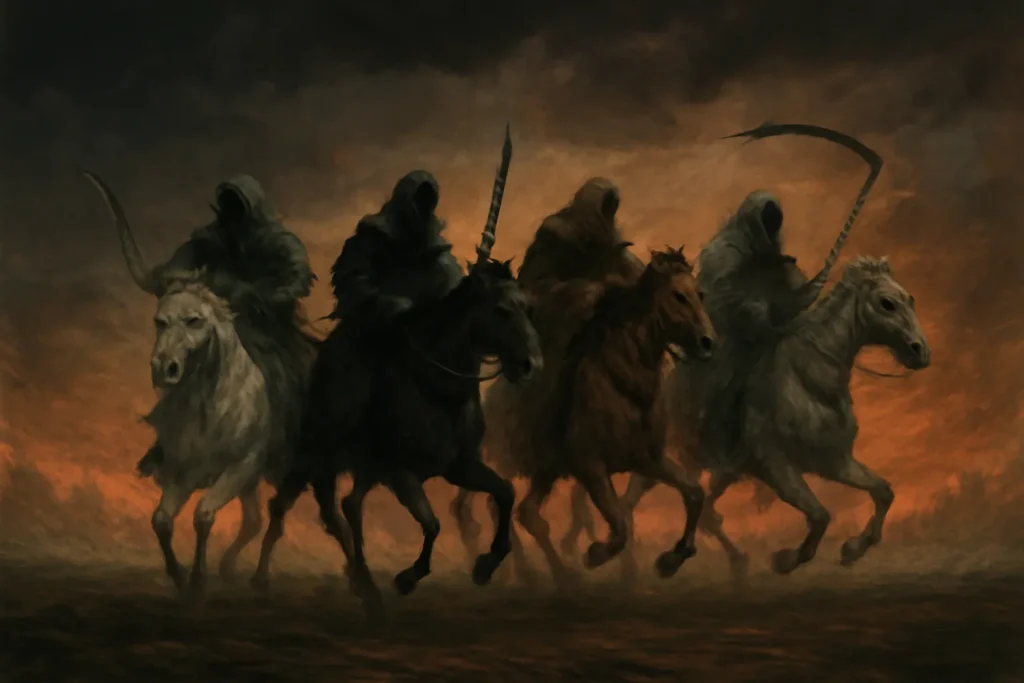
Conquest on the white horse, a rider who holds a bow and has a crown, is commonly read as symbolic of imperial power, victory, or sometimes pestilence disguised as triumph.
War on the red horse, wielding a great sword, embodies conflict, bloodshed, and the breakdown of peace.
Famine on the black horse, with the rider carrying a pair of scales, signals scarcity, unequal distribution of resources, and economic stress that accompanies siege and war.
Death on the pale (greenish) horse, with Hades following, represents the final consequence of war and famine, the broad sweep of mortality, and the stratified toll on human communities.
In addition to the canonical four, some traditions note that the setting involves a chorus of cosmic forces operating under a divine plan. The image’s potency lies in its compression: four riders, four kinds of catastrophe, and a frame in which the human story and the divine plan intersect with terrifying clarity. Because of this compact design, countless interpreters—from theologians to poets, from painters to game designers—have used the horsemen as a shorthand for the complex, often frightening possibilities of the end of days.
Symbolism is the backbone of the apocalypse horsemen. Each rider functions as a symbolic emblem rather than a literal forecast, yet the metaphorical meanings can be read in multiple ways. The imagery is deliberately multivalent: it can describe political realities, social crises, or existential anxieties. In this sense, the horsemen act as archetypes for human vulnerability and divine sovereignty, a pairing that has kept their meaning resonant across diverse historical moments.
The riders and their emblems
Here is a closer look at the conventional associations commonly attached to each horse and rider. Note that interpretations often shift depending on theological tradition, literary genre, or historical context, but the core associations tend to recur across time.
White Horse — Conquest (or Pestilence in some readings): The white horse is frequently interpreted as victory and imperial power, suggesting dominance, expansion, and the allure of triumph. Some readers read this figure as the first stage of judgment—conquest as a form of order that precedes chaos. Other readings stress a warning about the seductive nature of power, or, in a more allegorical sense, the idea that “conquest” can be as dangerous as it is alluring.
Red Horse — War: The red rider carries a sword, and the color red signals bloodshed, conflict, and the breakdown of social peace. War in this reading is an inevitable consequence of human ambition and political struggle, a force that tears at the fabric of communities and leaves scars that endure long after battles end.
Black Horse — Famine: The black horse brings scarcity and economic imbalance. The scales carried by the rider symbolize the measuring of grain and commodities, highlighting the way basic sustenance becomes precious in times of shortage. Famine here is not merely a natural disaster but a moral and social test: who bears the burden, and who enjoys relief?
Pale Horse — Death (with Hades following): The pale color evokes decay and mortality. Death is not a single event but a sweeping reality that encompasses wars, famines, plagues, and yes, the quiet, daily erosions of life. The presence of Hades as a companion emphasizes the shared fate of all people, regardless of status, in the face of ultimate consequence.
The symbolism of the Four Horsemen is not merely about doom. It is a language that compresses complex modes of human and cosmic action into four stark figures. When readers engage with these symbols, they are invited to reflect on vulnerability, accountability, and the limits of human power. The imagery also prompts a broader meditation on how societies respond to crisis—whether with resilience, fear, reform, or compounding cycles of violence. In many Christian traditions, the horsemen function as a stark reminder that history contains both human agency and divine governance, and that ultimate questions about meaning and justice are addressed within a larger, transcendent frame.
Interpreting the symbolism in different contexts
Across epochs, interpreters have shifted emphasis among the four riders depending on contemporary concerns. For example, in periods of political upheaval or empire‑driven expansion, the white horse figure might be read primarily as a symbol of conquest or imperial ambition. In eras shaped by outbreaks of disease, the same rider can be recast as a warning about pestilence concealed within the rhetoric of victory. The red horse becomes a lens for analyzing war and its moral complexities; the black horse raises questions about economic justice and inequality; and the pale horse stands as a meditation on mortality, historical violence, and communal grief.
Even within textual study, there are debates about how to reconcile the symbolic readings with any potential historical fulfillment. Some scholars favor a idealistic approach, treating the horsemen as timeless symbols of struggle and judgment rather than specific historical events. Others adopt a futurist framework, suggesting that the horsemen foreshadow events still to come in an imminent eschatological horizon. Still others argue for a preterist reading, seeing the imagery as primarily describing events in late antiquity—such as warfare, famine, and persecution experienced by early Christian communities. A historicist stance traces the symbols across the course of church history, while an idealist interpretation emphasizes perpetual spiritual warfare and moral trial. Each approach highlights different facets of the same symbolic core, and readers often blend insights from multiple frameworks to form a richer understanding.
End-Time Legends
The end-time legends surrounding the apocalypse horsemen have morphed through centuries, absorbing local cultures, theological debates, and popular imagination. Rather than remaining a single, fixed doctrine, the story of the four riders has become a flexible template for explaining crises, imagining divine judgment, and pondering the fate of humanity. In this sense, the end‑time legends around these riders function as a cultural mirror, reflecting fears and hopes in every era that encounters them.
Escoherent frameworks: how scholars classify readings
Scholars categorize eschatological readings in a few broad frameworks that help explain why the horsemen remain legible across centuries and cultures. Here are the main lines of thought, with examples of how they shape interpretation:
Preterist readings: Treat the horsemen primarily as symbols of events that occurred in the early Christian century—persecutions, political turmoil, and social upheaval experienced by the original audience. This approach emphasizes the historical immediacy of the text and its relevance to first-century readers.
Futurist readings: View the horsemen as precursors to events that will occur at the end of time. This approach is common in many contemporary evangelical contexts and in some apocalyptic fiction, which uses the horsemen to symbolize looming global crises that presage the second coming.
Historicist readings: Trace the horsemen through the entire span of church history, associating each rider with significant epochs, powers, or movements in Europe and beyond—from imperial conquests and religious wars to modern geopolitical forces.
Idealist or symbolic readings: Treat the horsemen as evergreen archetypes describing the perennial struggle between order and chaos, civilization and anarchy, life and death. They are less about specific events and more about universal truths about human fate and moral choice.
These frameworks are not mutually exclusive; many readers hold blended views, noting that symbols can carry multiple meanings depending on the moment and the reader’s questions. The “end-time legends” of the apocalypse horsemen thus live on primarily because they invite ongoing interpretation rather than providing a single forecast.
In the Middle Ages and the early modern period, the Four Horsemen became a standard motif in illuminated manuscripts, sermons, and moralizing literature. They functioned as visual and rhetorical devices to instruct lay readers about the fragility of human life and the inevitability of divine judgment. Some medieval legends personified the horsemen as actual agents who could be invoked in times of plague or famine, while others used them as allegorical prompts to reform social behavior, cautioning against greed, cruelty, and the hubris of rulers. The image of the horsemen also appears in allegorical plays and moralized Bibles, where their actions are integrated into broader narratives about sin, repentance, and salvation.
Crises such as the Black Death and other plagues in medieval Europe fueled a vivid association between these riders and widespread mortality. Art and literature often linked pestilence to divine anger in a way that reinforced communal solidarity and encouraged charitable acts toward the afflicted. In this context, the horsemen functioned not only as prognostic symbols but as didactic tools, guiding communities toward piety, reform, and shared responsibility for those who suffered.
Modern reimaginings and cultural legacies
In modern times, the Four Horsemen appear everywhere in popular culture—from graphic novels and film to video games and music. Contemporary retellings often recast the riders to reflect current anxieties: geopolitical instability, climate crises, technological disruption, or pandemics. Some modern authors and artists present the horsemen as a suite of archetypal forces rather than as discrete, predictable events. This flexibility allows creators to explore moral questions—what does it mean to confront fear, to respond ethically to catastrophe, and to imagine a path toward renewal after devastation?
In the realm of art and media, the apocalypse horsemen have become a versatile metaphor for human agency under pressure. They appear in apocalyptic fiction such as post‑apocalyptic narratives, as well as in fantasy worlds where epic battles and cataclysmic events hinge on the interference of mighty powers. The enduring appeal lies in their stark clarity: four distinct forces converge to shape a world in crisis, inviting audiences to reflect on accountability, resilience, and the possibility of redemption even in the shadow of collapse.
Broader context: why the apocalypse horsemen endure
There is more to the staying power of this image than its dramatic spectacle. The Four Horsemen of the Apocalypse symbolize fundamental human concerns: power and its temptations, conflict and violence, scarcity and inequality, and mortality in all its forms. Because these concerns recur across civilizations and eras, the horsemen function as a shared vocabulary for discussing large‑scale change. They also provide a somber reminder that history operates under conditions that can overwhelm individuals and communities, while still leaving room for moral agency, collective action, and hope for renewal.
Educational pathways: teaching and studying the horsemen
For students of theology, literature, and history, the apocalypse horsemen offer a compact case study in how symbolic language travels across time. Consider the following teaching prompts and study activities:
Compare the Four Horsemen in Revelation with other symbolic rider figures in ancient literature and analyze similarities and differences in function and meaning.
Explore how different eschatological frameworks (preterist, futurist, historicist, idealist) change the interpretation of the horsemen’s significance.
Investigate how medieval artists portray the riders differently from modern graphic novels or films, noting techniques of symbolism and narrative purpose.
Discuss how real historical crises (plagues, wars, famines) have influenced popular interpretations of the horsemen during various periods.
In all these discussions, remember that the note of bolded terms helps highlight the most central ideas and terms for readers who wish to trace the argument across sections. The apocalypse horsemen, in their many forms, invite careful study as a window into how cultures wrestle with threat, accountability, and the possibility of renewal in the face of catastrophe.
Further reflections: ethics, hope, and interpretation
Beyond analysis, the enduring symbol of the apocalypse horsemen challenges readers to consider ethical responses to crisis. When confronted with images of conquest, war, famine, and death, communities are pressed to think about:
How power is exercised and resisted, and who bears the burden of political decisions.
Ways to mitigate conflict and to protect the vulnerable during times of war and upheaval.
Strategies to address famine and economic injustice, including food security, fair distribution, and sustainable practices.
Means of supporting the dead and the grieving, and of maintaining social cohesion in the midst of loss.
Interpreting the end-time legends responsibly involves recognizing that symbolic language can illuminate moral questions even as it resists simplistic predictions. The horsemen are not a deterministic forecast but a provocative framework that challenges readers to analyze human choices and systemic vulnerabilities. They offer a language for discussing urgent realities—conflict, scarcity, mortality—while also sustaining a hope that communities can respond with courage, compassion, and practical action to heal and rebuild in the aftermath of crisis.
In sum, the apocalypse horsemen—whether called the Four Horsemen of the Apocalypse, apocalypse riders, or sometimes simply the horsemen—are a richly layered emblem in the religious and cultural imagination. They originated in an ancient text but have adapted to new historical contexts, continuing to shape how people think about origins, crisis, and the possibility of renewal. By tracing their origins, examining their symbolism, and exploring the end-time legends that have grown up around them, readers can appreciate not only their dramatic power but also their enduring capacity to prompt reflection on human nature, history, and hope.








Leave a Reply