Introduction: The Four Horsemen in Revelation and Their Enduring Significance
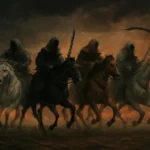
The concept commonly known as the four horsemen in Revelation captures a dramatic moment in the Christian Bible’s apocalyptic literature. These riders appear in a highly symbolic vision that has fascinated readers for centuries, shaping both theological reflection and cultural imagination. When people encounter the phrase 4 horsemen in Revelation, they are usually thinking of a quartet of riders who symbolize fundamental forces believed to shape human history: conquest, war, scarcity, and death. The idea is not merely a sensational trope; it sits at the intersection of literary imagery, theological meaning, and eschatological expectation.
In this article, we will explore the four horsemen of the Apocalypse in depth, including their canonical context in Revelation 6, the traditional interpretations of each rider, the broader symbolism they carry, and the ways scholars and faith communities have understood them across time. We will also consider how different Christian traditions interpret the riders within larger schemes of prophecy, eschatology, and history. By looking at both the textual details and the wider scholarly conversation, readers can gain a nuanced view of the quartet of horsemen and what they have come to represent in religious thought, art, and popular culture.
The Text and the Sequence: Where the Four Riders Appear
The imagery of the four horsemen in Revelation appears in the opening pages of the sixth chapter of the Apocalypse, often referred to as the Seals discourse. In this section of the book, the Lamb opens a scroll with seven seals. As each seal is broken, a new vision unfolds. It is with the breaking of the first four seals that the four horsemen make their entrance, each riding a distinct horse and assigned a specific symbolic meaning.
The sequence is not merely decorative; it is designed to convey a progression of events under divine sovereignty. The imagery emphasizes movement from conquest to conflict, from deprivation to death, and it situates these forces within a cosmic drama that many readers interpret as both historical and future-oriented. When people discuss the 4 horsemen in Revelation, they are often tracing how these riders set in motion forces that ripple through human affairs—political, economic, military, and sociocultural.
Key textual notes to orient the conversation
Opening of the sixth seal signals a transition into a new stage of revelation, where four distinct riders emerge as agents of change
White, Red, Black, and Pale (or Green) are the colors associated with each horse, each color conveying its own symbolic resonance
The riders are often read as emblems of universal human experiences, rather than merely local events
There are divergent interpretations about whether these riders describe ongoing, cyclical patterns in history or a climactic, end-times sequence
The Riders of the Apocalypse: Who They Are and What They Symbolize
The White Horse: Conquest, Pestilence, or Spiritual Victory?
The first rider appears on a white horse, and the rider carries a bow while wearing a crown. The immediate symbol—the white horse—invites a range of readings. In one traditional reading, this rider represents Conquest or victory achieved by force, a literal or figurative conquest that spreads across nations and peoples. In other interpretive frameworks, the white horse has been associated with Pestilence or with a more nuanced sense of spiritual victory, depending on the interpretive lens a reader brings to the text.
Important distinctions exist here, which is why discussions about the 4 horsemen in Revelation often open with the white rider. Some scholars emphasize the combination of the bow and the crown as signals of sovereign authority and forward momentum—an emphasis on domination, expansion, and the legitimacy conferred by rulers. Others point to the context of early Christian communities that wrestled with imperial power and looked to the imagery as a critique of conquest’s moral costs. Regardless of the precise emphasis, the white rider is decidedly about the arrival of a new phase initiated by a claim to legitimate rule.
The Red Horse: War, Violence, and the Toll of Conflict
The second horseman rides a red horse and is said to carry a sword. The color red immediately calls to mind bloodshed, violence, and the tearing apart of peace. In many readings, this figure represents War or violent conflict that disrupts social order, inflames disputed boundaries, and imposes a climate of fear. The sword as a symbol underscores decisiveness and force, often interpreted as the instrument through which power asserts itself and suppresses opposition.
The presence of the red horse raises questions about how societies seasonably experience conflict—whether as a series of localized wars, as systemic militarization, or as a broader climate of violent competition that affects economies, populations, and moral choices. In discussions about the four horsemen in Revelation, the red rider is frequently linked to the way war reshapes human life, displaces communities, and redefines political cartography. Some commentators stress that war, in the vision, is not merely a historical accident but a force that seems to be allowed or permitted within a divine framework.
The Black Horse: Famine, Scarcity, and Economic Anxiety
The third rider appears on a black horse and is accompanied by a set of scales. The coloring—black as a symbol of scarcity or mourning—paired with the scales (a measure of goods) explicitly signals Famine or severe economic imbalance. The imagery communicates not only hunger but also the inimical logistics of provisioning and distribution: prices rise, basic staples become scarce, and social justice questions arise about who bears the burden of scarcity.
Interpretations of the black horse emphasize the fragility of food systems, the moral dangers of hoarding and price-gouging, and the way famine affects the vulnerable first. Some readings point to the scales as a reminder that the crisis is measured and weighed—suggesting that scarcity, even when driven by external forces, is processed through human institutions and policy choices. Discussions about the four horsemen in Revelation thus connect prophetic imagery to concerns about economic justice, humanitarian distribution, and the ethics of care in times of shortage.
The Pale Horse: Death and the Afterlife’s Shadow
The fourth rider rides a pale (often translated as pale, green, or pale-green) horse and is identified with Death, with Hades following close behind. This rider’s message is overtly existential: in historical and literary terms, it signals the ultimate human limit—the end of life and the descent into the afterlife. The pairing with Hades underscores the intimate association between death’s inevitability and the unseen realm that tradition describes as the place where the dead continue their experience of existence.
As with the other riders, there is room for varied interpretation in discussing the 4 horsemen in Revelation. Some theologians read the pale rider as a warning about mortality under human systems of power and natural disaster; others see in Death a broader allegory for the consequences of sin and divine judgment. In many Christian traditions, the pale horse becomes a somber reminder that life’s fragility exists within a larger divine drama, one that moves toward ultimate questions about meaning, accountability, and hope beyond death.
Symbolism and Theological Meaning: Reading the Riders in Context
The images of the four horsemen are not isolated symbols; they function within a complex web of apocalyptic symbolism. The colors, the riders’ equipment, and the sequence all invite readers to engage with themes of sovereignty, judgment, and human vulnerability. Across traditions, the imagery is read through lenses that consider history, prophecy, ethics, and eschatology.
Symbolic Motifs in the Quartet: Conquest, Conflict, Scarcity, and Death
The four riders collectively articulate a narrative arc that many readers interpret as a commentary on the trials of the world under divine sovereignty. A common framework is to view Conquest as the initial realization of power’s reach, followed by War as the ethical and social consequences of force. Famine then emerges as a consequence of conflict and mismanagement, and finally Death acts as the universal end that no political system can fully escape. This sequence has offered fertile ground for sermons, literary analysis, and political reflection.
Historical and Theological Implications
In the long arc of Christian history, scholars have seen the four horsemen in Revelation as both a warning and a call to moral renewal. Some interpret them as graphically describing actual historical episodes—wars, famines, and epidemics—that have punctuated human life. Others emphasize a more symbolic reading: the riders represent pervasive forces that recur through time, rather than a single, finite cataclysm. A number of theologians also highlight the pastoral purpose of apocalyptic imagery: to comfort communities under pressure by showing that the forces of chaos operate under divine oversight and will be judged.
Representations Across Traditions
Across Christian traditions, the way the four horsemen are framed varies. In amillennial and premillennial contexts, the riders may be positioned within differing schemes of eschatology—some focusing on imminent events, others on symbolic depiction of ongoing eschatological processes. In some threads of reformed or catholic interpretation, the imagery emphasizes the moral implications of human choices in the face of divine sovereignty. In other contexts, the imagery has inspired painters, poets, and songwriters to explore the tension between human suffering and the hope of ultimate restoration. This diversity speaks to the adaptability of the four horsemen in Revelation as a cultural and spiritual symbol, not merely a narrow doctrinal claim.
Interpretive Variations: How Scholars and Traditions Read the Riders
Conquest or Pestilence? Debates about the First Rider
A central area of discussion around the White Horse’s rider concerns whether the figure primarily signifies Conquest (rulership and expansion) or Pestilence (disease and spiritual disruption). Some interpreters argue for a primarily political dimension: empires making their presence felt through conquest, colonization, and cultural influence. Others stress a spiritual dimension, suggesting that the white horse points to a triumph of good over evil or to deceptive appearances of victory that mask deeper spiritual consequence. Because the image is multi-layered, the debate about the first rider remains a touchstone for broader discussions on the nature of power and responsibility in prophetic literature.
War, Famine, and Death: Are They Separate Realities or Interconnected Phases?
The next three riders—Red (War), Black (Famine), and Pale (Death)—are often treated as a tightly linked sequence. Some scholars stress a causal link: wars often produce famine; famines can accelerate mortality; and death follows in the wake of violence and deprivation. Others emphasize the symbolic autonomy of each rider: each rider represents a distinct form of human vulnerability that can operate independently of the others, yet together they present a composite portrait of a world under strain. In this sense, discussions about the 4 horsemen in Revelation can illuminate how people understand interconnected crises—political violence, economic collapse, and mortality—within a single prophetic tableau.
The imagery of the four horsemen has influenced a wide range of cultural expressions, from medieval art to modern film and literature. In many cases, the riders serve as archetypes for the forces that threaten human flourishing. Bold interpretations may cast the horsemen as agents of judgment, while more hopeful readings may see them as catalysts for repentance, resilience, and moral renewal. Either way, the enduring appeal of the four horsemen in Revelation lies in their capacity to evoke deep questions about power, responsibility, and the possibility of transformation even in times of crisis.
Real-World Reflections: Why the Four Horsemen Still Matter
Reading the four horsemen today invites reflection on how communities navigate periods of upheaval, scarcity, and loss. The imagery can be used as a framework for ethical analysis—how societies respond to war, how economies safeguard the vulnerable during shortages, and how communities remember the dead while continuing to seek justice and mercy. The discussion about the 4 horsemen in Revelation remains relevant because it engages universal themes: power and responsibility, the suffering of the innocent, and the human longing for redemption in the face of mortality.
Pastoral care: How communities care for those affected by war or famine, offering shelter, food, medical aid, and emotional support
Public policy: How policy can reduce vulnerability to conflict and hunger, with attention to justice, trade, and humanitarian aid
Theological reflection: How belief communities interpret suffering within the larger story of hope and divine sovereignty
Common Misunderstandings to Avoid
That the riders predict a single global catastrophe in one moment; many interpreters read them as symbolic representations of recurring forces across time
That the riders presuppose a purely secular reading; in fact, most Christian readings connect the imagery to faith commitments, moral questions, and an overarching narrative of redemption
That the white rider is exclusively political power; some readings highlight its spiritual dimension and its potential to reveal truth about power and ambition
Conclusion: The Four Horsemen as a Lens on Human Experience
The four horsemen in Revelation offer more than a dramatic set of symbols; they provide a framework for understanding the enduring tensions at the heart of human history: the allure and risk of power, the fragility of life, and the moral call to respond with wisdom, courage, and mercy. Whether viewed as historical markers, symbolic archetypes, or future-oriented prophecies, the riders prompt readers to consider how communities endure, respond to crisis, and articulate hope in the midst of suffering.
The exploration of the four horsemen in Revelation can be extended into many directions: historical-critical readings that explore the original context of Revelation’s composition, literary studies that analyze the structure and imagery of apocalyptic writing, and practical theology that contemplates how modern societies confront war, famine, and mortality in ways that reflect ethical commitments. For students, clergy, and lay readers alike, the four riders invite ongoing inquiry—an invitation to read, study, and reflect on the ways the world’s deepest challenges can be interpreted, confronted, and transcended through faith, action, and communal memory.

 Por Laura Jara