Apollos appears mainly in the book of Acts and in Paul’s First Letter to the Corinthians. Acts identifies him as a Jew from Alexandria, an influential city in Egypt, and describes him as an educated man who knew the Scriptures well. He arrived in Ephesus during the early expansion of the Christian movement and began speaking publicly in the synagogue.
His name is Greek, and his background in Alexandria helps explain his ability to communicate in a setting shaped by both Jewish Scripture and Greek culture. Alexandria had a large Jewish population and a strong tradition of learning, although the Bible does not provide enough information to reconstruct Apollos’s education in detail.
Luke describes Apollos as eloquent and fervent in spirit. These qualities suggest more than polished speech. He had conviction, energy, and the ability to explain what he believed. His public teaching attracted attention because he spoke confidently and argued from the Scriptures.
At the same time, Apollos’s understanding was incomplete when he first came to Ephesus. Acts 18:24-25 says that he knew about the baptism associated with John and taught accurately about Jesus to the extent of his knowledge, but he did not yet understand the whole message of Christian faith. The passage presents him as sincere and gifted, while also showing that sincerity and ability do not eliminate the need for continued learning.
The central lesson about Apollos: strong communication and genuine devotion are valuable, but Christian ministry also requires humility, accurate teaching, and a willingness to receive correction.
Apollos should not be confused with one of the twelve apostles. The New Testament does not call him one of the Twelve, and it gives no evidence that he personally followed Jesus during Jesus’ earthly ministry. His importance came through his later work as a teacher and coworker in the growing churches.
Why Apollos needed further instruction in Ephesus
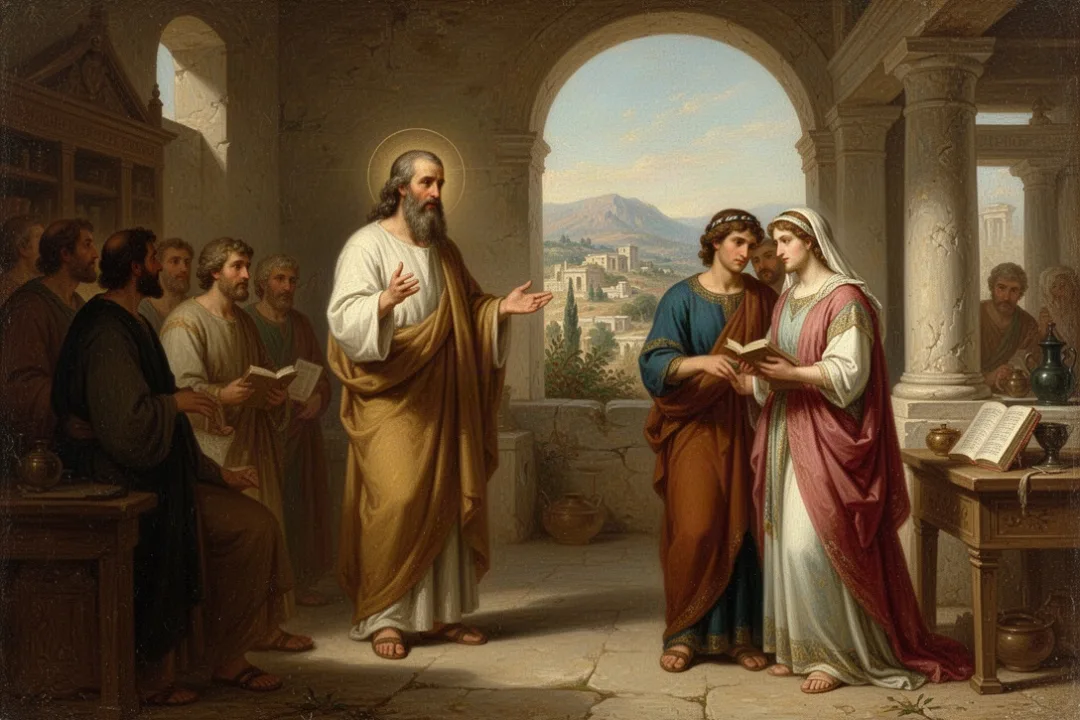
Apollos began teaching in the synagogue, where he spoke boldly about Jesus. Priscilla and Aquila, a married Jewish Christian couple who had worked with Paul, heard him. Instead of publicly humiliating him, they invited him into their home and explained the way of God more accurately, as Acts 18:26 describes it.
The wording matters because Apollos was not portrayed as a fraud or an enemy. He already had a real grasp of important truths, but his knowledge had limits. The reference to John’s baptism indicates that he may have known the message of John the Baptist and recognized Jesus as the promised Messiah without yet having a complete understanding of developments such as Christian baptism and the fuller work of the Holy Spirit.
Acts 19:1-7 provides a related picture of people in Ephesus who knew only John’s baptism. That episode does not explicitly say that these people were Apollos’s students, so it would be too strong to claim that they certainly learned from him. It does, however, show that some people in the region had received an incomplete form of instruction connected with John.
Priscilla and Aquila’s response offers a model for correcting a capable teacher. They did not dismiss Apollos because he lacked some information, and they did not treat his public confidence as proof that he knew everything. They helped him privately and respectfully, allowing his gifts to be directed by a more complete understanding of the gospel.
Apollos’s response is not described in detail, but the next part of the story strongly suggests that he accepted the help. The narrative moves from his instruction to his recommendation for ministry in Achaia. His willingness to continue serving after being corrected is one of the most constructive features of his story.
He was teachable: his existing knowledge did not prevent him from receiving better instruction.
He was accountable: public teaching was connected to the responsibility to teach accurately.
He was useful after correction: learning more did not end his ministry; it strengthened it.
He benefited from a teaching partnership: Priscilla and Aquila contributed to his preparation without seeking public recognition.
This episode also gives Priscilla a significant role. Acts names both Priscilla and Aquila as the people who explained the faith to Apollos. Their shared ministry shows that the early Christian communities recognized the value of careful instruction from faithful believers, not only from the most prominent public speakers.
What Apollos did in Corinth and Achaia
After Apollos wanted to go to Achaia, the believers in Ephesus encouraged him and wrote to the disciples there asking them to welcome him. Acts 18:27-28 says that he was especially helpful to those who had believed through grace. He publicly argued that Jesus was the Messiah, using the Jewish Scriptures to support his case.
The city most closely associated with this stage of his ministry is Corinth. Paul’s First Letter to the Corinthians refers to Apollos as a known leader among the believers there. The church included people who identified themselves with Paul, Apollos, Cephas, or Christ, creating factions around respected teachers.
Paul’s comments in 1 Corinthians 1:12-13 show that the problem was not that Apollos had encouraged division. The problem was that some members of the church had turned ministers into badges of identity. They treated the names of Christian workers as if different leaders represented competing spiritual camps.
Paul also mentions Apollos in 1 Corinthians 3:5-9. He describes himself as the one who planted and Apollos as the one who watered, while God gave the growth. This picture assigns both men real work but places the result under God’s authority. Paul does not deny Apollos’s contribution; he puts it in the proper relationship to the work of God.
Apollos may have had a style that differed from Paul’s. Acts emphasizes Apollos’s eloquence and skill in arguing from Scripture, while Paul sometimes contrasted polished human rhetoric with the power of the message about the crucified Christ. Still, Paul’s letters do not portray Apollos’s ability as a problem in itself. The problem was allowing admiration for a teacher to replace loyalty to Christ.
“I planted, Apollos watered, but God gave the growth.” — 1 Corinthians 3:6, paraphrased
The image of planting and watering explains how different servants can contribute to one mission. One person may establish a church, another may explain its faith more fully, and another may provide pastoral care. Their work can be distinct without being competitive.
Paul’s point becomes even clearer in 1 Corinthians 3:21-23, where he tells the believers not to boast in human leaders. Paul, Apollos, Cephas, the world, life, death, the present, and the future all belong within God’s larger provision, while believers belong to Christ and Christ belongs to God. The passage does not erase individual roles; it prevents those roles from becoming objects of spiritual rivalry.
For church leadership: a gifted teacher can strengthen a community, but the community becomes unhealthy when loyalty to a human leader outweighs shared allegiance to Jesus.
Paul’s attitude toward Apollos also appears in 1 Corinthians 4:6 and 16:12. In the first reference, Paul uses himself and Apollos as examples while urging the Corinthians not to go beyond what was written or become proud in favor of one leader over another. In the second, Paul says that he strongly urged Apollos to visit Corinth with the other workers, but Apollos was not willing to go at that time and would come when he had an opportunity.
That final reference gives a small but useful detail: Apollos was not simply an extension of Paul’s will. Paul could encourage him, but Apollos made his own decision about travel and timing. Their relationship appears cooperative rather than controlling.
What Paul’s letters reveal about Apollos’s character
Apollos is mentioned in several other New Testament passages, although the information is brief. In Titus 3:13, Paul tells Titus to help Zenas the lawyer and Apollos on their journey so that they would lack nothing. This indicates that Apollos remained active in Christian work after the Corinthian disputes described in First Corinthians.
The reference in Titus is especially useful because it places Apollos alongside another traveling worker who needed practical support. Ministry in the early churches involved movement between communities, teaching, correspondence, hospitality, and material provision. Apollos was not only a speaker in a local congregation; he was part of a wider network of workers serving different churches.
Paul never presents Apollos as a rival apostle or as a dangerous teacher. Instead, he treats him as a fellow servant whose work had genuine value. The Corinthian divisions came from the believers’ misuse of leaders, not from evidence that Apollos was trying to build a personal following.
Several character traits emerge from the combined references:
Scriptural knowledge: Apollos could reason from the Hebrew Scriptures and connect them with the claim that Jesus was the Messiah.
Public courage: he spoke boldly in the synagogue and continued teaching in challenging settings.
Communication skill: Acts specifically highlights his eloquence and effectiveness in argument.
Teachability: he accepted fuller instruction from Priscilla and Aquila.
Independence within cooperation: he worked alongside Paul without being portrayed as dependent on Paul for every decision.
Long-term service: later references show that he continued helping Christian communities.
These qualities create a balanced picture. Apollos was neither an all-knowing authority nor an incompetent beginner. He was a capable teacher with incomplete understanding who became more effective through correction and continued service.
The account also guards against two common mistakes. One is to assume that a gifted speaker must be correct in every detail. The other is to assume that someone who needs correction has no valuable contribution to make. Apollos challenges both assumptions: his teaching needed improvement, and his improved teaching was worth receiving.
What Christians can learn from Apollos today
Apollos’s story applies first to anyone who teaches, leads, preaches, writes, or explains Christian beliefs. Knowledge of Scripture and an ability to speak clearly are valuable, but they must be joined to accuracy, humility, and a willingness to grow. A persuasive presentation cannot compensate for a distorted message.
His example also shows how correction can be handled responsibly. Priscilla and Aquila did not use Apollos’s incomplete knowledge as an opportunity to gain status. They helped him understand more accurately, and their private approach protected both truth and the teacher’s dignity.
For a church or study group, this suggests several practical habits:
Check teaching against Scripture: confidence and popularity should not be the only measures of reliability.
Correct privately when possible: personal conversations often allow questions and clarification that public criticism does not.
Separate a person from an error: someone may be mistaken on a point without being dishonest or useless.
Welcome complementary gifts: one person may explain, another may organize, and another may provide pastoral care.
Keep Christ at the center: ministry roles should serve the church rather than create competing camps.
Apollos also speaks to people who feel unqualified because they are still learning. His early limitations did not disqualify him from service. The key issue was not whether he knew everything at the beginning, but whether he was willing to receive instruction and teach responsibly afterward.
At the same time, his story should not be used to excuse careless teaching. Acts presents his initial understanding as incomplete, and the church provided fuller instruction. Growth is not a substitute for accuracy; it is the process by which a servant becomes more accurate.
The contrast between Paul and Apollos is especially helpful. Paul planted, Apollos watered, and God gave growth. Churches need different kinds of labor, and no single worker possesses every gift. A congregation becomes stronger when it recognizes these differences without ranking people according to style, education, or public influence.
Apollos therefore remains a model of capable service shaped by humility. His story combines biblical knowledge, persuasive communication, correction, cooperation, and continued usefulness. The New Testament remembers him not because he sought attention, but because God used his gifts to help people understand and live out the Christian faith.
Frequently asked questions
Was Apollos one of the twelve apostles?
No. The New Testament does not identify Apollos as one of the Twelve apostles chosen by Jesus. He was a later Christian teacher and ministry leader, known for his knowledge of Scripture and ability to explain that Jesus was the Messiah. His work took place during the expansion of the early church, especially in Ephesus and Corinth.
Who taught Apollos more accurately?
Priscilla and Aquila provided Apollos with fuller instruction. Acts 18 says they took him aside and explained the way of God more accurately. Their approach was personal and respectful rather than confrontational. The passage does not list every point they taught him, but Apollos’s earlier knowledge connected particularly with John’s baptism was incomplete.
Did Apollos disagree with Paul?
The New Testament does not describe a personal dispute between Apollos and Paul. Some Corinthian believers created factions around Paul, Apollos, and Cephas, but Paul criticized the factions rather than Apollos. Paul portrayed himself and Apollos as fellow workers with different roles, using planting and watering to show how their ministries complemented each other.
Where else is Apollos mentioned in the New Testament?
Apollos is mentioned chiefly in Acts, 1 Corinthians, and Titus. Acts describes his teaching in Ephesus and Achaia. First Corinthians discusses his ministry in Corinth and the divisions associated with different leaders. Titus 3:13 refers to helping Apollos on a journey, showing that he remained active in Christian service later on.








Leave a Reply