Paul in Corinth: His Ministry, Challenges, and Letters
Paul in Corinth: His Ministry, Challenges, and Letters
Paul spent about 18 months in Corinth, where he worked, preached, faced opposition, and established one of the earliest Christian communities in Greece.
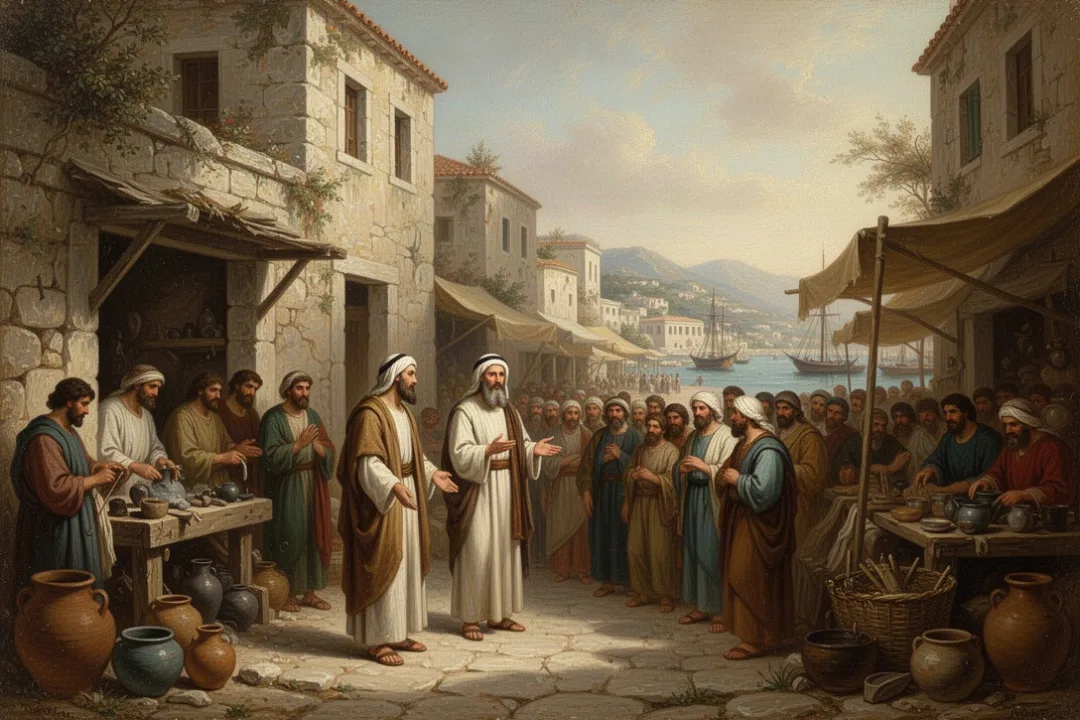
Corinth was a major commercial city connecting mainland Greece with the Peloponnese. Its position between two seas brought merchants, travelers, sailors, soldiers, freedpeople, and residents from many cultural and religious backgrounds. That movement made Corinth a strategic place for spreading the Christian message beyond one local synagogue or household.
The city Paul entered was prosperous but also marked by sharp social differences. Wealthy patrons, laborers, enslaved people, immigrants, and tradespeople could all be found in the same urban setting. The church Paul founded therefore included people with very different backgrounds, resources, habits, and ideas about status.
Corinth also had a reputation in the ancient world for commercial ambition and moral disorder, although modern readers should be cautious about reducing the entire city to a stereotype. Paul’s letters show a congregation dealing with ordinary human disagreements: competition over leaders, disputes about sexual conduct, arguments about food, confusion about worship, and unequal treatment at communal meals.
The central fact: Paul’s work in Corinth was not simply a short preaching visit. It became a sustained relationship involving a long stay, repeated correspondence, difficult visits, pastoral correction, and deep affection.
What happened when Paul first arrived in Corinth
Acts 18 describes Paul’s arrival in Corinth during his wider missionary activity in Macedonia and Greece. The account places him first among Jewish residents and synagogue worshipers, where he reasoned from the Scriptures about Jesus as the Messiah. As resistance developed, Paul shifted some of his activity to a nearby home associated with Titius Justus, a worshiper of God.
According to Acts 18, Crispus, the synagogue leader, believed in the Lord along with his household. Many other Corinthians also heard Paul, believed, and were baptized. These details suggest that the growing community was not limited to one ethnic or social group, even though Paul’s initial discussions took place in a Jewish religious setting.
Paul appears to have received encouragement through a vision in which he was told not to be afraid and to continue speaking. The narrative emphasizes that God had many people in the city. Paul then stayed for about a year and a half, teaching the word of God among the Corinthians.
That length of residence helps explain why Corinth became one of Paul’s most significant congregations. He was not offering a brief message and immediately leaving. He had time to teach new believers, develop relationships, organize communal life, and become known in the city.
Paul’s work and relationships during his Corinthian stay
Acts presents Paul as a tentmaker, or more broadly as someone involved in leatherworking or a related trade. He worked with Aquila and Priscilla, a Jewish couple who had come to Corinth from Italy. Their shared trade provided a practical way to support ministry while also creating daily contact with local people.
The partnership with Aquila and Priscilla continued beyond Corinth. They later appear in Ephesus, where they helped explain the Christian message more accurately to Apollos. Their presence shows that Paul’s mission depended not only on his public teaching but also on networks of coworkers who hosted gatherings, instructed believers, and traveled between cities.
Silas and Timothy joined Paul during this period. Their arrival allowed Paul to devote more attention to preaching. Timothy later became an important messenger between Paul and the Corinthian congregation, carrying information and helping address problems that Paul could not handle personally.
Paul also names several Corinthian believers in his letters. These include Stephanas and his household, whom Paul describes as among the first converts in the region, as well as Fortunatus and Achaicus. Chloe’s people reported disputes to Paul, suggesting that members of her household or business network had communicated with him about serious tensions in the church.
These names matter because they show that the Corinthian church was made up of real households and working relationships. It was not an abstract audience. Paul’s instructions were directed to people who met in homes, shared meals, traveled for business, and carried news between congregations.
A step-by-step timeline of Paul’s connection with Corinth
Paul arrived in Corinth during his missionary work in Greece and began reasoning in the synagogue.
He worked with Aquila and Priscilla, supporting himself through his trade while continuing to teach.
He broadened his ministry when opposition arose, using a nearby house as a place for teaching and gathering.
Crispus and many Corinthians believed, and the new community grew across social and religious boundaries.
Paul remained for about 18 months, giving the congregation sustained instruction and pastoral care.
He left for Syria, traveling through Ephesus and other locations as part of his wider missionary route.
Paul later communicated by letter, especially when reports reached him about conflict, ethical problems, worship, and teaching.
He made or planned additional visits, though the precise sequence of every visit and letter is debated by scholars.
The timeline is clearer in broad outline than in every detail. Acts gives the main narrative of Paul’s first stay, while First and Second Corinthians preserve later correspondence. Some passages in Second Corinthians have led scholars to discuss a painful intermediate visit and a “severe” letter that is no longer preserved as a separate document.
How the Roman administration affected Paul’s time in Corinth
Paul’s ministry in Corinth took place under Roman rule. Acts 18 names Gallio as the proconsul of Achaia and describes a complaint brought against Paul. His opponents accused Paul of persuading people to worship God in a way that violated the law. Gallio declined to treat the dispute as a matter for his court and drove the complainants away.
This episode is significant because it shows that Paul’s preaching was visible enough to attract public attention. It also suggests that local authorities did not automatically regard Christian disagreements as criminal matters. The account does not mean Paul faced no danger anywhere, but it helps explain why his Corinthian stay could continue for an extended period.
Paul’s opponents later seized Sosthenes, the synagogue leader, and beat him in front of the tribunal, according to Acts. The episode is difficult to interpret in detail, but it underscores the tense setting in which religious, civic, and social disputes could overlap.
The approximate timing of Paul’s stay is often placed around the early 50s AD. The date is connected with the known office of Gallio, but precise chronology remains dependent on how evidence from Acts, Paul’s letters, and other historical material is combined.
What First Corinthians reveals about the church Paul founded
First Corinthians was written after Paul had left the city, most likely while he was in Ephesus. The letter responds to reports from Corinth and to questions the congregation had sent him. It gives an unusually detailed view of an early Christian community learning how to live together.
Division over leaders and spiritual status
Some Corinthian believers identified themselves with Paul, Apollos, Cephas, or Christ. Paul treats this as evidence that the church had adopted competitive ideas about leadership. Instead of allowing one teacher to become a badge of social identity, he directs attention to God as the source of the church’s growth.
Apollos was an eloquent Jewish teacher associated with Alexandria who had worked in Corinth after receiving further instruction from Aquila and Priscilla. Paul does not present Apollos as an enemy. Their different gifts could serve the same community, but the Corinthians were turning those differences into factions.
Paul’s response challenges the values of status and performance. He emphasizes the message about the cross, which appeared foolish or weak according to conventional standards. His concern was not to reject clear thinking or careful speech, but to prevent human prestige from becoming the foundation of the church.
Sexual ethics and the meaning of belonging to Christ
First Corinthians addresses a serious sexual relationship within the congregation, disputes between believers, prostitution, marriage, singleness, and sexual self-control. Paul’s instructions reflect the moral expectations of his Jewish and Christian framework, while also responding to the specific problems he believed were damaging the community.
He repeatedly links the body to Christian identity. For Paul, physical behavior was not spiritually irrelevant. Believers’ bodies belonged to the Lord, and sexual conduct affected both personal faithfulness and the health of the congregation.
His advice on marriage and singleness also recognizes different circumstances. Paul sometimes distinguishes between a direct command and his pastoral judgment, showing that he did not treat every question as having the same kind of answer. He wanted believers to live faithfully within their situation while avoiding unnecessary division and anxiety.
Food offered to idols and responsibility toward others
Corinthians also debated whether believers could eat food associated with pagan temples. Paul acknowledges that idols have no divine reality comparable to the one God, but he refuses to make private knowledge the only consideration. A believer’s freedom must be weighed against the possibility of harming another person’s conscience.
This reasoning leads to one of Paul’s strongest pastoral principles: love limits the use of freedom. The person with more knowledge should not use that knowledge in a way that pressures someone else to act against conscience. Paul even uses his own willingness to surrender rights as an example of choosing another believer’s good over personal entitlement.
The issue was not merely a menu choice. Shared meals could involve social loyalty, temple settings, business relationships, and public identity. What a person ate could communicate belonging. Paul therefore treats food as part of a larger question about how Christians should participate in public life.
Economic inequality at the Lord’s Supper
One of the sharpest problems involved communal meals. Some Corinthians were eating early and abundantly, while others arrived later and went hungry. Wealthier members apparently had more freedom to bring food and wine, whereas poorer members did not enjoy the same security.
Paul argues that this behavior contradicts the meaning of the Lord’s Supper. A gathering intended to express unity had become a display of economic separation. His criticism is directed not only at individual gluttony but also at a social arrangement that allowed some believers to feast while others were humiliated.
Paul’s practical test for worship: A gathering cannot genuinely express Christian unity when it humiliates the poor or allows social privilege to determine who is welcomed and fed.
Spiritual gifts and orderly worship
Corinthian meetings included gifts such as prophecy, speaking in tongues, teaching, and interpretation. Paul values these gifts but insists that they must build up the whole congregation. A dramatic spiritual experience was not automatically more useful than clear instruction that others could understand.
His famous discussion of love in First Corinthians 13 appears within this argument about gifts and communal behavior. Love is not presented as a sentimental interruption. It is the standard that determines whether spiritual activity serves the church or merely displays the individual.
Paul also gives instructions intended to make public worship understandable and orderly. His concern is that visitors and other believers should be able to recognize what is happening. The congregation’s freedom must be balanced with intelligibility, mutual respect, and concern for those who are present.
Resurrection as the foundation of Christian hope
Some Corinthians questioned or misunderstood the resurrection of the dead. Paul responds by connecting the future resurrection of believers with the resurrection of Christ. If there is no resurrection, he argues, Christian preaching and faith lose their foundation.
Paul distinguishes between the present body and the transformed resurrection body without treating the future hope as an escape from embodied existence. The resurrection means God will bring life to completion, not that the body is disposable or irrelevant.
This teaching also reinforces Paul’s ethical message. Because believers expect God’s future victory over death, their work for the Lord is not pointless. Hope shapes endurance in the present.
Why Paul’s preaching style mattered in Corinth
Paul’s first letter indicates that some Corinthians judged teachers by rhetorical polish, social influence, or intellectual impressiveness. Public speakers in the ancient Mediterranean world could gain honor through education and persuasive performance. Paul responds by presenting his ministry as centered on Christ crucified rather than on self-display.
That does not mean Paul never reasoned carefully or used persuasive language. His letters are structured, forceful, and sometimes highly emotional. His concern was that the gospel should not be treated as another platform for gaining status.
He also reminds the Corinthians that the congregation itself was not composed mainly of the socially powerful. God had called people whom the surrounding culture might overlook. Paul uses this reality to challenge boasting and to redirect honor toward God.
What Second Corinthians shows about Paul’s painful relationship with the church
Second Corinthians has a more personal and emotionally varied tone than First Corinthians. Paul defends his apostolic ministry, explains changes in travel plans, describes suffering, appeals for generosity, and confronts rival teachers. The letter reveals a relationship that included trust, disappointment, warning, and reconciliation.
Some Corinthian believers criticized Paul because he did not appear to fit their expectations of an impressive leader. They may have considered his physical presence unimpressive, his speech insufficiently polished, or his hardships evidence against his authority. Paul answers by arguing that genuine ministry is not measured by outward triumph.
His ministry is marked by weakness, suffering, honesty, and dependence on God. He describes carrying the message in fragile human vessels, using an image that places divine power and human limitation side by side. Paul is not celebrating pain for its own sake; he is explaining why suffering does not disprove his calling.
The letter also refers to a painful visit and a severe communication, although the exact reconstruction is debated. Paul’s grief over the response to his correction shows that discipline was not a detached exercise in control. He wanted restoration, but he also believed serious wrongdoing could not simply be ignored.
How Paul handled money and generosity in Corinth
Paul organized a collection for believers in Jerusalem. The project connected Corinth with other Christian communities and gave the congregation an opportunity to express solidarity across geographic and economic boundaries.
His instructions about giving emphasize voluntary participation, preparation, fairness, and integrity. He did not want contributions extracted through pressure, nor did he want the collection handled in a way that created suspicion. Trusted representatives were involved so that the money could be managed transparently.
The collection also had theological meaning. It was not merely emergency relief or an administrative project. Shared resources demonstrated that Gentile congregations and Jewish believers in Jerusalem belonged to one people through Christ, despite differences in background and location.
Paul’s teaching on generosity fits his wider concern about equality. The goal was not that one group should fall into poverty while another remained comfortable, but that believers should respond to need with mutual care.
What Paul in Corinth teaches about church life
Paul’s Corinthian correspondence presents the church as both gifted and immature. The believers were active in worship and eager to discuss spiritual matters, yet they were also capable of arrogance, exclusion, and serious ethical failure. Paul does not solve this tension by denying their gifts or by treating their problems as harmless.
Several principles run through his instructions:
Christian freedom is relational: personal rights should be considered alongside another believer’s conscience and welfare.
Worship should build people up: gifts and public speech should serve the whole congregation rather than showcase one person.
Economic inequality must be confronted: shared worship cannot coexist comfortably with the humiliation of poorer members.
Leadership is service: teachers are not trophies for competing factions.
Correction should seek restoration: Paul confronts wrongdoing while still longing for reconciliation.
Resurrection gives endurance meaning: present faithfulness is connected to God’s future work.
These principles arise from particular Corinthian disputes, but they also explain why the letters have remained influential. Paul is not offering a simple picture of a perfect congregation. He is showing how Christian convictions are tested when people with different habits, resources, loyalties, and expectations share one community.
How to read Acts and the Corinthian letters together
Acts provides the broad narrative: Paul arrives, works with Aquila and Priscilla, preaches, faces opposition, and stays for an extended period. First and Second Corinthians provide a closer view of what happened after the founding period, when the congregation had developed its own leaders and internal tensions.
The two sources have different purposes. Acts tells a missionary story shaped around the spread of the gospel and the work of the apostles. Paul’s letters are occasional documents written to address immediate pastoral, theological, and relational problems.
Readers should therefore avoid expecting every event to appear in a neat chronological order. The surviving letters do not preserve every message Paul sent, and some references are difficult to place precisely. Scholars continue to debate how many visits Paul made to Corinth and how several sections of Second Corinthians fit together.
The broad picture remains stable: Paul founded the Corinthian church, maintained a demanding relationship with it, and used correspondence to teach believers how the gospel should shape their shared life.
Why Paul’s time in Corinth still matters
Paul in Corinth represents the practical challenge of building a diverse community around a shared faith. The congregation was not separated from ordinary social pressures. Class, reputation, education, ethnicity, sexuality, economic security, and public honor all influenced how members understood their responsibilities.
Paul’s response was neither to pretend those differences did not exist nor to let them define the church. He repeatedly directs the Corinthians toward a community shaped by the cross, love, mutual responsibility, holiness, and resurrection hope.
His time in Corinth also shows that missionary success did not eliminate later conflict. A congregation could grow quickly and still require correction. A leader could love a community deeply and still confront it firmly. Paul’s letters preserve that complexity rather than presenting ministry as a smooth sequence of victories.
The Corinthian story is therefore useful for understanding both Paul and the early Christian movement. It combines travel, trade, synagogue debate, household gatherings, Roman administration, financial cooperation, theological argument, and pastoral struggle. Above all, it shows Paul trying to form a community in which faith became visible in conduct, not merely in speech or religious experience.
Frequently asked questions
How long did Paul stay in Corinth?
Acts 18 says Paul stayed in Corinth for about a year and a half, or approximately 18 months. The exact calendar dates are uncertain, but his visit is commonly placed in the early 50s AD. This was long enough for him to establish a congregation, teach extensively, work with local believers, and develop relationships that continued after he left.
Which books of the Bible discuss Paul’s relationship with Corinth?
Acts 18 describes Paul’s initial visit and the founding of the church. First Corinthians addresses divisions, sexual ethics, food, worship, spiritual gifts, the Lord’s Supper, and resurrection. Second Corinthians focuses more on Paul’s authority, suffering, travel plans, financial collection, conflict, and reconciliation with members of the congregation.
Who were Aquila and Priscilla in relation to Paul?
Aquila and Priscilla were a married Jewish couple who worked with Paul in Corinth. They shared his trade and supported his ministry through their home and professional network. They later appear in Ephesus, where they helped instruct Apollos. Their partnership illustrates how early Christian mission involved coworkers, households, and practical hospitality.
What was the main problem with the Corinthian church?
There was no single problem. The congregation faced factionalism, sexual misconduct, disputes about food and conscience, economic inequality at communal meals, confusion about spiritual gifts, and questions about resurrection. Paul treated these issues as connected because they revealed a deeper failure to practice love, humility, mutual responsibility, and unity within a diverse community.








Leave a Reply