Ephesus in the Bible: history, meaning, and key passages
Ephesus in the Bible: history, meaning, and key passages
Ephesus was one of the most important Christian centers in the New Testament. The city became a major setting for Paul’s ministry, the growth of the early church, and Jesus’ message to the churches in Revelation.
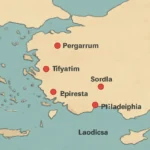
Ephesus stood on the western coast of Asia Minor, in the region that is now western Turkey. It was near the Aegean Sea and served as an important commercial, political, and religious center. Its location helped connect inland communities with maritime trade routes across the eastern Mediterranean.
By the first century, Ephesus was associated with the Roman province of Asia. It had a large population, public buildings, marketplaces, theaters, and a strong civic identity. The city was especially famous for the Temple of Artemis, one of the best-known religious structures of the ancient world.
The temple was connected with worship of Artemis, whom the city honored as a powerful goddess. Local craftsmen and merchants benefited from religious tourism and the production of silver images associated with the goddess. That economic and religious system helps explain why the message about Jesus created such strong opposition in Ephesus.
Central idea: Ephesus shows how the Christian message entered a prosperous, religiously influential city and gradually formed a community that affected the wider region.
Every major reference to Ephesus in the New Testament
The New Testament mentions Ephesus in several different settings. Some passages describe events in the city, while others address Christians who lived there or church leaders connected with the Ephesian congregation.
Acts 18: Paul briefly visits Ephesus, and Priscilla and Aquila help Apollos understand the Christian message more accurately.
Acts 19: Paul conducts an extended ministry in Ephesus, and many people become followers of Jesus.
Acts 20: Paul meets the elders from Ephesus at Miletus and warns them about future threats to the church.
1 Corinthians 15:32: Paul refers to fighting “wild beasts” at Ephesus, using language that has been understood in more than one way.
1 Corinthians 16:8–9: Paul describes an effective opportunity for ministry in Ephesus despite strong opposition.
Ephesians: Paul’s letter addresses Christians in the area and explains central themes of Christian faith and life.
1 Timothy 1:3: Timothy is instructed to remain in Ephesus and confront false teaching.
2 Timothy 4:12, 19: Tychicus is mentioned in connection with Ephesus, and Paul sends greetings to people connected with the church there.
Revelation 2:1–7: Jesus addresses the church at Ephesus, praising its perseverance while rebuking it for losing its first love.
These references do not all describe the same moment. Together, they trace Ephesus from an early stage of evangelism to the development of an established congregation facing internal and external challenges.
How Christianity first reached Ephesus
Paul first arrived in Ephesus during the events described in Acts 18:19–21. He entered the synagogue and reasoned with the Jewish community, but he did not remain for an extended period. Instead, he left Priscilla and Aquila there and indicated that he would return if God allowed.
Priscilla and Aquila then encountered Apollos, a gifted speaker who knew about Jesus but had received incomplete instruction. They took him aside and explained the way of God more accurately, as Acts 18:24–28 describes. Their role illustrates that Christian teaching in Ephesus began through several workers, not through one person alone.
Apollos later became an influential Christian teacher. His connection with Ephesus also helps explain why Paul later addressed divisions and leadership loyalties in the church at Corinth. In 1 Corinthians 1–4, Paul makes clear that no human teacher should replace devotion to Christ.
What happened during Paul’s ministry in Ephesus
Paul returned to Ephesus and remained there for an extended period, as recorded in Acts 19. His work included teaching in the synagogue and later using the lecture hall of Tyrannus. This gave him a setting where people could hear the message regularly and where the teaching could reach beyond one small gathering.
Acts says that Paul’s ministry continued for a substantial period and that the message spread through the surrounding province of Asia. People from different communities could have encountered the Christian message through travelers, converts, house churches, and ministry partners connected with Ephesus.
The chapter also describes unusual miracles associated with Paul’s ministry. These signs drew attention, but the main emphasis remains the power of God’s message and the transformation of people’s lives. Some who practiced magic publicly burned their expensive scrolls, showing that their commitment to Christ involved rejecting practices they had previously considered valuable.
That event provides one of the clearest pictures of repentance in the New Testament. Repentance was not merely an emotional response or a change in religious vocabulary. For these people, it meant turning away from practices that conflicted with their new allegiance to Jesus, even when doing so involved financial loss.
Why the riot in Ephesus happened
The most dramatic opposition appears in Acts 19:23–41. A silversmith named Demetrius became concerned that Paul’s teaching was damaging the business connected with making silver shrines of Artemis. He argued that the Christian message threatened both the craftsmen’s income and the honor of the city’s goddess.
The dispute grew into a public disturbance. A crowd gathered in the theater and shouted in praise of Artemis. Many people did not even know why they had assembled. The city clerk eventually calmed the crowd by directing the matter into proper legal channels.
This episode reveals several pressures that Christian communities could face:
Economic pressure: A change in religious practice could affect businesses built around idol worship.
Social pressure: Christians were viewed as rejecting customs that helped define the city’s public identity.
Political pressure: A large public disturbance could threaten Rome’s order and bring consequences from government officials.
Emotional pressure: Religious loyalty and local pride made it easy for a crowd to act before understanding the facts.
The riot did not end with a mass arrest of Christians. Instead, the city clerk dispersed the crowd and warned that the disturbance could expose Ephesus to accusations of disorder. Luke’s account shows that the early church could face serious opposition without every conflict becoming an official persecution.
What Paul taught the Ephesian elders
Paul’s farewell meeting with the Ephesian elders is recorded in Acts 20:17–38. Paul did not return to the city itself at that point. He called the elders to Miletus, where he gave them a deeply personal charge about their responsibilities.
He reminded them of his conduct among them: humility, perseverance, public teaching, and house-to-house ministry. He also described his determination to continue toward Jerusalem despite suffering and uncertainty. His words present Christian leadership as service rather than status.
Paul urged the elders to pay careful attention to themselves and to the entire flock entrusted to them. He warned that destructive teachers could arise from outside the community and even from within it. The church needed spiritual discernment because false teaching could distort the community’s understanding of grace and truth.
Acts 20 also emphasizes the value of faithful teaching over personal influence. Paul does not present himself as the permanent center of the Ephesian church. He points the elders toward their responsibility to care for the people and toward God’s power to strengthen them.
Leadership lesson: Paul’s farewell to the Ephesian elders connects sound doctrine with personal character, watchfulness, sacrifice, and care for the vulnerable.
What the book of Ephesians teaches
The Letter to the Ephesians presents a broad vision of God’s work in Christ. It speaks about salvation, the church, spiritual maturity, relationships, and Christian conduct. The letter’s themes are not limited to local problems; they address how believers understand their identity and live together.
Christ brings people into one new community
Ephesians 2 explains that Christ breaks down the hostility between Jews and Gentiles. Paul describes people who were once separated from God and from one another as being brought near through Christ. The church becomes a shared household and a dwelling place for God’s Spirit.
This teaching mattered in Ephesus because the city included people from different ethnic, social, and religious backgrounds. The church was not supposed to reproduce the divisions of the surrounding culture. Its unity rested on Christ rather than on ancestry, status, occupation, or local identity.
The church displays God’s wisdom
Ephesians 3 presents the church as a community through which God’s wisdom becomes visible. The mystery once hidden is now revealed: people from the nations are included as fellow heirs and members of the same body through the gospel.
Paul’s vision is larger than private religious experience. The church demonstrates that God is creating a reconciled people. Its unity becomes part of the message it proclaims.
Christian maturity requires truth and love
Ephesians 4 calls believers to grow into maturity rather than remain spiritually unstable. Teachers and ministry leaders are given to equip the church, so the whole body can become stronger and more capable of serving.
The letter combines truth and love. Christians are not told to preserve peace by ignoring error, nor are they encouraged to defend truth through harshness. Growth involves speaking truth in love, building one another up, and replacing destructive habits with conduct that benefits the community.
Christian behavior changes everyday relationships
Ephesians 4 and 5 address speech, anger, dishonesty, generosity, sexual conduct, forgiveness, and the use of time. The letter connects theology with ordinary decisions. A person’s new identity in Christ should affect conversations, work, relationships, and treatment of other people.
Ephesians 5 and 6 also discuss marriage, children, parents, servants, and masters within the social world of the first century. These passages require careful reading because the ancient household system was not the same as modern family or employment structures. The letter repeatedly emphasizes accountability to the Lord and calls for conduct shaped by love, justice, and self-giving responsibility.
The armor of God describes spiritual readiness
Ephesians 6:10–18 uses the image of armor to describe how Christians stand firm against spiritual opposition. Paul refers to truth, righteousness, readiness associated with the gospel of peace, faith, salvation, and the word of God. Prayer surrounds the entire image.
The passage does not encourage fear or aggression toward other people. Its focus is steadfastness, discernment, and dependence on God. The “battle” language describes spiritual resistance, not permission to treat human opponents as enemies who should be attacked or dehumanized.
What Paul’s other letters reveal about Ephesus
Paul’s first letter to the Corinthians gives a glimpse of the difficulty of his work in Ephesus. In 1 Corinthians 16:8–9, he says that a significant opportunity for ministry is open to him, while also acknowledging that there are many adversaries.
This combination is characteristic of the New Testament picture of ministry in Ephesus. Opportunity and opposition existed at the same time. A receptive audience did not guarantee an easy mission, and conflict did not mean the work had failed.
In 1 Corinthians 15:32, Paul mentions fighting wild beasts at Ephesus. Some interpreters understand this as a literal reference to danger from animals or public punishment, while others understand it as vivid figurative language for hostile human opponents. Because Paul was a Roman citizen and Roman citizens generally did not undergo certain forms of arena execution, the exact meaning remains debated.
The important point is that Paul uses Ephesus as a setting associated with serious danger. He immediately connects the statement with the reality of resurrection: if the dead are not raised, sacrifice for the gospel would be pointless. His ministry hardships make sense only because he believes Christ’s resurrection guarantees the future resurrection of believers.
First Timothy also places Timothy in Ephesus. In 1 Timothy 1:3–7, Paul instructs him to remain there and stop certain people from teaching false doctrines. The problem involved speculation, arguments, and misuse of the law rather than the kind of teaching that produces love, a clean heart, a good conscience, and sincere faith.
This suggests that the Ephesian church faced internal theological problems after its early growth. A congregation could have a respected history and still require correction, instruction, and patient pastoral care.
What Jesus said to the church at Ephesus
Revelation 2:1–7 contains Jesus’ message to the church at Ephesus. He praises the congregation for its hard work, endurance, refusal to tolerate evil, and testing of people who claimed to be apostles. The church had taken doctrine seriously and had persevered under pressure.
Yet Jesus also identifies a serious spiritual weakness: the church had abandoned its first love. The wording has been understood as pointing to love for Christ, love among believers, or both. The passage connects love with the congregation’s earliest devotion and practice.
Jesus tells them to remember where they had fallen, repent, and return to the works they did at first. This is not a call to abandon discernment or tolerate false teaching. Instead, it warns that correct doctrine and persistent service can become empty if love no longer shapes them.
The message contains both encouragement and warning:
Strength: The Ephesian church worked hard and endured hardship.
Discernment: It tested false apostles and rejected corrupt teaching.
Weakness: Its love had declined from its earlier condition.
Required response: Remember, repent, and return to faithful practice.
Promise: Those who overcome will receive access to the tree of life in God’s paradise.
The church at Ephesus therefore represents more than a congregation with a bad reputation. It was a serious, hardworking, discerning church that needed to recover the love that should animate all Christian faithfulness.
How the Ephesian church can be understood today
Ephesus raises questions that apply to churches, ministries, and individual Christians. A community may be busy, orthodox, organized, and resilient while still becoming spiritually cold. Activity alone does not prove health.
At the same time, the message to Ephesus should not be used to criticize every careful church as loveless. Revelation praises their ability to resist deception. The balance matters: Christian love is not sentimentality, and doctrinal discernment is not automatically harshness.
The biblical picture encourages you to examine several areas:
Are your beliefs producing love for God and other people?
Does your service come from devotion or only from habit and pressure?
Can you reject false teaching without treating people with contempt?
Do your public convictions match your private conduct?
Are you willing to repent when faithfulness has become mechanical?
The Ephesian story also demonstrates that the gospel interacts with an entire culture. It affected religious customs, family life, commerce, public identity, and personal behavior. The Christian message was not presented as a private belief disconnected from the city’s practices.
What happened to Ephesus after the New Testament period
Ephesus remained an important city for centuries after the New Testament era, although its influence eventually declined. Changes in the coastline, silting of the harbor, shifting trade patterns, and broader political developments affected its prosperity.
The ruins associated with ancient Ephesus include the theater, streets, public buildings, and remnants of religious structures. These remains help visitors picture the scale of the city described in Acts, though archaeological sites cannot answer every question about the early Christian community.
The New Testament does not provide a complete later history of the Ephesian church. It does, however, leave a lasting spiritual portrait: Ephesus was a place of remarkable opportunity, costly opposition, disciplined leadership, theological instruction, and a warning that perseverance must remain joined to love.
How to study Ephesus in the Bible step by step
Read Acts 18:19–28 to see how Paul, Priscilla, Aquila, and Apollos became connected with Ephesus.
Read Acts 19 for Paul’s extended ministry, the burning of magic scrolls, and the riot connected with Artemis.
Read Acts 20:17–38 to understand Paul’s farewell warning to the Ephesian elders.
Read selected passages from Ephesians, especially chapters 2, 4, 5, and 6, for teaching about unity, maturity, conduct, and spiritual readiness.
Read 1 Timothy 1 to see why Timothy was told to remain in Ephesus.
Read Revelation 2:1–7 to hear Jesus’ evaluation of the Ephesian church.
Compare the passages instead of treating each reference as an isolated story. Together, they show how a church can grow, face opposition, develop leadership, encounter false teaching, and still need renewal in love.
Ephesus in the Bible is therefore both a historical city and a spiritual case study. Its story shows the power of the gospel to challenge entrenched systems, the responsibility of Christian leaders to guard a community, and the need for perseverance to remain joined with love.
Frequently asked questions
Was Ephesus one of the seven churches in Revelation?
Yes. Ephesus is the first church addressed in Revelation 2–3. Jesus commends its endurance and doctrinal discernment, but he warns that the congregation has abandoned its first love. The church is told to remember its earlier devotion, repent, and return to the practices that marked its beginning.
Did Paul write the book of Ephesians while he was in Ephesus?
The letter does not identify its place of writing. Many Christians have traditionally connected it with Paul’s imprisonment, but the New Testament does not provide enough information to state the exact location with certainty. The letter is associated with Paul and addresses Christian teaching relevant to the Ephesian region.
What was the main religion in Ephesus?
Ephesus was especially known for the worship of Artemis and her prominent temple. The city also contained other religious practices common in the Roman world. Acts 19 shows that Christian teaching challenged both the spiritual beliefs and the economic activities connected with local idol worship.
Why did Paul leave Ephesus?
Acts 19 records a major public disturbance connected with Demetrius and the silversmith trade. Afterward, Paul continued his travel through Macedonia and Greece. Acts does not say that he abandoned the church or that the entire congregation was expelled; later passages show continued pastoral concern for its leaders and members.








Leave a Reply