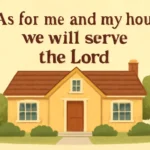
The words commonly rendered as “as for me and my household, we will serve the LORD” sit within a pivotal moment in Israel’s ancient narrative. Joshua, the successor of Moses, stands before the people at Shechem to recall the Lord’s faithfulness, recount the history of deliverance, and lay down a boundary for allegiance. The longer passage surrounding Joshua 24 weaves together memory and choice: the people are invited to acknowledge who has led them, to reject the idols of surrounding nations, and to commit themselves to a singular allegiance to the God who redeemed them.
When we encounter the phrase often glossed as “as for me and my household,” we are looking at a declaration that combines personal resolve with family responsibility. It is not merely a private piety or a solitary vow; it is a statement about leadership, influence, and legacy. The speaker, Joshua, addresses a generation and a household network—the people gathered at Shechem, the elders, the judges, the officers, and the families who would carry forward the covenantal life of Israel.
To understand the significance of this verse, it helps to know that Joshua 24 is a covenant renewal address. It follows chapters describing a renewal of the covenant at Shechem, a reaffirmation of worship practices, and a call to fidelity in the land that God promised. The decision to serve the Lord is framed not as a mere preference but as a covenantal oath that shapes daily living, community ethics, and future generations.
Key Phrases and Translation Variants
Readers encounter several notable phrases depending on the translation. In the familiar rendering from the King James Version, the line reads, “But as for me and my house, we will serve the LORD.” Other translations present slightly different but equivalent formulations:
“But as for me and my household, we will serve the LORD.” (NIV, CSB, NIV84, many modern translations)
“As for me and my family, we will serve the Lord.” (paraphrase common in contemporary devotionals)
“But as for me and my dwelling, we will serve the Lord.” (emphasis in some paraphrases on the idea of a home)
“Me and my family, we will serve the LORD.” (colloquial rendering in certain study Bibles)
The structural core across variants is the same: a personal declaration of fidelity joined to a household scope. The phrase “as for me” signals a personal commitment that extends outward to those who live under the speaker’s roof or influence. The addition of “my house,” “my household,” or “my family” acknowledges that leadership—whether formal or relational—carries responsibility for the spiritual direction of those within the home. Finally, “we will serve the LORD” is not just about formal worship; it encompasses devotion, obedience, and fidelity in daily life.
The Hebrew behind the English renders the sense of choosing priority. While most English translations smooth over nuance, scholars note that the translation points toward a conscious, intentional decision made publicly, not privately alone. In effect, the speaker is presenting a covenantal stance that will shape decisions about work, friendships, culture, media, education, and the cadence of daily routines.
Thematic Significance: Covenant, Choice, and Leadership
The command appears within a broader theological framework that emphasizes covenant fidelity. The phrase can be seen as having three interlocking themes:
Covenant fidelity: A pledge that binds a person and household to God’s purposes and commands, not merely to a sentiment or habit.
Choice and freedom: The verse sits alongside “choose you this day whom ye will serve,” highlighting a real and ongoing human capacity to choose loyalties, even within a community where many options exist.
Leadership and responsibility: A declaration that the leader’s stance influences the household’s commitments and ethical orientation, underscoring that household life has spiritual dimensions and consequences.
For readers today, the significance extends beyond a single historic moment. It invites reflection on leadership models, intergenerational faith, and how a family’s public commitment to God can shape values, goals, and everyday behavior. The verse is often used not only as a personal creed but as a reminder that a family’s spiritual life is lived in ordinary hours—meals, study times, conversations, and acts of service as much as in worship gatherings.
From Ancient Israel to Modern Homes: Reapplying the Principle
Although the context is ancient, the underlying principle translates across time to many households and communities. The idea that a household can pledge its devotion to a higher purpose resonates with contemporary readers who are seeking to parent, partner, and live with integrity in a complex world. Different families define “serving the Lord” in varied ways—through charitable actions, ethical decision-making at work, or the cultivation of a household culture that honors justice, mercy, and humility.
Some contemporary reinterpretations emphasize the idea of a household “mission statement.” The essence remains: a family commits to a shared set of values and rhythms that shape decisions, not merely a Sunday schedule. When families articulate “as for us, we will serve the Lord” as a living commitment, they align daily life with larger aims: mercy, truth-telling, generosity, hospitality, and a posture of learning together.
Practical Applications for Your Household
If you want to translate the spirit of Joshua 24:15 into practical steps for today, consider how the vow can shape routines, conversations, and community life. The core call—covenant fidelity expressed through daily choices—can be enacted in concrete ways. Below are ideas organized to help households of different shapes and sizes engage with the verse meaningfully.
Establish a Family Covenant or Creed
Creating a formal or informal family covenant can help anchor daily life. This might involve:
Writing a short statement that expresses your household’s commitment to integrity, kindness, and service to others.
Agreeing on core values or non-negotiables (e.g., honesty, respect, generosity, care for the vulnerable).
Posting the covenant in a common space as a regular reminder to live by it.
Regular Family Devotions and Scriptural Engagement
Set aside routine moments for reading, reflection, and discussion. This could be:
A shared scripture reading plan, perhaps focusing on themes of covenant, leadership, and community care.
Questions for conversation, such as “How did our actions reflect or fail to reflect our commitments today?”
A short time of prayer for family members and for neighbors in need.
“Serving the Lord” in modern life involves more than private devotion. Families may choose to participate in worship together (where possible), volunteer in community service, or engage in acts of hospitality. The aim is to translate belief into action—generosity, justice, and compassion become ongoing practices.
The vow implies a consistent stance against competing loyalties that pull a household away from its commitments. This can include:
Careful media choices—filtering content that undermines values or harms relationships.
Honest financial practices and stewardship of resources.
Healthy boundaries with social circles, workplaces, and online communities that support the household’s commitments.
Inclusive Language and Household Diversity
Not every household is identical—some include single parents, blended families, roommates, or extended family members. The principle remains applicable: a leader or central figure can guide a diverse group toward shared values, while recognizing that each member’s contribution matters. The spirit of the verse invites households to cultivate a culture where faith, care, and responsibility are shared in age-appropriate, respectful ways.
Step-by-Step Practices: A Practical Plan
The following plan is designed to be adaptable to different living situations, schedules, and spiritual backgrounds. It emphasizes routine, participation, and shared purpose without mandating a rigid ritual.
Define the household’s mission: Draft a short, positive statement that captures how your family hopes to live out its commitments in daily life.
Choose a weekly rhythm: Decide on a regular time for family conversation, devotion, or service planning (e.g., Sunday evenings or a weekday dinner).
Begin with scripture: Read a short passage together and invite each member to reflect in a few sentences on what it means for their life that week.
Practice prayer together: Offer a simple, inclusive prayer for loved ones, neighbors, and those in need.
Engage in a family project: Plan a shared act of service or kindness—cooking for a neighbor, volunteering, or supporting a local charity.
Review and adjust: At the end of each month, revisit the covenant, celebrate small wins, and adjust goals as needed.
30-Day Challenge: Living the Verse
Day 1: Write and post your family covenant.
Day 7: Have a meal together with a brief reflection on what it means to serve others.
Day 14: Initiate a service project or partner with a local charity.
Day 21: Invite a neighbor or friend to participate in a family activity or devotional.
Day 30: Celebrate the journey and renew commitments for the next period.
These steps are not a prescription for perfection but a pathway for consistency. The objective is to cultivate a shared sense of purpose—one that resonates with the spirit of Joshua’s declaration while remaining practical for every household.
Common Questions and Misconceptions
As households engage with Joshua 24:15, a few questions often arise. Here are some common inquiries and thoughtful responses to consider.
Is this verse only about religious traditions? Not at all. The core idea is a deliberate, covenant-centered life that shapes ethics, relationships, and choices. The “serving” mentioned often includes justice, mercy, and humility in everyday conduct, not only ritual acts.
What if family members disagree with the declaration? Disagreement can be a normal part of family life. The goal is honest dialogue, mutual respect, and time for individuals to explore their beliefs while maintaining a shared, non-coercive path toward service to the common good.
Does this apply to households with non-believing members? The principle can still guide how a household treats others, honors commitments, and pursues integrity. It may also open space for questions, learning, and dialogue about faith and values.
Can this be meaningful for people living alone? Yes. While the phrase refers to a household, the underlying principle—devoted, disciplined fidelity to one’s convictions—can be lived as a personal covenant with God, mentors, and a chosen community.
Common Challenges and How to Address Them
Real-life households face pressures that can complicate the aspiration behind Joshua 24:15. Here are some typical obstacles and practical responses:
Busy schedules: Prioritize short, regular touchpoints rather than long, sporadic sessions. Consistency usually matters more than duration.
Different faith backgrounds: Seek common ground in shared values like kindness, honesty, and care for others, while respecting diverse beliefs.
Digital distraction: Establish boundaries around screens and media, especially during family times together.
Financial strain: Align budget decisions with shared values, practicing generosity even in tight times, and modeling prudent stewardship.
Expanding the Conversation: The Verse in Church and Community Life
Beyond the home, Joshua 24:15 has been used in churches and communal settings to emphasize stewardship, mentorship, and intergenerational faith. The refrain echoes in catechesis, youth ministry, and adult education as a reminder that the spiritual journey is not only about private devotion but also about relational influence and public virtue.
Intergenerational Faith Formation
The phrase is a natural bridge between generations. When grandparents, parents, and children articulate a shared commitment, there is a tangible transfer of values, stories, and expectations. This can create environments in which elders model integrity, while younger members contribute energy, questions, and fresh perspectives.
Household Leadership and Civic Life
In a broader sense, households that declare such vows often extend their commitments into service in the community. They may participate in local service organizations, contribute to charitable causes, or mentor others. The verse becomes a catalyst for a climate of generosity and responsibility that transcends the walls of a home.
As for me and my household, the declaration invites a posture of daily reliability and direction. It is a call to align personal desires with a shared purpose that transcends individual gratification, anchoring life in a broader narrative of fidelity to the divine, to neighbor, and to future generations. The statement is not a static pledge but a dynamic practice—one that invites each household to examine its loves, its loyalties, and its commitments.
The contemporary reader may choose to interpret “we will serve the LORD” as a pledge to pursue justice, compassion, and truth in every sphere of life. The home becomes a training ground for character, a laboratory for virtue, and a gateway for hospitality. The verse thus remains a living invitation: to discern the path of service, to endure the trials that accompany faithful living, and to celebrate the grace that sustains households as they walk forward together.










Leave a Reply