Bible Certificate: What It Is, Why You Need It, and How to Get One
Bible Certificate: What It Is, Why You Need It, and How to Get One
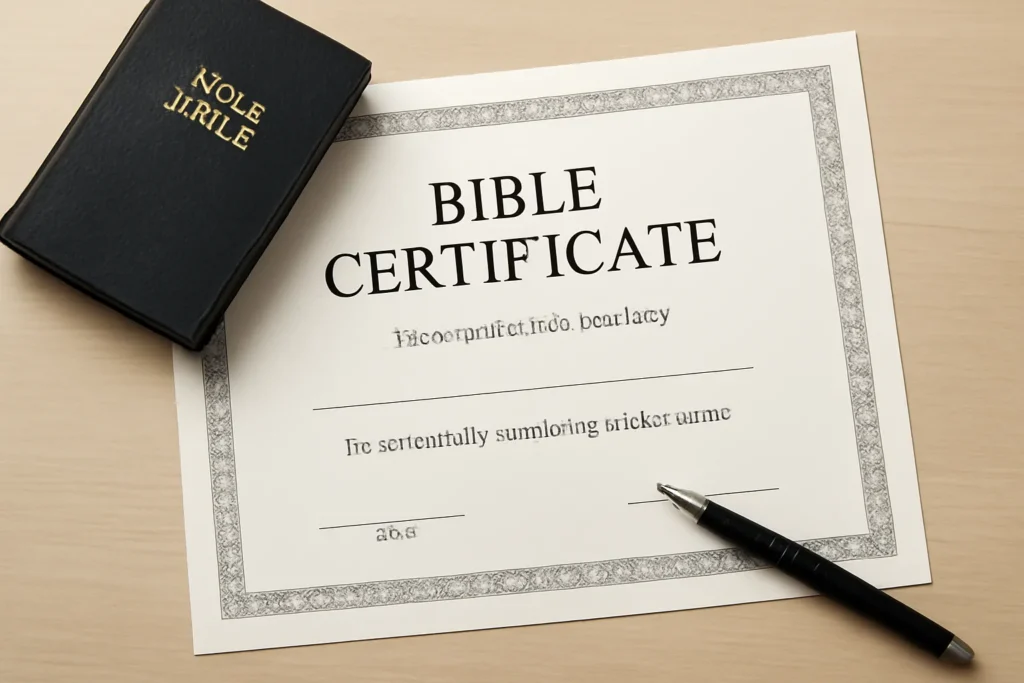
A Bible certificate is a formal document that accompanies a Bible or related biblical artifact to confirm something important about it. Depending on the context, a certificate may attest to authenticity, provenance (where it came from and its history), translation or edition status, ownership, or other legally or academically relevant details. In short, the purpose of a scripture certificate is to provide verified information that helps buyers, collectors, lenders, scholars, museums, or religious institutions understand and trust a Bible or Bible-related object.
There are several legitimate varieties of Bible documentation, and they each serve different ends. A certificate of authenticity (COA) for a Bible is a common type used by dealers, auction houses, and collectors to declare that the item is genuine, dated, and as described. A provenance certificate focuses on the lifecycle of the Bible, tracing ownership and transfers of custody over time. A translation or edition certificate verifies the language, publisher, edition, and sometimes the edition’s scholarly or ecclesial endorsements. An ownership certificate or certificate of ownership might be requested for lending, insurance, or donation purposes. Finally, a certification for religious or educational use can appear in programs, libraries, or seminaries to document suitability for study or teaching.
It’s important to understand that a Bible certificate is not a single universal document. The exact contents, wording, and authority behind a certificate depend on who issues it, what is being certified, and the standards the issuer uses. Different sectors—private collectors, public museums, libraries, churches, translation committees, and insurers—will have their own formats and requirements. What unites them is a shared goal: to provide credible, verifiable information about the Bible or Bible-related item so that stakeholders can rely on it with confidence.
Common types of Bible certificates
Below are some of the most frequently encountered variations. Each type serves a distinct purpose and may be issued by different kinds of organizations.
Certificate of authenticity for a Bible
This is perhaps the most widely recognized form of bible authentication. It asserts that the item is genuine and not a counterfeit or misrepresented product. For rare or antique Bibles, a COA may include:
Details about the publisher and printing date
Edition name or number, and language
Condition notes and any observed alterations
Photographic evidence or catalog references
Name and credentials of the appraiser or certifying authority
Provenance certificate
A provenance certificate focuses on the documented history of ownership and custody. It is particularly valuable for high-value manuscripts, historic Bibles with notable former owners, or items recovered from private collections. Typical elements include:
chain of ownership with dates and locations
transfer records, sales receipts, or donation documents
condition assessments made over time
any discoveries about restoration or conservation work
Translation and edition certification
When a Bible’s translation, edition, or textual lineage is important—such as for scholarly study, liturgical use, or biblical textual criticism—a translation certificate or edition certification may be issued. Useful details often include:
Language, version, and translation committee
Publisher, imprint year, and print run
Notable textual features or revisions
Scholarly notes or endorsements validating the edition’s credibility
Insurance and appraisal certificates
For insurers or lenders, a certificate for insurance or an appraisal certificate helps establish value, coverage terms, and risk considerations. Such certificates typically contain:
There are practical, financial, and scholarly reasons to obtain or maintain credible Bible documentation. Here are common scenarios where a certificate adds value and clarity.
Collectors and auctions: Certification helps establish authenticity and provenance, increasing buyer confidence and potentially the sale price.
Museums and exhibitions: A formal certificate ensures the artifact meets collection standards and can be loaned or displayed with proper documentation.
Libraries and archives: For rare or historic Bibles, documentation supports cataloging, preservation planning, and scholarly access.
Insurance and financial protection: An appraisal or authenticity certificate informs policy terms and guarantees against loss or damage.
Religious institutions and educational settings: Certification supports curriculum, sermon references, and historical study of sacred texts.
Legal and provenance matters: In cases of estate, donation, or sale, certificates reduce disputes about ownership and origin.
Research and scholarship: Researchers rely on documented lineage and edition information for textual criticism and historical analysis.
Beyond practical benefits, a Bible certificate also communicates commitment to accuracy and a respect for the history embedded in a sacred text. For many institutions, obtaining formal certification signals professionalism, stewardship, and an adherence to established standards of authentication and provenance.
Who issues a Bible certificate?
Various organizations may issue certificates depending on the context and the item involved. The credibility of a certificate often hinges on the authority and expertise of the issuer. Common issuers include:
Reputable auction houses with specialist departments in manuscripts and rare books
Certified appraisers who specialize in religious artifacts, rare books, and manuscripts
Museums or library conservation departments that issue provenance statements for loaned items
Religious organizations or biblical societies that publish edition notes and translation confirmations
Independent forensics or authentication labs that offer third-party verification for texts, bindings, or materials
When engaging with any issuer, consider their track record, affiliations, and peer reviews. A credentialed and transparent issuer strengthens a Bible certificate’s reliability, while a lack of transparency should prompt careful scrutiny and additional verification.
What to look for in a credible Bible certificate
Not all certificates are created equal. To distinguish a robust, trustworthy document from a lesser quality one, review several key elements.
Issuer credibility: Is the issuer recognized in the field? Do they publish or list qualifications, standards, or affiliations?
Scope of the certificate: What exactly is being certified (authenticity, provenance, translation, edition, ownership, condition)? Is it clearly defined?
Detailed description: Are the Bible’s edition, language, year, printer, and binding described? Are serial numbers or catalog references included?
Evidence and documentation: Does the certificate point to attached documentation, photographs, inventories, or receipts? Are these verifiable?
Methodology: Is the method for authentication or valuation explained, including standards used or texts consulted?
Signatures and seals: Are the certifier’s credentials, licenses, or organizational seals present? Are dates clearly indicated?
Limitations and disclaimers: Does the certificate note any uncertainties, potential for variation, or conditions for validity?
Serial or certificate number: Is there a unique identifier that can be cross-referenced with a public or private registry?
Physical and archival details: If relevant, does it describe the item’s condition, restoration history, and storage recommendations?
When possible, request a sample certificate or a specimen copy to understand the format, language, and level of detail you can expect. A credible certificate will be clear, precise, and verifiable.
How to obtain a Bible certificate: step-by-step guidance
If you own, plan to acquire, or are considering loaning a Bible or Bible-related artifact, here is a practical, step-by-step approach to secure a reliable certificate for a biblical artifact.
Identify the type of certification you need. Decide whether you require authenticity, provenance, translation verification, edition status, or an insurance/appraisal certificate.
Gather preliminary information and documentation. Collect all available data: publication details, edition name or number, language, binding, inscriptions, marginalia, unique features, and any known provenance facts. Take high-resolution photos from multiple angles, including bindings, plates, stamps, and watermark positions.
Check current value and market context. If you think the item has significant value, consult a specialist early to avoid undervaluation or overvaluation that can mislead buyers or lenders.
Choose a reputable issuer. Look for licensed appraisers, established auction houses with manuscript divisions, museums, or organizations that publish standards for authentication and provenance.
Request a formal proposal. Ask for a scope of work, estimated timeline, required documentation, and fee structure. Compare at least two or three credible options.
Provide all requested materials. Submit copies of receipts, previous certificates or catalog entries, publication records, and any letters of provenance you possess. Supply clear photographs and any other evidence they request.
Receive the draft certificate. Review the draft for accuracy, especially the item description, dates, and any stated limitations. Seek clarification on any ambiguous language.
Finalize and store the certificate. Once you approve, obtain the official certificate, and store both the document and the original item in a secure, controlled environment. Consider digital backups or archiving in a trusted registry if offered by the issuer.
Register or link with a provenance registry (optional). Some collectors or institutions prefer linking the certificate to a provenance or cataloging registry for long-term traceability.
Steps you can take to prepare for a certification process
Preparation helps ensure the process goes smoothly and yields a comprehensive, credible biblical certificate.
Compile a master file with all known details about the Bible, including publisher, edition, year, language, binding type, and any known anomalies.
Document all existing ownership and transfer records, including dates, locations, and witnesses where possible.
Capture high-quality images: cover, spine, title page, any engravings, inscriptions, or marginalia, as well as pages that show the binding and condition.
Prepare a short, factual description of the item’s history, including how you acquired it and its current context (personal collection, library, church archive, etc.).
Assess current conservation needs and storage requirements to maintain the item’s condition while the certification is underway.
Digital Bible certificates and online records
Technological advances have led to more digital and traceable forms of certificate documentation. Digital Bible certificates can offer advantages such as:
Immediate verification through online registries or databases
QR codes or digital identifiers that link to a full certificate with a secure history
Immutable provenance records, potentially aided by blockchain technology
Efficient disaster recovery with cloud-backed copies and backups
When adopting digital certificates, ensure the issuer provides a secure, verifiable method to authenticate the certificate’s integrity. Ask about encryption, access controls, and how the certificate can be updated if new information becomes available. A credible digital certificate should offer the same reliability as a physical document, with the added benefits of accessibility and audit trails.
Care, preservation, and your Bible’s long-term value
Certification is only one piece of the equation. The long-term value and integrity of a Bible or related artifact also depend on careful care and proper storage. A few essential practices include:
Climate control: Keep humidity and temperature within ranges that minimize paper and leather deterioration. Avoid extreme fluctuations that can cause binding damage or ink fading.
Handling precautions: Use clean hands or cotton gloves when handling; support the spine and avoid flexing bindings unnecessarily.
Storage solutions: Store in acid-free boxes or wrapped in archival-quality materials to protect against light, dust, and pollutants.
Security: For high-value items, implement secure storage, inventory controls, and insurance coverage as appropriate.
Conservation assessment: Periodically consult a professional conservator to assess condition changes and recommendations for stabilization or restoration, if required.
Well-maintained conservation practices complement the credibility of a certificate by ensuring the item remains in a condition that supports the certificate’s statements about authenticity, edition, or provenance.
Important cautions and common myths
As with any specialized document, there are myths and caveats you should be aware of when dealing with Bible certificates.
Myth: A certificate automatically guarantees value. Reality: Certification can inform value by confirming authenticity and provenance, but market value still depends on demand, rarity, and condition.
Myth: Any certificate will do. Reality: The certificate is only as good as the issuer’s credibility and the scope of the certification. Always verify the issuer’s qualifications and standards.
Myth: Certificates are permanent and unchangeable. Reality: New information, discoveries, or updates may modify a certificate’s statements. Reputable issuers may issue addenda or amended certificates when warranted.
Myth: All Bibles require certification for sale or loan. Reality: Most everyday Bibles do not require formal certification, but high-value, historic, or ecumenically significant items often benefit from documentation.
Myth: Digital certificates are less trustworthy than physical ones. Reality: When properly secured, digital certificates can offer robust, easily verifiable provenance with equal or greater reliability than paper certificates.
Frequently asked questions about Bible certificates
Here are answers to common questions that people often have about certificates for Bibles and Bible-related artifacts.
What items can be accompanied by a Bible certificate?
Rare or antique Bibles, illuminated editions, incunabula, notable translations, colonial-era Bibles, and any artifact with historic, scholarly, or monetary value.
Who should I contact to obtain a certificate?
Start with established appraisers, museums with manuscript departments, or auction houses that specialize in rare books and religious artifacts. For translations or editions, consult publishers or scholarly panels when possible.
Does a certificate affect ownership rights?
A certificate documents status but does not itself transfer ownership. Ownership transfers follow applicable laws and the terms of sale, donation, or inheritance.
Can I obtain a certificate for a Bible that is not for sale?
Yes. Many institutions certificate items for archival, educational, or insurance purposes even if the item is not being sold.
How long does the certification process take?
Times vary widely based on item complexity, the issuer’s workload, and the scope of certification. It can range from a few weeks to several months.
Using the certificate responsibly
A well-done certificate for a Bible is a tool for accountability and trust. Use it to:
Inform potential buyers or lenders about the item’s status
Support scholarly research and cataloging in libraries or archives
Guide conservation decisions and insurance terms
Maintain an auditable record of the item’s history for future generations
Always ensure that your use of the certificate aligns with the issuer’s guidelines and with the governing policies of any institutions involved, such as libraries, museums, or churches.
Variations in naming and semantic breadth
To reflect the breadth of what these documents cover, you will encounter a range of terms beyond the simple Bible certificate. Some alternative or related phrases include:
Scripture certificate
Biblical authentication document
Edition verification certificate
Translation status certificate
Provenance document for a Bible
Certificate of provenance for sacred texts
Using varied terminology helps capture the nuanced purposes of different documents. For example, “provenance document” signals a focus on the item’s custody history, while “translation status certificate” signals scholarly verification of language and textual lineage. A comprehensive Bible certificate may even combine several of these facets into a single, cohesive record.
Practical tips for buyers, collectors, and caretakers
If you are considering purchasing a Bible with a certificate or if you already own one, keep these practical tips in mind:
Request copies of all related documentation, including any photographs, catalog entries, or previous certificates.
Verify the issuer’s contact information and cross-reference the certificate number with the issuer’s registry if available.
Ask for a written description of what is certified and what is not. Clarify any exclusions or limitations.
Keep the certificate with the item or in a secure, accessible archive so it remains readily available for future transfers or appraisal.
Maintain separate records for documents and physical item details to ensure you can quickly verify references during research or sale.
Conclusion: understanding the value of a Bible certificate
In the field of biblical artifacts, a bible certificate serves as a bridge between the physical object and the world of verified information. It signals that a qualified expert has examined the item and determined that certain statements about its authenticity, provenance, or textual status are trustworthy. While a certificate does not guarantee price or immortality of the object, it significantly enhances confidence for buyers, researchers, lenders, and custodians alike. For anyone who handles a Bible with historic, scholarly, or religious significance, pursuing credible documentation is a prudent step that supports responsible stewardship, scholarly integrity, and the ongoing history of sacred texts.
Whether you are a collector seeking assurance for a rare edition, a library archivist aiming to document a key manuscript, or a church administrator coordinating an exhibition loan, a well-constructed Bible certificate is a valuable tool. By understanding the types of certification, choosing reputable issuers, evaluating the certificate’s scope and evidence, and combining it with proper care and preservation, you can navigate the complex world of biblical artifacts with clarity and confidence.










Leave a Reply