Bible Stories of the Old Testament: Key Narratives, Lessons, and Characters Explained
The Old Testament presents a vast tapestry of narratives that span creation, family dynamics, national crises, and personal quests for faith. These stories are not only ancient tales but vessels for enduring questions about authority, justice, mercy, and humanity’s relationship with the divine. In this article, we explore the most influential stories across the Old Testament, highlight their core characters, and distill the practical lessons they offer for readers today. We will touch on variations in the narratives, the recurring motifs that appear in multiple books, and the way these stories illuminate the character of God and the responsibilities of people who walk in faith.
Creation, Fall, and the Early Covenant: Foundations of the Old Testament Narrative
The opening chapters of Genesis establish the world’s beginnings, the first humans, and the moral structure that governs human life. Two distinct yet complementary portrayals of creation appear in the opening chapters, and both set the stage for the arc of human history that follows.
Creation Narratives: Two Angles on Origins
Genesis 1 presents a structured, orderly account of a sovereign Creator who speaks the world into existence. The refrain, “And God said, Let there be…,” emphasizes the power of the word of God and the goodness of creation. Humans are created last, male and female, in the image of God, with a mandate to steward the earth.
Genesis 2 zooms in on the human story and the intimate details of Eden—the Garden, the naming of animals, the creation of companion relationship, and the intimate design of human life. This account highlights the personal relationship between God and humanity, the dignity of work, and the significance of companionship.
Across these two accounts, readers encounter the themes of order, purpose, and intimacy with God. They also introduce the principle that human choices matter, setting up the next major hinge in the biblical narrative: the Fall.
The Fall and the Promise: Disobedience, Consequence, and Covenant Hope
In Genesis 3, the human decision to disobey God brings consequences—pain, toil, and broken relationships. Yet even within judgment, there is a glimmer of promise. The story foreshadows that life will continue through a line of descendants who walk in faith, and it introduces a pattern that repeats throughout Scripture: sin, judgment, mercy, and divine-human partnership.
The Covenant with Noah after the flood marks a turning point where God commits to restraining violence and sustaining life on earth, with the sign of the rainbow.
The broader arc then moves toward the calling of a family line—the patriarchs—through whom God will unfold a redemptive plan for all nations.
Patriarchs and Promise: The Foundational Journeys of Abraham, Isaac, Jacob, and Joseph
The stories of the patriarchs center on a promise and its testing. They reveal how trust, obedience, patience, and even fear shape a person’s relationship with the divine. They also show how family dynamics, migration, and covenantal faithfulness intersect in surprising ways.
Abraham: Faith, Testing, and Covenant
Abraham’s life is a running study in faith under pressure. God calls him to leave comfort, to become the father of a great nation, and to trust in a promise that seems humanly improbable. The defining moments include:
The call to leave his homeland and journey to a land God will show him, signaling a life oriented toward divine direction rather than immediate security.
The promise of countless descendants and blessing for all nations, accompanied by the sign of the circumcision as the covenant’s visible mark.
The test of offering his son Isaac, a narrative that presses the limits of faith and ultimately demonstrates God’s provision and faithfulness in a way that reorients the meaning of obedience.
Across these episodes, trust and obedience are tested, yet God’s fidelity remains constant. Abraham’s story is often framed as a study in how faith is counted as righteousness and how God’s plans unfold through imperfect human instruments.
Isaac and Jacob: Continuity, Blessing, and the Shaping of a People
Isaac, the son of promise, functions as a bridge between the patriarchal era and the next generation. His life is less dramatic than Abraham’s but no less significant in preserving the line through which blessing flows. Jacob, however, becomes the central figure as the son who wrestles with God and with human limits and who receives the covenant blessing and a new name, Israel.
Jacob’s encounters—at Bethel, in his dream of a ladder, and during his eventual return home—reiterate the idea that God sustains the promises despite human frailty.
The story of Jacob’s twelve sons becomes the genesis of the tribes of Israel, each carrying a unique role in the nation’s unfolding history.
Two persistent themes emerge: divine initiative and human response. The narrative repeatedly shows that God’s purposes advance through human choices, even flawed ones, while God remains faithful to the terms of the covenant.
Joseph: Providence in Adversity and the Weaving of a Community
Joseph’s arc—from favored son to slave, from prisoner to prime minister—reads like a drama of providence. His ability to interpret dreams and his steadfast integrity become tools by which God preserves a family and then a broader people during famine. Joseph’s story has several potent elements:
The theme of forgiveness and reconciled relationships, especially with his brothers who once betrayed him.
The demonstration of divine sovereignty over human plans, realizing that what people intend for harm God can transform into salvation for many.
A quiet political realism about how a nation can be guided through crisis by wise leadership and steadfast faith.
Overall, Joseph’s life emphasizes that even in the darkest chapters, there can be a redemptive thread that leads to the flourishing of a people and the fulfillment of a larger calling.
Exodus, Covenant, and Law: Formation of a Nation
The tale of the Exodus is the foundational epic for Israel’s identity as a people chosen by God. It begins with oppression, leads through miraculous deliverances, and culminates in a community governed by a covenantal framework that governs worship, ethics, and civil life.
Moses and the Burning Bush: A Messenger Called to a Mission
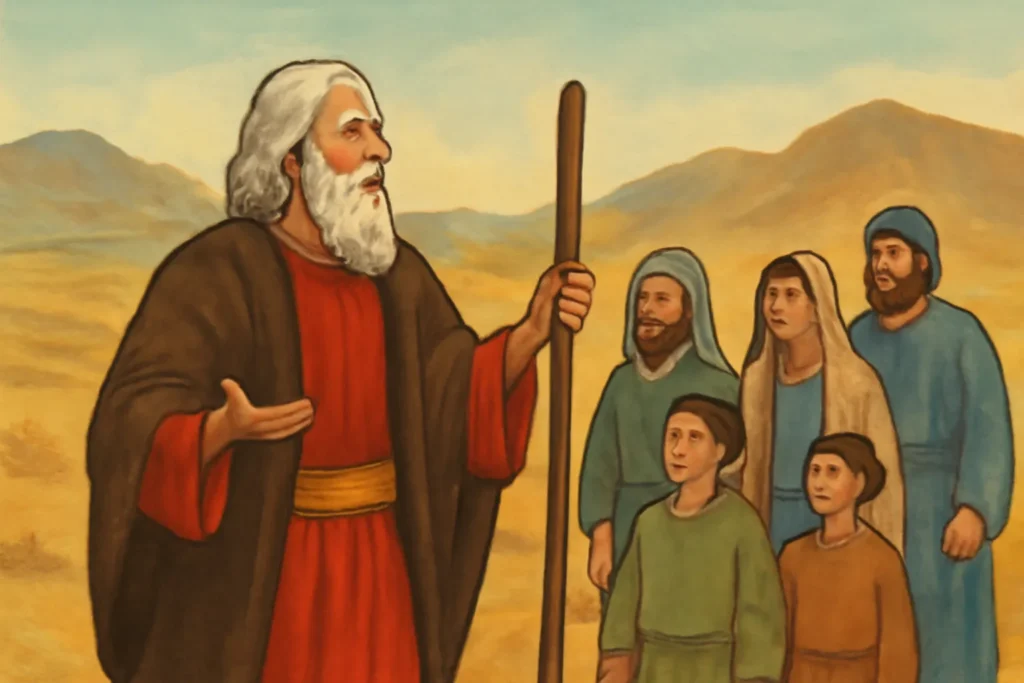
Moses’ encounter with God at the burning bush marks a dramatic turning point in biblical history. He is called to confront Pharaoh, to lead Israel out of Egyptian bondage, and to bring God’s law to a people who will form a new society under God’s guidance.
The insistence that God has heard the cries of the people motivates action, highlighting God’s compassion for oppression and suffering.
Moses experiences a paradox of authority and humility, learning that leadership is often accompanied by doubt, questions, and dependence on God’s power.
Plagues, Passover, and the Crossing: Deliverance and Salvation Symbols
The dramatic events surrounding the plagues culminate in the Passover, a ritual memory that ties together liberation, faith, and obedience. The later crossing of the Red Sea becomes a foundational image of salvation and a demonstration of God’s power to part waters and lead a people to safety.
Two core lessons emerge here: the danger of oppression and the potency of divine intervention. The narrative also foregrounds the idea that freedom is bound to a relationship with God, not merely a change of circumstance.
The Covenant at Sinai and the Giving of the Law: A Community with Boundaries
At Sinai, the people enter into a formal covenant with God, and God gives the Ten Commandments along with broader laws that regulate worship, justice, and social life. The law is not only a list of prohibitions but a framework for living as a people set apart for God’s purposes.
The tabernacle, priests, and sacrificial system establish a means of approaching God while illustrating that holiness requires structure and discipline.
The repeated emphasis on obedience and remembrance shows how memory functions as a teacher for future generations.
Wilderness Wanderings: Lessons in Dependence and Leadership
The years in the wilderness test faith, character, and the community’s ability to follow God in a desert setting. The narrative is punctuated by victories and failures, faithfulness and rebellion, all of which form the school of trust for a nation under covenant.
Key takeaways include the importance of daily reliance on God, the consequences of grumbling and turning away, and the way God provides, guides, and disciplines in a complex journey toward a promised land.
Conquest, Judges, and the Shaping of a Nation
After entering the land, the biblical narrative shifts toward a combination of conquest, settlement, and a recurring cycle of faithfulness and unfaithfulness. The stories of the Judges reveal how Israel navigated moral complexity and national leadership before the establishment of a united monarchy.
Joshua: Crossing, Conquest, and the People’s Identity
Under Joshua, the people cross the Jordan, claim the land, and face a series of military campaigns and faith-filled decisions. The fall of Jericho, the allotment of territory by tribe, and the maintenance of covenantal worship are all central threads.
The narrative emphasizes courage grounded in obedience to God and the belief that victory belongs to the one true God who fights for his people.
It also highlights the dangers of compromise and the need for wholehearted devotion to the covenant.
The Judges: A Cycle of Sin, Distress, Deliverance, and Restoration
Judges presents a recurring pattern: the people turn away from God, oppression follows, God raises up deliverers (judges), and a period of relative peace ensues. The stories of Ehud, Deborah, Gideon, and Samson illustrate how leadership comes in varied forms and how God uses unlikely vessels to accomplish significant acts of rescue and reform.
Deborah’s leadership demonstrates that wisdom and courage can emerge in unlikely moments, especially when supported by prophetic insight.
Gideon’s victory with a small army shows how God often chooses effectiveness over magnitude, turning weakness into strength.
Samson’s strength and shortcomings offer a nuanced portrait of charisma, vulnerability, and the consequences of personal compromises.
Ruth and Naomi: Loyalty, Faith, and the Line of David
Ruth’s story, though set in the era of the Judges, functions as a bridge to the united monarchy by reinforcing themes of faithfulness, kinship, and inclusion. Ruth’s loyalty to Naomi leads to her marriage into the lineage of David, highlighting the way God works through everyday loyalty to accomplish a larger redemptive plan.
Ruth’s narrative adds a human dimension to the national story: personal fidelity can unfold into national destiny. The book also introduces the idea that Gentiles can be woven into God’s plan alongside Israel, hinting at a broader scope of blessing beyond ethnic boundaries.
Kings, Prophets, and the Voice of God: The United and Divided Kingdoms
The rise of the monarchy marks a shift from tribal leadership to a central, royal institution. This era is characterized by promising possibilities, spectacular failures, and prophetic voices that call Israel back to its covenantal roots.
Samuel, Saul, David, and Solomon: A Century of Rise and Reflection
The books of Samuel and Kings trace the arc from the prophet Samuel’s leadership to the reigns of Saul, David, and Solomon. David’s reign, in particular, becomes a template for a king who loves God, yet struggles with personal failures. Solomon’s wisdom and subsequent divisions of the kingdom reveal how even the wisest plans can be undermined by pride and neglect of covenant obligations.
The Davidic covenant promises a lasting throne, foreshadowing future hope and the complexity of leadership under divine sovereignty.
The division of the kingdom after Solomon’s reign marks a turning point in Israel’s history, emphasizing the consequences of disobedience and the need for renewed fidelity to God.
Elijah and Elisha: Prophetic Witness in Turbulent Times
Prophetic narratives in these books reveal a robust critique of idolatry and social injustice. Elijah challenges the prophets of Baal on Mount Carmel and demonstrates the power of a God who is alive in the midst of a people tempted to worship other gods. Elisha, his successor, expands on that prophetic fire by performing signs, healing, and social advocacy, underscoring God’s care for the vulnerable and marginalized.
The live question of divine power in history is answered through dramatic acts, social justice concerns, and steadfast trust in God’s purposes.
Both prophets illustrate the tension between a nation’s outward power and inward faithfulness, reminding readers that true success lies in covenant obedience and compassion for the weak.
Daniel: Wisdom in Exile and Fidelity under Pressure
Daniel’s story unfolds in a foreign land, where political pressures, personal integrity, and steadfast worship of the one true God collide. Daniel’s ability to interpret dreams, remain faithful in hostile environments, and navigate the challenges of exile demonstrates how intellectual excellence, devotion, and wise governance can coexist with strong spiritual identity.
The image of living in exile yet maintaining spiritual allegiance points to a larger biblical theme: God’s sovereignty remains intact no matter who holds earthly power.
The visions and prophecies attributed to Daniel become a thread that many readers connect to later hopes and eschatological expectations, even as they remain rooted in historical circumstances.
Wisdom, Poetry, and the Language of Faith: Job, Psalms, and Proverbs
Beyond narrative history, the Old Testament includes profound literary works that explore human experience, divine justice, and the right way to live before God. These books enrich the storytelling with distinct voices that illuminate questions about meaning, suffering, worship, and practical counsel for daily life.
Job: The Integrity of Suffering and the Everything-Under-the-Sun Question
Job presents a searing meditation on why suffering happens to the righteous. The book explores the limits of human understanding and the reality that faith can persevere even when circumstances defy explanation. The dialogues between Job and his friends grapple with the relationship between righteousness and success, while Job’s final encounter with God reorients perspective toward awe, humility, and trust in a divine plan beyond human logic.
The core question—what is the nature of God’s justice—receives no simplistic answer, but a richer, more nuanced ring of reverence for the God who is both holy and compassionate.
The concluding restoration shows that God values repentance, humility, and a renewed posture toward the Creator rather than mere human vindication.
Psalms and Proverbs: Voices of Worship, Wisdom, and Daily Life
The Psalms give voice to a wide range of human emotion—praise, lament, thanksgiving, and trust. They offer prayers for guidance, comfort in sorrow, and celebration of God’s steadfast love. Proverbs provides practical wisdom for living ethically and wisely, emphasizing the fear of the Lord as the beginning of knowledge and the ethical centerpiece of daily conduct.
In worship settings, the Psalms teach readers to bring honest language to God, whether in hardship or delight.
Proverbs invites readers to cultivate virtue, patience, prudence, and justice in personal conduct and social relationships.
Exile, Return, and Rebuilding: A People Reorients Itself Toward God
The later part of the Old Testament emphasizes a return from exile and the rebuilding of the community around worship, law, and identity. The stories of Esther, Ezra, and Nehemiah highlight courage, reform, and devotion as the people attempt to restore covenant life in a changing political landscape.
Esther: Courage Beneath a Silent Fate
Esther centers on a courageous refusal to remain silent in the face of danger to the Jewish people. Her bravery and the strategic leadership of Mordecai demonstrate that ordinary individuals can become instruments of divine protection and deliverance. Esther’s story is a vivid example of how bravery, loyalty, and trust in God’s purposes can alter the course of history, even in hostile environments.
The celebration of Purim arises from events in Esther, illustrating how memory and festival reinforce communal identity and resilience.
Ezra and Nehemiah: Rebuilding a Community and Renewing Covenant Life
After the exile, Ezra works to restore the purity of worship and the integrity of the people’s covenant with God, while Nehemiah focuses on rebuilding the physical walls and social institutions that support a God-centered community. These narratives emphasize:
The importance of reform in worship and practice as the basis for national renewal.
The need for practical leadership to rebuild infrastructure, walls, and civic life, ensuring a stable base for spiritual growth.
Core Themes and Lessons Across the Old Testament Narratives
Taken together, these stories present recurring themes that shape how readers understand God, humanity, and the world. Some of the most important lessons include:
Faith in God’s promises even when the evidential situation seems improbable.
Obedience and righteousness as the path to blessing, and disobedience as a path to consequence, yet always within a framework of divine mercy and steadfast love.
The covenant relationship as a living, dynamic promise that calls for ethical living, communal worship, and social justice.
God’s sovereignty and providence over history, including times of exile, hardship, and national transformation.
The crucial role of leadership—whether through patriarchs, prophets, judges, or kings—and the corresponding responsibility of people to respond in faith and loyalty.
Worship, justice, and mercy as interconnected facets of the life of a people who belong to God.
Notable Characters: Quick Portraits of Key Roles
God as Creator, Lawgiver, deliverer, and covenant partner; the central actor whose faithfulness shapes every other narrative.
Abram/Abraham and Sarai/Sarah as archetypes of faith and hospitality, whose obedience inaugurates a people and a hope for nations.
Moses as liberator, lawgiver, and mediator who guides a people from bondage toward a life organized around divine instruction.
David as a king whose heart seeks God, whose life embodies both glory and vulnerability, and whose lineage becomes a stage for later messianic expectations.
Elijah and Elisha as bold prophetic voices challenging idolatry and calling the nation back to true worship.
Ruth as an exemplar of loyalty and faith that crosses social and national boundaries.
Esther as a quiet strategist who leverages courage for the protection and salvation of her people.
How to Read Old Testament Stories Today: Practical Guidance
Reading the Old Testament can be enriched by several careful approaches that respect genre, context, and purpose. Here are some practical ideas for readers who want to engage these stories thoughtfully:
Consider genre and context: Remember that narratives, laws, poetry, and prophecy each have different aims and should be interpreted in light of their own literary forms.
Look for themes and motifs: Recurrent ideas like covenant, faith, obedience, justice, mercy, and divine faithfulness help connect disparate stories into a coherent whole.
Notice the human voice and divine voice: Some passages emphasize human agency and decision; others highlight God’s initiative and guidance. Both strands illuminate the relationship between heaven and earth.
Be aware of variations and perspectives: Some stories appear in multiple books or in slightly different forms, offering layered understandings rather than a single, linear account.
Find contemporary relevance: The stories invite readers to consider questions of leadership, responsibility, and how communities live out their values in daily life.
Closing Reflections: Why the Old Testament Narratives Matter Today
The Old Testament is more than a collection of ancient tales. It is a repository of ethical questions, spiritual longing, and a record of people who wrestled with the same questions we face: What does it mean to trust in something greater than ourselves? How should a community live in pursuit of justice, mercy, and truth? How do we respond when power and faith seem to be at odds?
By exploring the key narratives, the central characters, and the recurrent themes across the corpus, readers can gain a deeper understanding of historical faith communities and discover insights that remain meaningful in contemporary life. Whether you approach these stories for theological study, personal devotion, or literary appreciation, the Old Testament invites you to encounter God’s ongoing work in the world and to reflect on your own place within a long continuity of faithfulness and hope.
In short, the stories of the Old Testament are not relics of the past but living narratives that continue to shape how people imagine God, community, leadership, justice, and mercy. They invite readers to reflect, to question, and to respond—personally and communally—to the enduring invitation to live within a relationship of trust with the God who creates, saves, guides, and renews his people.








Leave a Reply