Overview of the Old Testament: What this brief guide covers
The Old Testament, also known as the Hebrew Bible or the Tanakh in Jewish tradition, is a collection of ancient writings that together tell a history, narrate laws and wisdom, and explore the relationship between God and humanity. This OT summary presents a broad survey of its major stories and enduring themes, organized to help readers recognize the through-lines that connect diverse books written across many centuries. It is not a single linear narrative, but a tapestry of covenant stories, prophetic messages, and poetic reflections that shaped religious thought in the ancient world and continue to influence faith, ethics, and culture today.
In this article, you will encounter several variants of the phrase “Old Testament summary” as a way to emphasize different angles: a Old Testament overview, a summary of the Hebrew Scriptures, or a Canon-wide survey of OT literature. Each term points to the same body of literature, but with a slightly different emphasis—scriptural narrative, law and covenant, wisdom and poetry, or prophetic voices calling for justice and fidelity.
Structure and organization: the main sections of the Hebrew Bible
The Old Testament structure is conventionally divided into three broad groups in Christian traditions, and four in the Jewish arrangement. All traditions, however, recognize four major literary clusters that contain most of the material:
The Pentateuch (often called the Torah), consisting of Genesis, Exodus, Leviticus, Numbers, and Deuteronomy; these books lay the world’s beginnings, the first human communities, and the foundations of Israel’s covenant life.
The Historical Books, which narrate the journey of the people of Israel from conquest and settlement to exile and return, including Joshua, Judges, Ruth, Samuel, Kings, Chronicles, Ezra, and Nehemiah, among others.
The Wisdom and Poetry books, such as Job, Psalms, Proverbs, Ecclesiastes, and Song of Songs, along with some edifying or reflective writings that explore human experience, worship, and the meaning of life.
The Prophetic Books, which contain messages proclaimed by figures like Isaiah, Jeremiah, Ezekiel, and the twelve Minor Prophets; these writings often address social injustice, faithfulness, and the hope of restoration.
Within this framework, the stories unfold in a way that highlights covenant relationships—the commitments between God and people—and the ways in which those relationships are upheld or broken through generations. This is a central thread in any Old Testament summary: the tension between fidelity and failure, judgment and mercy, law and love.
Foundations in Genesis: Creation, fall, and the promises that shape a people
The opening narratives of the Book of Genesis set the stage for the entire Bible, presenting a worldview in which God creates, blesses, tests, and calls a people into relationship. In many readers’ eyes, Genesis functions as the orientation section for the entire Old Testament outline.
Creation and the image of God: The opening chapters reveal a God who brings order, assigns purpose, and declares goodness; human beings are created in God’s image, entrusted with stewardship, and invited into relationship with the Creator.
The Fall and human longing: The story of disobedience introduces sin into the world, a pattern of brokenness, and the persistent need for repair that recurs throughout biblical history.
Key early narratives: The tales of Adam and Eve, Cain and Abel, Noah and the Flood, and the tower of Babel show recurring themes of faith, fidelity, and the consequences of human choices.
The Abrahamic covenant: God calls Abraham and promises to make him a blessing to all nations, a pledge that will ground the entire Old Testament storyline and inform later hopes for a restored world order.
Genesis as a map for later developments
The promise to be a blessing to all nations begins the genealogical and tribal drama that leads to the people of Israel.
Birth narratives, shepherd imagery, desert wanderings, and familial rivalries shape a recurring motif: testing, perseverance, and the faithfulness of God in the face of human weakness.
From Egypt to Sinai: Exodus, wilderness, and the covenant at Sinai
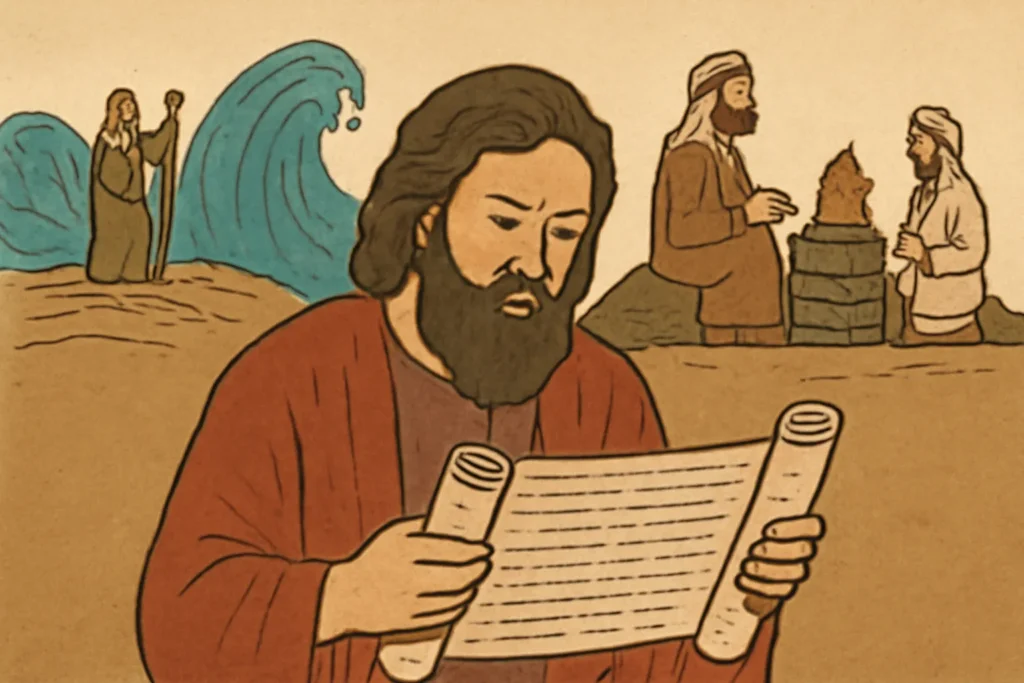
The narrative arc of the Exodus centers on deliverance from oppression, the dramatic leadership of Moses, and the formation of a people bound by a conditional covenant. The Sinai event—where God gives the Law and establishes guidelines for community life—becomes one of the most influential anchors for later Jewish and Christian ethics.
Deliverance and redemption: The dramatic liberation of the Israelites from slave labor in Egypt marks a turning point in biblical history and becomes a foundational memory for faith communities.
Law and covenant: The giving of the Ten Commandments and the broader law code shapes worship, civil life, and communal responsibility. It also raises questions about obedience, holiness, and justice that echo across the rest of the Canon.
Wilderness experience: A long period of testing, dependence on God, and formation of identity occurs as people learn trust, leadership, and communal discipline in the desert journey.
Key books in this section
Exodus and Leviticus together chart liberation, sacrificial system, and ritual purity, offering a framework for how a holy people live in God’s presence.
Numbers tracks the travels and organizational tests of Israel, while Deuteronomy revisits the law in a renewed covenantal context as the people stand on the edge of entering the land.
Settlement and leadership: Judges, kings, and the search for a unified people
After the conquest narratives, the Biblical story moves through an era of judges, the rise and fall of a united monarchy, and the growing awareness that leadership is essential for national definition and faithfulness to the Covenant.
The era of the Judges
Cycles of faithfulness and failure: Judges portray a recurring pattern in which Israel experiences times of deliverance under leaders, followed by moral laxity and apostasy.
Local leadership and tribal identities: The period emphasizes regional dynamics and the way communities strive to govern themselves under evolving norms.
The United Monarchy: Saul, David, and Solomon
Samuel’s leadership and the anointing of a king: The transition from tribal confederacy to a centralized monarchy raises questions about power, responsibility, and divine guidance.
David’s kingdom: A complex portrait emerges of faith, warfare, prayer, and political intrigue; the covenant with David anchors hope for an enduring dynasty.
Solomon’s wisdom and temple: The construction of the Temple becomes a symbol of communal identity and divine dwelling among the people, even as later chapters reflect on the costs of prosperity and pride.
The split and the prophets: Judah, Israel, and the voices that call back to fidelity
The sequence of books describing the divided kingdoms, the prophetic witness, and the exile reveals a persistent concern: whether Israel will remain faithful to the covenant in the face of political pressure, temptation, and power struggles.
The Divided Kingdoms
The kingdom splits after Solomon, producing the northern kingdom of Israel and the southern kingdom of Judah. Conflicts, idolatry, and foreign alliances complicate national life and spiritual expectations.
Writers and communities begin to interpret national misfortune as a consequence of covenant faithfulness, while also insisting that sincere devotion can survive even in hardship.
Prophetic voices and social critique
Major prophets like Isaiah, Jeremiah, and Ezekiel speak to kings and commoners alike, urging justice, mercy, and fidelity to the God of Israel.
Minor prophets—a collection of shorter books—address local concerns, call for social righteousness, and point toward a future restoration.
The narrative culminates in the exile: a period when many leaders and citizens are displaced, temples are destroyed, and life is reimagined from a distant homeland. Yet even in exile, themes of hope, repentance, and divine faithfulness persist, shaping the Old Testament summary as a story of loss and restoration.
After the exile, the biblical writers describe a return to Jerusalem and a rebuilding of the temple, walls, and community structures. This phase emphasizes renewal, reform, and the re-centering of life around Torah, worship, and covenant loyalty.
Ezra, Nehemiah, and the rebuilding era
Ezra emphasizes the reestablishment of Torah study and religious identity among returnees, highlighting the importance of Scripture in community life.
Nehemiah focuses on practical leadership, the rebuilding of walls, and social reform as a means of restoring security and moral order.
Later post-exilic writings
Books like Ester and the aggregated writings in Chronicles reframe national memory, presenting alternative paths to perseverance and faithfulness under foreign rule.
Wisdom and prophetic voices continue to speak into the life of the community, articulating trust in God’s timing and the hope for future restoration.
Themes that tie the Old Testament together
Across the varied genres and historical settings, a set of enduring themes recurs in the many Old Testament summaries of the stories and teachings:
Covenant and faithfulness: The central relationship is with a God who makes promises and invites human beings into mutual commitment; fidelity to that covenant shapes identity and destiny.
Law, worship, and holiness: The law is not merely a rulebook; it is a way of life that communicates holiness, justice, and care for the vulnerable.
Redemption and salvation: Repeatedly, the text is about rescue from danger, bondage, or despair, and the transformation that accompanies deliverance.
Judgment and mercy: When communities stray, consequences follow, but mercy often accompanies corrective critique, offering paths back to integrity.
Justice and social concern: The prophetic books, in particular, insist that faithfulness has public dimensions—care for the poor, fairness in judgment, and protection of the marginalized.
Lament and hope: Many passages blend lament with a confident hope that God’s purposes will prevail beyond present suffering.
Wisdom and instruction: Probing questions about meaning, purpose, and how to live well appear in poetry, proverbs, and reflective discourse.
Literary styles and how to read the Old Testament
The Old Testament literature comprises a rich palette of genres. Understanding the type of writing helps readers interpret it with care and nuance.
narrative and history
Narrative books tell stories of individuals, families, and nations—their journeys, crises, and divine interactions—often with embedded moral or theological lessons.
Historical books trace the arc of a people from conquest and settlement to exile and return, weaving political events with religious meaning.
law and covenant codes
Law sections articulate a system of norms that govern worship, civil life, ritual purity, and social justice.
These laws are not isolated rules; they express a vision for a holy community marked by responsibility toward God and neighbor.
wisdom and poetry
Poetic books like Psalms and Song of Songs celebrate worship, love, and human experience through metaphor, imagery, and prayer.
Wisdom literature—Proverbs, Ecclesiastes, Job—offers reflections on the meaning of life, the nature of wisdom, and the problem of human suffering.
prophets and exhortation
Prophetic writings speak in the voice of God’s spokespersons who challenge injustice, call for repentance, and point toward a hopeful vision of future restoration.
They often use vivid symbolism, dramatic action, and social critique to press for transformation in the hearer.
The Old Testament in dialogue with faith traditions today
The study of the OT today often involves engaging with two or more cross-cutting questions: How do these ancient texts illuminate contemporary ethics, worship, and community life? In what ways do they point to a broader narrative of salvation and divine action across the Bible?
Judaism and Christianity: The Old Testament functions as scripture in both faith communities, though interpretive horizons differ. In Judaism, the Tanakh forms the core scriptural canon, with rabbinic interpretation shaping practice. In Christianity, these books are read in light of the life and teaching of Jesus, with many passages understood as anticipating fulfillment in the Christ event.
Interfaith dialogue: Studying the OT can foster mutual respect and understanding between traditions by focusing on shared stories, ethical principles, and historical contexts.
Reading plans and practical guidance for exploring the Old Testament
If you want to embark on a thorough or a gentle exploration of the OT narrative landscape, here are practical approaches that respect the integrity of each book while highlighting the through-lines that bind them together.
Start with a broad outline: Review the major blocks—Law, History, Wisdom/Poetry, Prophecy—to anchor your reading in the overall architecture of the canon.
Read with themes in mind: As you read, look for covenant faithfulness, calls to justice, and visions of hope. Note how different writers address similar questions from distinct angles.
Use informed translations and study aids: Choose translations that balance readability with fidelity to the original languages, and consult glossaries or commentaries for cultural and historical context.
Combine genres: Pair a narrative section with a parallel psalm or proverb to see how history and wisdom illuminate each other.
Reflect on contemporary applications: Consider how themes like mercy, governance, and community responsibility might inform modern ethical discussions, both in faith communities and civic life.
A practical plan might involve first reading the Pentateuch to grasp the fundamental laws and promises, then moving through the historical books to see how those promises play out in real-world politics and exile. After that, a guided foray into the poetry and wisdom books can deepen reflection, followed by the prophetic literature to explore critique, judgment, and hope. The Old Testament summary can be read as a coherent arc even though its parts were written in different contexts.
A compact glossary of terms and concepts found in the Old Testament
Covenant (berit): A solemn agreement or bond between God and people, defining obligations and blessings.
Prophet (navi): A messenger chosen to deliver God’s word, often calling for repentance and ethical reform.
Temple and worship: Central places and practices for offering sacrifices, prayer, and communal devotion.
Sin and salvation: Themes of human failure and divine rescue recur throughout the narrative.
Exile and restoration: A recurring motif about being displaced, refined, and provided with renewed hope.
Wisdom literature: A genre that wrestles with life's big questions through observation, proverb, and philosophical inquiry.
Understanding these terms helps readers navigate the Old Testament summary more effectively and appreciate how different books contribute to a shared spiritual conversation.
Closing reflections: the enduring value of the Old Testament
The Hebrew Scriptures present a long arc of human experience, divine initiative, and communal life that continues to resonate. A thoughtful OT overview invites readers to consider how ancient voices speak to present concerns: questions about justice, about the sanctity of life, about how power should be exercised, and about ways to live with hope in the face of suffering. The stories of creation, of patriarchs and matriarchs, of exodus and exile, of prophets and poets, offer a vocabulary for faith that remains meaningful in many contexts today.
In sum, this old testament summary has aimed to present not merely a catalog of events but a map of ideas: how promises endure, how communities learn to worship, how justice is pursued, and how hope persists through adversity. By exploring the canonical narratives, readers can gain both historical insight and practical wisdom—tools for thoughtful reflection and ethical living in a complicated world.







Leave a Reply