The Bible does not give a precise number of years for building Noah’s ark. The most common estimate is roughly 100 to 120 years, but that figure comes from interpreting several passages rather than from a direct statement about the construction project.
Genesis describes Noah receiving God’s command to build the ark, gives the vessel’s dimensions, and records Noah’s age when the Flood began. It does not say, “Noah built the ark for this many years.” As a result, any exact answer should be presented as an estimate, not as a stated biblical fact.
Why many people say Noah built the ark for 120 years
The 120-year estimate comes from Genesis 6:3. Before the Flood narrative continues, God’s Spirit is described as not remaining with humanity indefinitely, and a period of 120 years is mentioned. Many readers understand that number as the time God gave people before judgment came. Since Noah was commanded to build the ark during this period, the 120 years became a traditional estimate for the construction period.
That interpretation fits the broad sequence of the story. Humanity’s violence and corruption are described, Noah receives instructions, the ark is built, and the Flood eventually arrives. The 120 years can therefore be understood as a long warning period during which Noah prepared the vessel and proclaimed, by his actions, that judgment was coming.
However, Genesis 6:3 does not explicitly say that Noah spent exactly 120 years constructing the ark. The verse may refer to the time remaining before the Flood, to a limit on human lifespan, or to a general period associated with God’s patience. The surrounding story leaves room for more than one interpretation.
Most careful answer: Scripture does not state the ark’s construction time directly. “About 120 years” is a traditional interpretation, while the timeline in Genesis may support a shorter period of roughly 100 years.
What Noah’s age tells us about the possible timeline
Genesis provides two important age markers. Noah is described as having three sons after reaching the age of 500, and the Flood begins when Noah is 600. Those details create a possible interval of about 100 years between the birth of his sons and the beginning of the Flood.
If the command to build the ark came after Noah’s sons were born, the construction period could have been less than 100 years, because the ark had to be finished before the Flood began. The text does not clearly establish the exact moment when God gave the building command in relation to the sons’ births, so even this estimate is not completely certain.
Some readers reason that the ark-building instructions came when Noah was 500, or near that time, and that the Flood came when he was 600. On that reading, Noah may have worked on the ark for approximately one century. Others place the command earlier, based on the 120-year statement, and understand the sons’ births as occurring during the preparation period.
The ages are therefore useful for establishing a general range, but they do not produce a single indisputable number. They show that Noah’s preparation lasted for many decades, not merely a few months or a few years.
How Genesis presents the ark-building sequence
The account in Genesis 6–9 can be read as a sequence of major events rather than as a construction diary. First, the text describes widespread human wickedness and identifies Noah as a righteous man in his generation. God then tells Noah about the coming Flood and gives him instructions for building the ark.
The ark’s dimensions are given as 300 cubits long, 50 cubits wide, and 30 cubits high. Genesis also describes multiple levels, an opening or window, a door, and the use of wood coated to make the vessel watertight. Noah is told to bring his family aboard and to preserve representatives of the animals.
After the command, the narrative says that Noah did what God commanded. It does not list separate phases such as cutting timber, shaping beams, assembling the hull, sealing the structure, gathering supplies, and loading the animals. Those activities are reasonable practical inferences, but they should not be confused with details explicitly recorded in the text.
The story then moves to the Flood itself. Noah is 600 when the waters come, and his family enters the ark with the animals and provisions. The transition from the building command to the Flood is brief, which is why readers often combine the 120-year statement with the age information to reconstruct a longer timeline.
Why the 120-year interpretation is not certain
The main difficulty is that the 120 years in Genesis 6:3 appears before the detailed account of the ark, but the verse does not identify the number as construction time. It speaks about humanity and divine patience rather than directly describing Noah’s work schedule.
Another question concerns Noah’s sons. Genesis says Noah fathered Shem, Ham, and Japheth after he was 500. Later, the Flood begins when Noah is 600. If all three sons were already adults, married, and helping with the ark before the Flood, the building period could reasonably fit within the century between those age markers. Yet the text does not provide their exact ages or say when each son began working on the vessel.
There is also a difference between the time available before the Flood and the time actually spent building. Noah may have received instructions long before construction was completed. He may also have spent part of the period gathering materials, organizing provisions, warning others, and preparing the animals. A statement about the warning period would not necessarily equal the number of years of physical labor.
For these reasons, responsible explanations usually distinguish between what Genesis states and what interpreters infer:
Genesis states that Noah was 600 when the Flood began.
Genesis places Noah’s three sons’ births after he was 500.
Genesis mentions 120 years before the Flood account unfolds.
Genesis does not directly say that Noah built the ark for 120 years.
Many traditional explanations use 120 years as an approximate construction timeline.
Could Noah have built the ark in less than 120 years?
Yes. A shorter period is possible if the 120 years refers to the broader period before judgment rather than to the construction itself. The age information allows for an estimate of roughly 100 years or less, depending on when the command was given and how the family timeline is arranged.
Even that estimate should not be treated as exact. Noah’s age of 600 identifies the year of the Flood, but the narrative does not provide a precise age for Noah when construction began. If he received the instructions when he was 550, for example, the construction period would have been about 50 years. That scenario is not explicitly confirmed, but it illustrates why the text does not support a mathematically certain answer.
The word “less” also matters because the final preparation may have extended right up to the Flood. Building the ark, storing food, collecting animals, and bringing Noah’s family aboard were related but distinct tasks. The time required for each cannot be calculated from the information Genesis provides.
A useful way to state the possibilities is that Noah probably had several decades to prepare, and traditional readings commonly extend that period to about 120 years. The biblical account supports a long process but does not identify its exact duration.
What the ark’s size suggests about the work involved
The ark described in Genesis was enormous by ancient standards. Using the common estimate of a cubit as approximately 18 inches, its stated dimensions would be about 450 feet long, 75 feet wide, and 45 feet high. Because ancient cubits may have varied, these modern measurements are approximate.
The dimensions help explain why readers imagine a lengthy building period. A wooden structure of that scale would have required an organized labor force, large quantities of timber, tools, joinery, waterproofing materials, and a method for moving heavy components. Noah’s family may have assisted, but Genesis does not tell us how many people worked on the project or whether outside laborers were involved.
Practical reconstruction raises questions that the biblical narrative does not answer. We do not know the type of wood in modern botanical terms, the shape of the hull beyond the basic dimensions, the exact meaning of the coating material, or the methods used to raise and join the timbers. Those uncertainties make it impossible to calculate a reliable building schedule from engineering assumptions alone.
The size does, however, reinforce the story’s emphasis on patient obedience. Whether the work took 50, 100, or 120 years, Noah’s task was presented as a long-term assignment rather than a quick emergency project. The ark had to be ready before the waters came, and the preparation required sustained effort.
What Noah may have done during the preparation period
The Bible focuses on Noah’s obedience instead of describing his daily routine. It says that he acted according to God’s instructions, but it does not explain how the work was divided or how he obtained every material. Any detailed reconstruction should therefore be labeled as a possibility.
A long preparation period could have included several kinds of work:
Planning and measuring: Noah would have needed to lay out the ark according to its prescribed proportions.
Gathering timber: The project required finding, cutting, transporting, and preparing wood.
Assembling the structure: Large timbers had to be connected into a vessel with several levels.
Sealing the ark: The interior and exterior needed a coating to limit water penetration.
Creating storage areas: Food and supplies had to be kept available for Noah, his family, and the animals.
Preparing for animal care: The family needed a plan for feeding, cleaning, and managing the creatures aboard.
Warning the surrounding population: Noah’s preparation served as part of the story’s wider warning about coming judgment.
These tasks may not have occurred in a simple order. Timber preparation could have continued while parts of the ark were assembled, and storage planning could have happened before the structure was complete. The narrative gives the theological purpose of the ark more attention than its construction logistics.
Common mistakes when answering the question
Several popular answers sound definite even though the biblical evidence is more limited. Keeping the distinctions clear prevents an estimate from being presented as a quotation or direct statement.
Calling 120 years an explicit construction figure: Genesis mentions 120 years, but it does not say, “Noah built the ark for 120 years.”
Ignoring Noah’s age at the Flood: Noah was 600 when the Flood began, and that detail creates another possible timeline.
Assuming the sons’ ages are given: Genesis names Shem, Ham, and Japheth but does not provide their exact ages when the ark was built.
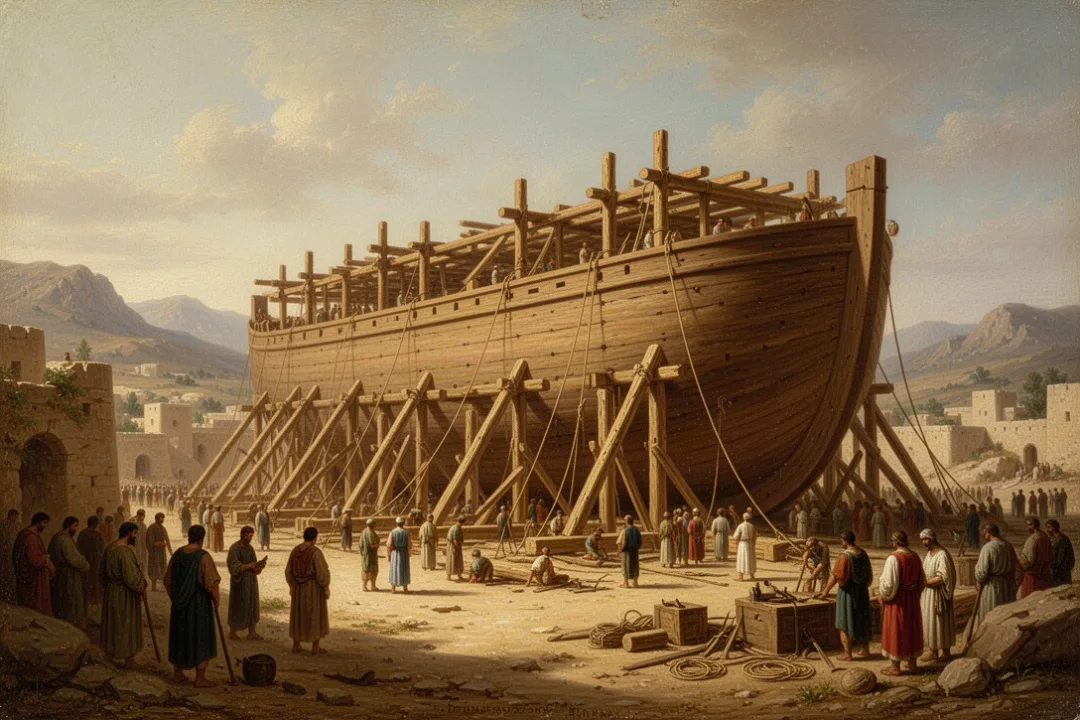
Adding unsupported construction details: Modern illustrations may show particular tools, workers, or building methods that Scripture never describes.
Treating every tradition as biblical text: Later religious traditions may offer additional ideas, but they should be distinguished from Genesis itself.
Giving one number without explaining uncertainty: “About 120 years” is more accurate than “exactly 120 years.”
When giving a short answer: Say that the Bible does not specify the duration. Then add that many interpreters estimate about 120 years, while Noah’s age markers can support a timeline of roughly 100 years or another period of several decades.
How different Christian explanations handle the timeline
Many Christian teachers use the 120-year interpretation because it connects Genesis 6:3 with Noah’s preaching and preparation. In this view, God gave the world a period of warning, and Noah spent that extended time building the ark and calling attention to the coming judgment. The number is often taught as a rounded description of the project’s length.
Other interpreters focus more heavily on the age references in Genesis. They note that Noah’s sons are introduced after Noah reaches 500 and that the Flood comes when Noah is 600. On this reading, the ark may have been built during approximately the final century before the Flood, although the command could have been given at another point.
Some readers also understand the 120 years as a limit on human life spans rather than a countdown to the Flood. That interpretation does not provide a construction schedule at all. It illustrates why the answer depends partly on how a person reads the purpose of Genesis 6:3.
These views share an important point: none requires the ark to have been built in a short period. They all portray Noah’s preparation as substantial and demanding. The disagreement concerns the relationship between the 120-year statement and the actual work on the ark.
What the Bible emphasizes more than the number of years
The narrative’s main concern is not project management. Genesis presents Noah as someone who trusted God’s warning and followed instructions despite the unusual nature of the assignment. The length of time matters because it shows persistence, but the story does not use a construction timetable to make its central point.
Hebrews 11:7 later refers to Noah’s faith and his response to a warning about events not yet visible. That passage also does not provide a number of construction years. Its emphasis is on Noah’s trust, reverence, and action in response to God’s command.
Second Peter 2:5 describes Noah as a preacher or herald of righteousness, which has led many readers to connect the ark project with a prolonged public warning. Again, the passage does not state the duration of the building work. It supports the idea that Noah’s role involved more than private construction, while leaving the calendar unspecified.
For many readers, the most meaningful conclusion is that Noah remained committed over an extended period. Whether the period is described as 120 years, a century, or several decades, the account portrays obedience that continued long after the initial command.
The clearest way to answer how long it took
If someone asks for a one-sentence answer, the most accurate response is: The Bible does not say exactly how long Noah built the ark, but traditional interpretations estimate about 120 years, while the age references may suggest roughly 100 years or another long period.
That wording gives the commonly heard answer without overstating the evidence. It also explains why different sources may offer different figures. A source that says “120 years” is usually relying on the interpretation of Genesis 6:3; a source that says “100 years” is usually calculating from Noah’s age of 500 to his age of 600.
The safest distinction is between the stated facts and the reconstructed timeline. Noah was 600 when the Flood began, the ark was built before then, and Genesis mentions 120 years. The exact amount of time spent cutting, assembling, sealing, and stocking the ark remains unstated.
So, Noah likely spent a very long period preparing the ark, but no exact construction duration can be proven from the biblical text. “About 120 years” is a traditional answer, not a direct biblical measurement.
Frequently asked questions
Does the Bible explicitly say Noah built the ark for 120 years?
No. Genesis mentions 120 years, but it does not directly identify that period as the time Noah spent constructing the ark. Many interpreters connect the number with the warning period before the Flood, while others understand it differently. The 120-year figure is therefore a traditional estimate rather than an explicit construction measurement.
Why do some people say Noah built the ark for 100 years?
Genesis says Noah was 600 when the Flood began and places the births of his sons after Noah was 500. Readers who use those age markers may estimate that Noah had about a century to prepare. The actual construction could have taken less time because the command may have come after Noah reached 500, and the text does not give the exact starting point.
How old was Noah when he started building the ark?
Genesis does not state Noah’s age when construction began. It gives his age when the Flood arrived and provides other family-related ages, but it does not connect the building command to a precise birthday. Any claim that Noah started at exactly 480, 500, or another age depends on interpreting the timeline rather than quoting a clear statement.
Did Noah build the ark by himself?
Genesis does not explain who helped Noah build the ark. His family was involved in the larger preparation and entered the vessel with him, but the account does not list workers or describe a construction crew. It is reasonable to imagine assistance, especially for a project of that size, but the number and identity of any helpers are not given.











Leave a Reply