Overview: who are these figures and why do their stories endure?
The story of Ruth and Boaz sits at the crossroads of devotion, law, and providence in the biblical narrative. Ruth, a Moabite woman, joins Naomi’s household in a time of famine and exile, choosing loyalty over return to her homeland. Boaz, a respected landowner in Bethlehem, becomes Ruth’s champion and guardian by means of a sacred trust known as the go'el or kinship redeemer. Their relationship unfolds within the ordinary rhythms of gleaning in the fields, the social obligations of the ancient Near East, and the extraordinary intervention of divine sovereignty. This combination of the ordinary and the miraculous makes their story both relatable and transcendent. The epic arc moves from loss and exile to covenant faithfulness, culminating in a lineage that leads to King David and, in Christian tradition, to Jesus himself.
In this article, we explore the story itself, the lineage that emerges from Ruth and Boaz, and the lasting lessons that readers encounter across generations. We will highlight how the text uses concrete details—fields, booths, threshing floors, and legal procedures—to illuminate broader truths about faithfulness, inclusion, and divine purpose.
The Story of Ruth: from loss to loyalty
Ruth’s decision at Moab: a pledge that reshapes a life
Morally, Ruth’s most defining moment comes when she insists on accompanying her mother-in-law Naomi back to the land of Judah, declaring, “Where you go, I will go; and where you lodge, I will lodge; your people shall be my people, and your God, my God” (paraphrased from Ruth 1). This vow, spoken in the face of uncertainty, frames Ruth not as a passive recipient of hardship but as an active agent in her own story. The drama of Ruth’s loyalty transcends national boundaries and religious boundaries, highlighting a theme that recurs throughout the Hebrew Bible: fidelity to people and to the God of Israel under difficult conditions becomes a channel for transformation.
Gleaning in the fields: Ruth’s practical courage
Upon returning to Bethlehem with Naomi, Ruth chooses to participate in the practice of gleaning, gathering grain behind the harvesters. This act is not merely economic; it is a deliberate posture of humility and perseverance. In Ruth, the reader sees how the disciplines of daily life—sowing and reaping, labor in the sun, and reliance on God’s provision—become the very landscape through which providence works. The field owner, Boaz, notices her not for her origin but for her character: her loyalty, her work ethic, and her kindness toward Naomi.
From gleaner to guest: the turning point at the threshing floor
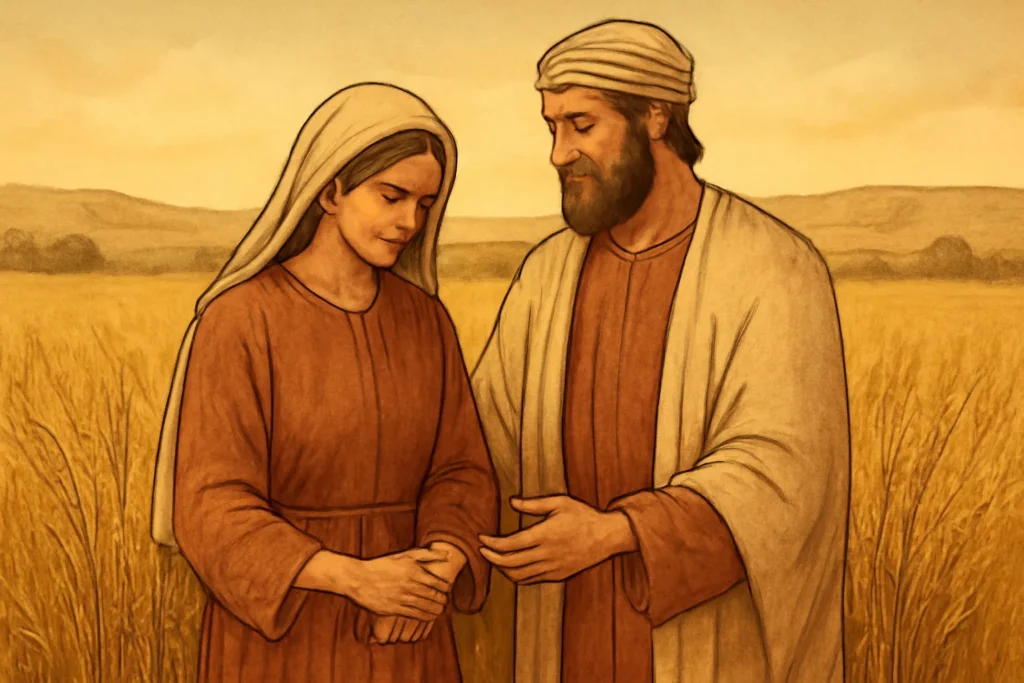
The pivotal moment arrives when Ruth meets Boaz at the threshing floor after harvest. Boaz acts with protective generosity, extending blessings, and ensuring Ruth’s safety and well-being. Yet a more formal turn comes through the kinsman-redeemer arrangement, a legal framework in which a near relative can redeem property and family lineages that threaten to vanish. Ruth’s approach to Boaz at the edge of the night becomes a powerful stand for courage and initiative, reframed within the larger storyline of God’s faithfulness to Naomi’s family. The scene is not merely romantic; it is a hinge moment that ties Ruth’s personal fidelity to the future of Israel.
Boaz’s role as guardian-redeemer: a bridge between compassion and law
Boaz embodies a model of leadership that respects the letter of the law while prioritizing mercy and justice. He responds to Ruth’s noble appeal with protective action, but he also recognizes the legal process required by the go'el institution. The formal steps—acknowledging the near-kinsman, inviting him to redeem, and then publicly confirming the arrangement—emphasize that righteousness often requires both personal virtue and communal accountability. The outcome is not only Ruth’s security but also the preservation of Naomi’s family line and the divine plan that will bring forth the royal lineage.
The wedding and the sealing of a covenant: Ruth and Boaz’s union
The story climaxes in a lawful marriage that secures Ruth’s future and ensures the continuity of the family line. The naming of their child, Obed, and the subsequent generations illustrate how ordinary acts—choosing a field to glean in, sharing bread, following through on a promise—can yield extraordinary consequences. The union of Ruth and Boaz also demonstrates that God’s purposes often unfold through the alliance of unlikely protagonists who show loyalty, integrity, and trust in God’s timing.
Across these scenes, the narrative emphasizes practical faithfulness. It invites readers to notice how Ruth and Boaz navigate social norms, economic constraints, and legal procedures without compromising personal virtue. Their journey is a case study in how vulnerable individuals can become part of a larger story that reshapes a people and a nation.
Lineage and legacy: from Ruth and Boaz to David and beyond
One of the most striking features of the Ruth and Boaz narrative is its placement within the genealogical framework of the Hebrew Bible. The couple’s child, Obed, becomes the father of Jesse, who in turn becomes the father of David, Israel’s renowned king. This royal lineage is not incidental; it foregrounds the idea that God’s covenant promises extend beyond ethnic Israel to include faithful Gentiles who join themselves to the God of Israel through bonds of loyalty and righteousness. The Ruth-Boaz connection thus serves as a bridge between the faithful remnant of Israel and the broader human world, foreshadowing a messianic expectation that would be central to later biblical writers and readers.
In Christian tradition, the genealogical path is often traced further, multiplying the symbolic significance of Ruth and Boaz. The Gospel genealogies, including those in the Gospel of Matthew, trace Jesus’ human ancestry through David, another link in the same chain that begins with Ruth and Boaz. This perspective invites readers to see Ruth not merely as a historical figure but as a symbol of inclusion and divine orchestration—an ancestor whose life illustrates how God can weave generosity, loyalty, and faith into the fabric of salvation history.
Obed (son of Ruth and Boaz) is the father of Jesse.
Jesse is the father of David, the shepherd-king whose lineage becomes central to Israel’s story.
The Ruth-Boaz line appears in traditions that trace the ancestry of Jesus in the New Testament genealogies, highlighting the inclusive scope of God’s redemptive plan.
Beyond royal lineage, the Ruth-Boaz narrative demonstrates a pattern: God honors deeds of love and loyalty by securing a future for those who might otherwise be marginalized. Ruth’s identity as a Moabite, historically a foreign nation, is reframed within a narrative of welcome and inclusion. This reframing has been a source of theological reflection for centuries, especially in discussions about how nations and peoples relate to one another within the people of God.
The Ruth-Boaz episode is saturated with themes that recur throughout Scripture and continue to shape faith communities today. They include:
Loyalty and courage: Ruth’s choice to stay with Naomi illustrates steadfast devotion; Boaz’s protective actions reflect courageous leadership within community norms.
Kindness to the vulnerable: Ruth’s gleaning and Boaz’s generosity model a social ethic that honors the dignity of the poor and the immigrant.
Providence and divine timing: The sequence of events—two widows, a careful guardian, a redeemer, a wedding—shows how ordinary choices align with a larger divine plan.
Inclusion and covenantal continuity: Ruth’s status as a Gentile (Moabite) who becomes part of the people of Israel points to a broader vision of inclusion in God’s redemptive purposes.
Law and mercy: The go’el framework preserves legal order while prioritizing mercy and protection for the vulnerable members of society.
The social and ethical implications
From a social ethics standpoint, the Ruth and Boaz narrative offers several important lessons that remain relevant today:
The value of humble labor and ethical conduct in daily life, especially in contexts of scarcity or hardship.
The transformative power of hospitality and care for strangers and foreigners who become part of a faith community.
The importance of protecting the vulnerable within a legal framework that seeks to honor both tradition and justice.
The way stories of individuals can contribute to a larger national identity and a longer historical memory within faith communities.
Symbols and motifs worth noting
Several motifs recur in the Ruth-Boaz narrative that carry symbolic weight:
The field as a space of opportunity, risk, and encounter with grace.
The threshing floor as a liminal space where vulnerability can become vulnerability transformed into blessing through trust and integrity.
The kingship motif that foreshadows the eventual messianic expectation and the inclusive reach of God’s plan.
A note on literacy and reception
Scholars note that the Ruth narrative uses a distinct literary design to highlight moral action. The text’s balance of concrete details—names, places, fields, and a courtroom-like legal procedure—with larger theological claims invites readers to see how real-world choices interact with divine purposes. The story’s reception in Jewish and Christian traditions has emphasized disparities and convergences: Ruth’s fidelity is celebrated; Boaz’s generosity is highlighted as a model of social virtue; and both figures become touchstones for discussions about inclusion and salvation history.
Common variations: names, terms, and transliterations
In biblical scholarship and in translations, certain variations of names and terms appear that reflect linguistic and cultural shifts over time. These variations help readers recognize the same characters across different textual traditions and languages. Boaz is sometimes rendered as Boas or with a transliteration emphasizing the “bo” sound, while Ruth may be familiar as Ruth in most English translations but appears in Greek as Routh in some transliterations. The term for the legal figure who can redeem is go'el (often translated as “kinsman-redeemer” or “guardian-redeemer”).
Boaz — Bethlehemite landowner, husband of Ruth, guardian-redeemer figure.
Ruth — Moabite woman, daughter-in-law of Naomi, great-grandmother of David.
Go'el — the near kinsman who has the right and obligation to redeem a relative’s property or family line within the law of levirate custom.
Naomi — Ruth’s mother-in-law, whose sorrow turns into gratitude as she witnesses Ruth’s steadfast faithfulness.
These variations reflect the text’s long history of transmission, translation, and interpretation. When studying the narrative, it can be helpful to note how different readers approach the same scenes through the lens of various languages and theological emphases. Yet across all variants, the core story remains recognizable: a faithful woman from a neighboring nation is drawn into Israel’s story through kindness and courage, and a righteous man from Bethlehem becomes a critical link in a lineage that matters far beyond their lifetimes.
Theological and cultural significance: why the Ruth and Boaz narrative matters today
The Ruth and Boaz account carries enduring significance for readers across generations and cultures. Its themes invite reflection on hospitality, inclusion, and the way ordinary human choices participate in God’s larger redemptive plan. Some of the most important implications include:
Hospitality as a virtue that bridges cultures: Ruth, a Gentile, is welcomed into the community through acts of kindness that align with a higher ethical standard than tribal exclusion would permit.
God is at work through everyday actions: The fields, meals, and negotiations are not secondary details; they are the channels through which God’s purposes unfold.
Legacy and memory: The narrative demonstrates how memory—of Ruth’s loyalty, Naomi’s faith, and Boaz’s integrity—can become a powerful source of national identity and spiritual hope.
Ethics of protection and provision: The story models a community ethic that prioritizes care for the vulnerable, the widow, and the immigrant, within a framework of legal responsibility.
For contemporary readers, these themes translate into practical implications for community life, governance, and intergroup relations. The Ruth-Boaz story challenges readers to consider how courage, compassion, and adherence to just processes can intersect to build families, communities, and societies that reflect the ideals of mercy and justice. In this sense, Ruth and Boaz remain not only historical figures but living archetypes whose example invites ongoing reflection and application.
Lessons for readers today: practical takeaways from Ruth and Boaz
From Ruth and Boaz we can extract several actionable insights that resonate in personal life, congregational settings, and public ethics. Here are some weighted takeaways:
Loyalty to family and community: Ruth’s choice to remain with Naomi illustrates the power of steadfast loyalty, even when the path ahead is uncertain.
Respect and care for vulnerable people: Ruth’s dignity is preserved through Boaz’s generosity; communities teach their members to protect the vulnerable with grace and fairness.
Integrity in difficult decisions: The kinsman-redeemer process requires honesty and accountability, showing that difficult decisions can be made ethically with proper procedures.
Inclusion beyond boundaries: Ruth’s inclusion into the Israelite lineage signals a broader theological horizon where outsiders can become insiders through acts of faith and fidelity.
Hope grounded in real relationships: The story demonstrates that hope is born not in abstract ideas alone but in the concrete relationships built through trust, faithfulness, and mutual care.
For readers studying the Bible as literature and as faith tradition, Ruth and Boaz offer a model of human agency harmonized with divine sovereignty. They show that God’s purposes often run through ordinary people who perform extraordinary acts of loyalty, generosity, and trust in God’s timing.
Conclusion: embracing the legacy of Ruth and Boaz
The narrative of Ruth and Boaz stands as a powerful reminder that fidelity and generosity can change the course of a family, a people, and ultimately history itself. Their story demonstrates that belonging and virtue are not limited by nationality or social status; rather, when people align with God’s purposes through brave and kind action, the results can ripple through generations. The partnership of Ruth, a Moabite woman, and Boaz, a Bethlehemite landowner, reveals a shared humanity that transcends boundaries and invites us to consider how our own acts of loyalty, care, and ethical stewardship might contribute to a broader, hopeful future. In the end, their legacy is not only a genealogical line but a spiritual inheritance—one that invites every reader to consider where faithfulness meets daily life, and how small, ordinary decisions can join a much larger divine story.









Leave a Reply