The Book of Ruth shows how faithful love can restore people after devastating loss. Its short story follows Ruth, a Moabite widow, as she joins Naomi, returns to Bethlehem, finds protection with Boaz, and becomes part of the family line leading to King David.
Ruth is only four chapters long, but its setting and themes reach across the Old Testament. The events take place during the time of the judges, a period often marked by instability, violence, and spiritual unfaithfulness. Against that troubled background, Ruth presents ordinary acts of loyalty, courage, generosity, and integrity.
The story begins with famine in Bethlehem. Bethlehem’s name is associated with food or bread, yet the region has no harvest available to Naomi’s family. Elimelech, Naomi, and their two sons leave Judah for Moab. After Elimelech and both sons die, Naomi is left with her two Moabite daughters-in-law, Ruth and Orpah.
Naomi decides to return to Bethlehem because she hears that the Lord has provided food for his people. Orpah eventually returns to her family, but Ruth refuses to abandon Naomi. Ruth’s decision is more than an emotional promise. It means leaving her homeland, accepting Naomi’s people, and placing herself under the care of Israel’s God.
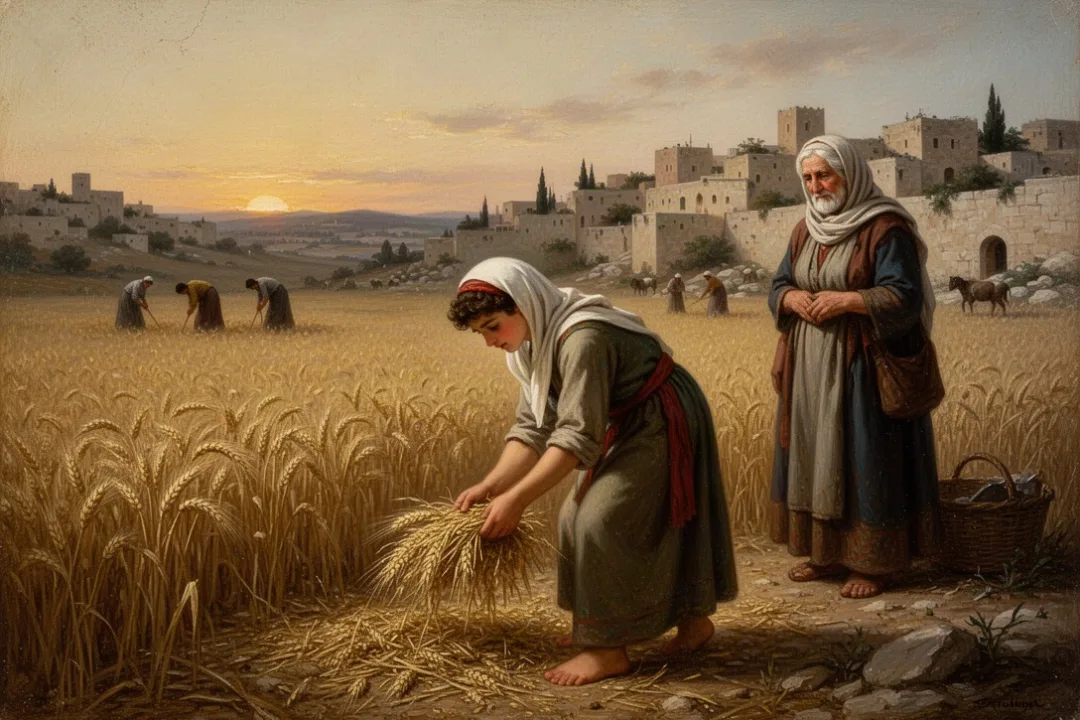
When the two women arrive in Bethlehem, Naomi is grieving and economically vulnerable. Ruth must find a way to support them. She goes to gather leftover grain in the fields, a practice permitted by Israel’s law for the poor, foreigners, widows, and others without land or family protection.
Ruth eventually gathers in the field belonging to Boaz, a wealthy relative of Elimelech. Boaz notices her, protects her from harassment, provides extra grain, and later acts as a family redeemer. Their marriage brings new life to Naomi’s household and connects Ruth to the ancestry of David.
Central idea: Ruth shows that God’s providence often appears through faithful human choices—someone offering protection, keeping a promise, sharing resources, or accepting a person who seems to belong outside the community.
The historical setting of Ruth during the time of the judges
Ruth opens by placing its events “in the days when the judges ruled,” as described in Ruth 1:1. The book does not repeat the violent episodes found in Judges, but the reference creates a significant contrast. The wider period was marked by disorder; Ruth focuses on people who act with moral steadiness within that disorder.
The famine also gives the opening chapters a social and theological dimension. Food shortages threatened families with displacement, debt, and death. Elimelech’s decision to move to Moab would have been understandable as a survival measure, but it also places his family among a neighboring people with a complicated relationship to Israel.
Moab appears elsewhere in the Bible as a nation connected to Israel through Lot, and the relationship between the two peoples is often tense. Deuteronomy contains restrictions concerning Moabites and participation in Israel’s assembly. Ruth’s identity as a Moabite therefore matters throughout the story. She is not simply a traveler entering a new town; she is a foreign widow entering a community that may view her with suspicion.
Her acceptance makes the ending especially significant. Ruth becomes the mother of Obed, the grandfather of David. The genealogy in Ruth 4:18–22 places a foreign woman within the family line of Israel’s great king. The narrative does not erase her Moabite background. Instead, it shows that faithful allegiance and righteous conduct can matter more than inherited social boundaries.
Naomi’s grief and Ruth’s decision to stay
Naomi’s story begins with repeated bereavement. She loses her husband, then both sons. In the ancient world, widowhood could bring serious economic danger, especially when there were no sons to protect the family’s property and provide for the household.
Naomi urges Ruth and Orpah to return to their mothers’ homes. Her advice is practical. In Moab, the younger women might have a better chance of remarrying and rebuilding their lives. Naomi does not ask them to remain out of guilt. She recognizes that staying with her may mean poverty, uncertainty, and a foreign future.
Orpah’s decision to return is not condemned by the narrative. She responds to Naomi’s counsel in a reasonable way. Ruth, however, chooses a different path. Her commitment includes Naomi, Naomi’s people, and Naomi’s God. Ruth 1:16–17 records the substance of that commitment, but the passage should be understood as a description of covenant-like loyalty, not merely romantic affection or family duty.
Ruth’s choice also involves a change of identity. She does not merely accompany Naomi until conditions improve. She commits herself to a people and a faith she did not inherit by birth. That makes her later actions in Bethlehem more meaningful: she is learning how to live faithfully in a new community while carrying the vulnerability of an outsider.
Naomi responds to Bethlehem’s return by saying that she went away full and came back empty. Her words reveal how grief can shape a person’s interpretation of life. From her perspective, the losses have overwhelmed every remaining blessing. Yet the narrative quietly shows that she is not truly alone. Ruth is beside her, and the barley harvest is beginning.
The book does not quickly correct Naomi’s sorrow. It allows her to speak honestly. This makes her eventual restoration more credible. The story honors both the reality of grief and the possibility that suffering does not describe the whole future.
What gleaning reveals about justice and dignity
Ruth goes to the fields during the barley harvest and gathers behind the reapers. Israel’s law instructed landowners not to harvest every part of their fields. They were to leave some produce for the poor and for foreigners, widows, and orphans. Relevant instructions appear in Leviticus 19:9–10, Leviticus 23:22, and Deuteronomy 24:19–22.
Gleaning was not charity in the modern sense. It was a lawful way for vulnerable people to obtain food through their own labor. Ruth still has to work, bend down, carry grain, and endure the uncertainty of collecting what remains. The system recognizes her dignity while also requiring landowners to limit their claim to every possible part of the harvest.
Ruth’s situation includes several layers of vulnerability:
She is a widow without a husband to provide household protection.
She is a foreigner unfamiliar with local customs and social relationships.
She is responsible for helping Naomi, another widow.
She has no obvious access to land, wealth, or a secure family future.
Boaz notices Ruth and asks his workers about her. He learns that she has stayed with Naomi and has worked steadily in the field. His response goes beyond the minimum legal requirement. He tells Ruth to remain with his workers, instructs the men not to bother her, allows her to drink from the water jars, and directs the workers to leave extra grain for her.
Boaz’s behavior demonstrates that justice requires more than avoiding exploitation. He follows the law, but he also uses his position to create safety and abundance. Ruth is not treated as an invisible poor person at the edge of the field. She is addressed, protected, and welcomed to eat with the workers.
Practical principle: Biblical generosity protects people from harm, gives them meaningful access to resources, and treats them as neighbors rather than as burdens.
Boaz as a family redeemer
Naomi identifies Boaz as one of their close relatives and as a potential goel, often translated as a family redeemer or guardian-redeemer. In Israelite society, a close relative could sometimes act to protect a family’s interests. The responsibilities connected with this role included matters such as recovering family property or assisting relatives facing severe hardship.
The exact relationship between Ruth’s situation and the law of levirate marriage requires care. Deuteronomy 25:5–10 describes a duty involving a widow and the brother of her deceased husband. Boaz is not Mahlon’s brother, so Ruth is not a simple example of that specific obligation. The book combines concerns about family continuity, land, widowhood, kinship, and redemption in a way that reflects Israelite social customs without reducing the story to one legal rule.
Naomi’s plan in Ruth 3 asks Ruth to approach Boaz at the threshing floor. The scene is deliberately restrained and culturally specific. Ruth asks Boaz to spread his garment over her, an action that functions as a request for protection and marriage. The same imagery recalls Boaz’s earlier blessing that Ruth had come to seek refuge under the wings of Israel’s God.
Boaz responds honorably. He acknowledges Ruth’s reputation, recognizes her request, and promises to address the matter properly. He does not take advantage of her vulnerable position or force a private arrangement. Instead, he explains that another relative has a prior claim in the matter and that the issue must be settled publicly.
This part of the story presents Boaz as a man whose private character matches his public reputation. His wealth alone does not make him righteous. His treatment of Ruth, his respect for the law, and his willingness to accept responsibility reveal his character.
The meaning of hesed in Ruth
A central Hebrew concept in Ruth is hesed. The word can refer to steadfast love, covenant loyalty, kindness, or faithful commitment. No single English word captures every use. In Ruth, hesed describes actions that preserve relationships when doing so is costly or inconvenient.
Ruth shows hesed by staying with Naomi when she could return to her own family. Naomi later recognizes Boaz’s hesed when he offers protection and pursues a lawful solution. Boaz also points to Ruth’s earlier faithfulness, suggesting that her loyalty to Naomi has been widely recognized.
Hesed is not merely a warm feeling. It becomes visible through decisions:
Ruth leaves familiar surroundings to support Naomi.
Naomi seeks a secure future for Ruth rather than keeping her trapped in grief.
Boaz protects Ruth from harassment and provides food.
Boaz accepts a costly family responsibility.
The community celebrates the restoration of Naomi’s household.
The book also connects human hesed with God’s hidden providence. God is not quoted speaking directly in most of the narrative, and there are no dramatic miracles like the parting of a sea or the defeat of an army. Yet the story repeatedly shows circumstances moving toward preservation and blessing.
That quiet style matters. Ruth teaches that divine care may operate through harvest timing, a field chosen by chance, a person who notices a vulnerable worker, a relative willing to act, and a community ready to welcome new life. The absence of spectacle does not mean the absence of God.
Providence, coincidence, and the field of Boaz
Ruth 2:3 describes Ruth as going out and arriving at a field belonging to Boaz. The wording can sound like coincidence from Ruth’s perspective. She does not appear to know in advance whose field she will enter. The reader, however, already knows Boaz’s connection to Elimelech’s family.
This literary detail illustrates one of the book’s main techniques. Events appear ordinary as they happen, but their significance becomes clear over time. Ruth needs grain, and Boaz has a field. Naomi needs a family connection, and Boaz is a relative. Ruth needs protection, and Boaz is a man willing to provide it.
Providence in Ruth does not cancel human responsibility. Ruth still chooses to work. Boaz still chooses to protect her. The nearer relative still has the freedom to accept or decline the obligation. The book presents God’s care through human agency rather than treating people as passive pieces on a board.
This perspective can help readers interpret their own circumstances carefully. Ruth does not teach that every hardship has an immediately visible explanation. Naomi’s losses are real, and the narrative does not pretend that she should have been grateful for them. It does show that an incomplete chapter can still be part of a larger story of restoration.
The public legal resolution at the town gate
Boaz goes to the town gate, the place where elders and community business were commonly gathered. He waits for the nearer relative and brings ten elders to witness the discussion. This public setting protects the rights of everyone involved and prevents the arrangement from resting on rumor or private pressure.
Boaz first presents the matter as a question involving Naomi’s land. The nearer relative expresses interest in redeeming it. When Boaz explains that the redemption is connected with Ruth and the preservation of the deceased man’s name, the relative declines because he fears damaging his own inheritance.
The relative’s refusal is not presented as a crime. He has the right to decline, and Boaz respects the established order. The exchange shows that redemption carries real cost. It may require a person to combine resources, accept responsibility for a widow, and preserve another family’s name rather than simply increase personal wealth.
The sandal transaction confirms the agreement in the presence of witnesses. The custom may seem unfamiliar today, but its function is clear: the public act marks the transfer of responsibility and gives the community a recognized record of the decision.
Boaz then marries Ruth. Their son, Obed, becomes a source of joy for Naomi. The women of Bethlehem describe the child as a restorer of life and a support in Naomi’s old age. They also praise Ruth, who has become more valuable to Naomi than seven sons, an expression of exceptional honor rather than a literal ranking system.
How the genealogy connects Ruth to David
The genealogy at the end names the line from Perez to David. This ending changes how the reader understands everything that came before it. Ruth is not only a private account of two widows and a generous relative. It explains how a Moabite woman becomes part of the ancestry of Israel’s future king.
The genealogy also links the story with Judah’s family history. Ruth’s son Obed is the father of Jesse, and Jesse is the father of David. The book therefore connects personal redemption with national history. A family rescued from poverty becomes part of the line through which Israel will receive its king.
Matthew 1:5 includes Ruth in the genealogy of Jesus. In that later biblical context, Ruth’s inclusion reinforces themes already present in her own book: God works through outsiders, women, unexpected family lines, and people whose circumstances appear insignificant. Her story contributes to a broader biblical pattern of grace reaching across social and ethnic boundaries.
The genealogy should not cause readers to overlook Ruth’s individual value. She is not important only because she becomes an ancestor of David. The narrative honors her before the genealogy appears. Her courage, labor, loyalty, and faithfulness matter in themselves.
Major themes for a study of Ruth
Faithfulness in ordinary responsibilities
Ruth does not perform a public miracle or lead an army. She gathers grain, cares for Naomi, listens to wise counsel, and enters an uncertain future. Her example shows how daily faithfulness can carry lasting significance.
Welcome for the outsider
Ruth’s Moabite identity remains central to the story. She is welcomed not because her past is ignored, but because her present character is recognized. Boaz’s treatment of her offers a model for communities that claim to care about justice: vulnerable outsiders need safety, dignity, and genuine belonging.
Redemption that costs something
Boaz’s role is not symbolic language detached from practical consequences. Redemption involves property, family responsibility, public decision-making, and marriage. The story presents redemption as an action that requires sacrifice rather than a slogan for good intentions.
God’s quiet providence
God’s name appears in the story through blessings, prayers, and the narrator’s perspective, but direct divine speech is absent. The result is a narrative of quiet providence. God’s care is perceived through events and relationships rather than through constant explanation.
Restoration after bitterness
Naomi begins the book convinced that her life has been emptied. By the end, she holds a child and receives communal affirmation. Her restoration does not erase the people she lost, but it shows that grief and renewed hope can exist together.
Common mistakes when studying Ruth
Reducing Ruth to a romance: The marriage matters, but the story begins with famine, widowhood, migration, poverty, and family survival.
Calling Ruth’s approach to Boaz immoral: The threshing-floor scene should be read within its cultural setting and alongside Boaz’s careful, honorable response.
Assuming Boaz was required to marry Ruth under every form of levirate law: Boaz was a relative, not Mahlon’s brother, so the legal situation is more complex.
Ignoring Ruth’s foreign identity: Her Moabite background heightens the significance of her welcome and her place in David’s ancestry.
Treating gleaning as effortless charity: Ruth works hard for the food she gathers, while the law protects her access to the harvest.
Claiming that Naomi’s grief disappears instantly: The story moves toward renewal, but it does not trivialize bereavement.
Assuming every event is obviously miraculous: Ruth emphasizes providence through ordinary decisions, timing, and relationships.
Focusing only on Boaz: Ruth’s courage and initiative drive much of the plot, and Naomi also acts with practical wisdom.
Practical steps for studying the four chapters
A careful study of Ruth benefits from reading the entire book more than once. Its short length makes it possible to observe repeated words, shifts in setting, and changes in each character’s condition.
Read Ruth straight through. Notice the movement from famine to harvest, emptiness to fullness, and vulnerability to security.
Read one chapter at a time. Record who speaks, what problem appears, and what action changes the situation.
Track the locations. Moab, Bethlehem, the fields, the threshing floor, and the town gate each contribute to the story’s development.
Mark references to food and family. These details reveal how the narrative connects material provision with belonging.
Study the legal background. Compare the story with passages about gleaning, family redemption, land, and levirate responsibility.
Observe the women’s agency. Ruth and Naomi make plans, interpret events, and respond to danger rather than merely waiting for Boaz.
Read the genealogy carefully. The ending connects the household story to David and later biblical expectations.
Apply the themes responsibly. Ask how your community protects outsiders, supports widows, shares resources, and keeps promises.
It can also help to compare several translations for terms such as “kindness,” “redeemer,” “rest,” and “spread your garment.” Since English translations make different choices, the underlying context matters more than relying on one familiar phrase.
Questions Ruth raises for readers today
Ruth asks what faithful belonging looks like when it requires sacrifice. Ruth does not demand acceptance while remaining detached from Naomi’s people; she commits herself to a new community. At the same time, Bethlehem must decide whether it will recognize and protect someone who arrives with no wealth or social standing.
The story also asks how people with resources should use them. Boaz could have followed the minimum requirements for gleaning and remained distant. Instead, he gives Ruth security, access, food, and public recognition. His example challenges readers to consider whether their generosity merely meets a rule or genuinely reduces vulnerability.
Naomi’s experience raises another question: how should communities respond to people who return from suffering? Naomi comes home bitter and without visible prospects. The women of Bethlehem do not reject her for speaking from pain. They participate in her restoration when the child is born.
Finally, Ruth invites readers to look for God’s work without demanding constant spectacle. The story’s most important changes happen through decisions that could appear small: Ruth stays, Boaz notices, Naomi plans, the elders witness, and a family accepts responsibility. These actions become the means through which a damaged household is renewed.
Ruth’s lasting message about belonging and redemption
The Book of Ruth presents redemption as a movement from displacement toward home, from hunger toward provision, and from isolation toward family. It does not promise that loss is simple or that every hardship is quickly repaired. Instead, it shows how loyal people and just communities can become instruments of restoration.
Ruth’s foreign birth does not prevent her from becoming a faithful member of Israel. Naomi’s bitterness does not prevent her from receiving renewed joy. Boaz’s wealth becomes meaningful because he uses it for protection and responsibility. The story’s final genealogy confirms that the household’s restoration has consequences far beyond what its characters could see at the beginning.
A study of Ruth therefore belongs in conversations about faith, grief, migration, poverty, family responsibility, and community life. Its message is both personal and social: faithful love is shown through concrete action, and God can work through people who choose to protect, welcome, and remain loyal when the future is uncertain.
Frequently asked questions
Who wrote the Book of Ruth?
The book does not identify its author. Jewish and Christian traditions have proposed different possibilities, but the text itself gives no definite name. The important interpretive evidence comes from the narrative, its setting during the judges, its attention to family customs, and its closing genealogy connecting Ruth with David.
Is Ruth a love story or a story about redemption?
It includes a marriage between Ruth and Boaz, but romance is not the central focus. The larger story concerns survival after bereavement, loyalty between Ruth and Naomi, protection for a foreign widow, family responsibility, and restoration. Their marriage becomes one part of a broader pattern of redemption.
What does Ruth teach about foreigners and outsiders?
Ruth shows that a person’s foreign background does not prevent faithful belonging. She is treated as vulnerable because she is a Moabite widow, yet her loyalty and character are recognized. Boaz provides a model of protection and inclusion, while the genealogy shows Ruth becoming part of Israel’s royal ancestry.
Why is the genealogy at the end of Ruth important?
The genealogy connects Obed, Ruth’s son, to Jesse and David. It shows that the story’s household restoration contributes to Israel’s larger history. It also emphasizes the surprising place of a Moabite woman in the ancestry of David and, in Matthew’s genealogy, in the ancestry of Jesus.









Leave a Reply