Caesarea Philippi: history, Bible meaning, and location
Caesarea Philippi: history, Bible meaning, and location
Caesarea Philippi was the northern setting where Jesus asked his disciples who they believed he was, according to the Gospels.
The ancient city stood at the foot of Mount Hermon, near a powerful spring that forms one of the principal sources of the Jordan River. Known earlier as Paneas or Panias, it became a center of pagan worship before taking the name Caesarea Philippi under the rule of Herod Philip. Today, the archaeological site and surrounding spring are commonly called Banias.
The location matters for more than geography. Its temples, cliffs, flowing water, and position at the northern edge of Galilee help explain the setting of Matthew 16, Mark 8, and Luke 9. The Gospels do not describe Jesus as visiting the city to admire its ruins; they place a decisive conversation about his identity in a region known for competing religious claims.
Caesarea Philippi was in the northern part of the ancient region of Palestine, at the base of Mount Hermon. The site lies in the modern Golan Heights, close to the borders of present-day Israel, Lebanon, and Syria. Its position made it a natural crossroads between the Galilee, the Hauran, and territories farther north.
The city grew around a spring emerging from the limestone slopes. In antiquity, the spring was associated with the headwaters of the Jordan River. The water still gives the area a distinctive landscape: shaded vegetation, running water, rock formations, and a cooler environment than many nearby parts of the region.
The name Banias reflects the Arabic form of the older name Paneas. The initial “p” sound became “b” in Arabic, producing the name used for the modern nature reserve and archaeological area. Visitors may therefore encounter several names for the same general place: Caesarea Philippi, Paneas, Panias, and Banias.
Do not confuse the two Caesareas: Caesarea Philippi was an inland city near Mount Hermon, while Caesarea Maritima was the major Mediterranean port farther south. The name “Philippi” identifies the northern city associated with Herod Philip.
The spring also explains why the site had lasting strategic and religious importance. A reliable water source supported settlement, agriculture, and travel. At the same time, springs and caves often carried religious significance in the ancient Mediterranean world, especially when water appeared to come from the underworld or from a sacred mountain.
Mount Hermon rises dramatically above the surrounding landscape, although the exact view depends on weather and the position from which it is seen. Snowmelt from the Hermon range contributes to the region’s water supply. That combination of mountain, cave, and spring gave Paneas a setting that felt unusual and sacred to ancient visitors.
How Paneas became Caesarea Philippi
The earliest name of the city was connected with Pan, the Greek god associated with shepherds, wild places, flocks, music, and fertility. Greek settlers and later Roman authorities used the name Paneas or a related form. The city’s religious identity centered on a sanctuary near the spring and the rock face.
Herod the Great controlled the region during the final decades before the birth of Jesus. He built a temple at Paneas in honor of Augustus Caesar, strengthening the Roman presence and linking local religious life with imperial power. Herod’s building program appeared in several cities, where architecture helped display loyalty to Rome.
After Herod’s death, his territory was divided among his sons and other rulers. Philip the tetrarch governed the northeastern portion of the former kingdom. He expanded and developed Paneas, giving it the name Caesarea Philippi. The name honored the Roman emperor and distinguished the city from Caesarea Maritima.
Caesarea Philippi was therefore not simply a remote village. It was a city shaped by Roman administration, local religious traditions, and the political ambitions of Herodian rulers. Its public buildings and imperial name would have made the authority of Rome visible to residents and travelers.
The city’s earlier religious associations did not disappear when its political name changed. A Roman or Herodian name could be added to an older sacred landscape without erasing the traditions connected with it. The result was a place where several layers of identity existed at once:
Paneas, the older name connected with the worship of Pan.
Caesarea Philippi, the civic name linked to Herod Philip and Rome.
Banias, the later Arabic name used for the area today.
The Jordan headwaters, which gave the site practical and symbolic importance.
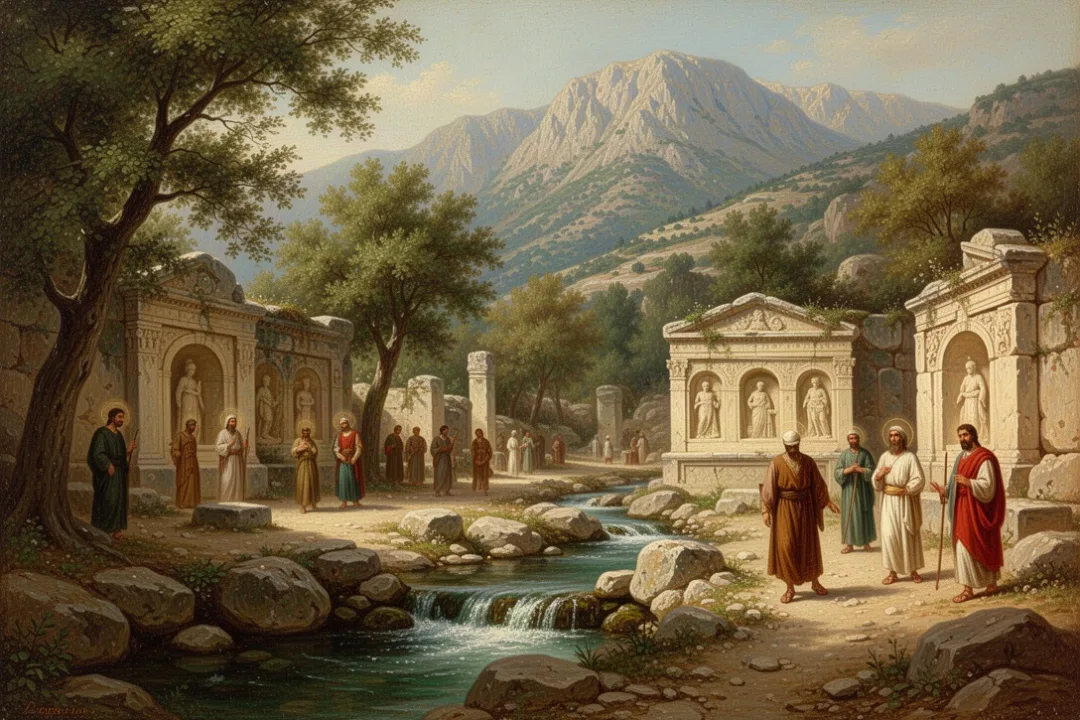
Archaeological remains show that the sanctuary area included carved niches and structures associated with pagan worship. The spring and cave were central to the religious character of the site. Ancient visitors did not view the landscape as a neutral backdrop; they encountered it as a place where the divine world was believed to touch the natural world.
Later periods brought Christianity, Muslim rule, earthquakes, changing political boundaries, and the gradual decline of the ancient urban center. The surviving remains do not represent the whole city as it appeared in the first century. They are fragments of a settlement that developed and changed over many centuries.
What happened at Caesarea Philippi in the Gospels
The most famous event connected with Caesarea Philippi appears in Matthew 16:13–20, with parallel accounts in Mark 8:27–30 and Luke 9:18–21. Jesus asks his disciples who people say he is and then presses them to answer for themselves.
Peter responds by identifying Jesus as the Messiah, or Christ, and as the Son of the living God. Jesus then speaks about Peter, the rock, the church, and the authority represented by “the keys.” The passage is theologically important for Christian traditions because it addresses Jesus’ identity, Peter’s role, and the foundation of the church.
Mark and Luke preserve the same broad movement of the conversation, though their wording and details differ. In Mark, the scene leads into Jesus’ teaching about suffering, rejection, death, and resurrection. Luke also connects Peter’s confession with Jesus’ prediction of suffering. The confession is therefore not presented as the end of the disciples’ understanding; it is followed by a correction of their expectations about what the Messiah would do.
The Gospel accounts do not provide a detailed description of the city during the conversation. They identify the wider region and then focus on the question Jesus asks. For that reason, interpreters should distinguish between what the text states directly and what can be inferred from the setting.
The text directly gives readers several details:
Jesus and his disciples were in the area of Caesarea Philippi.
Jesus asked about public opinions of his identity.
Peter gave a confession identifying Jesus as the Christ.
Jesus taught about the church, authority, suffering, and discipleship.
The disciples were instructed not to announce the confession publicly at that point.
Many readers connect the phrase about the “gates of Hades” in Matthew 16 with the cave and spring at Paneas. That connection may help modern visitors visualize the setting, but the Gospel does not explicitly say that Jesus pointed to the cave or used a particular rock formation as an object lesson. The phrase can also be understood more broadly as a promise that death and the powers opposed to God will not overcome the church.
Read the setting carefully: Caesarea Philippi can illuminate the Gospel scene, but geography should support the biblical text rather than replace it. The central point is Peter’s confession and Jesus’ teaching that follows it.
The location may still be meaningful. Jesus’ question about his identity takes place in a region marked by temples, imperial influence, and claims about divine power. Against that background, Peter’s confession presents Jesus not as one more religious figure among many, but as the promised Messiah and Son of God.
Some Christian teachers describe the setting as a deliberate contrast between pagan worship and the revelation of Jesus. That interpretation is reasonable as a theological reflection, particularly because the area was associated with Pan and Roman authority. However, the Gospel writers do not give a detailed explanation of why Jesus chose the location. Statements about his precise intention should therefore be presented as interpretation rather than established fact.
Why the site matters to Christian interpretation
Caesarea Philippi matters because the Gospel scene combines a public question with a personal confession. People offer several opinions about Jesus, but the disciples must answer directly. The passage moves from reputation to faithful recognition.
Peter’s answer is also more specific than calling Jesus a teacher or prophet. The title Christ means the Anointed One, the expected king and deliverer in Jewish hope. The title “Son of God” carries profound significance in the Gospel narratives, connecting Jesus with a unique relationship to God and with divine authority.
The next section of the Gospel story keeps the confession from becoming a triumphal slogan detached from discipleship. Jesus explains that his mission will include suffering. Peter accepts the messianic identity but struggles with the path Jesus says the Messiah must take. That tension remains central to the passage: recognizing Jesus correctly also requires learning what his mission means.
Matthew’s account gives special attention to Peter’s role. Jesus’ words about the rock have been interpreted in different ways by Christian communities. Some traditions understand the rock primarily as Peter himself and connect the passage with a continuing office or authority. Other traditions emphasize Peter’s confession of faith, or Christ as the ultimate foundation. The differences are longstanding and involve broader questions of church authority and biblical interpretation.
The phrase about the keys has also received several interpretations. In Matthew’s Gospel, it is connected with authority to bind and loose, language associated with making authoritative judgments within the community of faith. Christian denominations differ over how this authority continues and how it relates to church leaders, sacraments, discipline, and teaching.
These doctrinal questions should not be reduced to the physical site. The spring, cave, and ruins can help readers imagine the surroundings, but the theological claims arise from the Gospel accounts themselves. A visit may deepen attention to the passage without settling debates that depend on wider biblical and historical interpretation.
The place also highlights the difference between historical context and direct proof. Knowing that Paneas contained pagan sanctuaries can make the setting more vivid. It does not prove that every detail of the conversation was designed as a symbolic confrontation with Pan worship. Good interpretation keeps both the historical background and the limits of the evidence in view.
What visitors can see at Banias today
The modern site combines an archaeological park with a nature reserve. Visitors can see the spring area, portions of the ancient sanctuary, carved niches, fallen architectural blocks, and traces of later occupation. The remains are spread through a landscape of watercourses, trees, cliffs, and walking paths rather than concentrated in a single intact building.
The cave associated with the ancient sanctuary has changed substantially over time. Natural processes, earthquakes, construction, and erosion all affect how the site appears today. The spring once emerged directly from the cave, but water flow and the visible landscape have altered over the centuries.
Among the most recognizable features are the niches cut into the cliff face. These spaces once held statues connected with the religious life of Paneas. Their presence helps visitors understand that the site was not merely a scenic spring; it was a formal sanctuary with ritual and civic importance.
Ruins from later periods show that the location continued to be used after the classical and Roman eras. The site’s history includes changes in religion, administration, architecture, and settlement patterns. A visitor who sees only the Gospel connection may miss the much longer story of the place.
Practical conditions can affect a visit. The paths may include uneven ground, stairs, rocks, and damp areas near the water. Summer temperatures can be high, while winter weather in the Mount Hermon region can be cooler and wetter. Opening schedules, admission arrangements, trail access, and security guidance can change, so check current official information before traveling.
These simple preparations make the visit more comfortable:
Wear sturdy walking shoes suitable for uneven or wet paths.
Carry water, especially during warm weather.
Allow time for both the archaeological remains and the natural setting.
Follow marked trails and barriers near cliffs, streams, and protected ruins.
Check local travel and security conditions before setting out.
Read the Gospel passages before or after visiting so the setting does not distract from the text.
The site is especially useful for comparing different kinds of evidence. The ruins reveal building practices and religious patterns. The landscape explains the importance of water and elevation. The Gospel passages preserve a theological conversation. None of these sources should be treated as interchangeable, but together they provide a fuller picture of why Caesarea Philippi remains significant.
How to understand Caesarea Philippi without oversimplifying it
Caesarea Philippi was not important for just one reason. Its water supply supported settlement, its mountain setting shaped the landscape, its sanctuary gave it religious importance, and its renamed city expressed Roman political power. The Gospel connection added another layer that has made the place familiar to Christians around the world.
It is also helpful to avoid treating the site as though every ruin dates from the time of Jesus. Archaeological areas contain remains from different periods, and visible stones may have been moved, reused, or reconstructed. The landscape seen by a modern visitor is the result of centuries of natural and human change.
The best reading of the Gospel setting holds together three questions:
What does the biblical passage actually say? It says that Jesus and his disciples were in the region and records a conversation about his identity and mission.
What did the ancient setting contribute? Paneas was associated with pagan worship, imperial power, water, and a prominent mountain landscape.
What remains uncertain? The Gospels do not describe every physical detail or explain whether Jesus intended a specific contrast with the sanctuary.
That approach protects the historical value of the location while preserving the main emphasis of the text. Caesarea Philippi is more than a backdrop, but it is not a substitute for reading Matthew, Mark, and Luke. Its strongest contribution is to make the social, religious, and geographic world of the Gospel scene more concrete.
For many visitors, the most memorable feature is the contrast between the calm spring and the turbulent questions associated with the site. Ancient people came to the area with their own beliefs about gods and power. In the Gospel narrative, Jesus asks his disciples to identify him amid that crowded religious environment. The answer given there remains the defining reason Caesarea Philippi holds such a prominent place in Christian memory.
Frequently asked questions
Is Caesarea Philippi the same place as Caesarea Maritima?
No. Caesarea Philippi was an inland city near Mount Hermon and the Jordan headwaters, while Caesarea Maritima was a Mediterranean port built on the coast. Both names reflect Roman political influence, but they were separate cities with different landscapes, histories, and roles in the New Testament.
Why is the site also called Banias?
Banias is the modern Arabic name for the area, derived from the ancient name Paneas or Panias. Over time, the original “p” sound was represented as “b” in Arabic. Visitors may see Banias used for the nature reserve, spring, and archaeological remains associated with ancient Caesarea Philippi.
Did Jesus definitely point to the cave at Caesarea Philippi?
The Gospels place the conversation in the region of Caesarea Philippi, but they do not say that Jesus pointed to the cave, spring, or a particular rock formation. Connecting the “gates of Hades” with the cave is a common interpretation, not an explicit detail in the biblical accounts.
Can you visit Caesarea Philippi today?
Yes. The archaeological site and natural area are generally visited as Banias, with trails, spring scenery, and ruins of the ancient sanctuary. Conditions can vary, and paths may be uneven or wet. Check current opening information, access rules, weather, and local security guidance before planning your visit.



Leave a Reply