In the Catholic tradition, meals are more than a daily routine; they are occasions of
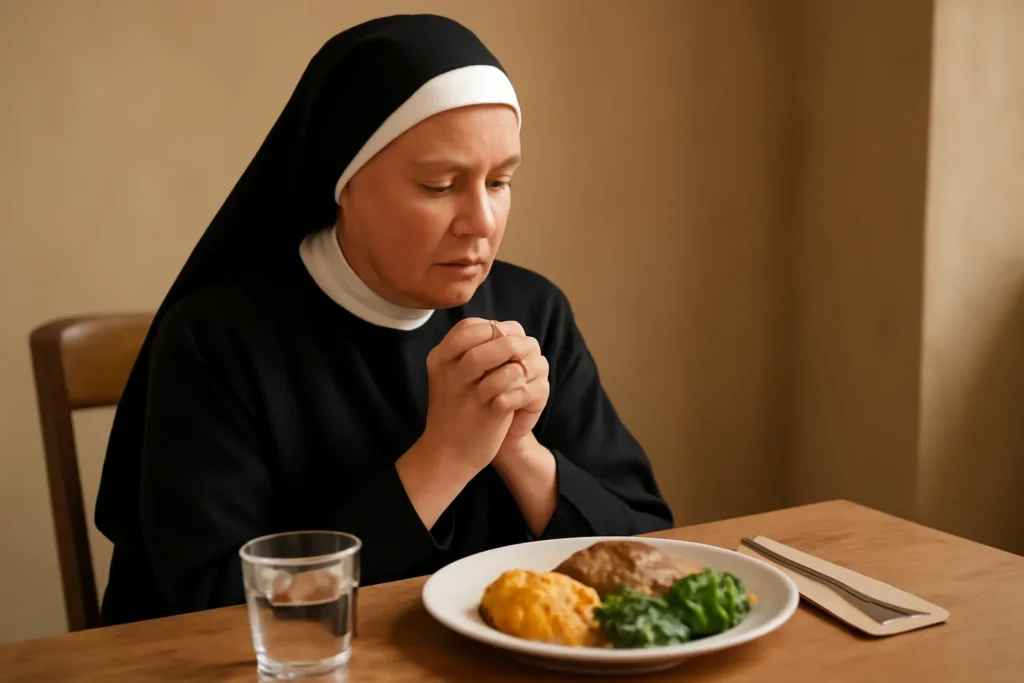
gratitude, community, and recognition of God’s providence. The practice of blessing before meals, often called grace before meals, invites all present to pause, acknowledge the gifts of creation, and petition
God for continued sustenance and mercy. Although the form of the blessing can vary from family to family,
and from culture to culture, the underlying purpose remains the same: to turn a meal into a moment of
relationship—with God, with one another, and with the wider world that makes nourishment possible.
The practical habit of saying a short prayer before eating helps foster gratitude, humility, and a sense
of responsibility toward “those who prepare the food, those who grow it, and those who assist in the
supply chain that brings it to our table.” For Catholics, this act also resonates with the Eucharistic frame of everyday life: food is a sign of God’s goodness, and the blessing aligns daily living with
the faith that the bread and the cup point toward greater spiritual nourishment in Christ.
Theological foundations of blessing before meals
A Catholic blessing before meals rests on a few core ideas that consistently appear in the Catechism and in
Catholic piety:
Gratitude for the gifts we receive, including the food on our table and the hands that prepared it.
Recognition of God as Creator and Provider, whose bounty sustains human life and all creation.
Communal prayer, tying the household together in a shared act of faith and dependence on God.
Participation in a larger story, where ordinary meals echo the Last Supper and the Eucharist, reminding us that earthly nourishment points toward divine nourishment in Christ.
The blessing is not magical language that makes the food appear or guarantees abundance; rather, it is a discipline of attention
and a formative practice that shapes attitudes toward food, labor, and generosity. In this light, a simple
blessing can become a small school of the faith—teaching children and adults alike to pause, thank, and
share.
Common English forms of the blessing before meals
Across cultures and families, several classic forms of the grace before meals are used in English. They share a
common spirit, but each carries its own cadence and emphasis. Below are several representative versions, with a
focus on clarity, brevity, and reverence.
Classic form
Bless us, O Lord, and these Thy gifts, which we are about to receive from Thy bounty, through Christ our Lord. Amen.
Short form for quick grace
Bless us, O Lord, and these Thy gifts, which we are about to receive from Thy bounty. Through Christ our Lord. Amen.
Form with the Sign of the Cross
In the name of the Father, and of the Son, and of the Holy Spirit. Bless us, O Lord, and these Thy gifts, which we are about to receive from Thy bounty. Through Christ our Lord. Amen.
Family-friendly variation
We thank Thee, O Lord, for this food and this family. May our hearts be grateful, and may we share Thy gifts with joy and generosity. Through Christ our Lord. Amen.
Heavenly Father, bless this food and those who prepared it. May this meal nourish our bodies and strengthen our fellowship in love. Through Christ our Lord. Amen.
Latin and non-English variants
Catholic households often honor tradition by including a Latin form or speaking the blessing in the family’s native language.
Latin remains a language of universal Catholic identity, linking local practice with the wider Church.
Latin traditional form
Benedic, Domine, et haec Tua dona, quae de Tua largitate sumpsimus, per Christum Dominum nostrum. Amen.
Spanish variant
Bendícenos, Señor, y estas y estas dones tuyas, que de tu abundancia recibimos; por Cristo nuestro Señor. Amén.
French variant
Bénis-nous, Seigneur, et ces dons que nous recevons de ta main; par le Christ notre Seigneur. Amen.
Tagalog (Filipino) variant
Mapagpakumbabang magpasalamat po kami, Panginoon, sa pagkain. Nawa’y ito’y maging pagkain ng ating kaluluwa at katawan, sa pamamagitan ni Kristong aming Panginoon. Amen.
When using forms in other languages, keep the meaning intact: gratitude, petition for blessing, and
the framing of the meal within the relationship to Christ and the community. The exact wording is less important
than the intention to turn the meal toward God and one another.
Structure and elements of a well-formed blessing before meals
Although there is no single universal “manual” for every Catholic home, most effective blessings share a few
common elements that you can intentionally include.
Preparation: Pause, gather, and invite participation. No one should feel pressured, but the prayer is
more meaningful when everyone, including children, can join.
Sign of the Cross (optional but common): A gentle reminder of baptism and belonging to Christ.
Opening acknowledgment: A phrase that thanks God for creation, life, and the gift of the meal.
Petition or intention: A short wish—e.g., that those who are hungry, sick, or bereaved may be fed and comforted.
Conclusion: The name of Jesus, or the phrase “through Christ our Lord,” paired with “Amen.”
Sample structure in practice
A practical layout might look like this: a quick moment of silence, a sign of the cross (optional),
a single line of gratitude for the food, a brief intention for others, and the Amen.
Tips for leading the blessing in a family or communal setting
The way a blessing is led can shape its impact. Here are practical guidelines that help keep the practice meaningful for all ages.
Keep it concise. A blessing of 30–60 seconds is ideal for most meals, especially with children present.
Make it inclusive. Invite everyone to participate in a way that suits their age and ability—someone can read a line, others can respond with “Amen.”
Use language that is understandable. Clear, sincere words resonate more deeply than ornate phrases that feel distant.
Connect to daily life. Tie the prayer to the meal and to the people at the table—parents, siblings, guests, or caregivers.
Involve children. Let a child offer the blessing or recite a short line. It builds memory, tradition, and faith identity.
If your family is new to the practice, start simple and gradually incorporate additional elements—sign of the cross, a
gentle reflection, or a brief intention for others. The goal is not “perfume” the prayer with complicated phrases, but to
cultivate a posture of gratitude and dependence on God.
Ways to adapt the blessing for diverse meals
Breakfast: A quick "thank you" for the new day and the nourishment that sustains us.
Lunch: A short blessing that acknowledges the work of others who prepared or provided the meal.
Dinner or family meal
: A fuller expression of gratitude, possibly including a brief intention for neighbors and the sick.
Travel meals: A compact blessing honoring safe travel and the provision of food in unfamiliar places.
Guest meals: A welcome, including thanks for the guests and a note about sharing abundantly with those in need.
Variations for different situations and occasions
Catholic households and communities may adapt the blessing for special occasions, liturgical seasons, or
cultural celebrations. The core idea remains: acknowledge God as Source, give thanks for the food, and
ask for blessing on those who share in the meal.
Blessings for feast days and holidays
On Sundays, feast days, or national holidays, you can add a line that reflects the occasion—for example,
remembering the workers who produced the meal, or recalling a saint associated with hospitality and food.
Feast day emphasis: “We give thanks for this feast and for the hands that prepared it; may we serve others in imitation of Christ.”
Holy day reflection: “We thank Thee, O Lord, for the gift of work and rest, nourishment and community, today.”
Meals in the parish or school setting
In a group setting, a brief leader’s prayer can be followed by a short line that invites participation from all:
“Let us bless our meals and give thanks for the shared table that strengthens our community in Christ.”
Sanctification of the hands and work
Some families add a line acknowledging the labor of those who grew, harvested, and prepared the food:
“We thank Thee, O Lord, for the work of human hands in bringing this meal to our table. May we respect and care for the workers who make nourishment possible.”
Practical example prayers you can use or adapt
Example 1: Short and sweet
“Bless us, O Lord, and these Thy gifts, which we are about to receive from Thy bounty, through Christ our Lord. Amen.”
Example 2: With a family intention
“Bless us, O Lord, and these Thy gifts, for which we give thanks. May this meal nourish us in body and spirit, and may we be generous to those in need. Through Christ our Lord. Amen.”
Example 3: Latin form for formal occasions
Benedic, Domine, et haec Tua dona, quae de Tua largitate sumpsimus, per Christum Dominum nostrum. Amen.
Example 4: Youth-friendly wording
“Thanks be to God for this food and for everyone at this table. Help us to share Your blessings with those who have little.”
Example 5: Interfaith-friendly version that stays Catholic in content
“Creator God, we bless this meal and all the gifts of Your world. May Christ’s peace be with us as we eat and as we care for others.”
Practical guidance for catechesis and teaching children
Teaching children to bless their meals is a meaningful way to imprint faith on daily life. Here are ideas to make
the practice engaging and age-appropriate:
Use a simple, recurring formula and allow a child to say a line once they know it.
Explain the meaning of key phrases, such as gratitude, providence, and generosity.
Offer a moment of reflection after the blessing where family members name someone who might be hungry or in need.
Provide a printed card with a few short blessings that children can read or recite.
As children grow, you can introduce more formal prayers or expand the intention to include the needs of the sick,
hungry, or those who have lost work, as well as gratitude for the natural world that yields food.
Addressing common questions and misconceptions
The practice of blessing before meals is simple, but questions may arise. Here are some common points of
clarification.
Is saying grace mandatory for Catholics?
There is no universal command requiring every Catholic to say a blessing before every meal. However, it is a strongly
encouraged spiritual habit in many families and parishes because it forms a rhythm of gratitude and dependence on God.
Can meals with guests be included in the blessing?
Yes. A blessing can be extended to guests by inviting everyone to join in, or by offering a short blessing that
acknowledges hospitality and the sharing of goods.
What if I forget to say grace?
If a blessing is missed, you can still offer a quick prayer after the meal and commit to restoring the practice at the next meal.
The intention matters more than perfection.
Is the blessing appropriate for special diets or restrictions?
The blessing can be adapted to focus on the gift of nourishment and the care for those with dietary needs or health concerns.
You can include a line about safety, stewardship, and respect for creation within the same prayer.
Conclusion: Making blessing before meals a living practice
A Catholic blessing before meals is a small, concrete practice with a broad and enduring impact. It is a weekly or daily
reminder that food is a gift, that we rely on others, and that our common life is shaped by faith, hope, and love. Whether you
use the classic form, a modern adaptation, or a regional variant, the essential aim remains the same: to set the table as a place
where God’s generosity is acknowledged, where gratitude is expressed, and where neighbors near and far are held in prayer.
By integrating blessings into daily life, families build a rhythm that teaches reverence and fosters a sense of social responsibility, as well as personal sanctification. Graces before meals are not decorative rituals; they are
daily opportunities to orient the heart toward God, to recognize the labor that sustains us, and to open ourselves
to sharing blessings with others.









Leave a Reply