The Cave of Machpelah, located in the ancient city of Hebron (often referred to by its Arabic name Khalil), is one of the most venerable burial sites in the world. Known in English as the Cave of the Patriarchs, this sacred precinct is traditionally associated with the biblical patriarchs and matriarchs of the Jewish, Christian, and Islamic traditions. The phrase Machpelah itself is Hebrew, and it is commonly understood to mean "double" or "double tomb," a reference scholars sometimes give to the cave’s two-chambered structure and the notion of a shared sacred space. The site sits at the heart of Hebron’s historic core and has been a focus of devotion, architecture, conflict, and pilgrimage for millennia.
Across centuries, the Cave of Machpelah in Hebron has taken on multiple layers of meaning, evolving from a biblical burial ground into a monumental complex that blends religious reverence with architectural grandeur. In this article, you will find a thorough survey of its history, its significance for multiple faiths, and a practical visitor guide designed to help readers understand how to approach, interpret, and experience this remarkable site with respect and curiosity.
Historical background: from biblical roots to modern times
The narrative surrounding the cave begins in the Hebrew Bible and extends through long periods of architectural transformation. This section traces the trajectory from ancient traditions to the contemporary status of the site as a religious and cultural landmark in the region.
Origins in the Hebrew Bible and the tradition of burial
The story most closely associated with the cave’s founding appears in the book of Genesis, where Abraham purchases a plot of land for a family burial in the vicinity of Mamre. In Genesis 23, Abraham negotiates with Ephron the Hittite to obtain a field and a cave as a family tomb, and Sarah is buried there. The subsequent chapters describe the burial of Isaac and Rebekah, and later, Jacob and Leah, within or adjacent to the same sacred precinct. For Jewish and Christian readers, these verses anchor the site in the intimate narrative of the patriarchs and matriarchs—a link that would make the cave a symbol of ancestral connection and divine covenant.
The term Machpelah is often understood to refer to the cave as a double or twin tomb, possibly reflecting a physical feature of the burial chamber or a stylistic designation for a shared sacred space. The idea of a doubled sacred tomb would become a powerful symbol across generations, underscoring the idea of a continuous, covenanted lineage.
Herodian expansion and late antiquity: turning the site into a monumental precinct
By the late Second Temple period and into the early centuries of the Common Era, the site acquired monumental significance that transcended a single family burial plot. The Roman–Herodian period introduced grand urban and religious projects in the southern Levant, and Hebron’s cave complex was upgraded as a major sanctuary. A large enclosure was built around the actual burial cave, and the surrounding precincts began to function as a place of pilgrimage and veneration for Jews, Christians, and, in later centuries, Muslims as well.
The nature of the monument—the idea of a sacred tomb beneath a surrounding hall—made it an enduring symbol of dynasty, legitimacy, and genealogical continuity. The physical arrangement, with the cave at its core and an imposing structure above, provided a durable frame for centuries of liturgical rites, remembrance, and even political symbolism tied to lineage and inheritance.
Crusader era, medieval transformations, and the shift to a shared sanctuary
In the 11th and 12th centuries, the Crusaders built a large church over parts of the site as part of their Christian architectural program in the Holy Land. This era produced one of the most dramatic reconfigurations of the complex, turning the precinct into a major religious monument accessible to pilgrims from across medieval Christendom. After Saladin recaptured the city in the late 12th century, the structure underwent further changes that reflected the new political and religious realities of the region.
The ensuing centuries saw a layered history: the site remained a focal point of Jewish reverence for the patriarchs while the Muslim communities organized the space in ways that recognized the Cave of Machpelah as a sacred location associated with Ibrahim (Abraham). The modern designation as Ibrahimi Mosque in the local tradition testifies to this layered religious inheritance, where the cave’s sacred core sits beneath a grand, fortified above-ground hall that continues to host prayers and public rituals.
The Cave of Machpelah in Hebron has never been a single-room tomb but rather a complex that evolved through multiple architectural phases. Today’s structure reflects a long history of expansion, fortification, religious adaptation, and political delineation. The juxtaposition of sacred spaces—an underground burial chamber and an expansive above-ground sanctuary—speaks to how communities have engaged with the site over the centuries.
Underground core: the ancestral tombs
At the heart of the complex lies the underground burial chamber, traditionally associated with the patriarchs and matriarchs. In Jewish tradition, the cave remains the ancestral burial plot in which figures such as Abraham, Sarah, Isaac, Rebekah, Jacob, and Leah are connected to the shared historical memory of the Jewish people. The chamber is often viewed as the spiritual nucleus of the site, with a sense of continuity that transcends generations.
Access to the subterranean space is typically tightly controlled, and the sanctity of this core has shaped how the site is used by different communities through time. The cave’s underground status underlines the sense that this is a primordial, foundational space within the narrative of one of the world’s oldest monotheistic traditions.
Above-ground sanctuary and protective precincts
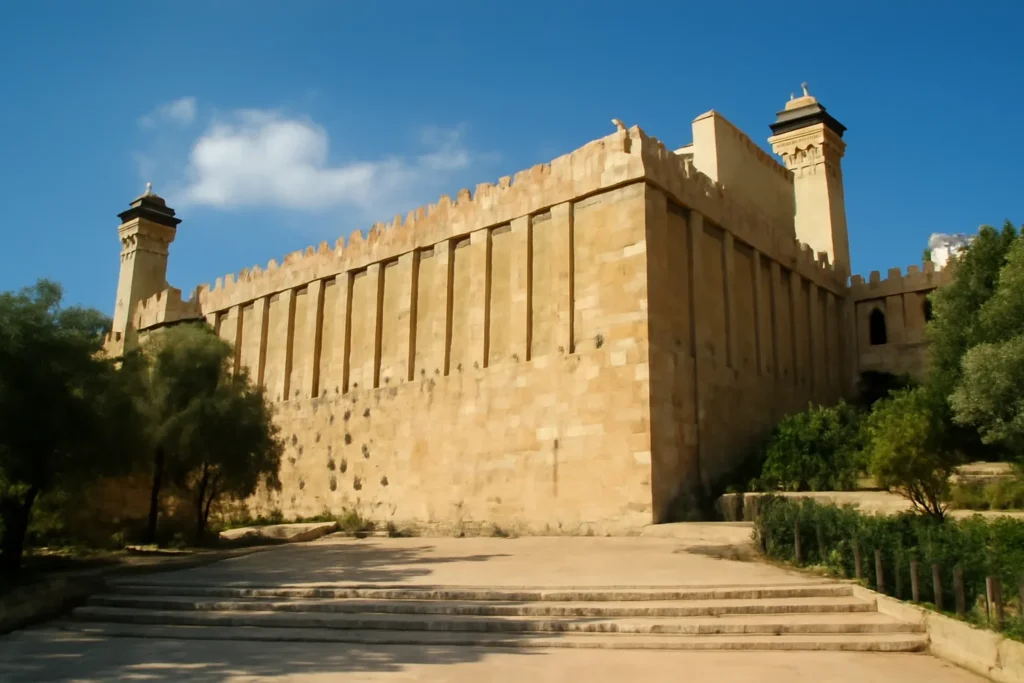
Surrounding the subterranean tombs is a robust, multi-layered above-ground sanctuary that has absorbed elements from various eras. In the medieval period, a monumental church or church-like structure was built over or around the burial space, reflecting the Crusader-era architectural style. In the present day, the site is commonly known as the Ibrahimi Mosque in Arabic, an indication of its Muslim function as a house of prayer and remembrance, while Jews and Christians continue to discuss and venerate the same sacred precinct from separate, sometimes overlapping perspectives.
The current architectural arrangement is a product of centuries of repair, ritual needs, and security considerations. The exterior of the complex, with its strong walls, thick gates, and conspicuous entrances, emphasizes the building’s dual role as a place of worship and as a symbol of the city’s long, contested history.
Religious significance across faith traditions
The Cave of Machpelah in Hebron is not simply a tomb; it is a living emblem that has shaped religious identity, memory, and pilgrimage across three major faiths. Each tradition has its own understanding of the site’s sanctity, rituals, and historical meaning.
Judaism: a patriarchal covenant and ancestral heritage
For Jewish pilgrims and scholars, the Cave of Machpelah is a sacred repository of the patriarchs and matriarchs. The burial site is tied to the covenantal promise made to Abraham and his descendants. The narrative features prominently in rabbinic literature and liturgy, reinforcing the sense of an irrevocable link between the Jewish people and the land of Israel. The idea of a shared family tomb carries powerful meaning about lineage, memory, and continuity—principles that have historically shaped Jewish ethics, identity, and claims to the land.
Islam: Ibrahim and the reverence of a significant patriarchal figure
In Islam, the figure of Ibrahim (Abraham) is revered as a prophet, and the area surrounding the cave is considered sacred due to its association with him. The mosque built there—often called the Ibrahimi Mosque—functions as a center of prayer and reflection for Muslims. While the precise tombs that Jewish tradition assigns to the patriarchs are understood differently in Islamic tradition, the site remains deeply significant as a legacy of Ibrahim’s test of faith and his role in establishing a monotheistic tradition.
Christian perspectives and shared scriptural memory
For Christians, the cave is part of the broader biblical narrative that intersects with the life of the patriarchs and matriarchs. The site’s association with Genesis stories and its place within the geography of the Holy Land have historically made it a place of pilgrimage and contemplation for Christian travelers seeking to connect biblical persons with real places in the world.
Modern history: governance, conflict, and the preservation of a sacred place
The modern history of the Cave of Machpelah in Hebron has been shaped by political change, urban development, and ongoing tensions in the region. The site has witnessed a transition from ancient religious architecture to a 20th- and 21st-century context where security, sovereignty, and access are influenced by two neighboring communities with deep historical grievances and hopes for peace.
20th century to present: governance and access patterns
In the mid-20th century, Hebron became a focal point of Jewish-Arab tensions, and the cave complex was affected by the broader political dynamics of the region. After 1967, Israeli authorities began to manage and secure sites in the area, including the Cave of Machpelah, while Palestinian institutions asserted cultural and religious ties to the same sacred space. The late 1990s introduced arrangements that divided the city into zones with distinct administrative control, influencing who can access which parts of the shrine and under what conditions. Today, the precinct remains a powerful symbol of intertwined histories, where worship, memory, and politics converge.
Preservation, restoration, and ethical considerations
Conservation efforts have sought to preserve the cave’s architectural integrity while respecting the diverse religious practices associated with the site. Because the complex sits at the intersection of memory and politics, maintenance work tends to be careful and deliberate, aiming to minimize disruption to worship and to safeguard the ancient stonework, inscriptions, and surrounding courtyards. Scholars, religious leaders, and local authorities continue to discuss best practices for preservation that honor the sensibilities of all communities connected to the Cave of Machpelah.
Visitor guide: how to plan a respectful and informative visit
For travelers, scholars, and curious readers, visiting the Cave of Machpelah in Hebron can be a meaningful experience if approached with sensitivity to its religious significance and its social context. The following sections offer practical guidance, insights into what to expect, and recommendations for making the most of a visit.
Access, hours, and orientation
The complex is often described in terms of a dual ritual space: a Muslim prayer precinct above ground and a sacred interior that houses the tombs beneath. Entrance policies have varied over time in response to security and political considerations. In practical terms:
Plan ahead for security checks and possible delays, especially during periods of heightened tension or prayer times.
Non-Muslim visitors may be admitted through controlled routes and times, typically by guided tours or with prior coordination with local authorities or guides. It is essential to respect local regulations and signage.
Muslim worshippers have access to the courtyard and prayer halls, and times may align with daily or Friday prayers. Visitors should be mindful of seating areas, sound levels, and moments of reverence.
What to expect inside: sacred spaces, rituals, and etiquette
Inside the precinct, the atmosphere is intimate and solemn. The underground tombs are the core of the sacred space, and access to them is controlled. Visitors may see the surface-level areas, inscriptions, and the architectural features that once framed the ancient cave. Important points to keep in mind:
Dress modestly and respectfully. In many contexts, this means covering shoulders and legs, avoiding hats indoors, and maintaining a quiet demeanor.
Photography rules vary by area and time. In some sections, flash photography or photography near worship spaces is discouraged or prohibited. When in doubt, ask a guide or staff on site.
Refrain from entering active prayer spaces during services. Respect the rhythm of worship and the sanctity of the space.
Follow the directions of security personnel and guides. They are there to ensure safety and to safeguard the sanctity of the site for all visitors.
Practical tips for visitors
Consider combining the visit with other historic and cultural sites in Hebron to gain a broader sense of the city’s long history and its modern life.
Bring a reliable guide or join a reputable tour to understand the layers of history, architecture, and religious practice that define the space.
Check travel advisories or local information sources before planning a trip, as access policies may change in response to security considerations.
Respect local customs, languages, and etiquette; a courteous, patient approach will enrich the experience for everyone present.
Connecting narratives: literature, archaeology, and memory
The Cave of Machpelah in Hebron has inspired a broad cross-section of literature, archaeology, and religious reflection. Archaeologists have explored the site’s stratigraphy to understand how successive peoples built, rebuilt, and adapted the complex across centuries. The narratives told by historians, religious authorities, and local communities often intersect, showing how the same physical space can function as a tomb, a sanctuary, a symbol of homeland, and a stage for political expression.
In many accounts, the sense of antiquity is palpable: the stone walls, the way light enters the spaces, and the proximity of the subterranean chamber to the above-ground sanctuary all contribute to a palpable feeling of antiquity. For scholars, this is a site where biblical memory, religious practice, and urban history meet in a single, enduring monument.
Nearby historical and cultural highlights in Hebron
To gain a fuller understanding of the Cave of Machpelah’s place in the cultural landscape of Hebron, visitors often explore other sites in and around the old city. A few nearby points of interest provide context and contrast, enriching the overall experience.
The Old City of Hebron, with its centuries-old markets, wooden balconies, and narrow alleyways that reveal the lived experience of daily life alongside centuries of memory.
Avraham Avinu Synagogue and other Jewish historic sites within the city’s Jewish quarter, which reflect the continuing thread of Jewish presence and heritage in the area.
Hebron’s urban panorama offering vantage points over the surrounding hills and the valley below, highlighting the city’s strategic location in the landscape of the region.
The Medieval and Ottoman-era architecture in the surrounding lanes, which tell stories of crafts, trade, and religious life across different eras.
Key terms and variations you may encounter
When researching or visiting, you’ll meet a variety of names that refer to the same essential site, or to different facets of the same complex. Here are some commonly used terms, along with brief clarifications:
Cave of Machpelah — the original biblical designation for the burial cave itself.
Cave of the Patriarchs — the name frequently used in English to emphasize the patriarchal figures associated with the site.
Machpelah Cave — another common variation emphasizing the cave’s Hebrew name and its interpretive meaning.
Ibrahimi Mosque — the Muslim name for the complex’s above-ground sanctuary, reflecting Muslim reverence for Ibrahim (Abraham).
Hebron’s sacred precinct — a broader term that underscores the site’s location within the city’s long religious and urban history.
Reflections: why this site endures in memory and faith
The Cave of Machpelah in Hebron endures not only because of its ancient origins but because it represents a living conversation among faith communities about ancestors, memory, and the land. The intricate layering of biblical narrative, medieval architecture, and modern-day religious practice offers a rare window into how sacred sites ferry cultural memory across generations. For many visitors, the experience is less about sightseeing and more about encountering a space where history and belief have repeatedly converged, sometimes peacefully, sometimes contentiously, and always with a sense of solemn responsibility.
Contemplative questions for visitors
If you approach the Cave of Machpelah in Hebron with curiosity and respect, you might consider pondering questions like:
How does a shared sacred space shape the identity of diverse communities who revere the same figures?
What does it mean for a modern city to balance access to a deeply historic site with security and governance concerns?
In what ways do architecture and ritual reinforce memory, legitimacy, and moral responsibility across generations?
The Cave of Machpelah in Hebron offers a substantial opportunity to reflect on how sacred space functions within a living city. Its history—from Genesis to the present day—illustrates the power of place to carry memory, faith, and community identity across centuries. Whether approached as a biblical tomb, a Crusader-era sanctuary, a mosque, or a site of pilgrimage, the Cave of Machpelah remains a profound reminder of the enduring human impulse to honor ancestors, to seek meaning in sacred space, and to navigate the complexities of shared heritage with care and reverence.
For readers who wish to delve deeper, consider exploring scholarly works on biblical archaeology, medieval Levantine architecture, and Islamic and Jewish religious practices surrounding sacred tombs. Museums, academic journals, and reputable guidebooks often present cross-disciplinary perspectives that illuminate the Cave of Machpelah’s multi-faith significance and its continuing influence on discussions of heritage, religion, and peace in the region.









Leave a Reply