Explanation of Psalm 1: Meaning, Themes, and Key Verses
Explanation of Psalm 1: Meaning, Themes, and Key Verses
Psalm 1 stands at the threshold of the Book of Psalms, offering a compact but powerful introduction to the entire collection. As a wisdom psalm and an antithetical meditation on the two ways of life, it invites readers to consider the consequences of their choices and to orient themselves toward the divine guidance found in Scripture. This article explores the meaning, themes, and key verses of Psalm 1, drawing out its literary design, its theological significance, and its practical applications for readers across traditions. We will look at multiple angles—historical, literary, devotional, and ethical—to provide a thorough explanation of what Psalm 1 says, why it matters, and how its message remains relevant today.
Psalm 1 is short—only six verses in most ancient Hebrew manuscripts—but it functions as a map for living. It contrasts two distinct paths: a path aligned with divine guidance and a path shaped by worldly counsel. In its perfectly balanced structure, the poem opens with a blessing pronounced on the one who steadfastly avoids negative influence, then describes the inner life of such a person, then compares the outward outcomes of the righteous and the wicked. The result is a portrait of flourishing for the one who orients life around God’s law, and a portrait of fragility for those who pursue a different trajectory.
There is a deliberate sequence in Psalm 1: avoidance, delight, meditation, and fruitfulness on one side; avoidance of God’s path, and the instability of life without God, on the other. The language is not merely moralizing; it uses concrete imagery from the Hebrew Bible’s wisdom tradition—counsel, path, counsel, law, meditation, fruit, leaf, wind, and judgment—to ground ethical reflection in observable realities. This is why Psalm 1 often serves as an accessible entry point for readers who are new to biblical wisdom literature, as well as a compact refresher for those who return to Scripture seeking clarity about the purpose of life.
Literary features and structure: how the Psalm achieves its effect
Scholars typically note several salient features that shape the impact of Psalm 1:
Contrast structure: The Psalm hinges on a stark dichotomy between the righteous and the wicked, the blessed and the undercut by harm. This binary is not merely punitive; it is observational—the text invites readers to reflect on what is truly sustainable in life.
Parallelism: Hebrew poetry often employs parallel lines that echo and intensify meaning. In Psalm 1, phrases like "walks... stands... sits" or "delight... meditate" reinforce the progression from action to habit to outcome.
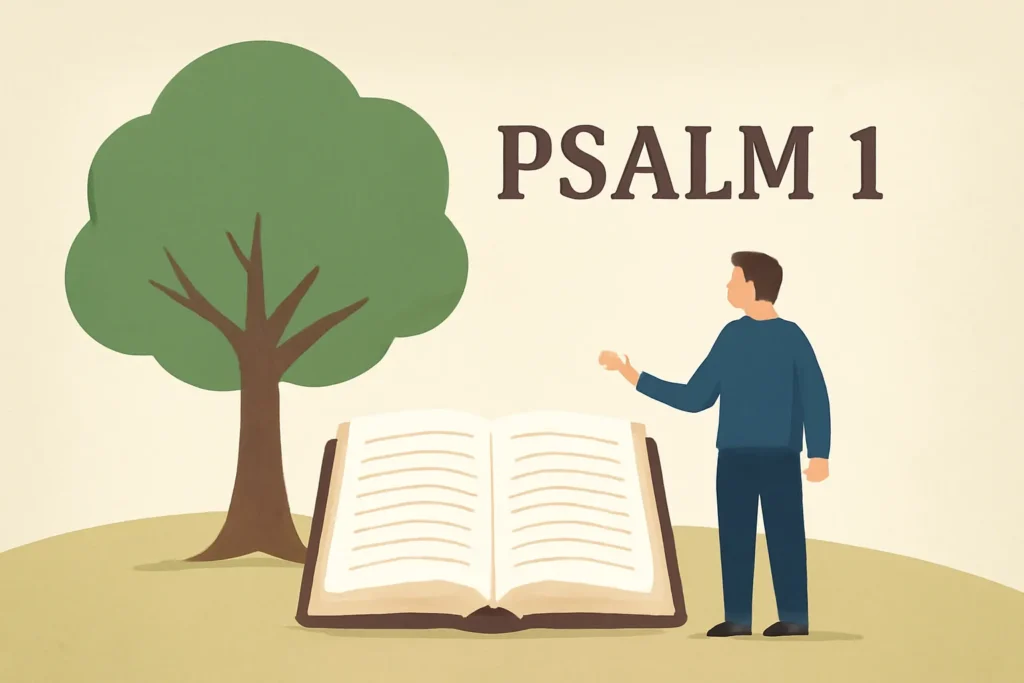
Imagery of the tree and the wind: The image of a tree planted by streams (verse 3) offers a vivid sense of rooted, steady life that bears fruit. The counterpart, the chaff blown away by the wind (verse 4), depicts transience and vulnerability.
Law-centered orientation: The central action for the righteous is delighting in the law of the Lord and meditating on His law day and night. This emphasizes a sustained, interior devotion rather than occasional religious acts.
Each of these features contributes to a holistic picture: wisdom cultivation leads to stability and fruitfulness, while ignoring divine instruction leads to instability and eventual judgment.
Meaning and interpretation: how readers have understood Psalm 1 across traditions
Psalm 1 is widely read in multiple faith communities and scholarly traditions. Its core message—choose the way of wisdom, rooted in God’s revelation, over the way of folly—resonates in both Jewish and Christian interpretive frameworks, and even in secular studies of wisdom literature. Here are a few angles commonly emphasized:
Wisdom literature orientation: The Psalm’s emphasis on the law of the Lord as the basis for flourishing connects it to other biblical wisdom writings (Proverbs, Job, Ecclesiastes). It presents a practical ethic: knowledge of God’s guidance shapes choices, habits, and life outcomes.
Covenantal perspective: The blessing on the righteous is framed as alignment with God’s covenant expectations. Living according to divine instruction is not mere rule-keeping; it is participating in the life God intends for His people.
Two-way anthropology: Psalm 1 surveys human possibility through two interwoven axes—what one loves (delight/motion toward the good) and what one lives by (meditation, habit, conduct). This underscores that life’s direction is determined not by isolated acts but by habitual orientation.
Messianic and Christian readings: In Christian interpretation, Psalm 1 can be seen as a foreshadowing of the blessed life fulfilled in Christ, who embodies perfect obedience to the Father’s law. The Psalm’s portrait of rootedness in God’s word becomes a lens for reading Jesus as the true Teacher and the true Source of life.
In Jewish interpretive tradition, the Psalm often serves as a doorway into wisdom pedagogy—how to study and live by God’s Torah in daily life. In Christian tradition, the Psalm is frequently read as an invitation to rest in the Gospel’s grounds for righteousness, while recognizing the enduring value of Scripture as a light for the path. Across both, the central claim remains: true blessing comes to those who align their inner life with divine instruction and commit to a practice that renews the heart.
Core themes: blessing, guidance, and the fate of the two ways
Several thematic threads run through Psalm 1 and echo across biblical literature. Understanding these themes helps readers apply the Psalm to contemporary life while appreciating its theological texture.
Blessing as vocation: The opening word “Blessed” signals a vocation rather than mere happiness. It invites readers to consider what it means to be blessed: not a temporary mood but a life oriented toward the good and sustained by God’s presence.
Delight and meditation: The Psalm links inward joy with outward practice. Delighting in the Lord’s law becomes a daily rhythm: a mental and emotional posture that shapes decisions and relationships.
Stability versus transience: The tree by the water represents enduring stability, while the wind-blown chaff marks fragility. The contrast is not only spiritual but practical: a life aligned with God tends toward resilience in the face of life’s trials.
Knowledge of God and judgment: The closing lines acknowledge that God knows the way of the righteous, while the way of the wicked shall perish. This emphasizes divine awareness and accountability—an appeal to trust in God’s discernment.
Key verses and explanations: verse-by-verse insights
Verse 1: The path is chosen by what one hopes to avoid
“Blessed is the man who walks not in the counsel of the wicked, nor stands in the way of sinners, nor sits in the seat of scoffers”
This opening line establishes a radical first principle: blessing comes to one who refuses three progressively intimate forms of influence. The progression—from walking to standing to sitting—depicts a gradual loosening of boundaries. The phrase “counsel of the wicked” suggests adopting others’ guidance rather than God’s, while “the way of sinners” and “the seat of scoffers” describe deeper levels of alignment with harmful culture. The moral arc is clear: the Psalm invites readers to distinguish between superficial avoidance and a sustained, committed stance of loyalty to God’s way. In practical terms, this verse can be read as a caution about the input we permit into our thinking and the company we keep, since both shape habit and worldview.
Verse 2: Delight and meditation as the center of life
“But his delight is in the law of the Lord, and on his law he meditates day and night.”
This verse places desire at the center of virtue. True blessedness comes not from avoiding harm alone but from choosing what is good with sustained affection. The “law of the Lord” functions as the measure and tutor of life. Meditation implies more than passive reading; it is an active, contemplative engagement that shapes attitudes and actions over time. The phrase “day and night” indicates consistency and perseverance, a rhythm of heart and mind that permeates daily life. For readers, this verse invites a practical practice: regularly returning to Scripture, letting it form judgments, and letting its insights recalibrate priorities.
Verse 3: Flourishing imagery — rootedness and fruitfulness
“He is like a tree planted by streams of water, which yields its fruit in season and whose leaf does not wither.”
The central metaphor of the Psalm comes to life here. A tree planted by living water signifies nourishment, stability, and vitality. The tree’s fruit in its season suggests a tangible, dependable productivity that arises from inner life. The leaf that does not wither indicates ongoing vitality even under pressure. The verse communicates a holistic flourishing: not only inner peace but outward productivity and resilience. The motif resonates with agricultural wisdom in the ancient Near East, where water supply and soil fertility determined life’s prospects. In spiritual terms, the verse speaks to a life that remains fruitful because its roots are in God’s provision and guidance.
Verse 4: The contrast — the wicked as chaff
“Not so the wicked! They are like chaff that the wind blows away.”
The negative counterpart to the blessed person is vivid and stark. Chaff, the husk separated from grain, is useless and easily scattered. It suggests impermanence and fragility in contrast to the sturdy tree. The image implies vulnerability to external forces and a lack of lasting substance. In some traditions, this verse links to the judgment that follows, as the Psalmist asserts that the fate of those who disregard God’s path will not endure. The rhetorical effect is designed to awaken moral perception: life without alignment to God becomes a life without durable meaning.
Verse 5: Judgment and accountability
“Therefore the wicked will not stand in the judgment, nor sinners in the assembly of the righteous.”
Verse 5 formalizes the consequences of the two paths. The imagery shifts from agricultural metaphors to social and judicial imagery. The righteous are described as able to endure communal judgment and participate in the assembly with confidence; the wicked cannot stand in judgment. The verse acknowledges a divine courtroom in which values, choices, and their outcomes are examined. It reinforces the Psalm’s ethical orientation: life’s path is not arbitrary but subject to divine assessment.
“For the Lord watches over the way of the righteous, but the way of the wicked leads to destruction.”
This final verse ties intention to outcome by asserting God’s awareness of human paths. The blessing of the righteous rests in God’s protective and guiding presence. The contrast ends with a stark judgment: the way of the righteous leads toward flourishing under divine care, whereas the way of the wicked leads to perishing. The closing line reinforces the Psalm’s practical takeaway: orientation to God’s way results in a secure, meaningful life, while disregard results in ruin. Readers can take from this verse a sense of hopeful accountability—that lives oriented to God’s path are known and upheld by God.
The Psalm’s influence on prayer, worship, and daily life
Psalm 1 has shaped liturgical practices, devotional habits, and ethical reflection in enduring ways. Some practical implications include:
Devotional rhythm: The call to delight in the law and meditate on it encourages a daily habit of Scripture study, reflection, and prayer.
Moral discernment: The Psalm’s two-path framework helps readers assess contemporary influences—media, friendships, and cultural norms—through the lens of wisdom and covenantal living.
Community formation: The Psalm’s portrayal of the righteous as those who endure in the assembly highlights the importance of communal life and mutual encouragement in pursuing righteousness.
Environmental and humane imagery: The tree by the water invites a holistic sense of flourishing that includes personal well-being, family life, and stewardship of creation.
Variations in interpretation: openness to nuance and breadth
Readers come from diverse backgrounds, and so the Psalm is often read with nuanced emphasis depending on tradition, era, and purpose. Some noteworthy variations include:
Ethical emphasis: Some interpreters highlight Psalm 1 as a primer on prudent living and moral formation, focusing on behavior and habit as the primary arena of transformation.
Theological emphasis: Others stress the Psalm’s function within covenant theology, reading the blessing as a sign of alignment with God’s redemptive purposes and covenant faithfulness.
Christocentric reading: In Christian interpretation, Jesus is often viewed as the true fulfillment of the “Blessed One” who perfectly delights in the Father’s law, thereby modeling the ideal life for believers to imitate.
Literary and symbolic emphasis: A literary approach may foreground the Psalm’s poetic devices—the parallelism, imagery of water, and wind—as keys to interpreting how language itself shapes moral imagination.
Practical guidance for applying Psalm 1 today
To translate the Psalm’s ancient wisdom into modern practice, readers might consider the following steps:
Assess influences: Regularly evaluate the sources of guidance in your life—the people you listen to, the media you consume, and the ideologies you entertain. Seek alignment with God’s standards rather than cultural convenience.
Cultivate delight in Scripture: Create a daily habit of reading a portion of Scripture, reflecting on its meaning, and identifying how it shapes decisions for the day ahead.
Develop a meditation practice: Practice meditating on a verse or phrase from Psalm 1, letting it expand into prayer, gratitude, and intention for action.
Root your life in God’s provision: Analogous to the tree by streams, seek nourishment from God’s word and presence to endure seasons of drought or difficulty without losing steadiness.
Build a community of accountability: Engage with others who share a commitment to wisdom and righteousness, encouraging one another to stay faithful to the path of growth.
Closing reflections: Psalm 1 as a compass for life
In a world saturated with competing voices and shifting values, Psalm 1 offers a timeless compass. Its core assertion—that there is a right way to live, rooted in the revelation of God, and that this way yields lasting vitality—remains compelling across centuries and cultures. The Psalm does not promise instant ease or material abundance in every circumstance, but it does offer a steady assurance: when one seeks God’s guidance, one’s life is configured for resilience, fruitful living, and enduring significance. By reading Psalm 1 as a compact wisdom oracle, readers gain not only ethical instruction but also a hopeful vision of what it means to be blessed: to live in harmony with God, to pursue truth through study and reflection, and to bear fruit that blesses others and endures through time.









Leave a Reply