First book of the New Testament: Matthew explained
First book of the New Testament: Matthew explained
The first book of the New Testament is the Gospel according to Matthew, commonly called Matthew, and it presents Jesus as the promised Messiah, King, and teacher of God’s kingdom.
Matthew opens the New Testament in the Bible’s standard Christian arrangement, but that position does not necessarily mean it was the first Gospel written. Its placement creates a deliberate bridge between the Old and New Testaments: the book repeatedly connects Jesus’ life, teachings, death, and resurrection with Israel’s Scriptures and hopes.
The New Testament contains 27 books, and Matthew begins the section known as the four Gospels. The Gospels—Matthew, Mark, Luke, and John—tell the story of Jesus from different perspectives, with each writer emphasizing particular themes and details.
Matthew comes first because it provides a strong connection to the Old Testament. Its opening genealogy links Jesus with Abraham and David, two central figures in biblical history. From its first chapter, the Gospel presents Jesus as the one through whom God’s promises to Israel reach their intended fulfillment.
The book also moves naturally from Israel’s story toward the worldwide mission of Jesus’ followers. It begins with Jewish history, customs, prophecy, and expectation, then ends with the risen Jesus sending his disciples to make followers among all nations.
The central point: Matthew shows that Jesus is the promised Messiah and explains what it means to recognize him, follow him, and participate in his kingdom.
The first position gives Matthew a teaching function as well as a narrative one. Readers encounter Jesus not only as the central figure of the Gospel story but also as an authoritative instructor who explains righteousness, prayer, forgiveness, leadership, faithfulness, and judgment.
What the Gospel of Matthew is about
Matthew tells the story of Jesus’ ministry in Galilee and Judea, his conflicts with religious leaders, his final days in Jerusalem, his crucifixion, and his resurrection. Alongside these events, it records substantial blocks of teaching that help readers understand Jesus’ identity and the life expected of his disciples.
The Gospel’s main subject is the kingdom of heaven. Matthew uses this phrase frequently to describe God’s active rule and saving purpose. The kingdom is connected with Jesus’ arrival, yet its complete fulfillment remains associated with the future. This creates a pattern in which God’s reign is already being revealed but has not yet reached its final expression.
Jesus announces the kingdom, demonstrates its character through healing and mercy, and calls people to respond with repentance and trust. Matthew does not present discipleship as admiration from a distance. Following Jesus involves changed priorities, practical obedience, endurance, and a willingness to serve.
The book also focuses on Jesus’ identity as the Son of David, a title connected with Israel’s royal hopes. Matthew shows Jesus exercising authority over illness, nature, demons, sin, religious interpretation, and death. These actions support the Gospel’s claim that he is more than a teacher or political figure.
How Matthew connects Jesus with the Old Testament
One of Matthew’s most recognizable features is its repeated use of Scripture fulfillment. The writer frequently explains an event in Jesus’ life by referring to what God had spoken through an earlier prophet or biblical passage. These references invite readers to see Jesus’ story as part of a much larger plan.
Matthew draws attention to several Old Testament themes:
The promised king: Jesus is linked to David’s royal line and presented as the rightful ruler.
The new Moses: Jesus teaches from a mountain and gives authoritative instruction, echoing important features of Moses’ role while presenting Jesus as greater than a traditional teacher.
God’s presence: The Gospel begins with the promise that Jesus’ identity involves God being with his people and ends with the risen Jesus assuring his followers of his continuing presence.
Israel’s calling: Jesus represents Israel faithfully and extends God’s blessing beyond Israel to the nations.
The suffering servant: Jesus’ rejection, suffering, and death are treated as part of his saving mission rather than as evidence that his mission failed.
These connections do not mean Matthew treats the Old Testament as a collection of isolated predictions. The Gospel often presents Jesus as bringing earlier patterns, promises, and hopes to their full meaning. Events such as the exodus, the wilderness, the giving of the law, and the restoration of God’s people help readers understand the significance of Jesus’ work.
When reading Matthew’s fulfillment statements, consider both the immediate Old Testament passage and the way Matthew applies it. The writer may be showing direct prophecy, a repeated pattern, a symbolic parallel, or a broader theme that reaches its climax in Jesus.
What happens in the opening chapters
Matthew begins with a genealogy that traces Jesus’ ancestry through Abraham and David. The list includes notable women, people associated with unexpected circumstances, and individuals connected with serious moral failure. Its purpose is not simply to provide family history. It introduces Jesus as the heir of Israel’s story while showing that God’s purposes have worked through complicated human situations.
The birth narrative explains Jesus’ conception, the role of Joseph, the visit of the Magi, the threat from Herod, and the family’s move to Egypt and later return. Matthew presents these events as part of a pattern in which Jesus relives and fulfills important experiences from Israel’s history.
John the Baptist then appears, calling people to repentance and preparing them for the arrival of God’s kingdom. Jesus is baptized, tested in the wilderness, and begins announcing the kingdom. The early chapters establish his authority before the Gospel turns to his major teaching sections.
The temptation in the wilderness is especially significant because Jesus remains faithful where Israel repeatedly failed during its wilderness testing. Matthew portrays Jesus as the obedient Son whose mission will not be redirected by comfort, power, or public acclaim.
What the Sermon on the Mount teaches
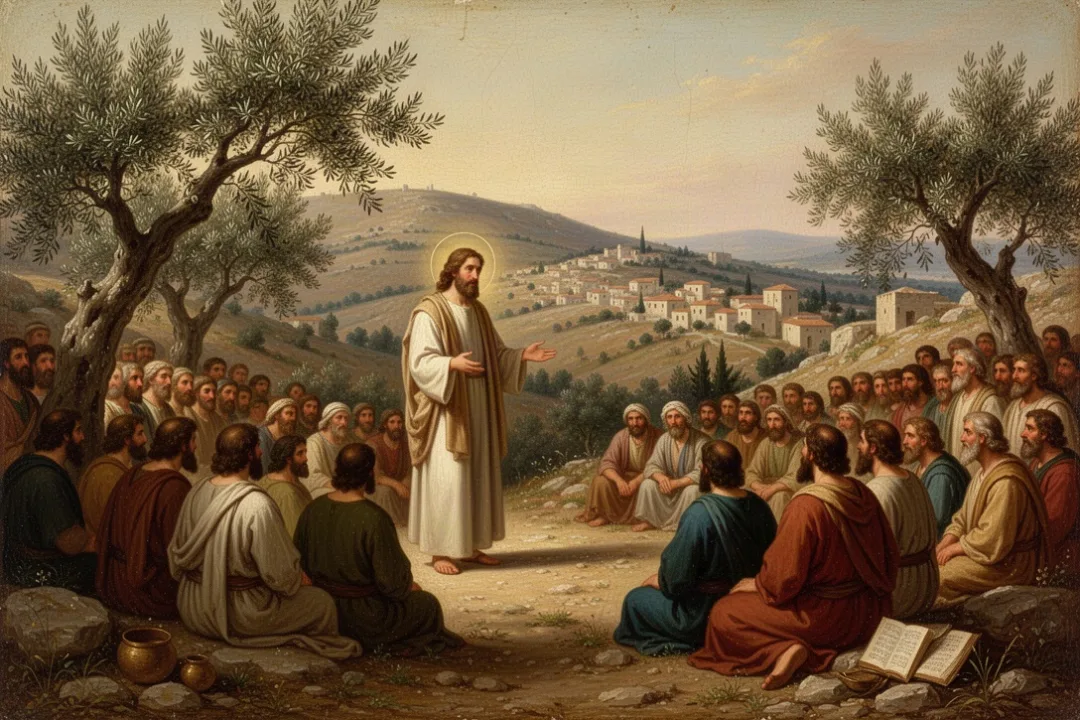
Matthew chapters 5 through 7 contain the Sermon on the Mount, the Gospel’s best-known teaching section. It begins with blessings for people who appear weak, grieving, humble, hungry for justice, merciful, pure in heart, or persecuted. These blessings reverse ordinary assumptions about success and show that God’s kingdom values are different from the world’s systems of status.
Jesus describes his followers as salt and light, using images of influence, visibility, preservation, and faithful witness. He then addresses the relationship between his teaching and the law. Matthew presents Jesus neither as casually discarding Scripture nor as reducing faith to external rule-keeping. Instead, Jesus presses obedience inward, toward motives, desires, reconciliation, integrity, and love.
The Sermon addresses anger, sexual faithfulness, divorce, promises, retaliation, love for enemies, generosity, prayer, fasting, money, anxiety, judgment, and wise decision-making. Its repeated concern is the difference between public religious performance and genuine devotion to God.
The prayer Jesus teaches his disciples places God’s name, kingdom, and will before personal requests. It also asks for daily provision, forgiveness, and protection from testing. The prayer is brief enough to remember but broad enough to shape a person’s entire view of dependence and community.
Matthew’s Sermon on the Mount should not be treated as a list of impossible ideals with no practical meaning. It describes the character of people who belong to God’s kingdom. At the same time, its depth exposes the limits of self-righteousness and points readers toward humble dependence on God’s mercy.
Matthew presents obedience as a matter of the heart, not merely outward religious appearance.
How Jesus’ miracles reveal his authority
Matthew records healings, exorcisms, restorations, and other signs of Jesus’ authority. These accounts are not included only to create a dramatic biography. They show the kingdom breaking into ordinary human suffering and reveal Jesus’ compassion toward people who are sick, excluded, afraid, or considered spiritually unclean.
Jesus heals individuals with different conditions, responds to a Roman officer’s trust, calms a storm, frees people from demonic oppression, and raises the dead. The Gospel also records his authority to forgive sins, a claim that creates controversy because forgiveness is understood as belonging uniquely to God.
Miracles in Matthew often lead to questions about faith. Faith does not mean controlling an outcome or treating belief as a technique. It means recognizing Jesus’ authority and relying on God rather than on visible circumstances, personal status, or religious reputation.
The miracles also point beyond individual relief. They represent the restoration associated with God’s reign. Jesus’ healing work does not remove every form of suffering from the present world, but it gives a preview of the renewal promised under God’s rule.
What Matthew teaches about discipleship
Matthew uses the language of discipleship to describe a continuing relationship with Jesus. A disciple listens to his teaching, trusts his authority, follows his example, and helps others learn to obey. The book therefore treats Christianity as more than agreement with a set of ideas.
Jesus calls ordinary people, including fishermen and a tax collector, to leave established routines and follow him. Their understanding develops gradually. They sometimes show courage, confusion, fear, ambition, and failure. Matthew’s portrait reassures readers that disciples grow through correction, instruction, service, and dependence on Jesus.
Several qualities repeatedly mark faithful disciples:
Humility: Greatness in God’s kingdom is connected with serving rather than dominating.
Mercy: Those who receive forgiveness are expected to extend forgiveness to others.
Perseverance: Loyalty to Jesus may bring opposition, loss, or misunderstanding.
Integrity: Private motives matter as much as public actions.
Watchfulness: Disciples are called to remain spiritually prepared rather than assume that delay means God’s purposes have disappeared.
Mission: Followers of Jesus teach, baptize, and invite people from every nation into his community.
Matthew gives special attention to relationships within the believing community. It addresses conflict, correction, forgiveness, care for vulnerable people, and the danger of causing others to stumble. Leadership is treated as service, not as an opportunity for prestige or control.
Why Matthew includes conflict with religious leaders
Much of Matthew’s middle and later material records disputes between Jesus and religious leaders. These conflicts concern Sabbath practices, purity, traditions, authority, interpretation of Scripture, and the character of genuine righteousness. The Gospel is not a license for contempt toward Jewish people; Jesus and his first disciples were Jewish, and the disputes occur within the setting of Jewish religious life.
The conflict centers on competing views of faithfulness. Jesus criticizes leaders who use religious authority for public honor while neglecting justice, mercy, and faithfulness. He also warns his followers not to reproduce the same behavior. His strongest warnings apply to anyone who turns devotion into status, control, or performance.
Matthew presents the rejection of Jesus as part of the Gospel’s painful movement toward the cross. The opposition grows as Jesus’ authority becomes clearer. Yet the book does not portray his death as an accident. Jesus repeatedly prepares his disciples for suffering and describes his death as connected with God’s saving purpose.
Reading caution: Do not use Matthew’s controversies to justify hostility toward Jews. Read them in their historical setting, remember Jesus’ Jewish identity, and apply the warnings first to your own religious attitudes and communities.
How Matthew describes Jesus’ death and resurrection
The final chapters move to Jerusalem, where Jesus enters publicly, teaches in the temple, shares a final meal with his disciples, and faces arrest. Matthew emphasizes both the injustice of the proceedings and Jesus’ deliberate acceptance of suffering. His silence, prayer, and refusal to escape reinforce the picture of a king whose authority is expressed through faithful surrender.
Jesus is crucified under the charge associated with kingship. The cross appears to be a public defeat, but Matthew interprets it as central to Jesus’ mission. The darkness, the tearing of the temple curtain, and the reactions of witnesses signal that this death has significance beyond the execution itself.
Matthew’s resurrection account begins with women discovering that the tomb is empty. An angel announces that Jesus has risen, and the women meet the risen Jesus as they leave. The disciples later encounter him in Galilee, where he gives them their mission.
The resurrection confirms Jesus’ identity and vindicates his teaching. It also transforms the disciples’ task. They are no longer simply students accompanying a teacher in Galilee; they become witnesses responsible for carrying his message to people across ethnic and geographic boundaries.
What the Great Commission means
Matthew ends with Jesus’ command to make disciples among all nations. The mission includes going, baptizing people in the name of the Father, Son, and Holy Spirit, and teaching them to observe everything Jesus has commanded. The emphasis is not merely on gaining decisions or collecting followers. It is on forming a community shaped by Jesus’ complete teaching.
The command is grounded in Jesus’ authority over heaven and earth. That authority gives the mission its scope and its confidence. The Gospel that began with Israel’s Scriptures and a Jewish family ends with an outward movement toward every people group.
The closing assurance of Jesus’ continuing presence gives the mission its foundation. Matthew does not promise that the work will be easy or free from resistance. It presents the risen Jesus as remaining with his people as they teach, serve, baptize, and live under his authority.
How to read Matthew carefully
Matthew rewards slow reading because its repeated themes connect distant passages. Notice where a teaching appears, how a miracle affects the surrounding discussion, and how the disciples respond. The Gospel’s arrangement often places action and instruction together so that readers can see both what Jesus does and what his actions mean.
A practical reading method can help:
Read a manageable section at a time. A chapter or a major scene is usually enough for one sitting.
Identify the setting. Ask where Jesus is, who is present, and what problem or question drives the scene.
Watch for repeated words. Kingdom, righteousness, faith, authority, fulfillment, disciples, and heaven are especially important themes.
Separate description from instruction. Not every action recorded in the Gospel is presented as a behavior for disciples to copy.
Compare parallel accounts carefully. Mark, Luke, and John may report the same event with different emphases and details.
Apply the teaching in context. Consider what Jesus meant for the original audience before deciding how a passage addresses your life.
Matthew’s five major teaching sections are often recognized as a useful structural pattern. These include the Sermon on the Mount, instructions to the apostles, parables of the kingdom, teaching about life in the community, and teaching about the future and final accountability. The pattern is not simply a technical outline; it highlights Jesus as a teacher whose words guide the community after his departure.
Common mistakes when studying Matthew
Readers can misunderstand Matthew when they isolate familiar verses from the Gospel’s larger argument. A careful approach keeps Jesus’ identity, kingdom, cross, resurrection, and mission connected rather than treating each passage as an independent saying.
Assuming first means first written: Matthew’s place in the canon does not prove that it was composed before Mark, Luke, or John.
Reducing Matthew to moral advice: The Gospel teaches conduct, but its commands flow from Jesus’ identity and God’s kingdom.
Ignoring the Jewish setting: Understanding Jewish Scripture, worship, customs, and expectations clarifies many scenes.
Reading “kingdom” only as heaven after death: Matthew describes God’s reign as a present reality with a future completion.
Treating faith as mere optimism: Matthew connects faith with trust in Jesus, obedience, humility, and endurance.
Using judgment passages to avoid mercy: The Gospel’s warnings about judgment stand alongside repeated commands to forgive, serve, and show compassion.
Separating the Great Commission from discipleship: Making disciples includes teaching people to live by Jesus’ commands, not only introducing them to Christian belief.
Another common mistake is assuming that every difficult passage has only one obvious interpretation. Matthew contains poetic images, parables, prophetic language, narrative, legal discussion, and symbolic scenes. Genre and context affect how each passage should be understood.
Who wrote Matthew?
Christian tradition identifies the author as Matthew, the tax collector who became one of Jesus’ twelve apostles. The Gospel itself does not explicitly name its author within the text. For that reason, discussions of authorship distinguish between the traditional attribution and the limits of what can be proven from the book alone.
The Gospel reflects a writer deeply interested in Jewish Scripture, Jesus’ teaching, the formation of a faithful community, and the mission to the nations. It was written in polished Greek and appears designed for readers who could follow connections between Jesus and Israel’s biblical story.
Questions about authorship do not remove the book’s central message. Whether examining Matthew devotionally, historically, or literarily, readers should pay attention to the Gospel as it stands: its structure, repeated themes, portrayal of Jesus, and call to faithful discipleship.
Why Matthew still matters to readers
Matthew addresses questions that remain practical: What does true righteousness look like? How should religious authority be used? What does forgiveness require? How can a community handle conflict? What does it mean to follow a teacher whose path leads through suffering? How should faith respond to outsiders and unfamiliar cultures?
Its answer is centered on Jesus. He announces God’s reign, embodies mercy and faithfulness, confronts hypocrisy, welcomes the overlooked, accepts the cross, rises from the dead, and sends his followers into the world. Matthew therefore serves both as an account of Jesus’ life and as a guide for communities seeking to live under his teaching.
Reading the first book of the New Testament from beginning to end helps you see how its parts fit together. The genealogy, kingdom announcement, miracles, teachings, conflicts, cross, resurrection, and worldwide mission are not disconnected topics. Together they proclaim that God’s promises are reaching their fulfillment through Jesus and that his followers are called to respond with trust, obedience, mercy, and faithful witness.
Frequently asked questions
Is Matthew the oldest book in the New Testament?
Not necessarily. Matthew is the first book in the standard New Testament order, but that arrangement is theological and literary rather than a firm timeline of composition. Many scholars discuss whether Mark was written earlier, while the exact dates and relationships among the Gospels remain matters of scholarly debate.
Why does Matthew say “kingdom of heaven” instead of “kingdom of God”?
Matthew’s preferred expression reflects a Jewish sensitivity about referring directly to God’s name. The two phrases generally refer to the same central reality: God’s active rule and saving authority. “Heaven” does not mean the kingdom is only a place people enter after death; Matthew also presents it as a present and future reality.
Should I read Matthew before the other Gospels?
Matthew is a sensible starting point because it introduces Jesus through Israel’s Scriptures and includes extensive teaching. Mark offers a shorter, fast-moving account, Luke emphasizes a broad historical narrative and concern for outsiders, and John uses distinctive language and structure. Reading more than one Gospel reveals both shared events and different emphases.
What is the most important theme to look for while reading Matthew?
Look for the relationship between Jesus’ identity and discipleship. Matthew presents Jesus as Messiah and king, then shows what life under his authority requires: humility, mercy, integrity, endurance, forgiveness, service, and participation in his mission. His teachings are connected to his death and resurrection rather than standing alone as general moral advice.









Leave a Reply