When you read the Gospel of Matthew, you may wonder where to begin: with Jesus’ genealogy, the Sermon on the Mount, the miracles, or the resurrection? The clearest answer is to see Matthew as a carefully arranged account of Jesus’ identity, teaching, death, and resurrection. It presents him as the promised Messiah, the authoritative teacher of God’s will, and the risen Lord who sends his followers to make disciples among all nations.
Matthew is the first book of the New Testament and the first of the four Gospels. It connects the story of Jesus to Israel’s Scriptures and history, while also showing how his mission reaches beyond Israel. Its chapters combine narrative scenes with substantial blocks of teaching, giving readers both a story to follow and a pattern for faithful living.
Matthew opens by identifying Jesus as the Messiah, the descendant of David, and the son of Abraham. Those opening names immediately place Jesus within the story of God’s covenant promises. The genealogy in Matthew 1 traces his line through important figures in Israel’s history, including Abraham and David, and prepares the reader to see his birth as part of a long-awaited purpose.
The birth narrative in Matthew 1–2 emphasizes Jesus’ unusual origin and the dangers surrounding him. Joseph learns in a dream that Mary’s child has been conceived by the Holy Spirit and is instructed to name him Jesus. Matthew explains the name through its association with salvation from sins, presenting Jesus’ mission as a rescue that addresses humanity’s deepest separation from God.
Matthew also calls attention to the name Immanuel, meaning that God is with his people. This theme returns at the very end of the Gospel, when the risen Jesus promises his continuing presence with his disciples. The beginning and ending therefore frame the entire book with a central claim: God is present through Jesus, from his birth to the church’s mission.
Jesus’ baptism and temptation in Matthew 3–4 mark the beginning of his public ministry. At his baptism, the Spirit descends upon him and a heavenly voice identifies him as God’s beloved Son. In the wilderness, Jesus faces temptations involving food, spectacle, and political power. He responds by remaining faithful to God rather than using his identity for self-serving purposes.
After John the Baptist is arrested, Jesus begins proclaiming that God’s kingdom is near. He calls ordinary people, including fishermen, to follow him. His early ministry combines teaching, healing, and proclamation: he announces the kingdom, restores suffering people, and demonstrates authority over disease, nature, demons, and sin.
A helpful reading lens: Matthew does not present Jesus only as a miracle worker or moral teacher. Each part of the story contributes to the larger question of who he is and what God’s kingdom means for those who hear him.
Matthew’s portrait includes several titles and images that work together. Jesus is the Son of David, fulfilling royal hopes; the Son of Man, an authoritative figure who will come in glory; the Son of God, uniquely related to the Father; and the servant whose suffering brings salvation. These descriptions are not interchangeable labels. Together, they show that Jesus’ authority is inseparable from humility, obedience, and sacrificial service.
How the Gospel of Matthew is organized
Matthew contains 28 chapters and can be read as a carefully shaped combination of story and instruction. The narrative moves from Jesus’ birth to his ministry in Galilee, his journey toward Jerusalem, his death, and his resurrection. Along the way, five major teaching sections help explain the meaning of his actions and the character of life under God’s reign.
Many readers notice a repeated formula near the end of these teaching blocks, describing Jesus as finishing his words or instructions before the narrative moves forward. This pattern suggests deliberate arrangement rather than a loose collection of memories. The teaching sections are not detached speeches; each one interprets events in the surrounding story.
Matthew 5–7: the Sermon on the Mount, which describes kingdom righteousness and faithful practice.
Matthew 10: instructions for the twelve disciples as they are sent to announce the kingdom.
Matthew 13: parables explaining the hidden and growing nature of the kingdom.
Matthew 18: teaching about relationships, humility, correction, forgiveness, and community life.
Matthew 23–25: warnings, judgment teaching, and preparation for the coming of the Son of Man.
Between these sections, Matthew includes healings, conflicts, journeys, conversations, and reactions to Jesus. This alternation creates a rhythm: Jesus acts, people respond, and Jesus explains what discipleship requires. The reader is repeatedly asked not merely to admire Jesus’ works but to understand and practice his teaching.
The Gospel can also be followed through several broad movements:
Preparation and beginnings: Jesus’ genealogy, birth, baptism, temptation, and first preaching appear in Matthew 1–4.
Galilean ministry: Chapters 5–13 present major teaching, miracles, calling, opposition, and kingdom parables.
Formation of the disciples: Chapters 14–18 emphasize Peter’s confession, Jesus’ identity, the cost of following him, and life within the believing community.
Journey to Jerusalem: Chapters 19–20 develop themes of service, wealth, marriage, children, leadership, and the coming suffering.
Jerusalem, crucifixion, and resurrection: Chapters 21–28 recount Jesus’ final teachings, conflict, death, empty tomb, and commission.
This structure helps explain why Matthew can feel both organized and expansive. It gives substantial space to Jesus’ words while preserving the forward movement toward the cross. The story’s destination is not simply Jesus’ public success. It is his rejection, death, resurrection, and the worldwide mission that follows.
What the Sermon on the Mount teaches about kingdom life
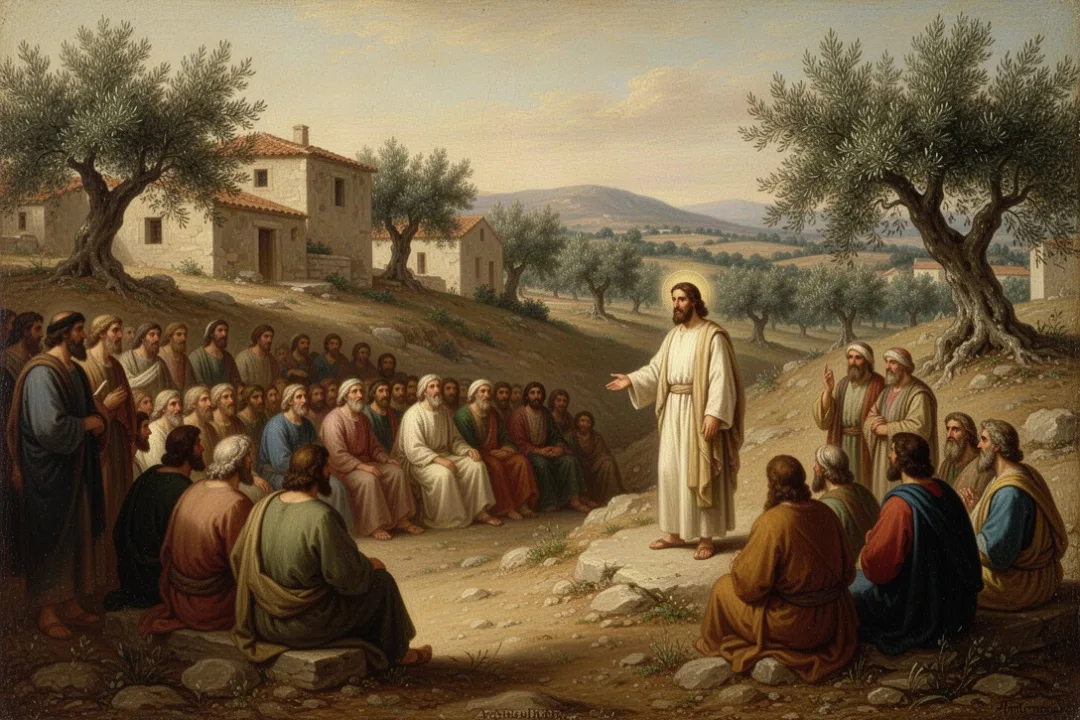
Matthew 5–7 is the Gospel’s most famous teaching section. The Sermon on the Mount begins with blessings for people who appear weak, grieving, humble, or desperate for justice. These blessings do not praise suffering for its own sake. They announce that God sees and will act for people who depend on him rather than on social status or power.
Jesus then describes his followers as salt and light, using ordinary images to explain their public witness. He does not call them to withdraw from the world or to seek attention for themselves. Their lives should make God’s goodness visible through faithful conduct, truthfulness, mercy, and works that direct praise toward God.
A major concern of the sermon is the relationship between Jesus and the Law of Moses. Matthew 5:17 presents Jesus as one who does not discard the Law and the Prophets but brings them to their intended fulfillment. The sermon then moves from outward actions to inner motives, addressing anger, lust, revenge, honesty, generosity, and love for enemies.
Jesus repeatedly reaches beneath visible behavior to the condition of the heart. Avoiding murder is not enough if a person nurtures contempt. Keeping an oath is not the only form of honesty if ordinary speech is unreliable. Refusing revenge does not mean passivity; it means resisting the cycle of retaliation and choosing a response shaped by God’s character.
Love for enemies is among the sermon’s most demanding teachings. Jesus connects this love with prayer for persecutors and with the Father’s generosity toward people who do not deserve it. The point is not to call evil good or to remove appropriate boundaries. It is to reject hatred as the governing response and to pursue a form of goodness that reflects God’s mercy.
Matthew 6 shifts attention to religious practices such as giving, prayer, and fasting. Jesus warns against using devotion as a performance designed to win public approval. The Lord’s Prayer, recorded in Matthew 6, places God’s name, kingdom, and will before daily needs, forgiveness, and protection from temptation.
The sermon also addresses anxiety, wealth, judgment, and discernment. Jesus tells his hearers to seek God’s kingdom rather than being consumed by material concerns. He warns against hypocritical judgment while still urging careful moral discernment. The closing images of two roads, two trees, and two foundations all stress that hearing Jesus must lead to action.
Reading Matthew 5–7 well: The sermon is not a checklist for earning God’s favor. It describes the character of people who belong to God’s kingdom and depend on God’s grace to live that way.
How Matthew connects Jesus with Israel’s Scriptures
One of Matthew’s clearest features is its frequent use of the Old Testament. The Gospel often says that an event happened so that something spoken through a prophet might be fulfilled. These references are not limited to predictions that resemble one future event. Matthew also sees Jesus reliving and completing patterns from Israel’s story.
Jesus’ early life illustrates this pattern. He comes out of Egypt, passes through water at baptism, and enters the wilderness. These events recall Israel’s exodus, passage through the sea, and wilderness testing. The difference is that Jesus remains faithful where Israel repeatedly failed. Matthew presents him as the representative Israelite who fulfills the nation’s calling.
The Gospel also emphasizes Jesus’ connection to Davidic kingship. His genealogy begins with Abraham but gives special attention to David, and Jesus is repeatedly called the Son of David. His entry into Jerusalem, his disputes with religious leaders, and the accusations placed above the cross all engage questions about royal authority.
Matthew’s use of Scripture also includes the prophetic hope of a servant who suffers. The Gospel does not treat Jesus’ rejection and death as an unexpected collapse of his mission. Instead, it interprets them as part of God’s purpose, while still showing the real injustice, betrayal, fear, and grief involved in those events.
Several Old Testament themes are especially important in Matthew:
God’s presence: Jesus fulfills the hope that God will dwell with his people.
Messianic kingship: Jesus inherits the promises associated with David’s line.
A new exodus: Jesus leads people into deliverance and forms a renewed people around himself.
Prophetic fulfillment: His ministry brings Israel’s hopes and warnings to their decisive point.
Universal blessing: The promise connected with Abraham extends through Jesus to people from every nation.
This scriptural focus does not mean Matthew is written only for readers who already know the Hebrew Bible. It gives newcomers a map for understanding why Jesus’ actions matter. His healings, teachings, conflicts, and suffering belong to a much larger story of covenant, sin, judgment, mercy, and restoration.
Matthew also shows that familiarity with Scripture does not guarantee faithful response. Some religious leaders recognize the texts yet oppose Jesus, while unexpected people respond with trust. The Gospel therefore asks not only whether a person knows Scripture but whether that knowledge leads to humility, mercy, justice, and obedience.
What Matthew teaches about discipleship and community
For Matthew, a disciple is more than someone who agrees with Jesus’ claims. Disciples listen, follow, practice, endure, and teach. The repeated command to follow Jesus includes leaving behind old securities, accepting hardship, and placing loyalty to him above status or possessions.
The calling of the first disciples shows that Jesus forms a community around himself. The group includes people with different backgrounds and personalities, and it is far from ideal. Peter misunderstands, the disciples compete for importance, and they struggle to grasp what Jesus says about suffering. Matthew’s honest portrayal makes discipleship realistic: commitment can coexist with confusion and failure.
Matthew 10 records Jesus sending the twelve to proclaim that God’s kingdom is near. Their mission involves practical dependence, opposition, and courage. Jesus does not promise that faithful messengers will always receive approval. He prepares them for rejection while assuring them that God knows and values them.
Matthew 18 focuses especially on community relationships. Jesus places a child among the disciples to challenge their ideas about greatness. In God’s kingdom, humility is not weakness; it is a defining quality. The community must protect vulnerable people, address serious wrongdoing, and pursue restoration rather than treating conflict as an excuse for revenge.
The chapter’s teaching about forgiveness is often remembered because it refuses to set a small limit on mercy. Yet forgiveness in Matthew is not cheap avoidance. The surrounding material includes private correction, witnesses, community accountability, and serious concern for harm. Mercy and truth belong together.
Leadership receives similar attention. Jesus contrasts kingdom greatness with the behavior of rulers who use authority to dominate. The greatest disciple is the servant. This principle reaches its fullest expression in Jesus himself, who later describes his mission in terms of serving and giving his life for others.
Matthew’s teaching about wealth also challenges ordinary measures of success. Jesus warns that possessions can make dependence on God difficult. The issue is not that every possession is automatically sinful, but that wealth can become a rival loyalty, reducing compassion and making sacrifice seem unreasonable.
The Gospel also presents discipleship as a task of teaching. At the end, the risen Jesus sends his followers to make disciples among all nations, baptizing them and teaching them to obey everything he has commanded. The mission includes both evangelism and formation: people are invited to become followers and then shaped into a life of faithful obedience.
Why the cross, resurrection, and Great Commission matter
Matthew’s final chapters move rapidly toward Jerusalem. Jesus enters the city publicly, receives royal acclamation, and confronts religious and political authorities. His actions in the temple and his debates with leaders reveal a conflict over worship, authority, hypocrisy, and the future of God’s people.
Jesus’ teachings in Matthew 23–25 combine severe warnings with promises. He denounces religious hypocrisy when public reputation replaces justice, mercy, and faithfulness. He also speaks about the destruction of the temple, future judgment, vigilance, and the need to remain faithful when the timing of God’s final action is unknown.
Several parables in this section emphasize readiness. Servants must remain responsible, bridesmaids must be prepared, and stewards must use what has been entrusted to them. The teaching about the final judgment in Matthew 25 portrays concern for vulnerable people as a revealing sign of one’s response to the King. Faith is not merely private belief; it becomes visible in mercy and action.
At the Last Supper, Jesus interprets his approaching death as connected with the covenant and with forgiveness. Matthew then records his prayer in Gethsemane, betrayal, arrest, trials, mockery, crucifixion, and burial. The disciples scatter, Peter denies knowing him, and the apparent defeat of Jesus seems complete.
Yet the resurrection changes the meaning of everything that came before. In Matthew 28, women discover the empty tomb and receive the announcement that Jesus has been raised. They meet the risen Jesus and are sent to tell the disciples. Their role as the first witnesses is significant within the Gospel’s narrative because it places their testimony at the center of the turning point.
The eleven disciples then meet Jesus in Galilee. Matthew describes both worship and doubt, showing that the disciples’ response is reverent but not presented as effortless or simplistic. Jesus declares that all authority in heaven and on earth has been given to him. On that basis, he commissions his followers to make disciples of all nations.
The Great Commission includes three connected responsibilities:
Going: the movement of Jesus’ mission extends beyond one location and one ethnic group.
Baptizing: new disciples are brought into a covenant community centered on the Father, Son, and Holy Spirit.
Teaching: disciples learn to practice all that Jesus commanded, not merely to repeat a message.
The Gospel ends with Jesus’ promise to remain with his followers always, to the end of the age. That ending echoes the opening promise of God’s presence and leaves the story open toward the church’s continuing mission. Matthew therefore moves from Jesus with his people to a worldwide community sent to represent his kingdom.
For a first reading, follow the narrative from Matthew 1 through 28 without stopping to resolve every difficult detail. Then return to the five teaching sections and read each one alongside the surrounding stories. Watch for repeated themes such as fulfillment, the kingdom of heaven, faith, mercy, authority, misunderstanding, and the presence of God. This approach lets Matthew remain both a portrait of Jesus and a practical summons to become his disciple.
Frequently asked questions
Who wrote the Gospel of Matthew?
The Gospel itself does not name its author within the text. Christian tradition has associated it with Matthew, one of Jesus’ twelve apostles, while modern scholars discuss authorship with appropriate caution. The work was probably composed by a knowledgeable Christian writer or community drawing on earlier traditions, Mark, other shared material, and distinctive sources.
What is the main message of Matthew?
Matthew presents Jesus as the promised Messiah and authoritative Son of God who fulfills Israel’s Scriptures, announces God’s kingdom, and brings salvation through his death and resurrection. It also emphasizes that people who follow Jesus must practice mercy, justice, humility, forgiveness, endurance, and faithful obedience while sharing his message with the nations.
Why does Matthew use the phrase “kingdom of heaven”?
Matthew commonly says “kingdom of heaven” where other Gospels often use “kingdom of God.” The wording reflects a Jewish sensitivity about speaking directly of God’s name, but it does not describe a different kingdom. It refers to God’s active rule, already breaking into human life through Jesus and awaiting its complete fulfillment.
How should someone read Matthew alongside the other Gospels?
Read Matthew on its own first so you can notice its distinctive emphasis on Scripture, teaching, discipleship, and the church’s mission. Then compare parallel scenes in Mark, Luke, and John. Differences in arrangement and detail need not be treated as contradictions; each Gospel shapes its material to highlight particular aspects of Jesus’ identity and work.








Leave a Reply