Genesis 5 is a genealogy that traces Adam’s family line through Seth to Noah. The chapter names the descendants, records their ages, and repeatedly describes them as dying. Its most striking exception is Enoch, who “walked with God” before God took him, as Genesis 5:24 explains in summary.
The chapter also introduces Noah’s father, Lamech, and records Lamech’s hope that his son would bring relief from the painful work caused by the Lord’s curse on the ground. Genesis 5 connects the creation of humanity in Genesis 1 with the coming flood account in Genesis 6, showing how God’s purposes continue through a particular family line.
Genesis 5 begins by recalling that God made humanity in his likeness. That statement echoes the opening creation account and gives the genealogy a theological purpose: the people named here are not merely entries in a family register. They belong to the human family God created and blessed, even after sin entered the world.
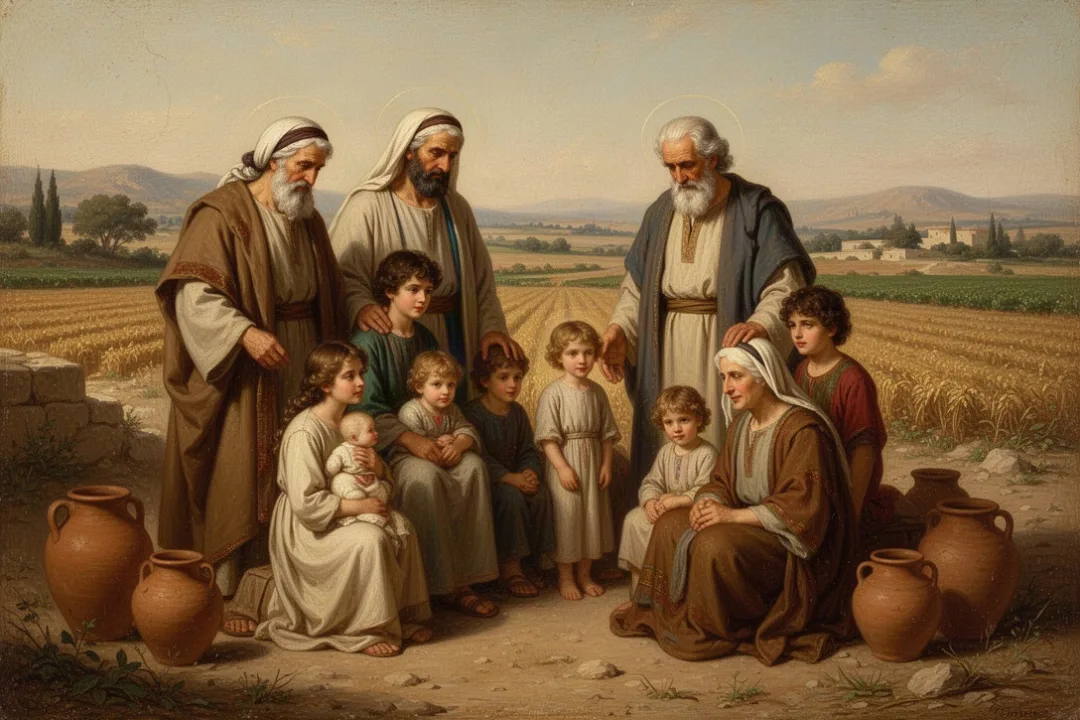
The genealogy follows the line of Seth, Adam and Eve’s son who was born after Abel’s death. It moves from Adam through Seth, Enosh, Kenan, Mahalalel, Jared, Enoch, Methuselah, Lamech, and finally Noah. The chapter does not list every person born into the family; instead, it traces the line that leads to Noah and the preservation of humanity through the flood.
For each major generation, the pattern is similar. The text identifies the father’s age when a particular son was born, gives the number of years he lived afterward, mentions other sons and daughters, and then records his total lifespan. The repeated ending is that the person died.
Adam lives 930 years and becomes the father of Seth.
Seth becomes the father of Enosh.
Enosh, Kenan, Mahalalel, and Jared continue the family line toward Noah.
Enoch is distinguished by his walk with God.
Methuselah is recorded as living 969 years, the longest lifespan mentioned in the Bible.
Lamech becomes the father of Noah and speaks about relief from the cursed ground.
Noah becomes the next major figure in the Genesis narrative.
The chapter’s structure makes the genealogy easy to follow, but its repetition is deliberate. “He lived,” “he fathered,” and “he died” create a steady rhythm. The pattern reflects God’s gift of life while also reminding the reader that the consequence of human sin is death.
Reading tip: Genesis 5 is not only a list of names and ages. Read the repeated death formula alongside the exceptional account of Enoch. The contrast is one of the chapter’s main messages.
Why Genesis 5 follows the line of Seth
Genesis 4 describes two significant family lines: Cain’s descendants and the line associated with Seth. Cain’s family contributes to the development of human society, including livestock keeping, music, and metalworking. Genesis 5, however, turns to a different line because it is tracing the descendants through whom the biblical story will continue to Noah.
Seth’s birth follows the loss of Abel and the separation caused by Cain’s murder of his brother. Genesis 4:25 presents Seth as another child given to Adam and Eve in place of Abel. The text then says that Seth had a son named Enosh, and Genesis 4:26 associates that generation with calling on the Lord.
Genesis 5 does not claim that every person outside Seth’s line was absent or unimportant. Genealogies in the Bible often select a line for a particular narrative purpose. Here, the line leads to Noah, whose family will be preserved during the judgment described in the chapters that follow.
The genealogy also reinforces the promise of continued human life. God had commanded humanity to be fruitful and multiply, and the names in Genesis 5 show that human generations continue despite exile from Eden, violence, and death. The line is wounded, but it has not disappeared.
How the repeated phrase “and he died” shapes the chapter
The most noticeable feature of Genesis 5 is the repeated record of death. The ages are unusually long by modern standards, but the chapter does not present long life as a solution to humanity’s condition. Even the longest-lived individuals eventually die.
This repetition connects Genesis 5 with God’s warning in Genesis 2:17 and the consequences described in Genesis 3. The chapter does not repeat those earlier events in detail, yet the genealogy shows their continuing effect. Adam was created for life with God, but the generations after him remain under the shadow of death.
The formula also challenges the idea that human achievement can overcome mortality. The people named in the chapter have children, build families, and live for many years, but none can escape the boundary marked by death. Their accomplishments and longevity are limited.
At the same time, the genealogy is not hopeless. The repeated endings are interrupted by Enoch’s unusual description. His experience does not erase the reality of death for everyone else, but it shows that fellowship with God remains possible in a world marked by sin and mortality.
Genesis 5 places long human lifespans beside an unchanging reminder: life is a gift, but death remains a serious consequence of human rebellion.
What makes Enoch different in Genesis 5
Enoch appears in the seventh generation from Adam in the line of Seth. His entry follows the standard pattern at first, but the description changes after his son Methuselah is born. Instead of ending with the expected statement that Enoch died, Genesis 5:22-24 says that he walked with God and that God took him.
“Walked with God” describes ongoing fellowship and faithfulness. It suggests a life oriented toward God rather than merely a private spiritual experience. The phrase is used again in relation to Noah in Genesis 6:9, creating a clear connection between Enoch and Noah.
The wording about God taking Enoch is brief and leaves some details unstated. The chapter does not describe a funeral, a physical process, or every circumstance surrounding his departure. Its emphasis is on the exceptional relationship: Enoch lived in communion with God, and his ending is presented differently from the deaths of the other patriarchs.
Later biblical passages interpret Enoch as an example of faith. Hebrews 11:5 refers to his being taken by God and connects his life with the idea of pleasing God. Jude 14-15 also refers to Enoch in a warning about divine judgment. These later references expand the picture, but Genesis 5 itself keeps the focus on his walk with God.
Enoch’s placement is also meaningful. He stands between Jared and Methuselah, interrupting the chapter’s repeated rhythm. His life shows that the genealogy is not simply counting years. It is drawing attention to the quality of a person’s relationship with God.
What Genesis 5 says about Methuselah’s age
Genesis 5:27 records Methuselah as living 969 years, the greatest age assigned to any person in the Bible. The chapter gives this figure as part of the genealogy’s pattern, not as a separate argument about human biology or a detailed explanation of how ancient time was measured.
The unusually long lifespans serve several literary purposes. They emphasize the distance between the earliest generations and later biblical history, show that the family line remains alive over many generations, and increase the force of the repeated statement that each person eventually dies.
Methuselah’s name is sometimes connected in popular discussions with predictions about the flood, but Genesis 5 itself does not explain the meaning of his name or state that his lifespan was intended as a coded prophecy. A careful reading should distinguish what the text explicitly says from later interpretations.
The genealogy does provide a timeline of relationships and stated ages. Readers may add those figures together for various chronological models, but the chapter’s central purpose is not to answer every question about ancient chronology. Its main focus is the family line from Adam to Noah and the contrast between mortality and faithful walking with God.
How Lamech describes Noah’s role
Lamech is the father of Noah, the final person named in the genealogy. When Noah is born, Lamech gives an explanation for the name and expresses hope that Noah will bring comfort or relief from the difficult work associated with the ground the Lord cursed in Genesis 3.
Lamech’s words connect Noah’s birth with the earlier story of Eden. Human beings were told to work the ground, but the ground would resist them because of sin. Farming would involve painful labor, sweat, and frustration. Lamech hopes that Noah will somehow bring relief from this burden.
The statement is important because it gives Noah a role before the flood story begins. He is not introduced as an accidental survivor or merely as the next name in a list. His birth carries an expectation of relief, although Genesis 5 does not spell out exactly how that hope will be fulfilled.
Later chapters show Noah preserving his family and the animals through the flood. After the flood, Noah becomes associated with the renewed cultivation of the ground, including planting a vineyard. These events provide partial connections to Lamech’s words, but the biblical narrative also shows that Noah does not remove sin from the human condition completely.
Lamech’s statement therefore works as both a promise of hope and a reminder of the world’s continuing brokenness. Noah’s arrival points forward, but it does not make the effects of the fall disappear overnight.
How Genesis 5 connects Genesis 4 and Genesis 6
Genesis 5 serves as a bridge between two major sections of Genesis. Chapter 4 focuses on Cain’s family and the spread of violence, while chapter 6 describes the corruption of humanity before the flood. Between them, Genesis 5 traces the Sethite line to Noah.
This arrangement lets the reader compare different developments in the early human story. Genesis 4 includes cultural progress alongside escalating violence. Genesis 5 includes family growth and extraordinary lifespans alongside repeated death and the example of Enoch’s fellowship with God.
The end of Genesis 5 prepares the reader for Genesis 6 by naming Noah’s sons: Shem, Ham, and Japheth. Their names become central to the flood narrative and to the later division of nations. The genealogy therefore ends at the point where the next generation of the story is ready to begin.
The final verses also create a sense of expectation. Noah is introduced as the father of three sons, but the crisis affecting the whole earth has not yet been described. The reader knows that the family line has reached Noah, yet does not know how he will respond to the conditions that Genesis 6 will reveal.
Common mistakes when interpreting Genesis 5
Genealogies can be easy to overlook, but they can also invite conclusions that go beyond the text. These common mistakes can make the chapter seem more confusing than it is.
Assuming every genealogy is complete: Biblical genealogies may select names for a theological or narrative purpose. Genesis 5 presents a continuous line in its stated sequence, but it does not necessarily claim to name every descendant of every person.
Treating the ages as the chapter’s only point: The numbers matter, but the repeated death formula, Enoch’s walk with God, and Noah’s introduction are equally important.
Reading “walked with God” as a vague compliment: The phrase identifies a distinctive pattern of faithful relationship with God and is later echoed in the description of Noah.
Confusing Seth’s line with a claim that no other people existed: The chapter follows the family line needed for the narrative. It is not a complete population record of the ancient world.
Making Methuselah’s age carry an unsupported prophecy: The text records his age but does not explain it as a hidden prediction. Interpretations should begin with what Genesis actually states.
Assuming Noah completely solves the problem of sin: Noah brings preservation and hope, but the later story shows that human sin continues after the flood.
Study principle: Keep the genealogy connected to its surrounding chapters. Genesis 5 explains where Noah comes from, why his birth carries hope, and how the story moves from Adam’s family to the flood.
Practical ways to study the names and ages
A simple chart can make Genesis 5 easier to read, especially because several names sound similar and the repeated wording can blur together. Write each major person in sequence and record the son named in the text, the age at that birth, and the total lifespan given.
Mark the line: Begin with Adam and follow the named descent through Seth to Noah.
Circle the interruptions: Note Enoch’s description and Lamech’s words about Noah.
Track the repeated ending: Observe which entries conclude with death and which one does not use that formula.
Compare nearby chapters: Read Genesis 4 before Genesis 5 and Genesis 6 afterward to see how the genealogy functions as a bridge.
Check later references: Read Hebrews 11:5 and Jude 14-15 for later biblical reflections on Enoch, while keeping those interpretations distinct from Genesis 5 itself.
It can also help to read the chapter aloud or in a modern translation for clarity, then compare the headings or notes in a study Bible. Translation differences may affect how the names and descriptions are presented, but the central sequence and themes remain recognizable.
When reflecting on the chapter, ask specific questions rather than treating the genealogy as background information. What does the repeated death formula communicate? Why is Enoch singled out? What hope does Lamech attach to Noah’s birth? How does the chapter prepare you for the flood?
What Genesis 5 teaches about life, death, and hope
Genesis 5 presents human life as both valuable and fragile. Each generation is capable of continuing the family line, yet each individual remains mortal. The chapter refuses to separate blessing from brokenness: people have children and live for many years, but death still marks the human story.
The account of Enoch shows that the chapter is not only about biological descent. Faithful relationship with God matters within the genealogy. Enoch’s life is remembered not simply for his age or descendants but for the way he walked with God.
Noah’s birth adds another dimension: hope can exist even when the consequences of sin remain visible. Lamech does not pretend that the ground is easy to work or that the curse has vanished. He looks for relief through the child who has been born.
The movement from Adam to Noah also shows continuity. God’s purposes do not end with human failure, Abel’s murder, Cain’s exile, or the spread of death. The genealogy records a preserved line through which the biblical story continues.
For Christian readers, Genesis 5 is often read as part of the larger biblical story of redemption. The chapter itself points to Noah, not to a final solution, but its themes of mortality, faithfulness, judgment, and hope continue throughout Scripture. Its quiet list of names is therefore a significant link between creation, the fall, the flood, and the promises that follow.
Questions Genesis 5 leaves for the next chapter
By the end of Genesis 5, several narrative questions are open. How severe has human corruption become? Why will judgment come upon the earth? What does it mean that Noah found favor with the Lord? How will Noah’s family be preserved?
Genesis 6 answers these questions by describing the condition of humanity, God’s grief over violence and wickedness, and Noah’s distinctive standing before God. The genealogy has prepared the reader to recognize Noah as the person through whom the story will move into its next crisis.
The chapter also leaves a lasting interpretive question: what should distinguish a person’s life in a world where everyone dies? Genesis 5 answers through its contrast. Long life is recorded, family lines continue, and names are remembered, but Enoch is singled out because he walked with God.
That emphasis gives the genealogy its lasting significance. It is a record of ancestry, but it is also a meditation on what remains meaningful amid mortality: God’s faithfulness, human responsibility, the continuation of hope, and a life lived in fellowship with God.
Frequently asked questions
Is Genesis 5 only a list of names?
No. The genealogy traces the line from Adam to Noah, but it also develops major themes: the continuation of humanity, the consequence of sin, the reality of death, Enoch’s fellowship with God, and hope connected with Noah’s birth. Its repeated structure helps readers notice both the ordinary pattern of mortality and the unusual accounts of Enoch and Lamech.
Did Enoch die according to Genesis 5?
Genesis 5 does not use the usual statement that Enoch died. Instead, it says that he walked with God and that God took him. The passage does not explain every detail of what happened, so readers should avoid adding specific circumstances that the text does not provide. Later biblical references connect Enoch’s experience with faith and pleasing God.
Why does Genesis 5 mention such long lifespans?
The chapter uses long lifespans as part of its genealogy and emphasizes that even these exceptionally long lives end in death. The figures also help mark the distance between Adam and Noah within the narrative. Genesis 5 does not present longevity as the main solution to humanity’s problem; its larger focus is the family line and the continuing effects of sin.
What does Noah’s name mean in Genesis 5?
Lamech connects Noah’s name with comfort or relief from the difficult work imposed by the cursed ground. His statement links Noah’s birth with the consequences of the fall in Genesis 3. It expresses hope, but the chapter does not say that Noah will remove every effect of sin. The later flood account shows both preservation through Noah and the continuing need for redemption.










Leave a Reply