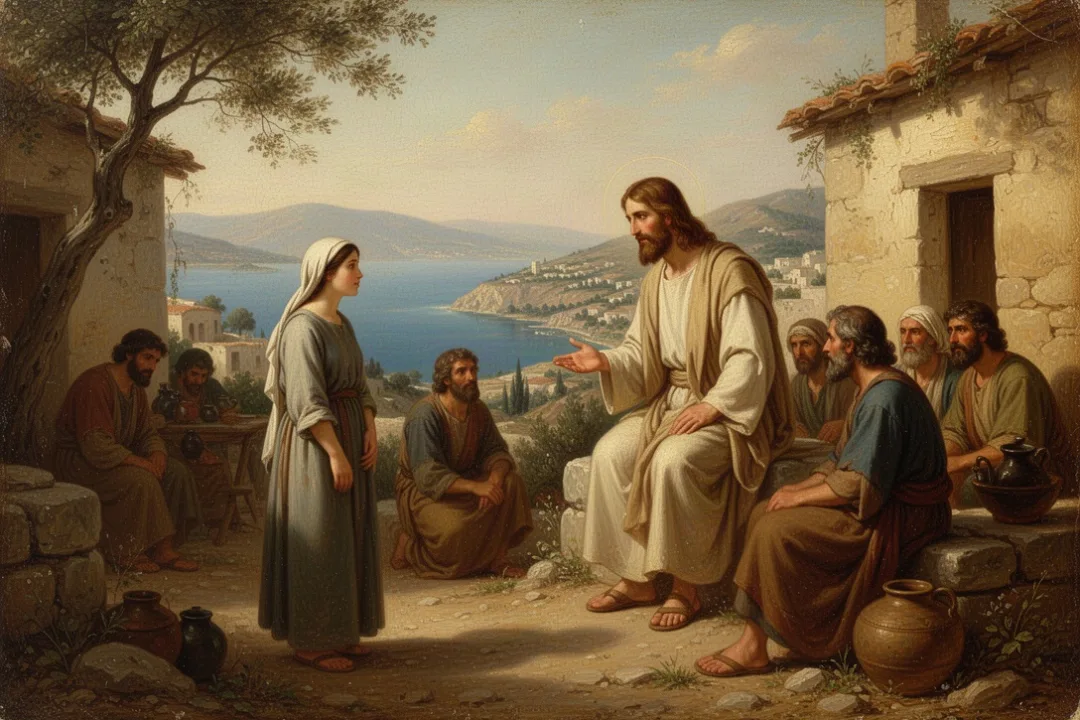
The Bible does not tell us exactly how Mary Magdalene first met Jesus.
What the Gospels do tell us is that Jesus healed Mary Magdalene, and she became one of his devoted followers. Luke introduces her among the women who traveled with Jesus and the Twelve, saying that seven demons had gone out of her (Luke 8:1–3). The passage gives the most reliable biblical clue about their relationship, but it does not describe the first conversation, the place where they met, or the circumstances that brought her to him.
That distinction matters because later Christian tradition has often supplied details that are not found in the New Testament. Mary Magdalene is sometimes identified with Mary of Bethany or with the unnamed woman who anointed Jesus, but the Gospels present these as different people. Keeping the biblical accounts separate makes it easier to answer the question honestly: we know why Mary followed Jesus, but not precisely how their first encounter happened.
What the Gospels say about Mary Magdalene’s connection with Jesus
Mary Magdalene first appears by name in Luke 8:1–3. Jesus is traveling through towns and villages, proclaiming the kingdom of God, and the Twelve are with him. Several women also accompany the group, including Mary called Magdalene, Joanna, Susanna, and others who support Jesus and his disciples from their own resources.
Luke describes Mary as a woman “from whom seven demons had gone out,” but the passage does not give a narrative of the exorcism. It does not say that Jesus met her in a particular town, that she approached him in a crowd, or that someone brought her to him. The wording assumes that her healing had already happened before Luke begins describing her role among Jesus’ followers.
The number seven communicates the seriousness or completeness of Mary’s suffering, although the text does not explain exactly what her condition involved. The phrase should not automatically be treated as a modern medical diagnosis. In the Gospel context, it indicates spiritual affliction from which Jesus delivered her, and that deliverance helps explain the depth of her commitment.
The clearest answer: Mary Magdalene met Jesus sometime before Luke 8:1–3, but Scripture does not preserve the details of that first meeting. It does preserve the result: healing, gratitude, discipleship, and faithful witness.
Mary’s name also provides a geographical clue. “Magdalene” most likely means she was associated with Magdala, a settlement on the western shore of the Sea of Galilee. The name distinguishes her from other women named Mary in the Gospel accounts. It does not tell us whether Jesus first met her in Magdala, however, because the text never identifies the location of her healing.
The Gospels therefore give us a sequence without every intermediate detail: Mary suffered under demonic oppression, Jesus freed her, and she then traveled with him and helped support his ministry. The first two events are connected by the text, but the setting and timing of their initial encounter remain unknown.
Why Mary Magdalene followed Jesus after her healing
Mary’s presence among Jesus’ traveling followers shows that her relationship with him was more than a brief healing appointment. She became part of a community of disciples who listened to his teaching, accompanied him on the road, and used their resources to support his work. Luke’s account places her alongside the Twelve rather than treating her as a distant admirer.
Her response reflects a common pattern in the Gospels: Jesus’ healing leads to discipleship. People who experience his mercy often become witnesses to what he has done. Mary’s contribution was practical as well as personal. Luke says that she and the other women provided for Jesus and the wider group from their means, suggesting initiative, generosity, and a continuing commitment.
The text does not say that Mary was married, wealthy, or socially powerful. Claims about her occupation or personal history should therefore be treated cautiously unless they come from a clearly identified later tradition. The biblical account gives enough to understand her importance without inventing a biography around her.
Mary’s discipleship also challenges assumptions about who could be a significant follower of Jesus. The Gospels name women as active participants in his ministry, even though the wider society of the time often limited women’s public roles. Mary was not simply present in the background; she was part of the group that traveled with Jesus and helped sustain it.
She had been released from severe spiritual suffering.
She joined Jesus’ traveling circle of disciples.
She helped provide material support for the ministry.
She remained near Jesus during his crucifixion and burial.
She became a primary witness to the empty tomb and resurrection message.
These details explain why Mary’s first meeting with Jesus mattered even though its setting is unknown. The encounter changed the direction of her life. Rather than recording only the moment of healing, the Gospels emphasize the long-term fruit of that healing: steadfast loyalty and public testimony.
What Mary Magdalene did during Jesus’ final days
Mary appears again in the Passion narratives, where her actions help confirm her place among Jesus’ closest followers. Matthew, Mark, and John identify her as present at the crucifixion, while Luke refers to the women who had followed Jesus from Galilee. The Gospel accounts differ in some details, but together they show that Mary did not abandon Jesus when his ministry ended in apparent defeat.
Mark 15:40–41 describes women watching the crucifixion and identifies Mary Magdalene among them. The passage also says that these women had followed Jesus and cared for his needs in Galilee. This connects her presence at the cross with her earlier discipleship. She was not a stranger who appeared only at the burial; she had been following him for some time.
Mary also witnessed where Jesus was laid. Matthew 27:61, Mark 15:47, and Luke 23:55 associate her with the women who observed the tomb and burial arrangements. This detail becomes crucial because the same witness who saw the burial could later report that the tomb was empty.
Her decision to remain near the cross is especially significant. Jesus’ public ministry had attracted crowds when he taught and healed, but the crucifixion was a dangerous and heartbreaking moment. Mary’s presence demonstrates courage under pressure and a loyalty that did not depend on visible success.
The Gospel writers do not tell us every conversation Mary had with Jesus after her healing. They do, however, show the practical shape of her discipleship:
She traveled with Jesus during his ministry in Galilee.
She supported the group’s needs with other women.
She witnessed his death from near the cross.
She observed his burial location.
She went to the tomb after the Sabbath.
This pattern also helps answer what kind of meeting Mary may have had with Jesus. Although Scripture does not describe the first encounter, the later scenes show a relationship marked by trust and personal loyalty. Whatever happened when Jesus first delivered her, Mary understood that she had received mercy from him and remained faithful when following him became costly.
How Mary Magdalene became a witness to the resurrection
Mary Magdalene holds a central place in the resurrection accounts. In the Synoptic Gospels, she is among the women who go to Jesus’ tomb and discover that the stone has been moved and the body is absent. They receive a message that Jesus has been raised and are instructed to tell the disciples (Matthew 28:1–10; Mark 16:1–8; Luke 24:1–12).
John’s Gospel gives Mary an especially personal role. John 20:1–18 describes her arriving at the tomb, reporting the missing body to Peter and another disciple, and then encountering the risen Jesus. The passage presents a moment of recognition when Jesus addresses her, after which he sends her to announce the news to the disciples.
Because of this scene, Mary is often called the first witness to the resurrection in Christian tradition. The phrase reflects the Gospel accounts that place her among the first people to encounter the empty tomb and, in John, the first person to meet the risen Jesus. The Gospels do not use every later title in exactly the same way, but they clearly give Mary a foundational role.
Her resurrection witness deepens the meaning of her earlier healing. Mary did not merely receive help and disappear from the story. She became someone entrusted with news that the disciples themselves needed to hear. Her story moves from being healed by Jesus to following him, standing near his death, and proclaiming that he was alive.
The sequence can be stated simply:
Jesus delivered Mary from severe spiritual oppression.
Mary joined his group of traveling followers.
She supported the ministry and stayed near him at the cross.
She saw where he was buried.
She encountered the empty tomb and announced the resurrection.
This is why the unknown details of their first meeting do not weaken Mary’s story. The biblical writers focus less on the setting of the initial encounter than on its lasting consequences. Jesus’ compassion restored Mary, and Mary’s response was sustained faithfulness.
Why Mary Magdalene is sometimes confused with other women
One reason people expect a more detailed answer about Mary’s first meeting with Jesus is that several Gospel stories involving women have been blended together in popular retellings. The New Testament names multiple women called Mary, and later interpretation sometimes treated separate characters as one person. The result is a portrait of Mary Magdalene that includes details the biblical texts do not assign to her.
Mary Magdalene and Mary of Bethany
Mary of Bethany is the sister of Martha and Lazarus. John 11 identifies her through this family relationship, and John 12 describes her anointing Jesus’ feet with costly perfume. Luke 10:38–42 also tells of a Mary who sits at Jesus’ feet and listens to his teaching in Bethany, although the passage does not describe the anointing.
Mary Magdalene, by contrast, is identified by her connection with Magdala and by her healing from seven demons. The Gospels never say that she was Lazarus’s sister, lived in Bethany, or anointed Jesus with perfume. These women may both have been devoted followers, but the texts present them as distinct.
Mary Magdalene and the unnamed sinful woman
Luke 7:36–50 tells of an unnamed woman described as sinful who enters a Pharisee’s house, weeps at Jesus’ feet, and shows him great honor. Jesus responds by defending her and declaring that her sins have been forgiven. Luke does not call this woman Mary Magdalene, and he does not connect her with the woman introduced immediately afterward in Luke 8.
The placement of the stories may have encouraged some readers to link the two women, but proximity is not identification. Luke 8:1–3 begins a new account and names Mary Magdalene separately. The Gospel’s structure supports treating the unnamed woman and Mary as different people.
What later tradition added
Some later Christian traditions combined Mary Magdalene, Mary of Bethany, and the unnamed woman from Luke 7. That combined portrait often presents Mary Magdalene as a repentant prostitute who washed Jesus’ feet. While the image is familiar, the canonical Gospels do not make those identifications.
Responsible reading separates three levels of information:
Explicit biblical claims: Mary Magdalene was healed of seven demons, followed Jesus, supported his ministry, witnessed his death and burial, and encountered the risen Christ.
Reasonable but unconfirmed possibilities: Jesus may have met her in or near Magdala, or during his ministry in Galilee.
Later traditions: identifications with Mary of Bethany or the unnamed sinful woman.
This distinction does not make Mary’s story less meaningful. It protects the details the Gospels actually emphasize. Mary Magdalene was not important because later readers made her fit another story; she was important because the Gospel writers remembered her as a healed disciple, a faithful witness, and a messenger of the resurrection.
What can responsibly be said about their first meeting
The most accurate answer combines certainty with restraint. Jesus and Mary Magdalene met before Luke 8:1–3, when Luke lists her among the women traveling with him. Jesus healed her from seven demons, and that experience led her to become a committed supporter and disciple. Beyond those facts, the New Testament does not provide a narrative of the encounter.
It is possible that the meeting took place during Jesus’ ministry in Galilee, since Mary was associated with Magdala and the women are described as having followed Jesus from Galilee. It is also possible that she encountered him in another setting during his travels. The text does not identify the town, the witnesses, the date, or the words spoken.
Readers should also avoid assuming that “seven demons” explains every aspect of Mary’s past. Scripture does not say that she was a prostitute, that she had a particular illness, or that she had committed a specific kind of sin. The only safe conclusion is that she experienced serious spiritual bondage and that Jesus brought her freedom.
Read the silence carefully: not knowing the location or dialogue of Mary’s first meeting does not mean the event was unimportant. The Gospel writers show its significance through the life of discipleship and witness that followed.
Mary’s story is therefore best understood through its full biblical arc. The first meeting is hidden from view, but its effects are not. She moved from affliction to freedom, from freedom to service, and from service to courageous witness at the cross and the empty tomb.
When asked how Mary Magdalene met Jesus, the answer should not be filled with details borrowed from other women. The Gospels give a more precise and compelling account: Jesus encountered Mary in her suffering, healed her, and she responded by following him faithfully. The setting of that first meeting remains unknown, while the transformation it produced stands clearly in the text.
Frequently asked questions
Did Mary Magdalene meet Jesus in Magdala?
The Bible does not say where their first meeting occurred. Her name connects her with Magdala, a town in Galilee, but that does not prove Jesus met her there. The Gospels only establish that Jesus had healed her before she began traveling with him and the Twelve.
Was Mary Magdalene the woman who washed Jesus’ feet?
The New Testament does not identify Mary Magdalene as the unnamed sinful woman in Luke 7 who honors Jesus at a Pharisee’s house. Nor does it identify her with Mary of Bethany, who anoints Jesus in John 12. These figures were combined in some later traditions but are distinct in the Gospel accounts.
What does “seven demons” mean in Mary Magdalene’s story?
The phrase indicates severe spiritual oppression from which Jesus delivered Mary. The Gospels do not provide a modern medical diagnosis or explain each demon individually. They also do not say that her condition resulted from prostitution or a particular sin. Those details belong to later assumptions rather than the biblical text.
Why is Mary Magdalene important in Christianity?
Mary is important because she became a committed disciple after Jesus healed her, supported his ministry, remained present at his crucifixion and burial, and witnessed the resurrection. In John’s Gospel, the risen Jesus appears to her and sends her to tell the disciples, giving her a prominent role as a resurrection messenger.









Leave a Reply