Ickabod, usually spelled Ichabod in English Bibles, is the name given to a child after Israel’s ark was captured and his family suffered devastating loss.
The name appears in 1 Samuel 4, where it becomes a solemn declaration that “the glory” has departed from Israel. Its meaning is connected with the loss of God’s honor and blessing, but the passage is not teaching that God can be controlled by a religious object or permanently driven away by human failure.
Ichabod is the common English spelling, while Ickabod is a less common spelling variant. The name is associated with the Hebrew expression often understood as meaning “the glory has departed” or “where is the glory?” English translations differ slightly in how they explain the name because the underlying Hebrew wording can be read in more than one way.
In the story, the name points to a national and family catastrophe. Israel has lost a battle, the sons of the priest Eli have died, and the ark of the covenant has been taken by the Philistines. When Eli’s daughter-in-law hears the news, she gives birth and names the child Ichabod before she dies.
The name therefore does not describe the child’s character. It records the circumstances surrounding his birth. He is born into grief, but the text uses his name primarily as a theological statement about what Israel believes has happened.
Plain meaning: Ichabod is a memorial name associated with the departure of glory from Israel after the ark was captured. It describes a crisis, not a permanent verdict over every person or community that experiences hardship.
Where Ichabod appears in 1 Samuel 4
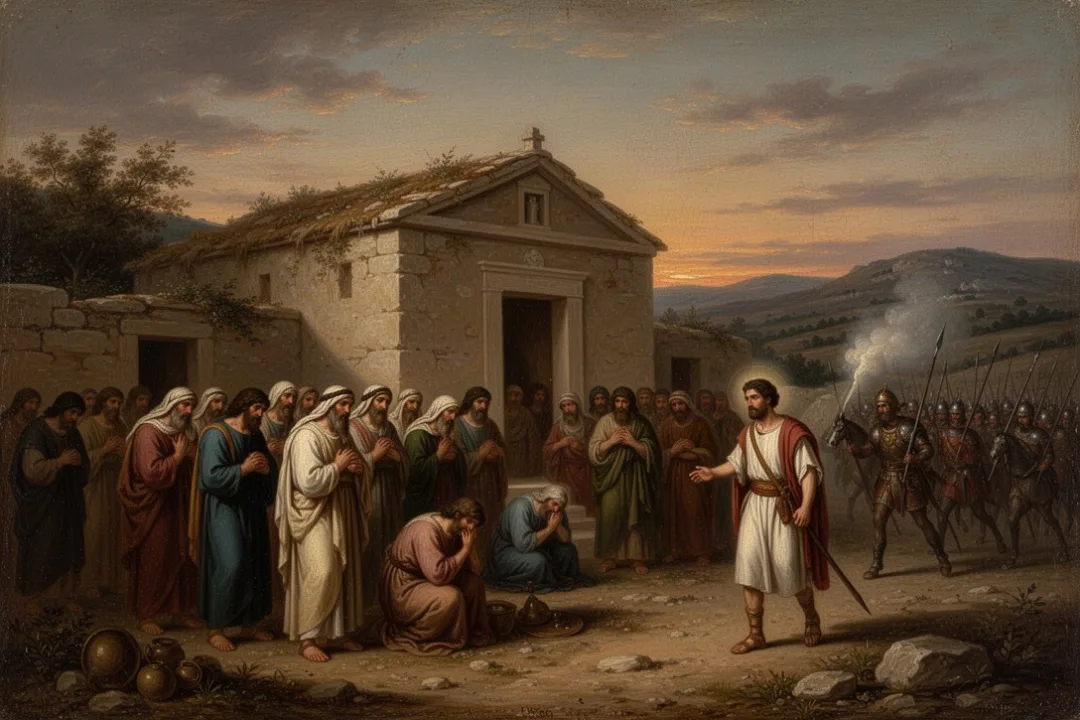
The story begins with conflict between Israel and the Philistines. Israel is defeated in battle, and the elders decide to bring the ark of the covenant from Shiloh into the Israelite camp. They hope its presence will secure victory, but the narrative presents this decision as a serious misunderstanding of the ark’s meaning.
The ark represented God’s covenant presence among Israel. It was not a magical object that people could carry into battle and use to force a desired result. Israel’s leaders treat it as though its physical arrival will guarantee success, while the story exposes the spiritual disorder beneath that confidence.
The ark arrives with Hophni and Phinehas, the sons of Eli, who serve as priests. The Israelite army celebrates loudly, and the Philistines become afraid. Yet the Philistines fight, Israel is defeated, the ark is captured, and the two priests die.
A messenger then travels from the battlefield to Shiloh. He reports the military defeat and the loss of the ark. Eli, who is ninety-eight years old and unable to see, is sitting by the road waiting anxiously for news. The report about the army causes concern, but the news about the ark produces the decisive reaction.
When Eli hears that the ark has been taken, he falls backward from his chair, breaks his neck, and dies. The text connects his death with his age and physical frailty, but it also emphasizes his grief over the ark. He has judged Israel for many years, and he knows the loss carries profound religious significance.
Why Phinehas’s wife names her son Ichabod
Phinehas’s wife goes into labor when she hears that her father-in-law has died and that her husband and brother-in-law are dead. Her labor is difficult, and those around her try to reassure her that she has given birth to a son. She does not respond with ordinary joy.
Instead, she names the child Ichabod. The explanation attached to the name focuses first on the ark’s capture and then on the deaths of Eli and her husband. For her, the ark’s loss is the central tragedy because it signals humiliation before Israel’s enemies and a crisis in the nation’s relationship with God.
Her response is striking because the birth of a son would normally be welcomed as good news, especially in a family connected with Israel’s priesthood. The story shows that personal joy has been overwhelmed by national disaster. The child’s name becomes a permanent reminder of the day Israel suffered defeat and the sanctuary’s sacred object was taken.
The text does not portray her as foolish for grieving. Her sorrow is intense but understandable. She recognizes that the capture of the ark is not merely the loss of valuable property. It reveals that Israel’s religious confidence has collapsed, and that the nation cannot treat God’s covenant presence as a guarantee of victory while ignoring covenant faithfulness.
What “the glory has departed” means
In this passage, glory refers to honor, splendor, and the weighty presence associated with God’s relationship with Israel. The phrase expresses the sense that Israel has been stripped of its dignity and protection. The nation has been defeated, its priests have died, and the ark has been removed from its sanctuary.
That meaning should be held together with an important distinction: the story does not say that God has ceased to exist, lost control, or been defeated by the Philistines. In fact, the chapters that follow show that the captured ark brings trouble to the Philistine cities. The ark’s removal from Israel does not give Israel’s enemies lasting power over Israel’s God.
Ichabod is therefore about Israel’s experience of judgment and loss, not about God’s actual weakness. Israel’s leaders had assumed that the ark would protect them automatically. The narrative rejects that assumption while affirming that God remains sovereign even when his people experience humiliating defeat.
The phrase can also be understood as a warning against confusing religious symbols with genuine faithfulness. A sacred object, public worship, inherited position, or respected title cannot substitute for obedience. The priests connected with the ark have acted corruptly, and Israel’s leaders have sought victory without addressing the deeper condition of the nation.
How Eli’s family contributes to the crisis
The background to Ichabod appears earlier in 1 Samuel 2. Hophni and Phinehas abuse their priestly authority and treat the offerings brought by worshipers with contempt. They also behave immorally at the entrance to the tent of meeting. Their conduct is not presented as a private flaw; it damages the worshiping community and dishonors the office they hold.
Eli knows about their wrongdoing. Although he rebukes them, he fails to restrain them effectively. A prophetic message announces judgment on Eli’s household because the family has placed its own interests above reverence for God. The events of chapter 4 fulfill that warning in a painful way.
This context matters because the battle loss is not an isolated military accident in the biblical narrative. The capture of the ark occurs after a long period of priestly corruption. The name Ichabod reflects the visible consequences of that corruption, particularly the collapse of a leadership family that should have represented holiness and service.
Still, the account does not encourage readers to take pleasure in the family’s suffering. The deaths are tragic, and Phinehas’s wife is left to grieve while caring for a newborn. The story combines moral seriousness with compassion for people caught in the consequences of a wider failure.
Why the ark was not a magic guarantee
The Israelites’ mistake was not honoring the ark. The ark was genuinely important within the covenant system. Their mistake was attempting to use it as a tool for controlling the outcome of war. They wanted the benefits associated with God’s presence without the humility and obedience that the covenant required.
The scene offers a useful distinction between trusting God and trying to manipulate God. Trust submits to God’s character and accepts that worship is not a transaction. Manipulation treats a sacred practice, object, or phrase as a mechanism for obtaining a preferred result.
That distinction is still relevant when people assume that a particular ritual, possession, prayer formula, building, or religious identity guarantees success. Biblical faith does not turn holy things into protective charms. The ark was a sign of the covenant, not a weapon that Israel could deploy at will.
The narrative also guards against the opposite mistake. Since the ark was captured, some readers might conclude that God’s presence was defeated or abandoned Israel forever. The later account corrects that conclusion by showing God’s power among the Philistines and by eventually returning the ark to Israel.
How the story of Ichabod continues in 1 Samuel
After the Philistines capture the ark, they carry it to Ashdod and place it beside their god Dagon. The following episodes describe the humiliation of Dagon and the distress that comes upon the Philistine cities associated with the ark. These events show that the ark does not become a trophy proving the superiority of the Philistine deity.
The Philistines eventually move the ark from one city to another because its presence brings calamity. Their leaders recognize that they cannot treat it casually. After a period of uncertainty, they arrange for its return to Israel with offerings intended to acknowledge the seriousness of what has happened.
This development adds balance to the meaning of Ichabod. Israel experiences a real loss, and the loss exposes its sin, but God is not absent in the sense of being powerless. The ark’s capture becomes part of a larger revelation of divine authority. Israel’s glory has appeared to depart, yet God’s sovereignty has not departed.
The return of the ark does not erase the deaths or remove the need for repentance. It does show that the crisis is not the final word. The name Ichabod preserves the memory of disaster, while the continuing story demonstrates that judgment and restoration can both belong to the same biblical account.
What Ichabod teaches about religious leadership
The account gives particular attention to leaders who hold sacred responsibilities. Hophni and Phinehas have access to worship and authority, but their position does not protect them from accountability. Their role makes their misconduct more serious because they influence how the community understands God.
Eli’s failure is different but related. He recognizes wrongdoing yet does not act with sufficient firmness. The narrative suggests that leaders are responsible not only for their own conduct but also for how they respond when people under their care abuse power.
Several leadership principles emerge from the passage:
Position is not the same as character. A title or inherited office cannot replace integrity.
Religious symbols require reverence, not manipulation. Sacred objects and practices should direct people toward God rather than serve personal ambition.
Ignored wrongdoing grows more destructive. Delayed action can allow private misconduct to become a public crisis.
Consequences affect more than the person who caused the harm. Families, communities, and vulnerable people may suffer because of a leader’s decisions.
Accountability and compassion belong together. Naming wrongdoing does not require treating grieving people without mercy.
Common mistakes when explaining Ickabod
Because the name is familiar in sermons, literature, and popular speech, it is often given meanings that go beyond the biblical account. A careful explanation keeps the original context in view instead of using Ichabod as a general label for every disappointment.
Spelling it only as “Ickabod.” “Ichabod” is the standard English biblical spelling, while “Ickabod” is a variant often used in searches or informal writing.
Calling it the name of a prophet. Ichabod is the newborn son of Phinehas’s wife, not a prophet or major teacher in the biblical narrative.
Saying the name means God is permanently absent. The passage describes a moment of judgment and humiliation, while later chapters show God’s continuing power.
Treating the ark as a magic object. The Israelites’ misuse of the ark is part of the problem the story exposes.
Ignoring the earlier corruption. The battle loss follows serious abuse by Eli’s sons and Eli’s inadequate response.
Using Ichabod to condemn every difficult season. Hardship does not automatically prove that God’s glory has departed from a person or church.
Separating the name from the surrounding grief. The name is spoken during childbirth, bereavement, national defeat, and the death of a priestly household.
How to apply the warning without misusing it
For modern readers, Ichabod can prompt honest questions about the difference between outward religious activity and faithful character. A congregation may have impressive buildings, respected leaders, familiar traditions, or large public influence while still needing to examine how it treats people and how seriously it takes integrity.
The story also warns against using spiritual language to hide failure. Saying that a group has God’s presence does not excuse exploitation, dishonesty, abuse, or refusal to accept correction. The conduct of leaders matters, and religious confidence should be tested by faithfulness rather than by spectacle.
At the same time, the name should not become a weapon for declaring that God has abandoned people whenever a church declines, a leader falls, or a community faces loss. The biblical passage is unusually specific: it connects the name with the ark’s capture and the deaths surrounding that event. Applying it responsibly means respecting that context.
Practical question: Instead of asking whether a difficult season proves that God has left, ask what the situation reveals about character, accountability, misplaced trust, and the need for faithful action.
A careful response to a crisis can include several steps:
Name the loss accurately. Do not minimize harm, grief, corruption, or public failure.
Examine the causes. Consider whether pride, neglect, abuse of authority, or false confidence contributed to the situation.
Separate symbols from substance. Ask whether religious language and practices are producing humility and justice.
Protect vulnerable people. Spiritual reflection should never replace practical safety, reporting, or appropriate accountability.
Leave room for repentance and restoration. Judgment in Scripture is serious, but a crisis is not necessarily the end of God’s work.
How to pronounce and spell Ichabod
The standard English form is Ichabod, often pronounced roughly ICK-uh-bod. The spelling begins with “Ich,” although the initial sound is commonly pronounced like the “ick” in “icky.” The less common form Ickabod reflects the way many English speakers expect the name to sound.
When writing for a general audience, use “Ichabod” when referring to the biblical name and mention “Ickabod” if you are addressing the search spelling or a variant. Some Bible translations and reference works may explain the name differently because the Hebrew expression behind it allows more than one English rendering.
The name is sometimes used in fiction or everyday speech to suggest a person, place, or institution associated with decline. That figurative use comes from the biblical image of departed glory, but it should not be confused with the full story in 1 Samuel. In Scripture, Ichabod is a child’s memorial name within a precise historical and theological crisis.
What Ichabod reveals about loss and hope
Ichabod is one of the Bible’s most mournful names because it gathers several losses into a single word. A nation has been defeated, a sacred object has been captured, a priestly family has collapsed, and a woman dies after giving birth. The child enters the world carrying a name formed by grief.
Yet the narrative does not end with the name. The ark’s later history shows that God’s authority cannot be reduced to Israel’s military success or to the location of a sacred object. The apparent departure of glory becomes an occasion for exposing false confidence and displaying divine sovereignty.
That tension gives the name its lasting force. Ichabod remembers that faith communities can suffer real consequences when leaders are corrupt and worship becomes presumptuous. It also prevents readers from equating visible defeat with the final disappearance of God’s presence.
The most faithful use of the name holds both truths together: sin and negligence can bring devastating loss, and God’s purposes are not defeated by human failure. Ichabod is a warning against empty religious confidence, a record of grief, and a reminder to seek integrity rather than rely on sacred symbols alone.
Frequently asked questions
Is Ickabod the same name as Ichabod?
Yes. “Ickabod” is a spelling variant, while “Ichabod” is the standard form commonly found in English Bibles. Both refer to the child named in 1 Samuel 4. If you are writing about the biblical account, “Ichabod” is generally the clearest spelling, but “Ickabod” may appear in searches, older usage, or creative works.
Does Ichabod mean that God had completely left Israel?
No. The name expresses Israel’s experience of humiliation and loss after the ark was captured. It does not mean that God was powerless, permanently absent, or defeated. The chapters that follow show that the ark’s presence causes trouble among the Philistines and that God remains sovereign beyond Israel’s immediate crisis.
Who was Ichabod’s mother?
The biblical account identifies her as Phinehas’s wife but does not give her personal name. She was the daughter-in-law of Eli and the mother of Ichabod. She died after hearing that her husband, his brother Hophni, and Eli had died and that the ark had been captured.
Why is Ichabod sometimes used as a symbol of decline?
The name is associated with the statement that glory has departed from Israel. As a result, writers and speakers sometimes use it figuratively for a person, institution, or community experiencing a serious loss of honor or influence. That figurative use should not erase the biblical context of priestly corruption, national defeat, grief, and God’s continuing sovereignty.









Leave a Reply