J.N.D. Kelly’s Early Christian Doctrines explained
J.N.D. Kelly’s Early Christian Doctrines explained
The central fact about J.N.D. Kelly’s Early Christian Doctrines is that it traces how Christian beliefs developed through the first several centuries rather than treating later creeds as fully formed from the beginning.
First published in the mid-twentieth century, Kelly’s work became a standard reference for the study of patristic theology, the branch of Christian thought associated with the early church fathers. It examines how Christians argued about Scripture, tradition, God, Christ, the Holy Spirit, creation, human salvation, baptism, the Eucharist, and the church.
The book is especially useful because it brings together material that is often scattered across Greek and Latin writers, creeds, baptismal formulas, liturgical practices, and controversies. Kelly does not present early Christianity as a single, perfectly uniform system. Instead, he shows how Christian doctrine emerged through debate, clarification, worship, and response to competing interpretations.
John Norman Davidson Kelly was an Anglican priest and scholar of early Christianity. He served as principal of St. Edmund Hall, Oxford, and became widely respected for his work on the church fathers, early creeds, and the development of Christian doctrine.
Kelly wrote for readers who needed more than a simple chronology of councils. His concern was to explain the ideas behind doctrinal formulas: what a word meant in its historical setting, what problem a theologian was addressing, and why a particular formulation gained authority.
That approach distinguishes Early Christian Doctrines from a modern systematic theology textbook. A systematic theologian may arrange teachings according to a logical structure and ask what a church should believe today. Kelly’s primary question is historical: How did early Christians understand and express their faith?
His work also belongs to a period when patristic scholarship was becoming more attentive to the variety within early Christianity. The early centuries included bishops, theologians, monks, biblical interpreters, liturgical communities, and rival groups with sharply different views. Kelly’s account gives space to this variety while also explaining the processes that produced recognized orthodoxy.
Keep the book’s purpose in view: Kelly is mainly describing the historical formation of Christian doctrine, not asking you to accept every early formulation or offering a complete guide to contemporary denominational belief.
How Kelly explains the development of early Christian doctrine
Kelly’s method begins with the conviction that doctrine developed from the church’s whole life. Scripture was central, but Scripture was read within worship, baptismal confession, preaching, pastoral instruction, and inherited patterns of interpretation.
This means that doctrine did not emerge only when theologians wrote formal treatises. A community could already confess that Jesus was Lord, baptize in the triune name, celebrate the Eucharist, and pray to God as Father before it possessed precise technical language for explaining those practices.
Kelly therefore pays attention to several kinds of evidence:
New Testament writings and the ways early Christians interpreted them.
Baptismal creeds, confessions, and rules of faith used to teach converts.
Worship and liturgy, which reveal how Christians addressed God and understood Christ’s saving work.
Works of church fathers, including homilies, letters, commentaries, apologies, and theological treatises.
Church councils and controversies, where disputed ideas were defined or rejected.
Terminology, especially Greek and Latin words whose meanings changed or became more precise over time.
One of Kelly’s recurring insights is that the history of doctrine cannot be reduced to a straight line from biblical statement to final creed. Early writers used the same biblical texts in different ways. Some emphasized Christ’s humanity, others his divine status, and still others the unity of God. The eventual language of orthodoxy was shaped by the need to hold several convictions together without destroying any of them.
For that reason, the book often distinguishes between what Christians believed and how they explained what they believed. A community might worship Christ in a way that strongly implies his divine status before it can explain the relationship between the Son and the Father using later theological vocabulary.
The main doctrinal subjects covered in the book
The book’s organization follows the major areas in which early Christian teaching was expressed and contested. The exact arrangement differs by edition and reading plan, but the central subjects remain recognizable.
Revelation, Scripture, and the rule of faith
Early Christians did not read the Bible in isolation from the church’s inherited teaching. Kelly examines the rule of faith, a compact summary of Christian belief used in instruction and defense. It commonly included belief in one God, the creator; Jesus Christ, God’s Son and Lord; his birth, suffering, death, resurrection, and return; and the Holy Spirit.
The rule of faith was not always a single fixed document. Its wording varied among regions and authors. Yet it provided a recognizable framework for interpreting Scripture and distinguishing Christian teaching from rival readings.
Kelly also discusses the gradual recognition of the Christian canon. The early church inherited Israel’s Scriptures and gradually treated apostolic writings as authoritative. This process was not simply a single official decision made everywhere at once. Different churches recognized books with considerable agreement, while some questions took time to settle.
The doctrine of God and the Trinity
Early Christian theology had to hold together two convictions: there is one God, and the Father, Son, and Holy Spirit are all involved in the divine life and the work of salvation. Kelly follows the attempts to express this belief without falling into either tritheism or a denial of meaningful distinctions among Father, Son, and Spirit.
The doctrine of the Trinity did not appear as a fully polished formula in the earliest Christian sources. The language developed gradually as theologians responded to questions about God’s unity, Christ’s identity, and the Spirit’s status. Terms such as ousia and hypostasis acquired technical importance, although their usage was not always uniform.
Kelly’s treatment helps explain why Trinitarian doctrine cannot be understood merely by memorizing the word “Trinity.” The historical question is how Christians came to speak of one divine reality and three distinct persons or subsistences while preserving monotheism.
The person and work of Jesus Christ
Christology, the study of Christ, occupies a major place in early Christian doctrine. Kelly examines how Christians interpreted Jesus as the promised Messiah, Lord, Son of God, Word, and Savior. He traces the movement from early confessional language to increasingly precise accounts of Christ’s divinity and humanity.
Several disputes shaped this development. Some approaches appeared to protect Christ’s divinity by weakening or minimizing his human experience. Others emphasized his humanity in ways that seemed to separate him too sharply from the divine Son. The church’s later formulations aimed to affirm both full divinity and full humanity without treating Christ as two unrelated subjects.
Kelly also explains why the interpretation of Christ’s death and resurrection mattered doctrinally. The cross was understood through several overlapping images and concepts, including sacrifice, victory over hostile powers, reconciliation, healing, liberation, and the restoration of human nature. Early Christian writers did not always arrange these ideas into one universally accepted theory of atonement.
The Holy Spirit and Christian spiritual life
Early Christian writers spoke of the Holy Spirit as the giver of prophecy, holiness, wisdom, and new life. Kelly follows the gradual clarification of the Spirit’s relationship to the Father and the Son, as well as the Spirit’s place within baptism and the worship of the church.
This subject shows that doctrinal development was not merely abstract. Christians connected the Spirit’s identity with practical questions: Who makes people holy? How does God act within the church? What does baptism accomplish? How should spiritual gifts and prophetic claims be evaluated?
Creation, humanity, sin, and grace
Kelly gives attention to early Christian teaching about the world as God’s creation and about humanity’s condition after sin. These discussions were often shaped by disagreements with views that considered matter evil or treated salvation as escape from the created order.
Many early writers defended the goodness of creation, the reality of the body, and the importance of Christ’s genuine incarnation. Later debates examined the inheritance of Adam’s sin, the role of human freedom, the necessity of divine grace, and the relationship between moral effort and salvation.
The language used in these debates varied greatly. Western writers and Greek-speaking writers did not always frame sin and grace in the same way. Kelly’s historical method helps prevent readers from assuming that later categories map perfectly onto every early author.
The church, baptism, Eucharist, and Christian worship
For early Christians, doctrine was expressed through visible practices. Baptism marked entry into the Christian community and was associated with forgiveness, new birth, union with Christ, and the gift of the Spirit. The Eucharist was understood as a central act of thanksgiving and communion, though explanations of Christ’s presence and sacrifice developed in different directions.
Kelly also discusses the church as a community with teaching authority, ordained ministry, apostolic continuity, discipline, and sacramental practice. The early church was not imagined simply as an association of people who privately agreed on ideas. It was a worshiping body with public leadership and a shared pattern of life.
These sections are valuable for readers studying the origins of sacramental and ecclesial traditions. They also show why arguments about doctrine often involved questions of who had the authority to teach and how a local church remained connected to the wider Christian community.
Why the early church faced so many doctrinal controversies
Doctrinal controversies arose because Christianity spread across different languages, cultures, cities, and intellectual environments. A term that seemed clear in one setting could sound misleading in another. Christian teachers also inherited philosophical vocabulary that carried meanings not originally intended by biblical authors.
Controversy was intensified by the fact that early Christians shared many texts but interpreted them differently. Rival teachers could appeal to the same Gospel or apostolic letter while emphasizing different passages and assumptions.
Kelly’s account generally presents controversy as a process in which several pressures interacted:
Worship: the church had to explain practices such as praying through Christ and baptizing in the triune name.
Pastoral concerns: teachings affected how Christians understood salvation, holiness, suffering, and hope.
Intellectual vocabulary: Greek philosophical terms were adapted, rejected, or given new meanings.
Church authority: bishops and councils sought to preserve a common confession across regions.
Competing movements: alternative interpretations forced mainstream teachers to define their position more carefully.
This does not mean every controversy was a purely intellectual exercise. The arguments could involve church politics, personal rivalries, regional tensions, and imperial pressure. A historically responsible reading holds these elements together without reducing theology to politics alone.
What readers should understand about orthodoxy and heresy
One of Kelly’s most useful contributions is his careful treatment of the relationship between orthodoxy and heresy. Modern readers sometimes imagine that one side possessed a complete doctrine from the beginning while the other side simply rejected it. The historical record is usually more complicated.
Some ideas later labeled heretical developed from genuine attempts to protect an important Christian conviction. A teacher might stress God’s unity because of concern about polytheism, or emphasize Christ’s divinity because of concern that salvation would otherwise be ineffective. The problem, from the perspective of later orthodoxy, was that one truth was protected by damaging another.
Kelly does not treat all positions as equally valid. He explains why church leaders judged some interpretations incompatible with the rule of faith. At the same time, he shows that official definitions often came after long periods of uncertainty and that terms could be used differently before a council established a preferred meaning.
This makes the book particularly helpful for readers who want to avoid two opposite mistakes:
Assuming that all early Christian groups believed exactly the same thing.
Assuming that the existence of disagreement means no meaningful Christian orthodoxy existed.
How to read Early Christian Doctrines effectively
The book is dense, and many chapters refer to authors, controversies, and technical terms that may be unfamiliar. A deliberate reading strategy makes the material easier to follow.
Start with the chapter headings and index. Identify the doctrine you want to study before reading every page in order.
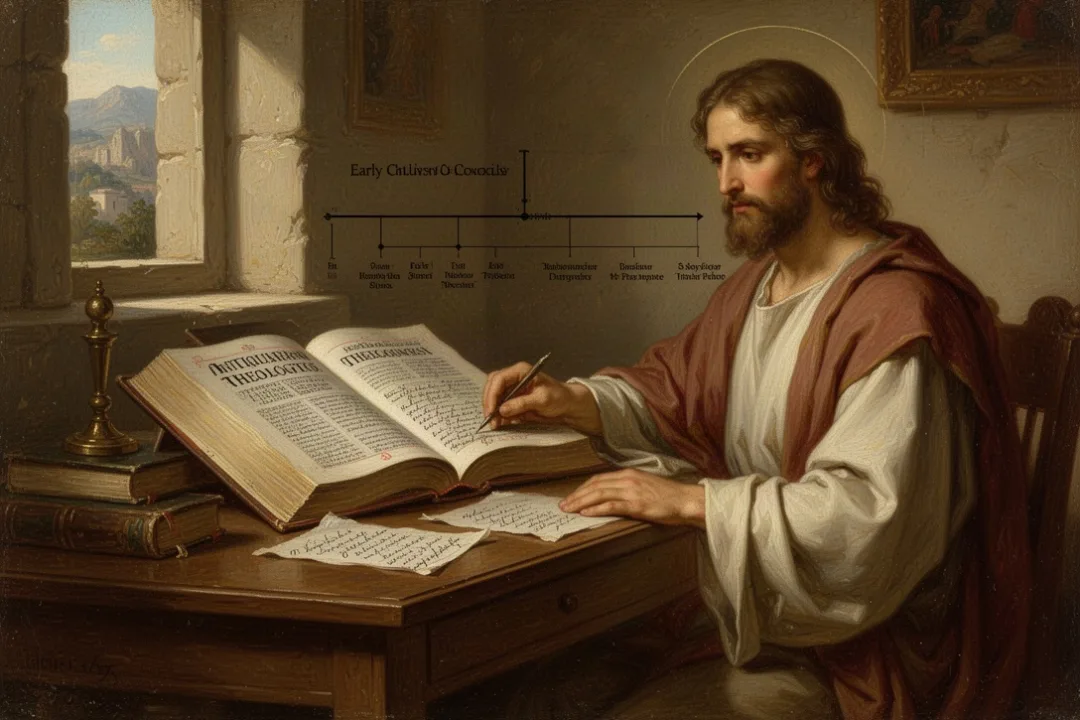
Keep a timeline nearby. Place major writers and councils in approximate chronological order so that you can see which sources preceded later definitions.
Separate primary voices from Kelly’s analysis. Mark whether a claim comes from a church father, a creed, a council, or Kelly’s historical interpretation.
Track changing terminology. Write down how words such as “nature,” “person,” “substance,” “economy,” and “image” function in each setting.
Read controversies alongside positive teaching. A rejection formula makes more sense when you know the belief it was intended to protect.
Compare the text with the primary sources. Use Kelly as a guide to authors such as Irenaeus, Athanasius, Augustine, and the Cappadocian theologians, then read selected passages directly.
Distinguish historical description from present-day application. Ask what early Christians believed before asking how a modern church evaluates that belief.
A glossary can also help. Theological terms often appear familiar while carrying a more specialized meaning. For instance, “person” in a Trinitarian discussion does not simply mean an independent modern individual, and “nature” in Christological debates does not mean a personality or temperament.
Practical tip: When a paragraph feels difficult, identify three things: the disputed question, the biblical or traditional evidence being used, and the consequence for Christian salvation or worship.
Common mistakes when using Kelly’s book
Readers can misunderstand the book if they treat it as a neutral list of timeless definitions or as a substitute for reading the early sources. Kelly’s work is broad and influential, but it remains a scholarly interpretation written in a particular academic context.
Do not read doctrine as a sudden invention. Councils usually formalized debates that had developed over generations.
Do not assume one writer represents all early Christians. Even respected fathers differed in language, emphasis, and theological method.
Do not treat “early church” as a single geographical culture. Greek, Latin, Syriac, Egyptian, and other Christian environments had distinctive traditions.
Do not confuse later technical meanings with earlier everyday usage. The same word may shift in significance over time.
Do not reduce heresy to simple bad faith. Some condemned positions arose from serious concerns about biblical faith and salvation.
Do not use the book as a denominational proof text. Historical evidence can inform theology, but it does not automatically settle every modern church dispute.
Do not overlook worship and practice. Early doctrine was expressed in baptism, prayer, Eucharist, preaching, and community discipline as well as in treatises.
Another common mistake is to judge early writers by whether they use modern theological precision. A second-century author may affirm a belief that later becomes central while explaining it in language that would not satisfy a later council. Historical development includes both continuity and refinement.
The strengths of J.N.D. Kelly’s approach
Kelly’s greatest strength is his ability to connect individual controversies to the broader development of Christian thought. He does not isolate a council’s formula from the questions that made the formula necessary. This gives readers a clearer sense of why doctrinal language mattered.
His coverage is also unusually wide. The book treats biblical interpretation, creeds, worship, Christology, the Trinity, the sacraments, human nature, grace, and eschatological hope as parts of one historical field. That breadth makes it a useful starting point for students, clergy, teachers, and serious general readers.
Kelly is also careful about distinctions. He differentiates between the earliest forms of a belief and later elaborations, between regional tendencies, and between a writer’s central teaching and an isolated phrase. Those distinctions prevent simplistic claims about what “the early church” supposedly believed.
Finally, the book encourages readers to see doctrinal history as a record of Christian reasoning under pressure. Beliefs were clarified because Christians needed to preach, worship, defend the faith, teach converts, and explain salvation in changing circumstances.
Limits and questions for readers today
A book of this scope cannot give equal space to every region, language, author, or recent scholarly debate. Readers should expect stronger coverage of the major Greek and Latin trajectories than of every Christian community active in the early centuries.
Its terminology and scholarly style may also feel dated. Later research has expanded knowledge of Syriac Christianity, non-Nicene groups, women’s religious lives, liturgical history, social context, and the diversity of early Christian communities. Kelly remains valuable, but he works best alongside newer studies and primary-source translations.
The book also tends to organize its subject around the doctrinal categories familiar to classical Christian theology. That organization is helpful for tracing the Trinity or Christology, but it may give less attention to topics that modern historians emphasize, such as everyday religious practice, material culture, identity, gender, and the relationship between Christianity and the Roman Empire.
These limits do not make the book obsolete. They clarify how to use it: as a substantial historical map, not as the only map available. Pairing Kelly with current scholarship allows you to benefit from his synthesis while recognizing questions that later researchers have framed differently.
Who will benefit most from reading the book
Early Christian Doctrines is a strong choice for readers who want to understand why Christian creeds use particular language and how those formulas developed. It is especially suitable for people studying church history, historical theology, patristics, or the background of Catholic, Orthodox, Anglican, and Protestant doctrinal traditions.
It can also serve readers who encounter early Christian claims in debates about the Trinity, the divinity of Christ, apostolic succession, baptism, the Eucharist, or the authority of councils. Kelly will not eliminate disagreement, but he can make the historical evidence more precise.
The book may be less suitable as a first introduction for someone who has no familiarity with the New Testament, ancient history, or basic theological vocabulary. Such readers may benefit from a shorter survey first, followed by selected chapters of Kelly’s work.
A productive reading sequence is to choose one theme, read Kelly’s treatment, consult a short biography of the relevant church father, and then examine a primary text. That sequence turns a difficult reference work into a guided study rather than a continuous wall of names and technical terms.
What Early Christian Doctrines contributes to Christian history
Kelly’s lasting contribution is a disciplined account of how early Christians moved from shared convictions and inherited practices toward increasingly exact doctrinal language. His work shows that creeds were not detached philosophical statements. They were attempts to protect the meaning of Christian worship, Scripture, salvation, and communal identity.
The book also gives readers a more realistic picture of historical continuity. Early Christian doctrine was neither invented from nothing at a late date nor delivered in a completely finished form at the beginning. It developed through memory, interpretation, conflict, prayer, teaching, and institutional decision-making.
That balance explains why the book remains useful decades after its original publication. It gives enough detail to support serious study while keeping sight of the central historical question: how did Christians learn to say more clearly what they believed God had done in Jesus Christ?
Frequently asked questions
Is J.N.D. Kelly’s Early Christian Doctrines a book about the church fathers?
Yes. The book focuses heavily on writers commonly called the church fathers, but it also examines creeds, councils, baptismal teaching, worship, biblical interpretation, and rival Christian movements. Its subject is broader than biographies of famous theologians because it asks how Christian doctrines formed across communities and historical periods.
Does Kelly argue that early Christian doctrine was invented by church councils?
No. Kelly presents councils as points of clarification within longer debates. Earlier Christians had already confessed, worshiped, taught, and interpreted Scripture in ways that shaped later definitions. Councils gave more precise language to disputed beliefs, although the resulting formulas also reflected regional, political, and institutional pressures.
What background should I have before reading the book?
Familiarity with the New Testament, the Roman Empire, and basic terms such as creed, incarnation, Trinity, and heresy will help. You do not need advanced theological training. A timeline, glossary, and a collection of primary-source excerpts can make Kelly’s dense discussions much easier to follow.
How does Kelly’s book differ from Early Christian Creeds?
Early Christian Creeds concentrates more directly on the history and wording of Christian creeds. Early Christian Doctrines has a wider scope, covering the theological ideas behind creeds as well as Scripture, worship, Christology, the Trinity, salvation, the sacraments, and other areas of early Christian teaching.







Leave a Reply